What is Solana?
Learn what Solana is, why it exists, how Proof of History and Proof of Stake work together, and what tradeoffs power its speed and low fees.
Introduction
For the token explainer, see SOL.
Solana is a high-performance blockchain designed to run payments, trading, and applications at low latency and low cost on a single shared network. That sounds straightforward, but it hides the real puzzle: blockchains are slow for a reason. If thousands of independent machines must agree on both what happened and when it happened, coordination itself becomes the bottleneck.
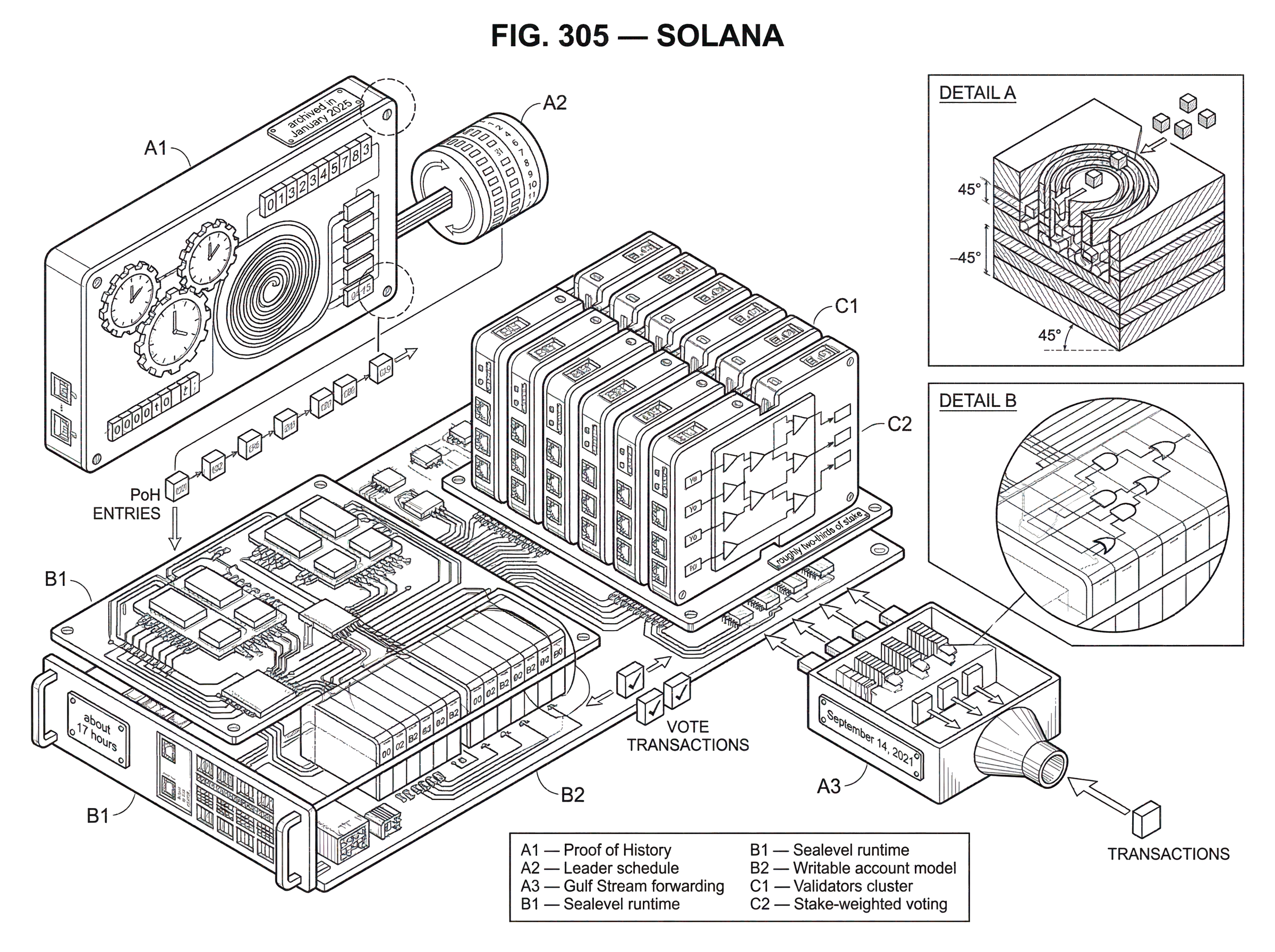
Solana exists because its designers took that bottleneck seriously. Instead of assuming a blockchain must wait for broad network conversation before it can order transactions, Solana tries to push part of that work into a cryptographic clock. The resulting system combines Proof of Stake for validator voting with Proof of History for ordering, then builds an execution and networking stack around that assumption.
This is why Solana tends to be discussed in unusually concrete terms: throughput, slot times, vote propagation, parallel execution, validator clients, and outages. Its value proposition is not mainly philosophical. It is architectural. If you want a chain where decentralized exchanges, stablecoin transfers, and consumer applications can all share the same base layer without pushing most activity into separate rollups, Solana is one of the clearest attempts.
The tradeoff is just as important as the ambition. A system tuned for speed becomes sensitive to hardware performance, networking behavior, software quality, and operational coordination. So to understand Solana, it is not enough to say that it is “fast.” You need to see what problem that speed is solving, what mechanisms create it, and where those mechanisms become fragile.
How does Proof of History reduce the coordination cost of transaction ordering on Solana?
Every blockchain has to solve two linked problems. First, it must decide which transactions are valid. Second, it must decide their order. The second problem is more subtle than it sounds, because in distributed systems there is no perfect shared wall clock. Different machines receive messages at different times, and an attacker can exploit that uncertainty.
Most chains handle this by making ordering emerge from consensus rounds. In effect, nodes talk to each other until they converge on a sequence. That works, but the more often you need global coordination, the more latency you create. Solana’s central idea is to make ordering cheaper before consensus finishes.
This is what Proof of History, or PoH, is for. In Solana’s whitepaper, PoH is described as a sequential cryptographic computation that can verifiably show that some amount of time passed between two events. The intuition is simple: if you repeatedly run a hash function in a way that cannot be shortcut or parallelized, then the resulting sequence acts like a clock. Anyone can later verify the sequence and check where an event was inserted into it.
That does not mean Solana has a perfect real-world clock embedded in the chain. PoH does not tell you “it was 12:02 PM in New York.” What it gives is a verifiable ordering and a bounded notion of elapsed time relative to the chain’s own state. That is the important part. Validators do not have to negotiate from scratch about the rough position of every event in time, because the ledger already contains a cryptographic sequence that orders them.
Here is the mechanism in plain language. A leader responsible for producing data for a slot continuously advances a hash chain. As transactions arrive, their data can be mixed into that running sequence. Later, other validators can verify the sequence without having to trust the leader’s local clock. The sequence becomes evidence that event A was recorded before event B, and that both occurred at particular positions in the ledger’s own timeline.
The consequence is not that consensus disappears. Solana still needs stake-weighted voting to decide which fork becomes canonical. But because ordering information is already embedded into a verifiable sequence, the consensus layer has less ambiguity to resolve. That is the compression point: PoH is not a replacement for consensus; it is a way to reduce the coordination burden of consensus.
How Solana reaches consensus
| Mechanism | Primary role | What it reduces | Main risk | Best for |
|---|---|---|---|---|
| Proof of History (PoH) | Verifiable ordering/timeline | Pre‑consensus coordination | Hardware / network assumptions | Low‑latency ordering |
| Proof of Stake (PoS) voting | Stake‑weighted votes | Sybil/fork ambiguity | Stake centralization pressure | Decentralized finality |
| Consensus (vote outcome) | Choose canonical branch | Ambiguity after PoH | Vote congestion during stalls | Security and finality |
Solana uses Proof of Stake. Validators hold stake directly or receive delegated stake from SOL holders, and their votes are weighted by that stake. The network treats a supermajority as roughly two-thirds of stake. This is the usual safety threshold for Byzantine fault tolerant systems: if more than one-third of voting power can behave adversarially or disappear, liveness or safety becomes much harder to preserve.
In practice, Solana rotates leaders. A validator scheduled as leader for a slot is expected to produce blocks by advancing the PoH sequence and packaging transactions into entries. Other validators observe that stream, execute the transactions, and cast votes on what they believe is the valid chain. Those votes are themselves transactions, so voting is part of the chain’s own data flow rather than an entirely separate side channel.
The important structural point is that PoH defines a timeline and leader schedule context, while stake-weighted voting decides which branch of that timeline the network accepts. Without PoH, the network would still need to reach agreement, but the ordering problem would be more expensive. Without PoS voting, PoH would merely be a fast local clock with no decentralized legitimacy.
Solana’s documentation and historical explainers also distinguish between faster practical confirmation and stricter finality. In ordinary use, users often care whether the network has converged enough that a transaction is very unlikely to be reversed; they do not always need the maximum possible finality guarantee before moving on. That distinction exists on many chains, but it matters especially on Solana because low latency is part of the design goal.
Staking ties this consensus system to economics. SOL holders can delegate to validators without giving up ownership of their tokens. Rewards are issued by epoch, and validator performance matters because rewards depend on successful voting behavior. The official staking FAQ also notes an important caveat: slashing is not automatic in the same way some readers might expect from other Proof-of-Stake systems. That is a meaningful design detail, because it affects both validator risk and how the network responds to some failures.
How does Solana enable parallel transaction execution with Sealevel and the account model?
Even if you solve ordering efficiently, a chain can still choke during execution. This is where Solana differs sharply from the “smart contract as self-contained state machine” model many people learn first.
On Solana, programs and state are separated. A program is executable code stored in one account, while the data it reads or writes lives in other accounts. A transaction declares up front which accounts it plans to touch. That one design choice has large consequences, because it tells the runtime which transactions conflict and which do not.
If two transactions touch disjoint sets of writable accounts, they can often be executed in parallel. If they both need to write the same account, they conflict and must be ordered more carefully. Solana’s runtime for this is known as Sealevel. The mechanism is not magic. It works because account access is explicit, so the runtime can schedule non-conflicting work across available hardware rather than serializing everything.
A simple example makes this concrete. Imagine one user sends USDC to a friend, another user mints an NFT in a completely separate program, and a third user updates collateral in a lending position. If those transactions touch different writable accounts, Solana does not need to treat them as one long queue. It can execute them simultaneously. On a chain where each transaction could potentially mutate broad hidden state, the runtime would have less freedom.
This explains both Solana’s speed and one of its recurring failure modes. Parallel execution helps when the workload is spread across many unrelated accounts. But if activity piles onto the same hot accounts or programs, the theoretical parallelism collapses. The September 2021 outage analysis highlighted this dynamic: some bot transactions write-locked a large set of accounts, including highly shared program-level resources, which reduced the runtime’s ability to process transactions in parallel. So the account model is not just a developer abstraction. It directly shapes real network behavior under stress.
What replaces a mempool on Solana and how does transaction forwarding affect performance?
| Model | Where txs live | Latency | Load behavior | Failure mode | Best for |
|---|---|---|---|---|---|
| Traditional mempool | Network‑wide gossip | Higher average delay | Absorbs bursts | Propagation delays, queue bloat | Open competitive ordering |
| Gulf Stream forwarding | Pushed to upcoming leaders | Lower end‑to‑end latency | Leader/forwarder hotspots | Forwarder overload, amplified retries | Fast leader‑local processing |
Another major part of Solana’s design is that it does not rely on a conventional public mempool in the way readers may know from other chains. Instead, clients send transactions toward leaders and upcoming leaders through a forwarding system often called Gulf Stream.
The intuition is again about latency. A public mempool is useful because it gives the network a shared waiting room for unconfirmed transactions. But it also creates overhead. If the protocol can predict who is likely to produce upcoming blocks, transactions can be pushed closer to where they will actually be processed.
That is good for speed, but it changes the system’s pressure points. Instead of a broad gossip-based waiting area absorbing demand, transaction forwarding can amplify load if leaders or forwarding queues get overwhelmed. During the 2021 stall, the official overview pointed to a flooded forwarder queue whose memory usage grew without limits, contributing to validator crashes. Secondary engineering analysis from Jump Crypto described how forwarding and automatic application retries could reinforce the flood.
So here is the mechanism and consequence together. Solana removes the delay of a traditional mempool by routing transactions directly toward scheduled producers. That reduces idle waiting in normal conditions. But under extreme contention, the forwarding path itself becomes a critical subsystem, and if retry logic, queue growth, and heavy transaction processing interact badly, failures can spread quickly.
This is why Solana discussions often sound like discussions about an exchange matching engine or a high-performance distributed database. The chain is designed less like a deliberately slow bulletin board and more like a system trying to keep packets, execution units, and validator scheduling tightly coordinated.
What are the common real-world use cases for Solana?
The architecture would not matter much if it did not enable a different application mix. Solana is heavily used for trading, stablecoin transfers, payments, and consumer-facing crypto apps where fees and latency shape behavior in obvious ways.
On a slower or more expensive chain, many actions that look small in isolation become impractical in aggregate. Routing across multiple liquidity pools, updating an onchain order book, rebalancing positions frequently, or serving users who expect near-instant feedback all become harder when each action is expensive or slow. Solana’s low-fee, low-latency environment makes those patterns more natural directly on the base layer.
That helps explain why so much of the ecosystem clusters around exchanges, payment flows, wallets, and high-frequency user interactions. Projects like Jupiter and Raydium depend on this throughput profile. Oracle and data-heavy systems such as Pyth also benefit from a network that can absorb many updates cheaply. Consumer apps benefit for a simpler reason: users notice delay immediately.
Institutional and enterprise interest follows the same causal path. Solana’s official site highlights payment companies, stablecoin infrastructure, and tokenization efforts because these use cases care about predictable settlement, low unit costs, and a shared global state that many parties can interact with. Whether every headline metric on a marketing page should be taken at face value is a separate question. The broader pattern is plausible and consistent with the design: if a chain can process a lot of activity cheaply, it becomes more attractive for applications whose business model breaks under high fees.
Why does validator client diversity matter for Solana’s security and performance?
A blockchain is not just a protocol description. It is also the software that operators actually run. In Solana’s case, this matters more than usual because performance engineering is central to the network’s identity.
Historically, the solana-labs/solana repository was the main implementation, but that repository was archived in January 2025 and is now read-only. The repository itself points readers to Agave, maintained by Anza, as an active validator implementation. At the same time, Firedancer, developed by Jump Crypto, is a new validator client designed from scratch for high performance, with Frankendancer as a hybrid deployment path combining Firedancer components with Agave.
This is not just ecosystem trivia. Client diversity is a security and resilience issue. If every validator runs essentially the same code, a single software bug can become a network-wide event. A second independently engineered client reduces that risk, much as multiple browser engines or multiple database implementations can reduce monoculture risk. Firedancer also matters because Solana’s performance goals are constrained by real software architecture, not only protocol theory.
There is a tension here. Multiple clients improve resilience, but high-performance systems are hard to reimplement faithfully. Compatibility bugs can be dangerous, and performance-oriented code can increase complexity. So client diversity is clearly beneficial in principle, but the practical benefit depends on how mature and widely deployed those clients become.
What caused Solana outages and what lessons do they teach about fragility?
The strongest way to understand a system is often to look at how it failed. Solana’s outage history is not a side note to its design; it reveals the costs of pushing performance hard.
The September 14, 2021 incident is the clearest example from the evidence here. According to the Solana Foundation’s initial overview, bot traffic during the Grape Protocol IDO on Raydium flooded the network, overwhelmed the forwarder queue, and caused many validators to run out of memory and crash. The network stalled for about 17 hours. Recovery required community coordination, a patch, and a validator-led restart from the last confirmed slot, with broad stake support.
That event teaches several lessons at once. First, throughput alone does not guarantee robustness under adversarial load. The structure of load matters: retries, queue behavior, shared write contention, and vote inclusion can all interact badly. Second, liveness failures on a Proof-of-Stake network are not repaired by some external operator pressing a reset button; they require distributed coordination among validators. Third, a system can preserve funds while still failing in the way users most immediately notice, which is availability.
It is also worth being precise about what has changed since the most criticized periods. Solana’s current status page shows a strong recent uptime window, and reputable ecosystem reporting argues reliability has improved significantly since early outage-heavy years. That does not erase the earlier incidents, but it does suggest a maturing system rather than a frozen design. The right conclusion is neither “outages define Solana forever” nor “past outages no longer matter.” The real conclusion is that Solana has been stress-tested in exactly the areas its architecture makes most difficult: networking pressure, software complexity, and maintaining liveness at high throughput.
How are Solana protocol changes governed and deployed in practice?
Solana’s governance is not best understood as a single parliament-like institution. It is a mix of onchain validator decisions, offchain coordination, software release adoption, and formal proposal processes.
For protocol changes, the canonical standards process lives in the Solana Improvement Documents, or SIMDs. These documents describe proposed and accepted changes to the protocol and related processes. That makes them similar in spirit to improvement proposal systems on other chains: they are where changes become legible, reviewable, and discussable.
But documentation is not enactment. A change matters only when validator operators adopt software that implements it and enough of the network converges on the new behavior. Solana’s history makes that especially visible because restart and upgrade coordination have sometimes been socially and operationally significant, not merely automatic consequences of an abstract governance vote.
Staking economics add another governance layer. The official staking materials state that inflation and staking rewards were enabled through an onchain governance process by validators. The published inflation schedule starts higher and declines over time toward a long-run rate. That means monetary policy on Solana is not just a whitepaper parameter; it is a live economic question because validator incentives, delegation, and decentralization all depend on it.
The Solana Foundation also plays a practical role through programs like the Delegation Program, which helps validators with vote cost coverage and stake matching. That can improve decentralization by helping smaller validators get onto the leader schedule. But it also means decentralization is not only an emergent property of the protocol. It is partly shaped by capital distribution and ecosystem policy.
Monolithic vs. layered scaling: what tradeoffs does Solana’s fast base layer create?
| Design | Composability | Latency & cost | Operational demands | Failure blast radius | Best for |
|---|---|---|---|---|---|
| Monolithic fast base layer | Single shared state | Low latency, low fees | High hardware and network needs | High systemic impact | Integrated apps and markets |
| Layered scaling (rollups) | Fragmented across rollups | Higher settlement latency, requires bridges | More infra across layers | Smaller base‑layer blast radius | Extreme scaling and isolation |
Solana is often contrasted with Ethereum, and the contrast is useful if kept simple. Ethereum has moved toward a world where the base layer is relatively conservative and much user activity is expected to live in layered scaling systems. Solana pushes harder on a monolithic base layer: one chain, one shared state, high throughput directly at layer 1.
Neither approach is free. A monolithic fast chain gives users and developers a cleaner environment: one liquidity domain, one state space, one place where applications compose. That is a genuine advantage. You do not have to move constantly across layers or bridge between fragmented execution environments just to use ordinary applications.
But the price is that the base layer itself must carry more complexity and performance burden. Hardware expectations matter more. Runtime efficiency matters more. Networking pathologies matter more. If the layer-1 engine is where everything happens, then any bug or bottleneck there has wider blast radius.
So when people argue about Solana, they are usually arguing about this deeper question: Should a blockchain try to scale by making the base layer much faster, or by keeping the base layer narrower and scaling elsewhere? Solana is one of the clearest embodiments of the first answer.
Conclusion
Solana is a blockchain built around a specific thesis: if you can make transaction ordering, networking, and execution efficient enough, a single shared chain can support markets, payments, and applications at internet-like speed. Proof of History is the key idea because it gives the network a verifiable internal timeline, reducing how much coordination consensus must do from scratch.
Everything else follows from that choice. Stake-weighted voting secures the chain. The account model enables parallel execution. Direct forwarding cuts latency. Multiple validator clients aim to reduce software monoculture. And the network’s past outages show exactly where this architecture is hardest to operate.
The short version worth remembering tomorrow is this: Solana is not just “a fast blockchain.” It is a blockchain that tries to make time, order, and execution cheap enough that the base layer itself can stay busy. That ambition is why it attracts so much activity; and why its engineering details matter so much.
How do you buy Solana?
You can buy SOL on Cube by trading against a USD-backed market. Fund your account, then open the SOL/USDC market at /trade/SOLUSDC to place a market or limit order and complete the purchase.
- Deposit fiat (card or bank) or transfer USDC into your Cube account.
- Open the SOL/USDC market on Cube and pick the trading pair you want to use.
- Choose an order type: use a limit order for price control or a market order for immediate execution; enter the SOL amount or USDC to spend.
- Review the estimated fill, fees, and destination details, then submit the order. Optionally set a stop-loss or take-profit after the trade.
Frequently Asked Questions
Proof of History (PoH) is a sequential cryptographic hash stream that embeds a verifiable ordering and bounded elapsed‑time relation into the ledger so validators start consensus with much less ambiguity about where events fit in the timeline; it does not replace consensus and it does not provide real‑world wall‑clock timestamps - stake‑weighted Proof of Stake voting still decides which fork becomes canonical.
Solana separates programs (code) from state (accounts) and requires transactions to declare up front which accounts they will touch, letting the runtime (Sealevel) schedule and run transactions that touch disjoint writable accounts in parallel; this parallelism collapses when many transactions contend for the same hot writable accounts or shared program resources, which can serialize execution and degrade throughput.
Rather than a shared public mempool, Solana forwards transactions toward scheduled leaders (Gulf Stream) to cut latency by putting transactions near the producer; that reduces idle waiting but makes the forwarding path and leader queues critical failure points - unbounded queue growth, retries, or overloaded leaders can amplify load and contributed to past stalls.
PoH provides a verifiable internal timeline and leader scheduling context, while Proof of Stake provides decentralized legitimacy by stake‑weighted voting that chooses the canonical branch; PoH reduces ordering ambiguity but does not substitute for stake voting to secure finality.
Validator client diversity matters because running multiple, independently engineered implementations (historically solana‑labs/solana, now archived, plus Agave and Jump Crypto’s Firedancer/Frankendancer) reduces monoculture risk where a single software bug could affect the whole network, but reimplementations also raise compatibility and performance‑complexity challenges.
Because Solana deliberately optimizes for a fast, high‑throughput base layer, it is more sensitive to hardware performance, networking behavior, and software bugs; the September 2021 outage showed how bot traffic, forwarder queue growth, and memory exhaustion can stall the network and require coordinated validator restarts to recover.
Solana’s design is intentionally monolithic: it aims to keep markets, payments, and consumer apps on a single high‑throughput base layer rather than pushing most activity into rollups or layer‑2s; that simplifies composition and liquidity but concentrates operational, hardware, and software complexity at layer‑1.
PoH is not a real‑world clock - it gives verifiable ordering and bounds on elapsed chain time produced by repeated hashing, but its security and assumptions depend on hash unpredictability and hardware characteristics; the whitepaper flags ASIC/partition attack vectors and leaves exact parameterization and attacker cost models unspecified, so hardware‑based centralization risks are discussed but not fully quantified.
Solana uses stake‑weighted Proof of Stake with delegation and epochal rewards, and the ecosystem notes that slashing is not automatic in the same way as some other PoS systems; precise slashing rules, penalty parameters, and some staking operational details are referenced in docs but are not exhaustively specified in the sources here.
Related reading