What is Circle?
What is Circle? Learn how Circle issues USDC, how minting and redemption work, what backs the token, and why institutions and developers use it.
Introduction
Circle is the company behind USDC, one of the largest dollar-backed stablecoins, and its importance comes from a simple but difficult promise: make a token that behaves like a dollar on the internet without asking users to trust an unbacked crypto asset. That sounds straightforward until you notice the tension. Blockchains are open, global, and always on; dollars live inside the banking system, which is permissioned, jurisdiction-bound, and tied to business hours. Circle’s product is the machinery that connects those two worlds.
If you want the shortest description, here it is: Circle issues USDC, a digital token designed to maintain price equivalence with the U.S. dollar and redeemable 1:1 for USD. The reason people care is not just that USDC is “a stablecoin.” It is that Circle tries to make that stability credible through reserve assets, redemption infrastructure, transparency reporting, and control over issuance across many blockchains.
What is Circle and how does it issue USDC?
At the product level, Circle is best understood as a stablecoin issuer and settlement company. Its core product is USDC, which Circle describes as a fully reserved stablecoin backed by highly liquid cash and cash-equivalent assets. In plain language, Circle is not trying to create a new volatile crypto asset. It is trying to create a digital claim that can circulate on blockchains while remaining anchored to off-chain dollar reserves.
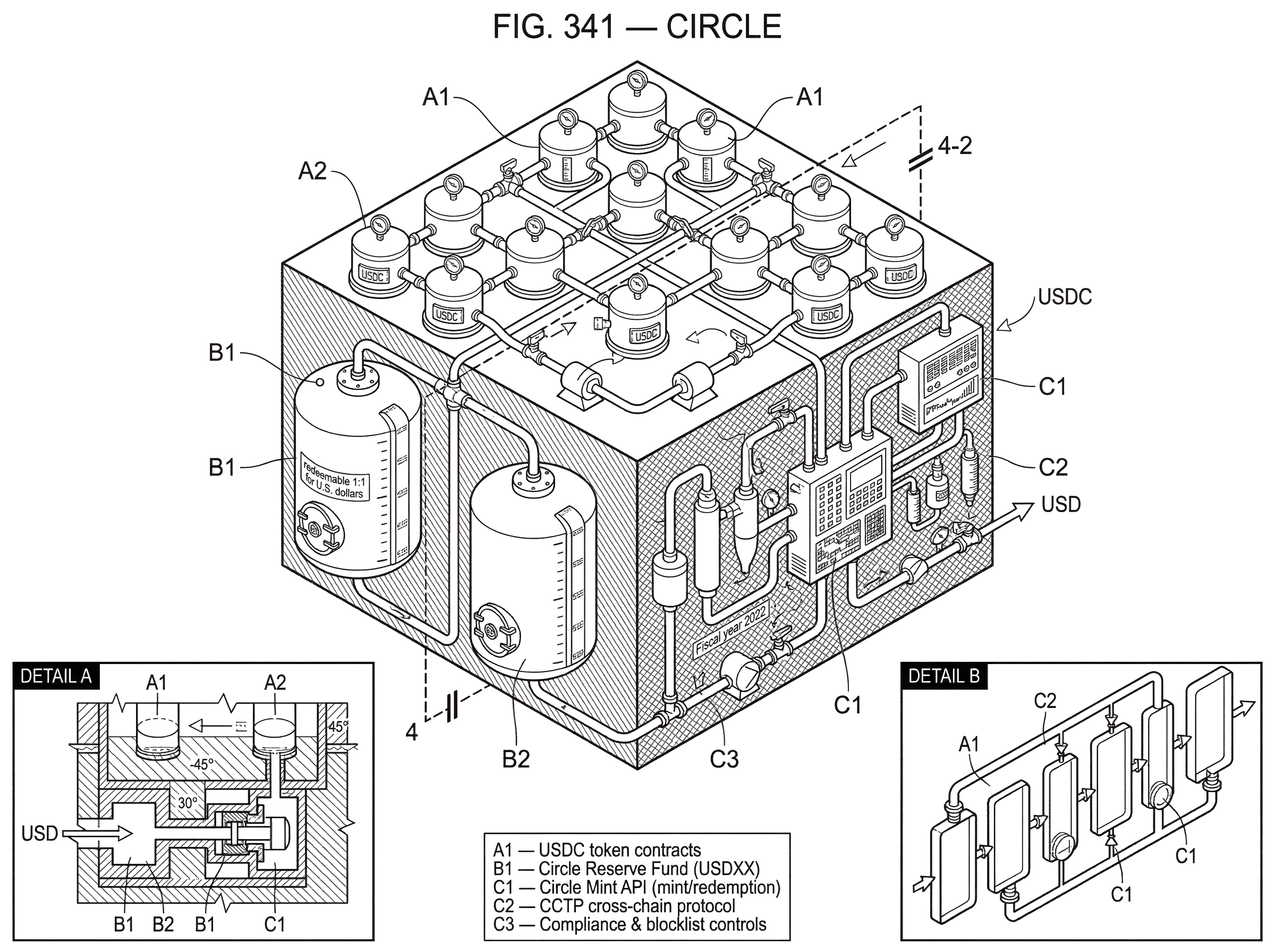
That framing matters because it explains why Circle looks partly like a software company and partly like a financial institution. On one side, it deploys and maintains token contracts, developer APIs, and cross-chain transfer systems. On the other, it manages reserves, banking relationships, attestations, redemption flows, and compliance controls. If you only look at the token, you miss the off-chain system that makes the token believable. If you only look at the reserves, you miss why anyone would want a blockchain-native dollar in the first place.
USDC is natively issued on many blockchains, and Circle says it is issued across dozens of networks. That multi-chain presence is not a side feature. It is central to the product. A digital dollar becomes more useful when developers can use the same unit across different crypto ecosystems, exchanges, wallets, and applications instead of rebuilding liquidity from scratch on each chain.
How does USDC’s mint-and-burn mechanism keep it pegged to $1?
The core mechanism is simple: mint when dollars go in, burn when dollars come out. When an eligible business deposits U.S. dollars with Circle, Circle issues the equivalent amount of new USDC. When that business redeems USDC for dollars, Circle destroys, or burns, the redeemed tokens and returns USD. That mint-and-burn loop is the anchor that ties token supply to reserve assets.
The important invariant is this: the value of the reserve assets should be at least as large as the amount of USDC in circulation. Circle states that USDC is 100% backed by highly liquid cash and cash-equivalent assets and redeemable 1:1 for U.S. dollars. On its transparency materials, Circle says the reserves are held separately from its operating funds for the benefit of stablecoin holders. That separation is meant to make USDC a reserve-backed liability rather than an informal promise floating on top of the company’s general balance sheet.
A concrete example makes the mechanism clearer. Imagine a crypto exchange or payments company that wants $50 million of on-chain dollars to settle customer activity. It opens access through Circle Mint, sends $50 million in USD, and Circle issues 50 million USDC. Those tokens can then move freely on-chain between wallets, protocols, and counterparties. Later, if that same institution no longer wants tokenized dollars and prefers bank deposits, it sends 50 million USDC back for redemption. Circle burns the tokens and wires back $50 million, assuming the customer is eligible and the redemption is processed under applicable terms.
That loop is why institutions and infrastructure providers care about Circle. They do not just want a token that usually trades near one dollar. They want a way to enter and exit the token supply against fiat in size. Direct access to that primary market is what makes arbitrage and balance-sheet management possible.
What assets back USDC and how liquid are the reserves?
| Asset type | Liquidity | Price stability | Primary purpose | Main risk |
|---|---|---|---|---|
| Cash | Immediate | Par USD | Instant redemptions | Bank counterparty risk |
| Circle Reserve Fund (USDXX) | High (daily) | Near‑par NAV | Pooled liquidity for redemptions | Fund/custody concentration |
| Short‑dated Treasuries & repos | High if liquidated | Market‑priced near par | Preserve value and liquidity | Market / settlement timing risk |
| Bank deposits (FBO accounts) | High during banking hours | Par USD | Settlement rails for wires | Banking‑hours limits |
The peg depends less on branding than on what the reserves are and how quickly they can be turned into cash. Circle says the majority of USDC reserves are held in the Circle Reserve Fund, USDXX, an SEC-registered Rule 2a-7 government money market fund managed by BlackRock and custodied at BNY Mellon. Circle also says reserve assets can include cash, bank deposits, short-dated U.S. Treasuries, and overnight reverse repurchase agreements.
Why that composition? Because the job of reserves is not to maximize yield for holders. The job is to remain liquid and dollar-like when redemptions arrive. Short-dated government instruments and cash are used because they are easier to value and liquidate than riskier credit assets. That does not make them risk-free in every operational sense, but it does mean the reserve design is aimed at redemption reliability rather than return generation.
Circle publishes weekly reserve disclosures and mint-burn flows, and it publishes monthly third-party assurance reports prepared under AICPA attestation standards. Circle also names Deloitte & Touche LLP as its independent auditor for financial statements since fiscal year 2022. The key idea is not that reports eliminate risk. It is that stablecoin trust depends on outsiders being able to check, at regular intervals, whether reserve claims line up with outstanding token supply.
There is also an economic trade-off here. Holders of USDC do not receive the interest earned on the reserves. Circle’s terms state that holders are not entitled to interest or other returns earned on reserve funds. That is a feature of the product design, not an accident. USDC is built to be a transactional digital dollar, not a yield-bearing fund share.
Who can mint or redeem USDC and how do different users access it?
Most people do not interact with Circle directly. That is an easy point to miss. Circle Mint is available to exchanges, institutional traders, banks, and other qualified businesses, not to individuals or small businesses. So there are really two user layers.
The first layer is the direct customer: institutions that need to mint, redeem, custody, or move large amounts of USDC as part of exchange operations, treasury management, payments, or settlement. For them, Circle is an issuer and on/off-ramp.
The second layer is everyone else: wallet users, traders, developers, and customers of platforms that integrate USDC. They usually obtain USDC through exchanges, wallets, or partners rather than by wiring dollars to Circle themselves. For them, USDC feels like an internet-native dollar balance that can be sent globally, used in trading, posted as collateral, or embedded inside an app.
This split explains why Circle invests so heavily in developer tooling. If institutions create supply but developers create demand, then Circle needs both sides of the market. Its developer documentation positions USDC as open, programmable money available 24/7 across many blockchains. That is attractive to builders because blockchain-based dollars can settle quickly, move with low friction, and be controlled by smart contracts.
Why does Circle issue USDC on multiple blockchains and how do cross-chain transfers work?
| Option | Mechanism | Trust assumption | Liquidity effect | Best for |
|---|---|---|---|---|
| Burn & remint (native/CCTP) | Burn on source, mint on dest | Issuer‑based trust | Consolidates canonical liquidity | Cross‑chain consistency |
| Bridged / wrapped tokens | Lock on source, mint wrapped | Bridge operator trust | Fragmented liquidity across tokens | When issuer unsupported |
A dollar token is more useful when it does not get trapped on one chain. Circle addresses this with native issuance on many networks and with CCTP, its Cross-Chain Transfer Protocol. Circle describes CCTP as a permissionless on-chain utility that allows USDC to move securely between supported blockchains.
The important distinction is between bridging a representation and moving the canonical asset by burning and reminting. In Circle’s model, cross-chain movement can be handled by destroying USDC on the source chain and minting native USDC on the destination chain. That reduces dependence on wrapped IOUs issued by third-party bridges. The advantage is cleaner asset consistency across chains. The trade-off is that users rely on Circle’s issuance system and supported-network design rather than on a purely external bridge market.
For developers, this matters because liquidity fragmentation is one of the hardest problems in crypto. If the “same dollar” exists as many disconnected wrapped versions, applications inherit extra risk and complexity. Circle’s multi-chain issuance and transfer tooling try to make USDC feel like one asset across different environments, even though the underlying token contracts live on separate networks.
What trust and governance assumptions underlie USDC and Circle’s controls?
| Trust locus | What is trusted | Why it matters | Primary risk |
|---|---|---|---|
| Reserves | Sufficient liquid reserves | Backing for 1:1 redemption | Liquidity access limits |
| Redemption ops | Operational ability to redeem | Enables large direct exits | Banking‑hours delays |
| Reporting & attestations | Regular attestations and disclosures | External verification of reserves | Snapshot limitations |
| Issuer controls | Address‑level freeze/blocklist | Enables compliance and security | Censorship risk |
It would be a mistake to think Circle removes trust. What it does is rearrange trust into more explicit places. You trust that reserves exist and stay liquid. You trust that redemptions remain operational. You trust that Circle’s reporting is accurate and that attestations are meaningful snapshots. You also trust Circle’s governance powers.
That last point matters because USDC is not censorship-resistant in the same way as an unmanaged crypto asset. Circle has an address-level access denial policy and says it can block addresses from sending or receiving Circle stablecoins on supported blockchains. Its terms also describe rights to blocklist, freeze, or restrict activity in response to legal obligations, sanctions requirements, or certain security incidents. Mechanically, that means USDC is programmable not just for users, but for the issuer.
For some users, especially institutions, that is part of the product’s appeal. Compliance controls make USDC easier to integrate into regulated businesses. For other users, especially those who want assets outside issuer control, it is a meaningful limitation. The same design choice that makes Circle legible to banks and enterprises makes it less neutral than fully permissionless crypto assets.
What are the main failure modes and risks for USDC?
The deepest risk is not that a token can trade at $1 in normal times. It is whether the structure holds under stress. The 2023 Silicon Valley Bank episode showed the mechanism. When a portion of Circle’s reserves became uncertain because roughly $3.3 billion was caught at SVB, USDC depegged sharply in secondary markets. Research from the Federal Reserve later described stablecoins as run-able liabilities and noted how impaired reserve access and limited redemption windows amplified market stress.
That incident is useful because it clarifies the weak point. A fiat-backed stablecoin is only as stable as the credibility and liquidity of the assets behind it, plus the operational ability to turn those assets into redemption cash when needed. Even if the reserve assets are high quality on paper, timing matters. Banking-hour constraints, settlement frictions, and concentration in financial counterparties can still create temporary breaks between “fully backed” and “immediately redeemable.”
Circle’s current reserve design appears aimed at reducing that sort of vulnerability through short-duration assets, a government money market fund structure, segregated accounts, and frequent disclosure. But no reserve architecture completely removes run risk. It manages it.
Conclusion
Circle is best understood as the infrastructure that makes USDC a redeemable digital dollar rather than just a dollar-themed token. Its usefulness comes from combining blockchain settlement, multi-chain distribution, and developer programmability with reserve management, redemption rights, and transparency practices meant to support the peg.
If you remember one thing tomorrow, remember this: Circle’s product is not only the token. It is the full mint, reserve, redemption, and control system that keeps the token tied to dollars.
How do you trade Circle-related assets?
You can trade Circle-related assets like USDC on Cube Exchange by funding your account and executing spot trades in the appropriate markets. The Cube workflow below covers funding, market selection, and order execution so you can buy, sell, or convert USDC quickly and with price control.
- Fund your Cube account with fiat via bank transfer or card, or deposit USDC from an external wallet using the on‑chain deposit address. Use a bank transfer for larger, lower‑fee deposits.
- Open the USDC/USD or USDC/USDT spot market on Cube by searching for USDC in Markets.
- Choose an order type: place a limit order to control price for large fills or a market order for immediate execution; enter the USDC amount (or fiat spend), then review estimated fill, fees, and slippage.
- Submit the order and monitor execution. After the trade fills, withdraw USDC on‑chain or keep it on Cube for further trading or settlement.
Frequently Asked Questions
Direct minting and 1:1 redemption (Circle Mint) is available only to qualified businesses such as exchanges, institutional traders, banks, and large financial institutions; most individuals obtain USDC indirectly via exchanges or wallets rather than by wiring USD to Circle themselves.
Circle says USDC is backed 100% by highly liquid cash and cash‑equivalent assets - principally cash, bank deposits, short‑dated U.S. Treasuries, overnight reverse repurchase agreements, and a large allocation held in the Circle Reserve Fund (USDXX) managed by BlackRock and custodied at BNY Mellon - because those instruments are designed to be easy to value and liquid for redemptions.
USDC holders are not entitled to interest or other returns earned on the reserve assets; Circle’s product is designed as a transactional, redeemable digital dollar rather than a yield‑bearing instrument.
Circle can blocklist, freeze, or restrict activity at the address level and says it will do so to comply with legal obligations, sanctions, or certain security incidents; it cannot freeze individual token units, only the addresses that control them.
Cross‑chain transfers can be handled by destroying (burning) USDC on the source chain and minting native USDC on the destination chain (via CCTP/xReserve), which aims to avoid third‑party wrapped IOUs and reduce liquidity fragmentation, but it concentrates reliance on Circle’s issuance and attester infrastructure rather than a purely external bridge market.
The SVB episode showed how reserve access impairments can cause USDC to depeg in secondary markets: roughly $3.3 billion of Circle’s reserves were stuck at SVB, which amplified redemption pressure and highlighted that fiat‑backed stablecoins are run‑able liabilities when banking or settlement frictions occur.
Circle’s public reserve disclosures include weekly breakdowns and monthly third‑party assurance reports prepared under AICPA attestation standards, which are limited‑scope attestations rather than a broad full‑scope audit of every underlying contract or counterparty.
Relying on USDC requires trusting specific operational and governance points: that the reserves exist and remain liquid, that redemptions remain operational, that Circle’s disclosures are accurate, and that Circle will exercise its issuer controls (e.g., blocklisting) appropriately.
USDC held in Circle Mint accounts is not covered by deposit insurance (e.g., FDIC) and Circle disclaims deposit‑insurance protections, so holders do not have the protections of insured bank deposits.
Circle’s cross‑chain technical stack (xReserve/CCTP) depends on off‑chain attesters and specific on‑chain messages (e.g., a DepositIntent magic constant that the docs mark as subject to change), meaning implementations rely on external key management, attester availability, and protocol‑level parameters that can evolve.
Related reading