What Is On-Chain Governance?
Learn what on-chain governance is, how blockchain voting and proposal execution work, why protocols use it, and where token-based governance fails.
Introduction
On-chain governance is the practice of making at least some governance decisions through blockchain state itself: proposals are recorded on-chain, votes are counted on-chain, and approved outcomes may be executed by smart contracts or protocol rules. The appeal is obvious. Blockchains are supposed to minimize reliance on trusted intermediaries, yet every live network and protocol eventually has to answer uncomfortable questions: Who can change parameters? Who approves upgrades? Who controls treasury funds? What happens when the system needs to adapt?
That tension is the reason on-chain governance exists. A blockchain can be decentralized in transaction validation and still be surprisingly centralized in decision-making if upgrades depend on a small team, a foundation, a multisig, or vague social consensus. On-chain governance tries to turn governance from an informal backstage process into a visible mechanism with explicit rules.
The important idea is not merely “voting on a blockchain.” The deeper idea is that the chain becomes part of the institution that governs the chain. Governance is no longer just discussion in forums and code merged by maintainers; it becomes a state machine with inputs, thresholds, deadlines, and execution paths. That makes some parts of political process programmable.
But that is also where the difficulty begins. Once governance is expressed in code, every design choice becomes sharp: how voting power is measured, who may propose, whether tokens can be borrowed, what quorum means, when execution happens, and how to prevent governance from being captured by people with temporary or weak economic alignment. On-chain governance is powerful precisely because it can act directly. The same property makes mistakes expensive.
What coordination problems does on-chain governance solve?
At first glance, governance looks like a social problem, not a technical one. People disagree, debate, and coordinate; code merely implements the result. That picture is partly true, but it misses the specific coordination problem blockchains create.
A blockchain is valuable because many parties can use the same system without trusting a central operator. But if changing that system depends on off-chain bargaining among a handful of privileged actors, then the decentralization story is incomplete. Someone still decides what software ships, what parameters change, and which emergency actions are legitimate. In a traditional company, this is normal because the institution already has a legal hierarchy. In an open blockchain network or DAO, that hierarchy is often contested.
On-chain governance tries to solve this by making three things explicit.
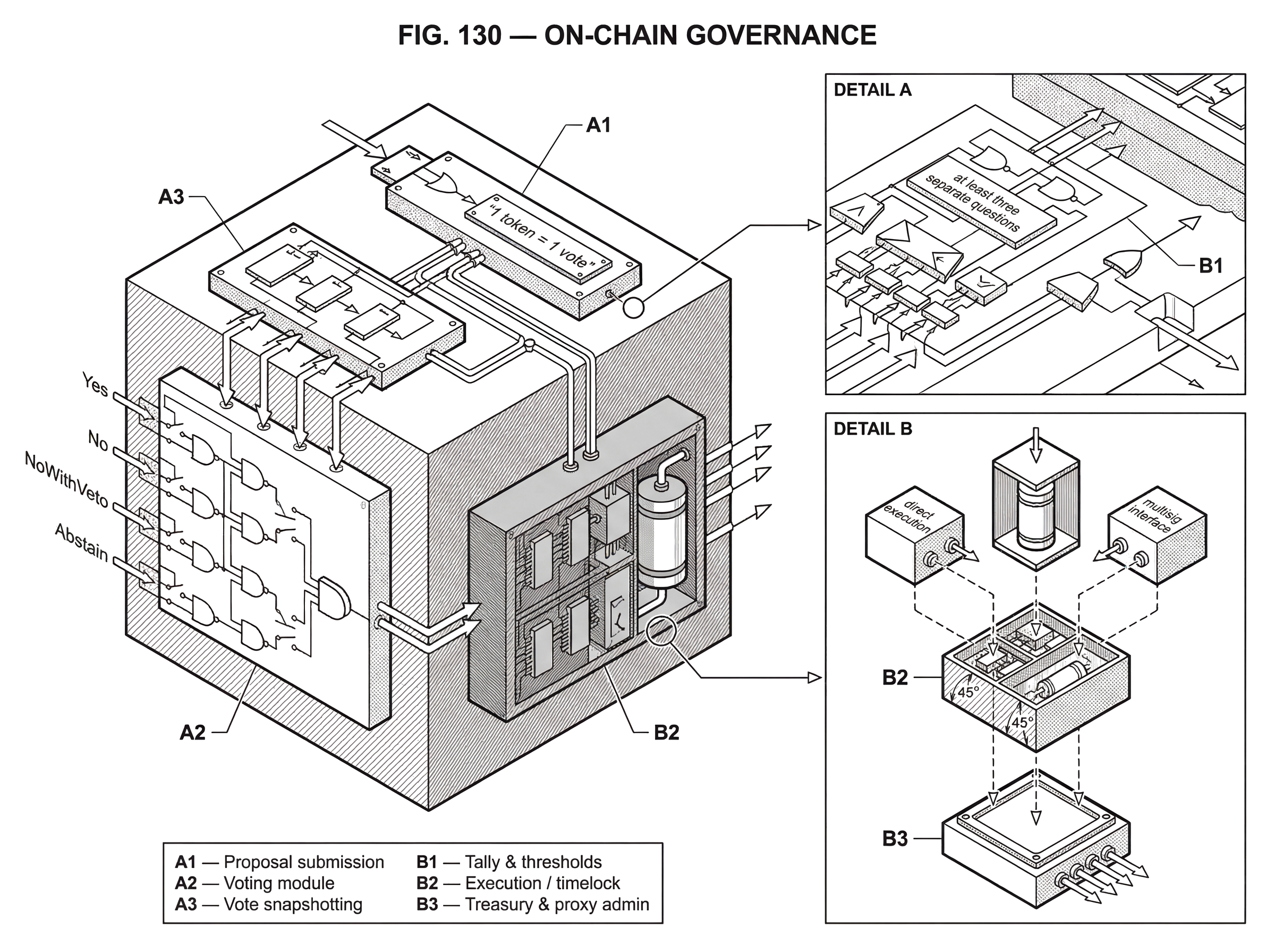
First, it specifies who gets political power. In many systems, that means holders of a native staking or governance token. Cosmos SDK chains, for example, define governance around holders of the native staking token on a 1 token = 1 vote basis, with voting rights tied to bonded stake rather than just any account balance.
Cardano’s Conway-era governance distributes decision-making across several bodies instead of a single undifferentiated voter class.
- DReps
- a Constitutional Committee
- Stake Pool Operators
These are different answers to the same question: whose consent matters?
Second, it specifies how preferences become decisions. A governance process needs proposal submission, eligibility rules, a voting period, tallying logic, thresholds, and usually some spam resistance. Cosmos chains do this with deposits, quorum, support thresholds, veto thresholds, and explicit vote options such as Yes, No, NoWithVeto, and Abstain. Cardano uses governance action types with different ratification thresholds depending on the action and the voting body involved. In each case, the mechanism is trying to convert a messy political question into deterministic state transitions.
Third, it specifies how decisions take effect. This is the real dividing line between symbolic voting and governance with teeth. Some systems execute approved changes directly on-chain. In Cosmos SDK governance, a proposal can contain an array of sdk.Msg messages that the governance module executes automatically if the proposal passes, provided the relevant modules have allowed those messages. In smart-contract protocols, governance often controls upgrade proxies, parameter-setting contracts, treasuries, or timelocks. Compound’s architecture illustrates the execution side even though the supplied documentation focuses on upgrade plumbing rather than vote mechanics: contracts such as a Configurator and ProxyAdmin are the levers that governance would ultimately control to change parameters or implementations.
The point is simple: governance matters when it can change state. Recording a community opinion is useful, but on-chain governance exists because protocols need a credible way to authorize real actions.
How do proposal, voting, and execution work in on-chain governance?
| Step | On-chain artifact | Typical protection | Main risk |
|---|---|---|---|
| Proposal submission | Proposal record / metadata | Deposit and RFC review | Spam or poisoned proposals |
| Voting | Vote txs and snapshots | Quorum and thresholds | Temporary voting manipulation |
| Tally & acceptance | Tally state and rules | Veto and quorum checks | Ambiguous eligibility edge cases |
| Execution / enactment | Msgs, proxies, timelock | Timelock, multisig, whitelists | Irreversible bad actions |
Most on-chain governance systems differ in details, but they share a common structure because they are all solving the same mechanical problem. A proposal introduces a candidate state change. A voting mechanism measures support under predeclared rules. If the result satisfies those rules, the system either enacts the change automatically or authorizes a bounded executor to do so.
That sounds abstract, so it helps to walk through a concrete narrative.
Imagine a lending protocol wants to raise a collateral factor or deploy a new implementation contract. Someone drafts a proposal describing the change and submits it. In a Cosmos-style chain, the submission may require a deposit, and the proposal does not even enter voting until the minimum deposit is reached. This is not cosmetic. The deposit exists because proposal processing is cheap to abuse if anyone can force every voter to consider unlimited junk. Requiring capital at risk turns attention into a scarce resource.
Once the proposal enters voting, the system snapshots or measures eligible voting power according to its own rules. Voters then cast support, opposition, abstention, or a veto signal. Depending on the system, voting power may derive from current token balances, bonded stake, delegated stake, locked positions, or role-based credentials. Cosmos even allows weighted voting, where a voter can split their power across multiple options, which is useful when a voter represents a coalition rather than a single opinion.
After the voting window closes, the protocol tallies according to its acceptance rule. This is more than counting raw Yes votes. Usually the mechanism asks at least three separate questions: Did enough voting power participate for the result to be legitimate? Was opposition, especially veto-style opposition, too strong? And among non-abstaining votes, did support clear the required threshold? Those conditions are trying to preserve an invariant: a proposal should not pass merely because most people stayed home or because a narrow coalition exploited low turnout.
If the proposal passes, execution begins. Here the system reveals whether its governance is mostly advisory or truly on-chain. A treasury disbursement might transfer funds. A parameter change might update storage variables in a controlled contract. A protocol upgrade might call a module or upgrade proxy. In Cardano, governance actions move through ratification and enactment rules near epoch boundaries before taking effect. In smart-contract DAOs, a governor contract may queue the approved action into a timelock, after which anyone can trigger execution once the delay expires.
That final step matters because it changes the security model. The more direct the execution path, the less room there is for trusted intermediaries to reinterpret the vote. But there is also less room to stop a bad decision once it has legitimately passed.
Why do blockchains choose different on-chain governance models?
The core mechanism is shared, but governance designs diverge because they optimize for different things. There is no single ideal design because the underlying systems are different.
A base-layer blockchain must govern things like protocol upgrades, constitutional rules, treasury outflows, and security-sensitive parameters. Errors can affect the whole network. That is why some chains use multi-body systems rather than pure token majoritarianism. Cardano’s Conway governance is a good example: different governance action types require different threshold combinations across the Constitutional Committee, DReps, and SPOs. The mechanism is saying that not every change should be approved by the same constituency in the same way. A treasury withdrawal, a constitutional change, and a hard fork trigger are all governance actions, but they carry different kinds of risk.
Tezos illustrates a related distinction from a different angle. The Tezos ecosystem has TZIPs, which are design documents for ecosystem standards and improvements, but the documentation is explicit that these are typically not protocol amendments. That matters because it separates proposal discussion artifacts from the formal online governance process that changes protocol rules. In other words, not every improvement process is itself on-chain governance, even when it influences what eventually gets adopted.
Application-layer protocols usually have a narrower scope. Their governance often revolves around parameter updates, treasury management, market listings, reward emissions, contract upgrades, and operational budgets. Maker’s MIP framework shows how broad this can become in practice: MIPs and subproposals define behavior for Maker Governance and the protocol, with community feedback, standardized proposal formats, and voting before enactment. Here governance is not just about code upgrades. It is also about governing a living organization around the code.
Some ecosystems deliberately keep the voting process off-chain while leaving execution on-chain or social. Snapshot is the clearest contrast. It is an off-chain, gasless voting system built around signed messages, customizable voting power strategies, and proposal validation logic. This is governance infrastructure, but not on-chain governance in the strict sense, because the vote itself is not settled by chain state. Projects choose this route because fully on-chain voting can be expensive and cumbersome. The tradeoff is that execution must be connected later through some trusted or semi-trusted path.
So when people ask whether a protocol “has governance,” the real question is narrower: which parts of the governance loop are on-chain, and which parts still rely on social or organizational coordination?
How is voting power defined and why does it matter for governance?
| Model | Weight measured | Responsiveness | Main risk | Best for |
|---|---|---|---|---|
| Token-weighted | Token holdings | Fast | Exchange or borrow capture | Simple parameter votes |
| Lock-duration (ve) | Amount × lock time | Slower | Voter lock-in lag | Long-term alignment goals |
| Role / multi-body | Committee or role votes | Selective | Elite capture, complexity | Base-layer security changes |
| Delegated / validator | Bonded stake via validators | Moderate | Delegation centralization | Staking ecosystems |
If there is one place where on-chain governance either works or breaks, it is the definition of voting power. Everything else follows from that choice.
The most common design is token-weighted voting: more governance tokens or staked tokens mean more votes. This is popular because it is easy to compute, easy to automate, and superficially aligned with the idea that those with the most economic exposure should have the most say. Cosmos governance uses this model directly with staked tokens and adds delegation inheritance rules so that validators’ votes can represent delegators who do not vote for themselves.
But token weighting only works well if token ownership is a decent proxy for long-term alignment. That assumption is often weaker than it appears. Tokens can be borrowed. They can be concentrated on exchanges. They can be accumulated for political influence rather than productive use. They can sit in wallets that never vote, which makes effective control more concentrated than nominal distribution suggests.
This is why some systems try to shape voting power rather than merely count it. VeTokenomics, for example, ties voting weight to lock duration, trying to reward holders who commit capital for longer periods. Cardano’s multi-body model avoids collapsing all legitimacy into a single token Snapshot. Some systems add proposer thresholds, voting delays, timelocks, delegated voting, or role-specific approval requirements to make raw balance less decisive.
Even then, there is no escape from the basic tradeoff. If voting power is easy to obtain, governance is responsive but vulnerable to manipulation. If it is hard to obtain or slow to activate, governance is safer against short-term attacks but less adaptive and more exclusive.
A smart reader should be careful not to confuse measuring stake with measuring legitimacy. The former is easy on-chain. The latter is the political problem the mechanism is only approximating.
What are the practical benefits of on-chain governance?
Its appeal is not mainly ideological. It is operational.
First, it creates legibility. Proposals, votes, thresholds, and enacted outcomes are public state rather than scattered across forum posts, private calls, and informal understandings. That does not make governance wise, but it makes it inspectable.
Second, it can create credible execution. If a treasury transfer or contract upgrade is gated by an on-chain vote and timelock, participants know in advance what the authorized path is. They do not need to trust a team to honor a poll result. This is especially valuable for protocols managing shared funds or upgradeable contracts, because the path from decision to action is itself part of the security model.
Third, it can reduce the need for disruptive coordination. One of the promises of protocol governance is to make some upgrades possible without relying entirely on hard-fork politics. That promise should not be overstated (many deep protocol changes still require client software changes and broad operator adoption) but on-chain governance can structure amendment more cleanly than pure social consensus alone.
Fourth, it can support more than software changes. Polkadot’s framing of an on-chain treasury paired with open governance highlights a broader use: deciding how collective resources are spent. Governance is not only about changing consensus rules. It is also about deciding what the protocol funds, rewards, or prioritizes.
In short, the attraction is that on-chain governance turns a blurry institutional process into something more explicit, automatable, and auditable.
What are the main failure modes and risks of on-chain governance?
The strongest criticism of on-chain governance is not that it is too technical. It is that it can make weak political assumptions look objective because they are encoded precisely.
The most important assumption is that voting power reflects committed stakeholders. Real systems often violate this. The Beanstalk exploit is the clearest example in the supplied material. The attacker used a massive flash loan to acquire temporary governance power, crossed the supermajority threshold, and pushed malicious emergency proposals that drained the protocol. The failure was not a bug in vote counting. It was a false assumption about what token-based voting power meant. The mechanism treated temporary capital as if it represented legitimate political consent.
This is not an isolated concern. Research surveying DAO attacks groups threats into bribing, token control, human-computer interaction, and code/protocol vulnerabilities. That taxonomy is useful because it shows governance attacks are not just smart-contract bugs. Vote buying, rented voting rights, social manipulation, and UI deception can be just as important. The same research notes that audits tend to focus on code vulnerabilities even though many real incidents exploit economic and human layers instead.
Low participation makes the problem worse. If only a small fraction of the token supply actually votes, then governance power belongs to whoever is both motivated and organized enough to show up. In principle, token governance sounds like distributed control. In practice, turnout can be so low that a determined minority effectively governs.
Bribe markets sharpen that vulnerability. Systems like Votium make explicit something that token governance often prefers to leave implicit: votes can be priced, bought, and routed toward whoever pays most. From one angle, that is just efficient market discovery around governance preferences. From another, it means governance can be captured without requiring ownership or long-term commitment. The protocol then inherits the logic of a market for influence.
There are also slower, less dramatic failure modes. Complex governance systems can be hard for ordinary holders to understand. Proposal quality varies. Voters rely on delegates, forums, dashboards, and social cues. Requiring active participation may decentralize authority formally while recentralizing attention around a small class of specialists. Cardano’s hash-protection mechanism shows a subtler tradeoff: it helps ensure proposals enact against the intended prior state, but it also creates interdependence among proposals and more complexity for participants to track.
So the core limitation is this: on-chain governance can formalize decision rules, but it cannot eliminate politics, incentives, or unequal attention. It often relocates those problems into new channels.
When is governance on-chain, off-chain, or a hybrid?
It is tempting to divide systems neatly into on-chain and off-chain governance, but most real protocols are hybrids.
Proposal formation is often off-chain even when voting is on-chain. Maker uses forums, GitHub, standardized templates, and RFC periods around MIPs. Solana uses SIMDs to document and discuss protocol improvements, with ideas expected to be vetted in discussions before becoming formal documents. Tezos uses TZIPs for ecosystem standards outside its protocol amendment path. These are not incidental extras. They exist because people need space to reason, argue, revise, and build consensus before committing to hard-edged voting.
Execution can also remain partly off-chain even when voting is on-chain. A base-layer protocol change may still require validator or node-operator software upgrades. The vote may authorize the change, but real adoption still depends on running the new client. Conversely, a project may use Snapshot for off-chain voting but couple it to a multisig or timelock that usually executes the result. Formally that is less on-chain than a governor contract executing directly, but practically it can still be a meaningful governance system.
The right way to think about the boundary is not binary. Governance has several stages: agenda setting, proposal drafting, deliberation, voting, ratification, and execution. Different systems place different stages on-chain. The phrase “on-chain governance” usually means that voting and at least some part of ratification or execution are determined by chain state, not merely by social agreement.
What checklist should I use to evaluate an on-chain governance system?
| Check | Why it matters | Red flag | Mitigation |
|---|---|---|---|
| Source of voting power | Defines who actually decides | Borrowable or concentrated stake | Locking, anti-flash rules |
| Proposal permissions | Controls noise and quality | Permissionless spam submissions | Deposit, templates, review |
| Turnout & quorum | Legitimacy of outcomes | Low participation dominance | Higher quorum, delegation |
| Execution path | Where votes take effect | Immediate autorun no delay | Timelocks, multisig, pause |
To understand whether a governance design is robust, focus less on branding and more on mechanism.
Ask where voting power comes from and whether it can be borrowed cheaply or activated temporarily. Ask whether proposal submission is permissionless and, if so, what prevents spam. Ask what thresholds must be met and whether low turnout can let narrow coalitions govern. Ask whether approved actions execute automatically, through a timelock, through a multisig, or through software coordination outside the chain.
Then ask the harder question: what assumptions about voter behavior must be true for the system to work as intended? Does it assume token holders are informed? Does it assume delegates are honest? Does it assume large holders are aligned with protocol health? Does it assume bribes are rare or visible? These assumptions are not secondary. They are the real constitution of the system, whether written down or not.
It is also worth separating what is fundamental from what is conventional. The fundamental part of on-chain governance is that governance state and decision rules are represented on-chain.
The conventional parts are design choices layered on top.
- token weighting
- quorum percentages
- deposits
- timelocks
- committees
- delegates
- lockups
They are important choices, but they are not the essence of the concept.
Conclusion
On-chain governance is an attempt to make collective control over a blockchain or protocol explicit, programmable, and enforceable. Its central promise is not simply that people can vote with tokens. It is that proposals, approval rules, and execution paths can be encoded into the same system they govern.
That gives protocols a clearer way to evolve, fund themselves, and manage shared infrastructure. It also exposes governance to new attack surfaces, especially when voting power can be rented, borrowed, or concentrated while participation stays low.
The idea to remember is simple: on-chain governance works best when the mechanism for measuring consent is a good approximation of real, long-term alignment. When that approximation breaks, the fact that governance is on-chain does not save it. It merely makes the failure execute more cleanly.
How does on-chain governance affect my ability to use or trade a network?
On-chain governance determines how protocol upgrades, treasury moves, and parameter changes can happen; and those paths directly affect asset risk and operational requirements before you fund or trade. Check the protocol’s governance execution model and proposal rules, then use Cube to research and trade the asset with that context in mind.
- Open the protocol’s governance docs and find the execution path (on-chain execution, governor/timelock, or multisig) and the timelock length.
- Check voting-power rules: note snapshot method, lockup or ve-token rules, and whether tokens can be borrowed or used in flash loans.
- Inspect upgrade adoption needs: look for client/node upgrade requirements, epoch boundary constraints, or mandatory validator/operator actions.
- Verify treasury and emergency controls: record multisig/timelock addresses, withdrawal limits, and recent proposal history.
- Fund your Cube account and place a trade (use a limit order to control entry). Monitor the project’s governance page for active proposals before adding large exposure.
Frequently Asked Questions
On‑chain governance records proposals, tallies, and sometimes execution in chain state so outcomes can be enacted automatically and audibly by the protocol; Snapshot and similar off‑chain tools collect signed votes off‑chain (gasless) and require a separate execution step (multisig, timelock, or trusted actor) to effect changes. Off‑chain voting is cheaper and more flexible but leaves enforcement to a later, often social or semi‑trusted, process.
Because every other design choice - who can propose, who counts as an eligible voter, how tallies are computed, and what attacks are possible - flows from how you measure voting power; if that measurement treats temporary or concentrated holdings as equivalent to committed stakeholders, the governance mechanism can be gamed. This is why the article treats voting‑power definition as the single place where governance “works or breaks.”
Yes. The Beanstalk incident shows an attacker used temporary capital to gain sufficient voting power and push malicious emergency proposals; broader surveys and incident studies also group flash loans, rented or bought votes, and bribery as common governance attack vectors. These examples illustrate that transient control of tokens can let attackers meet on‑chain thresholds.
Not necessarily irreversible, but often hard to stop: some systems execute approved changes directly on‑chain (leaving little room to intervene), while others queue approved actions behind timelocks, multisigs, or off‑chain coordination that create a window for remediation. The more direct the execution path, the smaller the opportunity to prevent a harmful outcome once a proposal legitimately passes.
Because proposal drafting, detailed debate, and iteration are usually better done off‑chain where discussion tools and revision cycles are cheaper and faster; the article cites Maker, Solana, and Tezos examples where forums, RFCs, or improvement documents are used before formal on‑chain voting. Projects adopt this hybrid approach to keep expensive or rigid on‑chain steps reserved for settled choices.
No: token‑weighted voting is easy to compute and automates decision‑making, but it only approximates legitimacy - tokens can be concentrated on exchanges, borrowed, or held by inactive parties, so raw balances may not reflect long‑term alignment. Systems therefore layer lockups (ve‑models), role‑based bodies, or delegation to try to better align voting weight with durable commitment.
Ask where voting power comes from and whether it can be borrowed, how proposals are permissioned and spam is resisted, what quorum/support/veto thresholds are, how low turnout affects legitimacy, how approved actions are executed (directly, timelock, multisig, or off‑chain), and which behavioral assumptions (informed voters, honest delegates, rare bribery) the system requires. The article emphasizes these mechanistic questions as the best way to judge robustness.
On‑chain governance makes rules explicit and enforceable, but it cannot eliminate politics, unequal attention, bribery, or the incentive to rent influence; encoding fragile political assumptions into code can make failures happen more cleanly rather than prevent them. Incident analyses and audits show that many governance failures exploit economic or human layers (bribes, vote buying, low turnout) that code audits alone often miss.
Related reading