What Is Spread?
Learn what spread means in market structure, why bid-ask spreads exist, how they form, and what tight or wide spreads reveal about liquidity.
Introduction
Spread in market structure usually means the bid-ask spread: the gap between the best price someone is willing to pay and the best price someone is willing to sell for. Nasdaq’s glossary gives the canonical definition in the simplest possible form: it is the difference between the bid and the asked prices. That sounds almost trivial, but the idea matters because this small gap is where many of the market’s deepest forces become visible.
If you look at a liquid stock, a futures contract, a token pair on an exchange, or even an automated market maker pool, prices are rarely a single number in the moment that you can trade. There is usually a buying price and a selling price, and they are not the same. That difference is not an accident or a nuisance added on top of an otherwise clean market. It is part of how markets survive uncertainty, process information, and ration liquidity.
The key to understanding spread is to stop thinking of it as just a fee-like markup and start thinking of it as a buffer between immediacy and risk. A trader who wants to buy now is asking someone else to part with inventory before the future is known. A trader who wants to sell now is asking someone else to absorb that inventory under the same uncertainty. The spread is the price of making that immediacy available.
What are the bid, the ask, and the bid‑ask spread?
| Type | Definition | Measured from | Main risk captured | Best use |
|---|---|---|---|---|
| Quoted spread | Ask − bid at top of book | Best bid/ask (BBO) | Displayed liquidity gap | Quick liquidity signal |
| Effective spread | Actual cost of executed trade | Transaction prices vs mid | Execution slippage & walking the book | Realized trading cost |
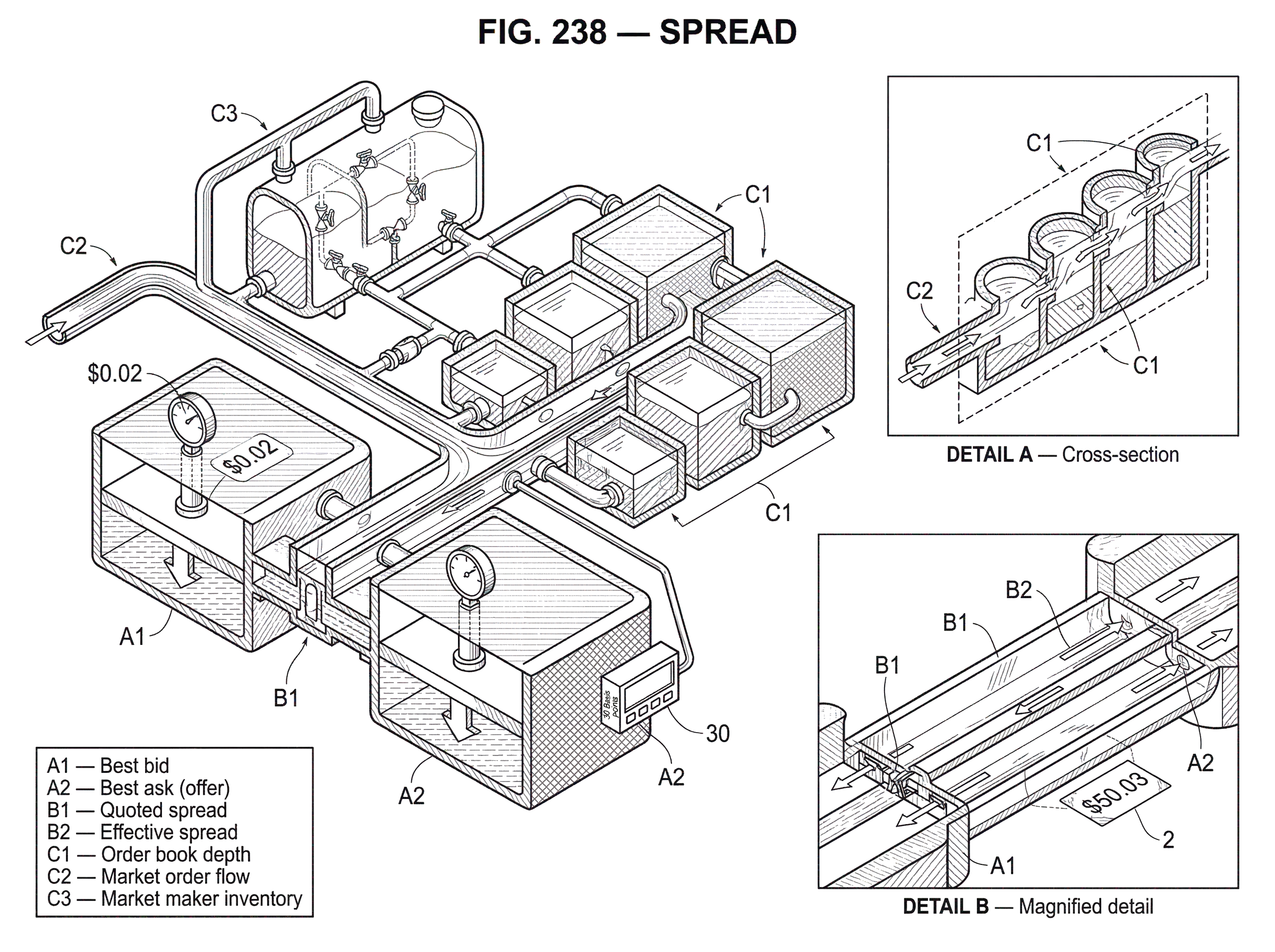
In an order-driven market, the bid is the highest standing price to buy, and the ask or offer is the lowest standing price to sell. The spread is simply ask - bid. If the best bid in a stock is $100.00 and the best ask is $100.02, the quoted spread is $0.02.
That quote pair is often observed through the best bid and offer, or BBO. Exchange data products are built around exactly this idea. For example, the NYSE’s BBO feed is described as a real-time top-of-book feed providing the best bid/ask quotations for traded securities. That matters because when people casually talk about “the spread,” they usually mean the spread at the top of the book: the gap between the current best displayed buy and sell prices.
The first useful distinction is between a quoted spread and the price a trader actually experiences. The quoted spread is the visible gap between best bid and best ask. But the actual cost of trading immediately can differ, because a market order may execute partially, move through several price levels, or interact with hidden or off-book liquidity. In the microstructure literature, this realized cost is often called the effective spread. Glosten and Harris explicitly distinguish the effective spread from the quoted spread, because the market as displayed and the market as experienced are not always the same thing.
This difference is easy to miss. A market can show a one-cent quoted spread and still be expensive to trade in size. Conversely, a market can show a somewhat wider quote but fill a moderate order with little additional movement. So the spread is not the whole story of liquidity, but it is the first number that reveals how expensive immediacy is likely to be.
Why does a bid‑ask spread exist instead of a single price?
If markets were frictionless and nobody had superior information, you might expect a single tradeable price. Why not let buyers and sellers meet at one number? The answer is that real trading is not just matching opinions; it is absorbing risk under uncertainty.
Suppose a dealer or market maker posts both sides of the market: willing to buy at $99.99 and sell at $100.01. If an incoming trader buys, the dealer sells first and only later learns whether that trade was harmless liquidity demand or informed demand just before the price rises. If an incoming trader sells, the dealer buys first and only later learns whether that sale was ordinary or a sign that the asset is about to fall. Without some cushion, the dealer is systematically vulnerable to being picked off by better-informed traders.
This is the central insight in classic market microstructure models. In Glosten and Milgrom framework, quotes reflect conditional expectations about value given the possibility that some traders know more than others. The ask must be high enough, and the bid low enough, that a liquidity provider breaks even on average despite this informational disadvantage. In that sense, spread is not merely an administrative charge. It is a defensive adjustment to adverse selection.
But information risk is not the only force. Even if no trader has superior information, a liquidity provider still faces inventory risk and operating costs. If many buyers arrive in sequence, the provider accumulates a short position; if many sellers arrive, a long position. Holding that inventory exposes the provider to price moves, financing costs, and balance-sheet usage. There are also exchange fees, clearing costs, technology costs, and the simple fact that making two-sided markets ties up capital and attention. These forces also push bids down and asks up.
So here is the mechanism in plain language: the spread exists because someone is standing ready to trade before the future is known, and that service needs compensation against several kinds of risk. The deeper point is that different risks leave different fingerprints in the spread.
What does a tight or wide spread indicate about market liquidity?
A tight spread usually means competition among liquidity suppliers is strong relative to the risks of supplying liquidity. A wide spread usually means that supplying immediacy is costly or dangerous.
That danger can come from several sources. One is information asymmetry: if some traders are better informed, liquidity providers widen quotes to avoid losing too much when those traders arrive. Another is volatility: if the asset’s value can move materially before inventory is unwound, a narrow quote is hard to sustain. Another is thin Depth: if there are few resting orders or little capital prepared to intermediate, each trade has a larger effect on the book. And another is market fragmentation and latency: if quotes across venues are not perfectly synchronized, a displayed quote can go stale faster, which again makes a narrow quote more dangerous to show.
This is why spread is widely used as a rough liquidity signal. It is not the only liquidity measure, and sometimes not the best one, but it is highly informative because it compresses many underlying frictions into one observable gap. Narrow spreads often accompany deep, active markets. Wide spreads often accompany small, volatile, illiquid, or informationally sensitive markets.
Still, a smart reader should be careful here. Spread is a signal, not a universal score. It tells you about the cost of immediate execution at the margin, not necessarily the cost of completing a large order, not necessarily market quality for every user, and not necessarily the same thing across different market designs.
How does the spread affect a simple order‑book trade? (worked example)
Imagine a stock with a best bid of $50.00 for 1,000 shares and a best ask of $50.03 for 1,200 shares. The quoted spread is $0.03. A retail trader sends a market order to buy 100 shares. The order hits the ask and fills at $50.03. If the trader immediately turned around and sold those shares back into the market, they would likely hit the bid at $50.00. That round trip would lose $0.03 per share, even if the underlying value of the stock had not changed at all.
Why does that happen? Because the trader used immediacy twice. First they asked the market for instant liquidity on the buy side; then they asked for instant liquidity on the sell side. The spread is the cost of crossing from one side to the other.
Now change the story slightly. Suppose the stock is awaiting earnings, volatility is elevated, and some participants may know more than others. Market makers now fear that any aggressive buyer might be buying because the news is good, and any aggressive seller might be selling because the news is bad. They widen the book to $49.95 bid and $50.08 ask. Nothing about the arithmetic of spread changed; what changed is the risk of being wrong after trading. The wider spread is the visible market response to that risk.
This is one reason spreads widen around announcements, in stressed markets, or in instruments with uncertain valuation. The mechanism is not mysterious. When the probability of trading against better information or being stuck with risky inventory increases, the price of immediacy goes up.
What components does the spread compensate for (adverse selection, inventory, costs)?
| Component | Economic meaning | Price signature | Typical drivers | What it implies |
|---|---|---|---|---|
| Adverse selection | Compensation for informed trades | Permanent price moves | Uneven information, announcements | Wider spread = info risk |
| Inventory risk | Compensation for holding imbalanced positions | Short‑run reversals | One‑sided flow, financing costs | Wider spread = hedging cost |
| Operating & fee costs | Fixed per‑trade expenses | Static uplift to quotes | Exchange fees, tech costs | Wider spread = higher costs |
Much of the research tradition on spreads asks a natural question: what exactly is this gap compensating for? That question matters because two markets can have the same observed spread for very different reasons.
A useful decomposition, reflected in the literature summarized by Glosten and Harris, separates the spread into at least two broad economic pieces. One piece is adverse selection: compensation for the chance that the other side knows something about fundamental value. This part has a permanent effect on price, because if a buy order reveals positive information, the market’s estimate of value should rise and stay higher. The other piece is transitory: compensation for inventory costs, clearing costs, and related frictions. This part tends to create price reversals, because the quote concession that compensates the liquidity supplier today may unwind later once the inventory pressure dissipates.
That difference matters. If a trade moves price because it conveyed information, the move is not just “bounce”; it reflects a real update in expected value. If the move is mostly a compensation effect for supplying liquidity, then part of it should reverse. This is why empirical work studies the serial correlation of transaction prices and quote changes: informational and non-informational parts of the spread leave different time-series patterns.
Roll’s classic estimator makes this intuition especially clear. Under strong assumptions, the first-order serial covariance of transaction price changes is negative, and from that negative covariance one can infer an effective spread using only prices. The core intuition is simple: if trades alternate between bid and ask around a stable underlying value, transaction prices will “bounce” back and forth, creating negative short-run serial covariance. The estimator is elegant because it turns a pattern in prices into an implied trading cost. But it depends on assumptions like market efficiency and short-run stationarity, so it is best understood as a model-based estimate, not a direct observation.
How do competition and market design affect the size of spreads?
Spread is not determined by risk alone. It is also shaped by who is allowed to supply liquidity, how they compete, and what the trading rules are.
In a centralized order book, many participants may post limit orders, and the best displayed prices become the market’s top-of-book spread. Competition tends to narrow that gap, but only until it reaches the point where liquidity suppliers are just compensated for risk and cost. If the tick size is coarse, the spread may get “stuck” at a minimum price increment even when competition would otherwise compress it further. If tick sizes are finer, quotes can narrow more precisely.
Fragmentation complicates this picture. Modern markets often have multiple venues, each with its own order flow and latency profile. The economically relevant quote may then be not just one venue’s BBO but the best available quote across venues, such as the NBBO in U.S. equities. Yet consolidated quotes can lag direct exchange feeds. Research comparing SIP-based NBBO data with faster proprietary feeds finds measurable delays and frequent short-lived dislocations. For a trader relying on slower public data, the apparent spread may differ from the actually actionable spread seen by faster participants.
This is a subtle but important point: spread is always a statement relative to a data view and a time slice. In fast markets, “the spread” is not a timeless object. It is a fleeting state of the best available quotes as seen through a particular infrastructure. That does not make the concept fuzzy; it means market structure and data plumbing are part of the mechanism.
How are spread and order‑book depth different and how should I use each?
A very common misunderstanding is to treat spread and liquidity as the same thing. They are related, but they are not identical.
The spread tells you the cost of crossing the market for a very small trade at the best quote. Depth tells you how much quantity is available before the price worsens materially. A market can have a tight top-of-book spread and still be shallow, meaning even a modest order pushes into worse prices. Conversely, a market with a slightly wider spread may have substantial depth behind it and absorb size more smoothly.
Kyle’s framework is useful here because it focuses on price impact and market depth rather than only the quoted bid-ask gap. In his model, market makers set prices based on observed order flow, and the reciprocal of the price-impact parameter measures depth: how much order flow is needed to move price by one dollar. The big idea is that liquidity has multiple dimensions. Spread captures the entry cost of immediate trading; depth captures how quickly costs escalate with size.
In practice, traders care about both. A small retail order may mostly care about the quoted or effective spread. A larger institutional order may care far more about depth and impact, because the visible spread is only the first few cents of a much larger execution problem.
How does the notion of spread apply to AMMs like Uniswap or Curve?
| Design | Price mechanism | Trader cost components | How cost scales with size | Best for |
|---|---|---|---|---|
| Centralized order book | Best bid/ask from limit orders | Quoted spread + walking the book | Stepwise with depth (price levels) | Small tight trades with depth |
| Constant‑product AMM | x·y = k reserve ratio | Explicit fee + slippage | Nonlinear; grows with trade size | Permissionless spot trading |
| StableSwap (hybrid) | Flat near parity, product off‑parity | Lower slippage + fee | Very small near parity; rises off‑parity | Stablecoin or pegged pairs |
The concept of spread also applies outside traditional order books, but the mechanism changes. In an automated market maker, there may be no standing bid quote from one participant and ask quote from another. Instead, the trading rule itself generates prices.
In Uniswap v2, for example, the marginal price comes from the ratio of reserves, and trades move the pool along a constant-product Curve. The important consequence is that the price a trader actually gets depends on trade size relative to pool reserves. There is also an explicit swap fee of 30 basis points in the design described by the whitepaper. So the on-chain trading cost has two pieces: an explicit fee and the slippage created by moving along the invariant.
That means the AMM analogue of spread is not just a fixed visible gap between bid and ask. It is the difference between the pool’s current spot price and the realized execution price once fees and curve movement are included. In the AMM literature and systematizations of practice, this realized difference is typically described as slippage. Conceptually, though, it plays a familiar role: it is the cost of immediate liquidity.
A small swap in a deep pool may experience very little slippage, making the effective spread feel tight. A large swap in a thin pool can move price sharply, making the effective spread wide. The same first principle reappears: immediacy is cheap when liquidity is abundant and low-risk, expensive when it is scarce or risky.
Different AMM designs change this shape. Curve’s StableSwap uses a hybrid invariant that is much flatter near balance than a constant-product curve, which is why it can offer dramatically lower slippage for assets that should trade near parity, such as stablecoins. Here again, what changes is the mechanism by which liquidity is supplied. But the economic meaning of spread remains recognizable: it is the cost paid for turning an intent to trade now into an executed trade now.
Why do spreads widen during market stress or before announcements?
The spread is especially informative when market conditions deteriorate, because it often widens before many other measures become obviously bad.
When volatility rises, the value of inventory becomes harder to hedge. When information is unevenly distributed, quote setters fear adverse selection. When order flow becomes one-sided, inventory accumulates in painful directions. When data feeds are stale or venue synchronization is imperfect, displayed quotes become easier targets for latency-sensitive traders. And in on-chain markets, transaction ordering, MEV extraction, and block-level execution risks can worsen realized prices beyond what a naive spot quote suggests.
All of these forces widen the cost of immediacy. Sometimes the quoted spread itself expands. Sometimes the displayed spread stays narrow but the effective spread rises because size walks the book, hidden liquidity vanishes, or on-chain execution suffers frontrunning and slippage. The form differs, but the underlying logic is the same: liquidity providers demand more compensation when their risk of loss rises.
How should traders use the spread to assess market quality?
In practice, spread is used because it is one of the fastest ways to summarize market quality.
Traders use it to estimate immediate transaction cost. Market makers use it to calibrate quoting behavior and manage expected profitability. Execution algorithms monitor it because a sudden widening often signals deteriorating liquidity or rising information risk. Researchers use it as a measurable window into adverse selection, inventory effects, competition, and market fragmentation. And in DeFi, users and protocol designers use spread-like measures such as slippage plus fees to compare pools, size trades, and evaluate whether liquidity is concentrated where it is most useful.
But the right use of spread always depends on the question. If you are comparing the cost of a tiny marketable order across venues, top-of-book quoted spread may be enough. If you are studying how much traders actually pay, you need an effective spread measure. If you are evaluating a large execution, depth and impact matter at least as much as the displayed gap. If you are comparing order books with AMMs, you need to translate both into a common idea: the realized cost of immediate exchange.
When can spread be misleading as a liquidity measure?
The main limitation of spread is not that it is unimportant. It is that it is easy to overread.
A narrow spread does not guarantee a cheap execution in size. A wide spread does not always mean a market is “bad”; it may simply reflect real information risk or a justified lack of natural counterparties. A quoted spread observed from a delayed feed may not be the actionable spread. And an inferred spread from prices alone, like Roll’s measure, depends on assumptions that may fail in real data.
There is also a convention hidden inside the term. People report spread in different ways: absolute price units, ticks, basis points, or percentages of midprice. None of these is “the true” form; they are ways of normalizing the same underlying gap for different comparisons. The fundamental object is still the same: the distance between the buy side and the sell side, or more generally the cost wedge between immediate purchase and immediate sale.
Conclusion
The spread is the market’s price for immediacy under uncertainty. In the simplest definition, it is just the difference between the bid and the ask. But that simple gap exists because liquidity is not free: someone must stand ready to trade while facing information risk, inventory risk, operating costs, and the rules of a specific market design.
That is why spread is so central to market structure. It is a small number that reveals a large mechanism. When it narrows, liquidity is easier and safer to supply. When it widens, the market is telling you that immediate trade has become harder, riskier, or both.
How do you improve your spot trade execution?
Improve spot execution by reading the spread and choosing the right order type on Cube Exchange. Use on‑book liquidity when you want price improvement, or accept taker fills when you need immediacy. The Cube workflow keeps the trade on‑exchange: fund your account, open the market, then pick limit or market execution depending on the spread and available depth.
- Check the top‑of‑book spread in basis points and the available size at the best bid/ask for your intended amount.
- If you need a guaranteed immediate fill for a small size, use a market order and size it to available depth at the best ask/bid to limit walking the book.
- If you want a better price, place a limit order inside the spread (or a post‑only limit) at mid or one tick inside the opposite best quote to capture maker pricing.
- For larger executions, slice into multiple limit fills or time‑spaced marketable limit orders and monitor slippage; prefer smaller marketable chunks that match visible depth rather than a single oversized market order.
Frequently Asked Questions
The quoted spread is the visible gap between the best bid and best ask (top-of-book), while the effective spread is the actual cost a trader experiences after execution (which can include walking the book, hidden liquidity, or partial fills); microstructure literature (e.g., Glosten and Harris) emphasizes this distinction because the displayed market and the market as experienced can differ materially.
Spreads exist because someone must stand ready to trade before future value is known; quotes compensate liquidity suppliers for adverse selection (being picked off by better-informed traders), inventory risk, and operating/clearing costs, so the spread is a defensive price for providing immediacy under uncertainty.
Researchers commonly decompose spreads into an adverse-selection (informational, more permanent) component and a transitory (inventory/transaction-cost) component, with empirical methods like Roll’s estimator and the Glosten–Harris approach using price/transaction patterns to identify these pieces, though those estimators rely on strong assumptions and can be sensitive to sampling choices.
No - a narrow top-of-book spread only indicates cheap immediacy for a very small trade at the best quote; larger orders may face shallow depth or price impact and therefore pay much more, so depth and price-impact measures matter alongside the quoted spread.
Market design and competition shape spreads: tick-size constraints can keep spreads at minimum increments, multiple venues and fragmentation make the economically relevant quote a consolidated best (e.g., NBBO) but can introduce stale or lagged information, and faster proprietary feeds can show different actionable spreads than slower consolidated feeds.
In AMMs there is typically no posted bid/ask pair; instead the execution price is determined by the pool invariant plus an explicit fee, so the AMM analogue of spread is the realized difference between spot price and execution price (slippage) combined with swap fees, and that cost depends strongly on trade size relative to pool reserves and the AMM design (constant-product vs StableSwap).
Spreads commonly widen around announcements and in stressed markets because adverse-selection risk, volatility and one‑sided order flow increase, inventory becomes costlier to hold, and stale or desynchronized quotes raise the risk of being picked off, so the price of immediacy rises.
Traders use spreads as a quick liquidity signal: they estimate immediate transaction cost from top-of-book spreads, execution algorithms monitor sudden widening as a sign of deteriorating liquidity or rising information risk, and researchers use spreads to study adverse selection, inventory effects and competition - but the correct spread measure depends on the question (quoted vs effective vs impact for size).
There is no single standard: spreads are reported as absolute price differences, ticks, basis points, or percentages of midprice in practice, and the article cautions that these normalizations are conventions for comparison rather than changes to the underlying economic gap.
Yes - consolidated public feeds (SIP/NBBO) can lag faster direct exchange feeds, creating situations where the quoted spread on the public feed differs from the actionable spread seen by low‑latency participants, so reliance on slower feeds can misstate effective trading costs.
Related reading