What Is a State Machine in Blockchain Execution?
Learn what a blockchain state machine is, how transactions and smart contracts change state, and why deterministic execution matters.
Introduction
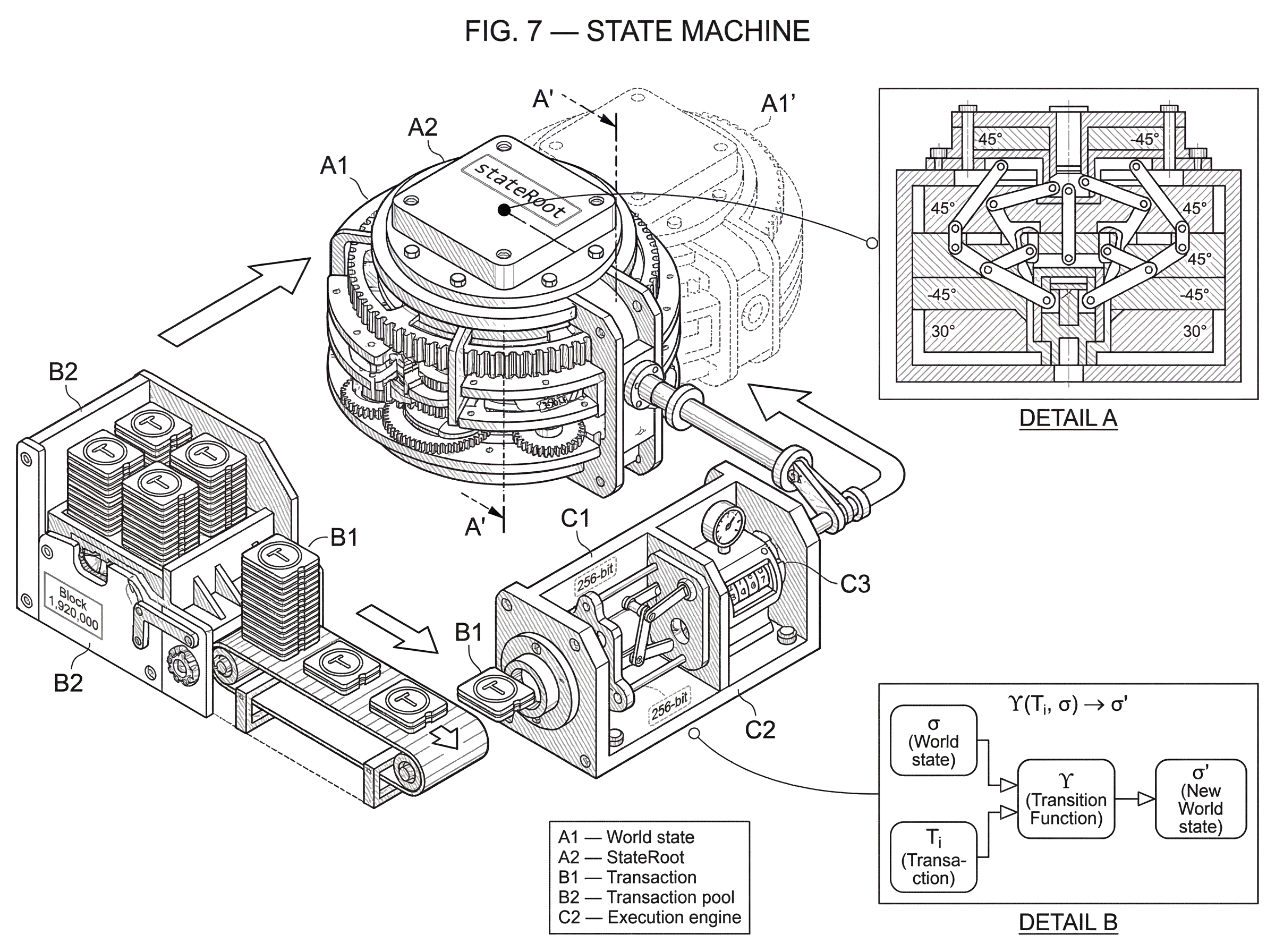
State machine is the idea that makes blockchain execution precise. Instead of thinking of a chain as merely “a list of transactions,” it is more accurate to think of it as a machine with memory: there is a current state, users submit inputs, and the protocol defines exactly how those inputs transform that state into the next one.
This framing matters because smart contracts are not just messages stored on-chain. They are programs whose effects must be reproduced independently by many nodes and still come out the same way. If two honest nodes see the same prior state and the same ordered transactions, they must compute the same result. That is the core promise of execution.
In Ethereum’s formal specification, this is stated directly: the system can be viewed as a transaction-based state machine. A transaction is applied to a prior world state σ, and a state transition function Υ returns the next world state. At block level, a block transition function Π applies transactions sequentially, so the block’s effect is just the composition of many transaction-level transitions. The notation is compact, but the underlying idea is ordinary: state plus input plus rules gives next state.
The same idea appears well beyond Ethereum. Tendermint describes itself as a state-machine replication engine and separates replication from the application that implements the actual state machine through ABCI. Raft, in distributed systems, defines a replicated state machine as many servers executing the same ordered commands to produce identical states and outputs. Solana’s whitepaper also characterizes blockchain as a fault-tolerant replicated state machine. The details differ, but the invariant is the same: agreement is useful only because there is something precise to agree on.
What are the 'state', 'input', and 'transition' in a blockchain state machine?
A state machine has three parts.
First, there is state: the information that exists now. In Ethereum, that state is the world state σ, a mapping from addresses to account states. Each account state includes a nonce, a balance, a storageRoot, and a codeHash. That is enough to determine, for each address, how much ether it owns, whether it has code, and how to locate its persistent storage.
Second, there is an input. In a blockchain execution system, the most natural input is a transaction. A transaction is a signed instruction from an external actor. It names a sender implicitly through its signature, carries a nonce, gas limit, destination, value, and optional data, and asks the state machine to do something: transfer funds, create a contract, or call a contract.
Third, there is a transition rule. This is the mechanism that says what happens when a valid input meets a particular state. In Ethereum’s whitepaper, this appears as APPLY(S, TX) -> S' or ERROR. In the Yellow Paper, the same idea is formalized as σ[t+1] ≡ Υ(σ[t], T). The notation differs, but both are saying: given the current state and a transaction, there is a well-defined next state, unless the input is invalid.
The compression point is simple: a blockchain does not “store transactions” as its primary truth; it stores and updates a shared state according to deterministic transition rules. Transactions matter because they are the inputs that cause state transitions. Blocks matter because they provide an agreed order for applying those inputs. But the object everyone is really trying to compute is the next valid state.
Why is the state-machine model essential for validating blocks and execution?
Without the state-machine model, it is hard to say what it even means for a node to verify a block. A block is not valid merely because it is well-formed or signed by the right proposer. It is valid only if, when its transactions are applied in order to the prior state under the protocol’s execution rules, they produce the claimed new state.
That is why Ethereum blocks do not just carry transactions. They also commit to the resulting state through the stateRoot in the block header. The state itself is represented with a Merkle Patricia trie, so the root acts as a compact authenticated commitment to the full world state. A node validating a block can re-execute the transactions, compute the resulting trie root, and check whether it matches the header. If it does not, the block is invalid.
This is the deeper reason execution must be deterministic. Consensus can tell the network which block to consider canonical, but consensus alone does not tell nodes what the block means. Meaning comes from the state machine. If two clients disagree about how a transaction updates state, then they will compute different state roots from the same block. At that point, “consensus” fractures into incompatible realities.
You can see the same separation clearly in Tendermint’s architecture. Tendermint handles the replication and ordering side, while the application behind ABCI defines the actual state machine semantics. Tendermint is the engine that says, in effect, “everyone should process these inputs in this order.” The application answers, “here is what those inputs do.” Consensus without a state machine is ordering without meaning; a state machine without consensus is meaning without shared agreement.
What does the blockchain 'state' include (accounts, storage, UTXOs)?
The phrase state can sound abstract, so it helps to make it concrete. In Ethereum, the world state is account-based. Each address maps to an account object with a few fields, and contract storage is itself a key-value structure reachable through the account’s storageRoot. This design makes the state look like a large mutable map.
That choice has consequences. If a contract increments a counter, the transition is not “append a fact that the counter was incremented.” The transition is “read storage at a key, compute a new value, and write the updated value back into persistent state.” The state machine model fits this naturally because it is fundamentally about transforming a current snapshot into a next snapshot.
Other blockchain families organize state differently, but the same idea still holds. Cardano’s ledger specification describes modular transitions over an extended UTXO-style ledger rather than an account map. In that setting, the “state” is not primarily balances attached to accounts with mutable storage; it is the current set of spendable outputs plus the associated ledger context and validation rules. Solana speaks in terms of accounts too, but with a runtime shaped around a different performance model. The structure of state changes across architectures, yet the shared principle remains: the protocol defines what the current authoritative data is, and execution defines how valid inputs transform it.
What is fundamental here is not the account model or the UTXO model. Those are design choices. The fundamental part is that there exists some canonical state representation and a deterministic rule for moving from one state to the next.
How does a transaction become a deterministic state transition on-chain?
| Case | Pre-exec checks | Execution gas | State effect | Fees |
|---|---|---|---|---|
| Invalid transaction | signature/nonce/funds fail | not executed | no state change | no gas charged |
| Valid but fails | passes intrinsic checks | consumes gas until failure | effects reverted | gas still paid |
| Valid and succeeds | passes intrinsic checks | within gas limit | state updated and committed | fees deducted, unused refunded |
The most useful way to understand a state machine is to watch one input go through it.
Imagine Alice submits a transaction to call a contract that updates a stored number and sends some ether onward. The transaction does not immediately “become truth” because it was broadcast. First it must pass the protocol’s intrinsic validity checks. In Ethereum those checks include basic structural correctness, a valid signature, a correct sender nonce, enough balance to cover the upfront gas commitment, and fee constraints such as the base fee requirement under EIP-1559.
Only then does execution begin. The sender’s account is charged for gas up front according to the transaction’s gas limit and fee parameters. If the transaction targets a contract, the Ethereum Virtual Machine executes that contract’s bytecode. The EVM is a stack-based machine with 256-bit words, transient memory, persistent storage, and gas-charged opcodes. As opcodes run, gas is consumed, storage may be read or written, logs may be emitted, and internal contract-to-contract messages may be created.
Suppose the contract reads a value from storage, adds 1, stores the result, and then calls another contract. If the nested call succeeds, the updates continue and the machine eventually halts normally. In that case, the transaction’s net effect is committed into the new world state. But if execution hits an exceptional halting condition such as out-of-gas, the attempted effects do not partially remain in the global state. In the Yellow Paper’s model, exceptional execution yields no resulting state changes from that attempted operation. Economically, the sender still pays for consumed resources, but semantically the failed execution does not get to mutate global state halfway.
That rollback behavior is not a decorative feature. It is part of what makes the state transition function usable. A blockchain execution environment must define not only successful transitions, but also what happens when computation fails. If failure semantics were vague, nodes could disagree about whether partial writes survive, and the state machine would stop being a machine in the strict sense.
Why does transaction ordering change execution outcomes?
A smart reader might ask: if each transaction has a deterministic effect, why is block ordering such a big deal? Because the transition function depends on the current state, and the current state depends on what happened before.
Take two simple transactions from the same account. If both use the same nonce, only one can be valid. Or imagine two transactions interacting with the same decentralized exchange pool. The output of the second trade depends on whether the first trade already changed reserves. In other words, transactions are not independent mathematical objects floating in space. They are state-dependent commands.
This is why Ethereum’s block function Π is defined as repeated application of the transaction function Υ. If a block contains transactions T0, T1, ..., then the result is obtained by applying Υ to T0, then applying it again to the resulting state with T1, and so on. The block transition is not a bag of effects. It is an ordered composition.
This also explains why replicated execution systems care so much about having a canonical order. Raft’s replicated state machine model requires each server to execute the same sequence of commands in order. Tendermint replicates ordered requests into the application. Solana’s architecture spends major design effort on producing an order and time source through Proof of History. Different systems make different engineering tradeoffs, but none escape the need for a shared sequence when commands are stateful.
How does gas limit execution and protect the network?
| Choice | Execution risk | Fees outcome | State effect |
|---|---|---|---|
| Underestimate gas | out-of-gas → revert | gas consumed and paid | no state changes committed |
| Adequate gas | completes execution | pay expected fees | state changes committed |
| Excessive gas limit | no extra execution risk | higher upfront hold, refunded unused | state same as adequate |
A naive state machine for smart contracts would be dangerously open-ended. If users can submit arbitrary programs and every node must run them, then a malicious or buggy program could loop forever or consume unbounded resources. The machine would no longer be operationally safe for a decentralized network.
Ethereum’s answer is gas. Gas is the unit that meters execution. Each opcode has a gas cost, transactions provide a gas limit, and execution halts when the budget is exhausted. This is the practical mechanism that turns a quasi-Turing-complete Virtual Machine into something a decentralized network can actually run.
The important point is not merely that gas “charges fees.” At a deeper level, gas is part of the state machine’s safety boundary. It ensures that every attempted transition has a bounded execution budget. That budget does two things at once: it prices resource consumption economically, and it makes execution mechanically terminable in practice.
Under EIP-1559, fee payment has additional structure. Each transaction in a block must pay the per-block base fee, which is burned, and can pay a priority fee to the validator. The base fee adjusts based on parent block gas usage. These details are often discussed as fee-market economics, but they are also execution-relevant because they affect which transactions are valid for inclusion and whether the sender can afford the transition being requested.
So gas is not external to execution. It is one of the rules that determines whether a proposed state transition is even admissible, and if admitted, how far execution is allowed to proceed.
How do blockchains replicate a single state machine across many nodes?
| Protocol | Ordering source | Fault model | App coupling | Best for |
|---|---|---|---|---|
| Raft | leader log | crash-faults only | leader-centric, app-coupled | private clusters, low-latency |
| Tendermint | consensus-ordered blocks | Byzantine tolerant (f < n/3) | separates app via ABCI | public BFT chains |
| Solana | Proof-of-History timestamps | PoS with fast timeouts | tightly integrated runtime | high-throughput execution |
A single computer running a state machine is straightforward. A blockchain’s harder problem is getting many independent computers to behave as if they were one machine.
The classic distributed-systems answer is the replicated state machine. Raft states the idea cleanly: if each server stores the same ordered log of commands and executes those commands in order on a deterministic state machine, then each server computes the same state and the same outputs. The difficult part is not execution itself; it is ensuring the same commands in the same order are applied everywhere.
This framing transfers almost directly to blockchains. The ordered log is the chain of transactions or blocks. The deterministic machine is the execution layer. Consensus is the mechanism that decides the log; execution is the mechanism that interprets it.
That separation helps clear up a common confusion. People sometimes talk as though consensus is the blockchain. It is not. Consensus answers, “which sequence of inputs should we all accept?” The state machine answers, “what does that sequence do to the shared state?” You need both, but they solve different problems.
Tendermint makes this separation explicit by positioning itself as a replication engine and letting applications implement their own semantics over ABCI. Ethereum integrates the pieces more tightly in protocol design, but the conceptual split is still there. Solana also describes blockchain as a replicated state machine, though its runtime and ordering mechanisms are tuned for high-throughput execution. The lesson across architectures is that scaling, programmability, and safety all depend on how well a system preserves this division of labor.
What are the subtle limitations and edge cases of the state-machine model?
The state-machine view is powerful, but it can mislead if stated too simply.
First, the “state” a node can reconstruct is not the same as “all historical states forever.” Ethereum’s formal specification defines the current world state and block validation rules, but it does not require indefinite storage of every prior state by every node. Historical retention, pruning, and checkpointing are implementation and protocol-evolution concerns layered around the basic model. So when people say “the blockchain stores everything forever,” they are mixing the logical state machine with archival policy.
Second, not every real-world protocol change is a normal user-driven transition. Ethereum’s DAO hard fork is a famous example of an irregular state change: block 1,920,000 executed a protocol-level intervention that moved funds into a recovery contract. That event is important not because it was typical, but because it shows what is fundamental and what is conventional. Fundamental: the network follows the transition rules implemented by its clients. Conventional: most of the time those rules only permit ordinary transaction-driven updates. A hard fork can redefine the state machine itself.
Third, deterministic execution places sharp limits on what contracts can safely depend on. A contract cannot consult an external web API during execution, because different nodes could receive different answers. It cannot generate truly unpredictable randomness internally in the simple sense, because every node must reproduce the same result from the same inputs. These are not incidental limitations. They follow directly from the requirement that the state transition function be deterministic.
Fourth, state machines can be modular. Cardano’s mechanized ledger specification emphasizes a hierarchy of modular transitions. That is a reminder that “the state machine” need not be one giant monolithic function in the human sense. It can be decomposed into smaller rules, as long as the composed result is still unambiguous. The abstraction is about semantics, not code organization.
How does the state-machine view help you understand smart contracts and composability?
Once the state-machine idea clicks, smart contracts stop looking magical. A token contract is just code that defines how certain inputs update balances and allowances in persistent state. A lending protocol is code that updates debt positions, collateral records, and interest indices. A naming system is code that updates mappings from names to owners and records. In every case, the contract is not “doing blockchain things” in some vague sense. It is implementing a specialized local transition rule inside the broader chain-level state machine.
This is also why composability is both powerful and dangerous. When one contract calls another, the combined effect is still a single larger state transition, possibly spanning many storage writes and nested calls. If the semantics are well designed, you get rich programmable behavior. If they are misunderstood, you get failure modes such as surprising rollback propagation, gas exhaustion, or reentrancy-related bugs. The state-machine lens helps because it forces you to ask the right question: what exact before-and-after state change is this code permitting?
Even outside account-based systems, the same mental model remains useful. In an extended UTXO system, a script is not mutating contract storage in place, but it is still participating in a formal transition from one ledger state to another under explicit validity rules. In Tendermint-based chains, the application defines how Request messages change application state. The surface APIs differ, yet the explanatory core does not.
Conclusion
A state machine is the execution-layer view of a blockchain: there is a current state, there are valid inputs, and there are deterministic rules for computing the next state. Transactions are the inputs, blocks provide the order, and smart contracts are part of the transition logic.
If you remember one thing, remember this: the chain is not just a history of transactions; it is a shared computation of state. Consensus decides the sequence. The state machine gives that sequence meaning.
How does the state machine affect real-world usage?
The state-machine model matters for real-world usage because it determines how long you should wait for a deposit to be safe, how fees and gas affect inclusion and execution, and which RPC or node features you need for history or complex interactions. Before you fund, trade, or rely on on-chain events, follow these practical checks and then use Cube Exchange’s deposit and trading flows to execute once the chain-specific requirements are met.
- Check the chain’s finality model and recommended confirmations: look up whether the chain uses probabilistic finality (e.g., many PoW chains) or instant/finality checkpoints (e.g., many PoS chains) and note the recommended confirmation count from the chain docs or your RPC provider.
- Verify the exact network and token details: confirm the network name and the token contract address you will use, and ensure your chosen RPC or wallet supports the historical data you need (archive vs. pruned access) for the intended operation.
- Estimate gas and fee parameters for the target chain: run a gas estimate or use a reliable estimator, then set appropriate gas limits and fees (for EIP-1559 chains set maxFeePerGas and maxPriorityFeePerGas) so the transaction won’t revert or be dropped.
- Fund your Cube Exchange account via the supported deposit flow and wait the chain’s recommended finality window; then place your trade on Cube (use a limit order to control price and slippage or a market order for immediate execution).
Frequently Asked Questions
Deterministic execution ensures that if two honest nodes start from the same prior state and apply the same ordered transactions, they compute the same next state; without determinism nodes could derive different state roots from the same block and consensus would no longer produce a single canonical reality.
A validating node re-executes the block’s transactions in order against the prior world state, computes the resulting state trie root, and checks that it matches the block header’s stateRoot - the stateRoot is a Merkle-Patricia-trie commitment to the claimed world state.
When execution hits an exceptional halting condition (for example out-of-gas) the attempted effects do not persist: the Yellow Paper models such exceptional execution as producing no resulting state changes while the sender still pays for consumed resources.
Ordering matters because each transaction’s effect depends on the current state; two transactions interacting with the same account or the same on-chain pool will produce different results depending on which one is applied first (nonce conflicts and reserve changes are concrete examples).
Gas bounds execution by assigning costs to opcodes and limiting a transaction’s runtime to the provided gas budget, which prevents unbounded or infinite work across the network; EIP-1559 further ties execution admissibility to fee rules (a per-block base fee that is burned plus a priority fee to the block proposer).
No: contracts cannot call arbitrary external web APIs during on-chain execution because different nodes could observe different responses, and true unpredictability from within a deterministic state transition is fundamentally constrained - the protocol provides only pseudorandom primitives (e.g., BLOCKHASH) and unbiased randomness remains an open challenge.
Nodes are not required to retain every historical full state forever; the formal execution model defines the canonical current state and validation rules, while practical choices like pruning, checkpointing, and archival retention are implementation- and policy-level concerns.
They are distinct but complementary: consensus (or a replication engine like Tendermint) decides the agreed order of inputs, while the state machine (the execution layer/EVM or application logic) defines what that ordered sequence means by deterministically transforming state - you need both ordering and deterministic semantics to get a consistent global state.
Related reading