What is Proof of History?
Learn what Proof of History is, how Solana uses it as a cryptographic clock, why it is not consensus, and what its real tradeoffs are.
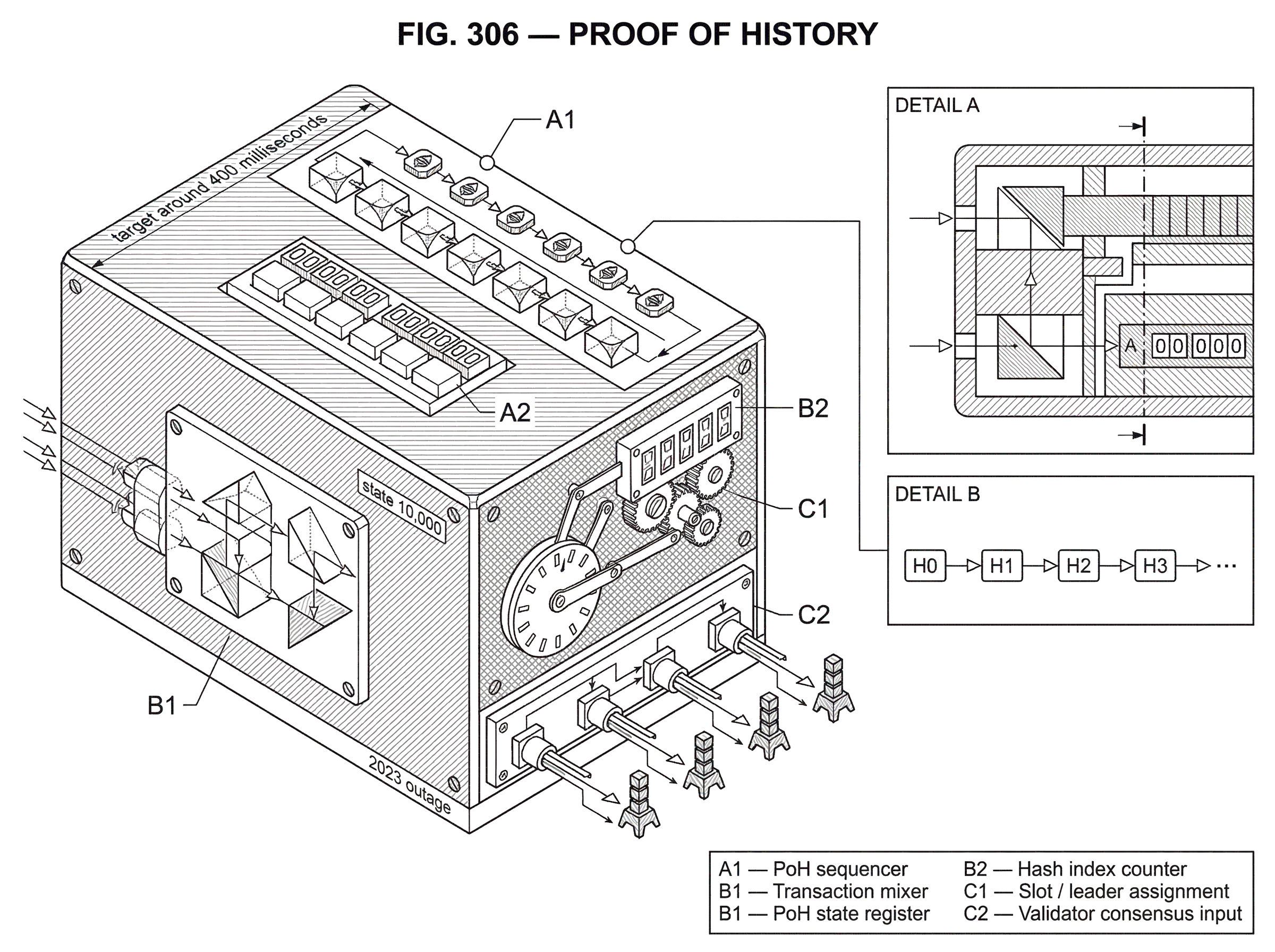
Introduction
Proof of History is Solana’s mechanism for proving that some time passed and that certain events happened in a particular order before the network reaches consensus on them. That may sound like a small improvement, but it targets one of the deepest bottlenecks in distributed systems: if many machines do not trust one another’s clocks, then even agreeing on when something happened becomes expensive. In many blockchains, a large part of latency comes from this coordination problem. Solana’s design tries to move some of that work out of consensus by putting a verifiable ordering signal directly into the ledger.
The key idea is easy to state and easy to misunderstand. Proof of History is not consensus. It does not, by itself, tell the network which chain is final, which validator is honest, or which state transition should win in a dispute. What it does provide is a shared, cryptographically checkable record that says: between this event and that event, this much sequential computation happened, and therefore these events have a definite order. Solana then uses that ordering as an input to its actual consensus machinery, especially Tower BFT.
That distinction matters because many descriptions of PoH blur together three separate jobs. One job is measuring ordered progress. Another is choosing a canonical branch. A third is executing transactions efficiently once an order is known. PoH is mainly about the first job. It helps the second by reducing coordination overhead, and it helps the third by giving other parts of the system a stable ordering to work from.
What ordering and latency problems does Proof of History solve?
A blockchain is a distributed state machine: many nodes must apply the same transactions in the same order and end up with the same state. The hard part is not just checking signatures or executing code. The hard part is that the nodes are geographically separated, network messages arrive late or out of order, and there is no trusted wall clock that every participant can safely treat as authoritative.
If a validator says, “I saw this transaction first,” the rest of the network has no reason to accept that claim just because the validator said so. Local clocks can drift. Messages can be delayed. Attackers can exploit timing ambiguity. Traditional Byzantine fault tolerant systems deal with this by exchanging more messages and by using conservative timeout logic. That works, but it costs latency and throughput because validators spend effort negotiating ordering and waiting long enough to be safe.
PoH tries to change the shape of that problem. Instead of asking validators to keep re-establishing time through communication, it gives block producers a way to generate a public sequence that is expensive to produce in order but much easier to verify afterward, especially in parallel. If transactions are inserted into that sequence as it is being generated, the resulting ledger carries evidence not just that the transactions exist, but that they were observed before particular points in the sequence.
The practical consequence is that validators can rely less on “when did this message reach me?” and more on “where is this event embedded in the history sequence?” That does not remove the need for consensus, but it reduces how much consensus must infer from network timing alone.
How does a sequential hash chain act as a cryptographic clock in PoH?
| Property | PoH (hash chain) | Formal VDFs |
|---|---|---|
| Sequentiality | Single‑threaded hash chain | Provable sequential delay |
| Verification cost | Parallelizable but nontrivial | Asymptotically very cheap |
| Proof succinctness | No short proof recorded | Small succinct proofs |
| Deployment practicality | Simple, hardware‑friendly | Often needs setup or SNARKs |
Here is the mechanism in ordinary language. Start with some initial value. Hash it with a cryptographic hash function such as SHA-256. Take the output and hash it again. Then hash that output again, and keep going. Because each step depends on the previous output, you cannot compute step 1,000,000 without computing steps 1 through 999,999 first. The sequence is inherently sequential.
That sequentiality is the entire point. If the fastest practical way to move from one state to the next is to do the hashes one after another, then the position in the chain becomes evidence that some amount of computation elapsed. Solana’s whitepaper describes PoH as a sequence of computation run on a single core, with outputs and a counter recorded. The count tells you how many hash steps have occurred; the chain tells you those steps were linked in order.
This is why PoH is often described as VDF-like, meaning similar to a verifiable delay function. A VDF, in the strict formal cryptographic sense, is usually defined so that evaluation takes a prescribed number of sequential steps while verification is very efficient, often polylogarithmic in the delay parameter. PoH does not match that ideal definition cleanly. Its verification is practical and parallelizable, but not “cheap” in the same asymptotic sense as the strongest VDF constructions from cryptography research. Solana’s own materials sometimes use a looser definition. That is an important nuance: **PoH behaves like a delay-based ordering mechanism, but it is not the same thing as a formally minimal-verification VDF construction such as Wesolowski’s. **
Still, the useful property is real. Producing the chain requires ordered work. Verifiers can split the recorded sequence into chunks and check those chunks across many cores or GPU resources, so the wall-clock cost of verification can be much lower than the wall-clock cost of generation. That asymmetry is enough for PoH to function as a practical clocking mechanism inside a blockchain protocol.
How are transactions anchored or 'timestamped' into the PoH sequence?
The next step is what makes the hash chain useful for a ledger rather than just an expensive stopwatch. As the sequence runs, a block producer can mix external data into the PoH state. In practice, that means taking the hash of some event or transaction data and appending or combining it with the current sequence state so that the next generated hash depends on that data.
Why does that matter? Because once the data is mixed in, the subsequent PoH output could only have been produced after that data was inserted. That gives the event a cryptographic position in the sequence. Solana’s whitepaper describes this as recording that some piece of data was created before a particular hash index was generated. The next hash after insertion effectively acts as a timestamp in the logical sense.
This is not a human-readable timestamp like “12:02:01 PM UTC.” It is more precise in one way and less in another. It does not try to represent civil time directly. Instead, it says the event occurred between two positions in the network’s evolving state machine. Solana’s own explainers stress this point: PoH will not tell you the wall-clock time of an event, but it can tell you where that event sits relative to the past and future of the ledger.
That distinction helps avoid a common mistake. PoH does not make every node share a perfectly synchronized physical clock. It creates a shared logical clock derived from sequential computation. The guarantee is about order and bounded progress, not exact global civil time.
Example: How PoH proves the relative order of two transactions
Imagine a leader is responsible for producing entries during its assigned slot. It starts from some known PoH state and keeps hashing: state 1, state 2, state 3, and so on. While this is happening, transactions arrive from users. Suppose transaction A arrives while the leader is at state 10,000. The leader mixes the hash of A into the current PoH state, and the next output becomes part of the public record. Later, while the sequence continues, transaction B arrives and gets inserted near state 12,000.
Now a validator receiving this record does not need to trust the leader’s word that A came before B. The validator can inspect the sequence and verify that the chain really progressed from the earlier state through the insertion point for A, then onward to the insertion point for B. Because each later state depends on all earlier states, the leader cannot retroactively pretend B was inserted before A without changing the sequence and invalidating subsequent outputs.
What exactly has been proved here? Not that A was submitted at a particular UTC second, and not that the leader behaved honestly in every respect. What has been proved is narrower and more useful: given this published sequence, A was incorporated before a later point in the sequence than B, and that order is cryptographically bound into the ledger. Consensus can then decide whether this leader’s chain becomes canonical, but the ordering evidence inside the chain is already there.
This is the sense in which PoH is a pre-consensus ordering layer. It prepares a structured history that consensus can evaluate, rather than making consensus reconstruct order from raw message arrival patterns.
How does PoH reduce consensus messaging and timeout overhead?
Consensus protocols in adversarial networks are expensive because they compensate for uncertainty. If replicas do not share a trustworthy notion of time, they must wait longer, talk more, or both. In protocols derived from PBFT, timeouts and rounds are a central part of safety and liveness. Solana’s design uses PoH so those timeouts can be expressed against positions in the hash sequence rather than only against unreliable local clocks.
This is where PoH becomes important to Tower BFT. Solana’s description of Tower BFT says PoH serves as the network clock before consensus. Validators vote on chains whose progress is measured in PoH hashes and grouped into slots. Because that clock is embedded in the ledger, validators can compute timeout-related behavior locally from the same data structure rather than continuously negotiating timing with peers.
The immediate consequence is lower messaging overhead. If the ledger itself already carries a verifiable notion of ordered progress, replicas do not need as much back-and-forth to decide whether enough time has passed to make a vote, extend a timeout, or consider a branch stale. Solana’s materials connect this directly to low-latency operation, including sub-second block production targets and faster finality than systems that must be more conservative about proposer timing.
But again, the boundary is important. PoH does not finalize blocks. Tower BFT does. Once stake-weighted supermajorities vote, the chain gains the safety properties of the consensus protocol. PoH mainly changes the environment in which that consensus operates.
How do slots and leaders use PoH to enforce proposer spacing?
Solana assigns leaders for slots, and the slot duration is tied to a target amount of PoH progress. Official materials describe slots as fixed periods of hashes, with a target around 400 milliseconds in some designs and deployments. The mechanism matters more than the exact number: a leader is expected to advance PoH through its slot and publish blocks anchored to that progress.
This creates a practical anti-racing effect. If leader n is supposed to produce during a given slot, leader n+1 cannot simply jump ahead and create a convincing competing history for later slots unless it can compute the required PoH progress faster than expected. A later leader that wants to skip missed slots must show the corresponding additional delay in the history sequence. In that sense, PoH turns “waiting your turn” into something the ledger can check rather than something the network merely hopes proposers respected.
That property is one reason Solana presents PoH as a source of objectivity. Messages do not have to arrive at every validator immediately for validators to recover the intended temporal structure. The ledger itself carries evidence that protocol delays were observed by the producer.
What parts of Solana’s stack benefit from PoH and where do the speed gains come from?
It is tempting to hear “cryptographic clock” and conclude that PoH alone makes Solana fast. That is too simple. The speed comes from an interaction between PoH and the rest of the stack.
PoH helps because it pre-orders events and gives validators a common timing reference. That makes fast leader rotation and lower-latency voting more feasible. It also helps downstream systems that want a predictable order. For example, Solana’s parallel execution model, Sealevel, benefits when the system already has a strong ordering signal and explicit information about which transactions touch which accounts. The effect is not that PoH magically parallelizes execution; the effect is that PoH reduces one source of uncertainty so other subsystems can run more aggressively.
The networking layer matters too. Solana’s throughput claims have always depended heavily on hardware assumptions, high bandwidth, GPU acceleration for some operations, and propagation mechanisms such as Turbine. The whitepaper and official explainers frame PoH as one enabling component among several. When Solana reports throughput figures like tens of thousands of TPS or theoretical much higher ceilings, those are claims about the whole architecture under particular conditions, not about PoH in isolation.
That broader framing also explains why outages and network stress events do not automatically refute PoH’s purpose. Many reported incidents involved transaction ingestion, deduplication, forwarding loops, fork selection bugs, or runtime nondeterminism rather than a direct failure of the sequential hash idea itself. At the same time, those incidents show an important truth: a pre-consensus clock only helps if the surrounding protocol and implementation handle the resulting data flow safely.
What Proof of History does not guarantee or protect against
| Guarantee | PoH provides? | Why not |
|---|---|---|
| Exact wall‑clock time | No | Depends on local execution speed |
| Hardware‑independence | Partial | Faster hardware can shift timing |
| Formal VDF succinctness | No | Verification still substantial work |
| Liveness/finality alone | No | Requires stake‑weighted consensus |
The cleanest way to understand PoH is to be explicit about its limits.
First, it does not guarantee exact real-world time. Different hardware runs at different speeds, network delays vary, and Solana’s own descriptions present PoH as operating in approximate real time. So the sequence gives ordering bounds and protocol-relative delay, not a perfect universal clock.
Second, it does not eliminate trust assumptions about hardware. PoH relies on the idea that the sequence is hard to accelerate dramatically through parallelism, since each hash depends on the last. But the actual speed of sequential hashing still depends on processor design. If some participant can compute the chain materially faster than expected, it gains timing advantage. Solana’s public materials discuss hardware optimization and common SHA-256 support, but this remains a practical assumption rather than a theorem about all future hardware.
Third, PoH is not “efficiently verifiable” in the strongest cryptographic sense usually associated with formal VDFs. Verification can be parallelized and made fast in wall-clock terms, but the total computational effort is still substantial relative to generating a succinct proof in a purpose-built VDF scheme. Critics have pointed this out, and Solana’s own Tower BFT explainer uses a loose definition of VDF for PoH. That does not make PoH useless; it just means the right mental model is practical sequential clock, not ideal asymptotic VDF.
Fourth, PoH does not solve liveness on its own. Solana’s own architecture notes tradeoffs when using multiple PoH generators for horizontal scaling: more throughput can mean less precise timestamping because network latency enters the synchronization process, and availability can also suffer. In other words, once you move from a single neat sequence to a distributed operational system, the old distributed-systems tradeoffs return.
Security implications of PoH: protections and remaining attack vectors
PoH does provide some useful security properties. Because history is tied to an ordered sequential computation, recreating a long ledger is costly. Solana’s whitepaper argues this raises the cost of long-range forgery: an attacker trying to fabricate a convincing alternative past must reproduce at least as much sequential work as the original ledger, unless the attacker has faster hardware.
That is a meaningful property, but it is not a complete defense. The strength of the protection depends on hardware assumptions and on the fact that consensus still decides canonical history. If an attacker controls sufficient stake or exploits implementation faults around voting, fork choice, or transaction processing, PoH alone does not save the system.
Real incident reports reinforce that point. Solana outages have been caused by overloaded propagation paths, duplicate blocks, fork selection bugs, and runtime nondeterminism. In one 2023 outage, investigators suggested an abnormally large block was likely related to padding PoH with virtual ticks when a validator had diverged from consensus. That is not a failure of the abstract idea “use sequential hashes to measure progress”; it is evidence that once such a clock is embedded in a live network with slots, shreds, forwarders, and failover behavior, edge cases matter enormously.
So the right conclusion is neither “PoH makes forgery impossible” nor “PoH is meaningless because outages happened.” The more accurate conclusion is that PoH changes the attack surface. It gives the system a useful ordering primitive, but the full security story depends on consensus, networking, implementation quality, and operational discipline.
Why did Solana choose PoH instead of relying on synchronized wall clocks?
| Dimension | PoH | Synchronized clocks |
|---|---|---|
| External dependency | Self‑contained ledger clock | Depends on NTP/peers |
| Attack resilience | Stronger under adversary | Vulnerable to spoofing |
| Resource cost | CPU hashing overhead | Low runtime cost |
| Ordering evidence | Cryptographic position proofs | Receipt timestamps only |
| Best for | Adversarial, high‑throughput nets | Stable, well‑synced nets |
A reasonable question is whether PoH is even necessary. Could a network simply assign fixed slot times and use ordinary clock synchronization? Many proof-of-stake systems do some version of that. If clocks are synchronized well enough, validators can ignore blocks that arrive too early and rely on the fork choice rule to sort out the rest.
The attraction of PoH is that it reduces dependence on external time synchronization under adversarial conditions. A wall-clock-based design works well if participants’ clocks stay close and if network behavior remains tame. PoH instead tries to make protocol time emerge from a cryptographic process recorded in the ledger itself. That gives the network something self-contained to verify.
The tradeoff is cost. Running and checking the sequential hash stream consumes resources. So the question is not whether PoH is the only possible design. Solana’s own materials explicitly say it is not necessary for a permissionless blockchain. The question is whether paying that computational cost lets the rest of the system run with less coordination and lower latency. Solana’s architecture is built around the answer “yes.” Critics and alternative designs argue that stronger time-sync approaches might achieve similar practical spacing at lower cost. That remains partly an engineering judgment, not just a theorem.
Key insight: how PoH 'turns waiting into data' and why that matters
The simplest way to remember PoH is this: it turns waiting into data.
In most distributed systems, waiting is implicit. A node delays because the protocol says to wait, but proving that the wait actually happened is hard. In PoH, the wait is represented by a sequence that cannot be advanced without doing the intermediate work. Once events are inserted into that sequence, their position relative to that work becomes part of the ledger.
That is why PoH helps consensus without being consensus. It does not tell everyone what to believe. It gives everyone better evidence about the order in which events could have occurred, so the actual agreement protocol has less ambiguity to fight through.
Conclusion
Proof of History is Solana’s cryptographic ordering clock: a sequential hash process that records the passage of protocol time and binds events to positions in that sequence. Its purpose is not to replace consensus, but to make consensus cheaper and faster by reducing how much the network must infer from message timing alone.
The durable insight is simple. **PoH works by making ordered progress verifiable.
** Everything else follows from that mechanism.
- lower messaging overhead
- fast slots
- pre-consensus ordering
- easier parallel verification
Its limits are just as important: it provides logical time, not perfect wall-clock time; it depends on hardware and implementation assumptions; and it only becomes a blockchain when paired with real consensus such as Tower BFT.
How do you get practical exposure after learning this protocol topic?
Use this topic as a practical check before you act on Cube Exchange. Turn the concept into a concrete funding, execution, or transfer decision instead of treating it as background reading only.
- Identify the asset, market, or transfer workflow you actually plan to use.
- Translate the topic into one specific execution or risk check before you proceed.
- Review the relevant market, network, or destination details on Cube.
- Submit the trade or transfer only after that check is complete.
Frequently Asked Questions
PoH gives a logical, cryptographic "position" for events inside a sequential hash stream - it proves that an event was incorporated before or after particular hash indices in the chain, not that it happened at a particular UTC time. This ordering bound is what the protocol uses as a timestamp surrogate; it does not provide human‑readable civil time and is approximate because it depends on execution speed and deployment choices.
The block leader mixes the hash of incoming transaction data into the current PoH state so that subsequent hash outputs depend on that data; the next PoH outputs therefore cryptographically attest the transaction was inserted before those later positions in the chain. Verifiers can then inspect the recorded sequence to confirm the insertion point and relative order.
No - PoH is a pre‑consensus ordering mechanism, not a finality or fork‑choice protocol. Solana uses PoH to provide a shared logical clock and ordering signal, while Tower BFT (stake‑weighted voting) is the consensus layer that finalizes blocks and enforces safety liveness tradeoffs.
PoH is "VDF‑like" in that it relies on inherently sequential work (repeated hashing) to produce an ordering that is costly to generate but easier to verify in wall‑clock time by parallel checking. It is not a formal VDF with the strongest asymptotic succinct‑verification guarantees: verification is practical and parallelizable but not as asymptotically cheap or succinct as research VDF constructions such as Wesolowski’s.
PoH’s security and usefulness rely on practical hardware assumptions: sequential hashing should be hard to massively accelerate by parallelism and participants’ execution speeds should stay within expected bounds. It therefore does not guarantee absolute wall‑clock time, can be advantaged by much faster hardware, and its verification cost (though parallelizable) is still nontrivial - so these are practical assumptions rather than formal proofs.
PoH reduces consensus messaging and timeout negotiation by letting validators measure progress against positions in the hash sequence rather than only against unsynchronized local clocks; that shared ordering signal lets Tower BFT express timeout and voting rules against PoH indices, cutting back‑and‑forth communication and enabling lower‑latency leader rotation and voting. However, finality and fork resolution remain the job of the consensus protocol.
Tying history to sequential hashing raises the cost for an attacker who wants to fabricate a long alternate chain because they must reproduce the same amount of sequential work (or have much faster hardware). That makes long‑range forgery more expensive in practice, but it is not an absolute defence: if an attacker controls sufficient stake, exploits implementation bugs, or possesses greatly faster hardware, PoH alone cannot prevent ledger manipulation.
Using multiple PoH generators or moving toward horizontal scaling weakens the single‑stream ordering guarantee: synchronizing multiple generators reintroduces network‑latency dependencies and can reduce timestamp precision and availability. Solana’s own materials note this tradeoff - PoH is cleanest as a single sequential stream and horizontal designs trade accuracy or availability for throughput.
Related reading