What Is a Fork in Blockchain?
Learn what a blockchain fork is, why forks happen, how soft and hard forks differ, and how networks resolve or live with competing histories.
Introduction
Fork is the name for a moment when a blockchain no longer has a single, universally agreed next state. Different nodes, miners, validators, or users are following different candidate histories, either briefly or permanently. That sounds like a failure, and sometimes it is. But in a distributed system, a fork is also an ordinary consequence of how independent machines coordinate under delay, software differences, and changing rules.
The key idea is simple: a blockchain is not just a list of blocks. It is a shared rule for choosing one history over other possible histories. A fork appears when more than one history is plausible at the same time. Everything else (stale blocks in Bitcoin, hard forks after rule changes, emergency chain splits after a bug, planned protocol upgrades in Ethereum, runtime upgrades in Polkadot, or coordinated software halts in Cosmos) is a variation on that same problem.
If you keep that in view, forks become much less mysterious. The real question is always: what created the competing histories, and what mechanism decides whether they collapse back into one chain or continue as separate chains?
What does it mean when a blockchain has multiple competing histories?
At first glance, a blockchain seems like it should prevent disagreement. Every block points to a previous block, so the chain should be linear. But that picture leaves out the fact that blocks are produced by many participants who do not see the network at exactly the same time. If two valid blocks are created nearly simultaneously, some nodes will hear about block A first and some will hear about block B first. For a while, both branches are locally reasonable.
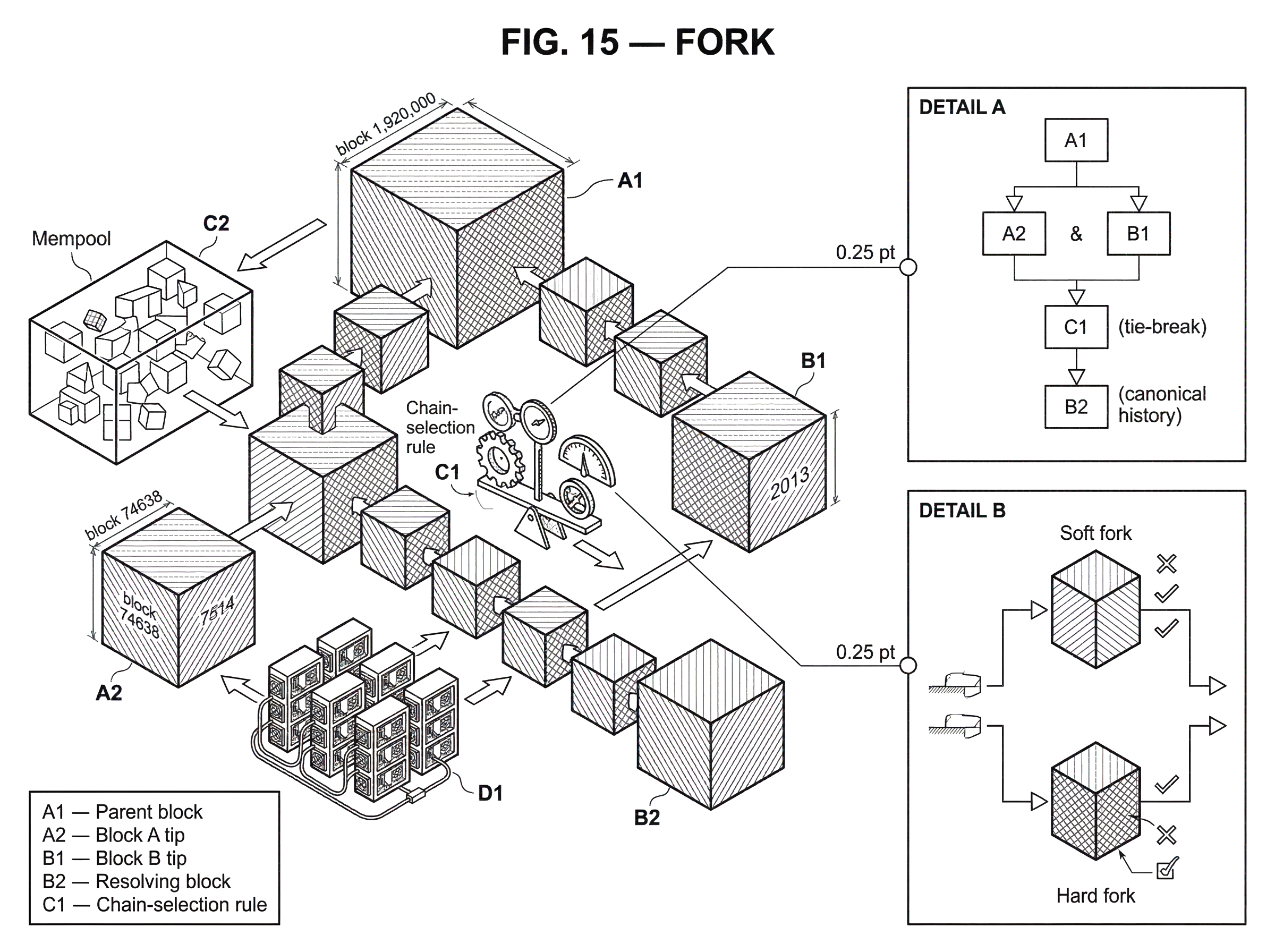
That is the simplest fork: two blocks at the same height, each extending the same parent. Bitcoin developer documentation describes this as an apparent fork. Nodes usually treat the first valid block they receive as the current tip, but they do not assume the choice is final. They keep listening for additional blocks, because the network’s chain-selection rule may later tell them to switch.
This is why block height is not a unique identifier. During a fork, multiple different blocks can have the same height. In Bitcoin, blocks are identified by their header hash, not by height, precisely because height alone does not uniquely specify a block when branches exist.
So a fork is not fundamentally “a new coin” or “a controversial upgrade.” At root, it is a branching of possible ledger histories. Sometimes the branch lasts for only a few seconds. Sometimes it becomes a permanent social and economic split.
Why do temporary forks occur on blockchains without a dispute?
The most familiar natural forks arise from network latency and probabilistic block production. In proof-of-work systems, miners search independently for a valid block. If two miners find one at roughly the same time, both blocks can be valid under the rules. The network now has two competing tips.
Here is the mechanism in plain terms. Imagine one miner in Europe finds a block and another miner in North America finds a different block seconds later, before the first block has reached everyone. Some nodes update to the European block; others update to the North American block. Transactions now begin to arrive on top of both branches. Then a later miner extends one of those branches. At that moment, the tie is broken: the branch with more accumulated work becomes the one honest nodes follow, and the other block becomes stale.
In Bitcoin, the rule is commonly described as following the chain with the most proof of work, more precisely the most cumulative work or most-difficult chain. This matters because “longest chain” is only an approximation. If difficulty changes, counting blocks alone can be misleading; what the protocol actually cares about is the total work represented by the branch.
This chain-selection rule is what turns a set of local observations into one global history. A node may temporarily prefer the first valid block it sees, but that preference is provisional. If later headers and blocks show that another branch has more cumulative work, the node reorganizes to that chain. That reorganization is how a temporary fork gets resolved.
The consequence is important for users. A transaction included in a block is not automatically permanent just because it appeared in “a block.” If that block ends up on the stale branch, the transaction may return to the mempool or disappear if it conflicts with the winning chain. This is one reason confirmations matter: more blocks built on top of a transaction make it less likely that the branch containing it will be abandoned.
Why blockchains rely on branch-selection rules instead of single-block agreement
Readers often picture consensus as universal agreement before the next block is added. Most public blockchains do not work that way. They allow temporary disagreement and rely on a deterministic rule to resolve it later.
That is the compression point for understanding forks. A blockchain does not eliminate competing histories at the moment they appear. It gives the network a way to rank them. In Bitcoin, that ranking is cumulative proof of work. In other systems, the ranking or upgrade mechanism looks different, but the principle is the same: nodes need a rule that says which history counts as canonical.
Once you see forks this way, two very different-looking phenomena become related. A short-lived PoW race between miners and a permanent split after a governance dispute are both cases where more than one candidate history exists. What differs is whether the protocol and the community still share the same branch-selection rule and the same validity rules.
That distinction leads to the two terms that dominate fork discussions: soft fork and hard fork.
How do soft forks and hard forks differ in practice?
| Type | Rule change | Compatibility | Resolution | Coordination needed |
|---|---|---|---|---|
| Soft fork | Tightens rules | Usually backward-compatible | Upgraded miners enforce | Split risk if insufficient hashpower |
| Hard fork | Loosens or alters rules | Incompatible | Nodes may accept different histories | Likely permanent without unanimous upgrade |
A temporary race between two valid blocks can happen without any rule change. But many important forks happen because the rules themselves change. Then the central question is no longer “which branch has more work?” but which blocks count as valid under which software?
A soft fork tightens the rules. Upgraded nodes reject some blocks or transactions that older nodes would still accept. Because the new rule is stricter, any block valid under the new rule is also usually valid under the old one. That is why soft forks are often called backward-compatible, though that phrase can mislead if taken too casually. Compatibility here does not mean old nodes fully understand the new system. It means they can often continue following the chain, provided upgraded miners or validators produce the chain that satisfies the tighter rules.
Bitcoin’s developer documentation makes the dependency clear: a soft fork stays unified only if upgraded participants control enough hash power to ensure the stricter-valid chain becomes the strongest chain. If they do not, older nodes may keep building on blocks that upgraded nodes reject, and the network can diverge in practice.
A hard fork loosens rules or changes them in a way that makes some blocks valid to upgraded nodes but invalid to non-upgraded nodes. Then old and new nodes no longer even agree on the set of permissible blocks. Unless everyone upgrades, the result is not just a temporary branch race. It is a lasting split in what different parts of the network regard as valid history.
This is the deepest difference. In an ordinary temporary fork, everyone agrees on the validity rules and disagrees only about which tip will win. In a hard fork, they may disagree about validity itself. Once that happens, there may be no shared path back to a single chain.
How does a temporary fork and reorganization work in Bitcoin?
Suppose two miners each produce a valid block extending the same parent. Call the parent P, and the new blocks A and B. Half the network sees A first, so those nodes treat A as the best tip. The other half sees B first and does the same. Both groups are behaving correctly.
Now a third miner finds a block C that extends A. Nodes that were already on A accept C immediately. Nodes that were on B now compare branches. The P -> A -> C branch has more cumulative work than P -> B, so they switch to the A branch. Their local chain history changes: block B is no longer on the best chain, and any transactions unique to B may need to be reconsidered.
Nothing here required politics, upgrades, or human intervention. The fork existed because distributed communication is not instantaneous. It ended because the protocol had a clear tie-break rule.
This example also shows why a fork and a reorganization are tightly connected. The fork is the branching itself. The reorganization is the process by which a node discards one branch and adopts the other as canonical.
How can software bugs cause dangerous blockchain forks?
| Cause | Mechanism | Resolution | Human action | Risk |
|---|---|---|---|---|
| Network latency | Simultaneous valid blocks | Chain selection by most work | No | Low (temporary) |
| Rule change | Incompatible client rules | Upgrade or chain split | Yes; coordination required | Medium to high |
| Client bug | Different validation outcomes | Patch plus coordinated rollback | Yes; emergency coordination | High |
| Misconfiguration | Local limits reject blocks | Patch or operator rollback | Yes; operator action | High |
Not all forks are benign races. Some happen because different nodes, or different software versions, evaluate the same block differently. Then the network is not merely waiting for more blocks to break a tie. It is split over validity.
Bitcoin’s 2013 chain fork is a good example. The root cause, documented in the BIP50 post-mortem, was not a formal consensus rule written into the protocol specification. It was an implementation dependency: older nodes using Berkeley DB had lock limits that caused them to reject large but otherwise valid blocks, while version 0.8 nodes using LevelDB could process them. That meant block validity depended on local software behavior that should never have mattered at the consensus layer.
This is a subtle but fundamental lesson. A blockchain’s consensus is only as clean as the parts of the implementation that affect state transition validity. If two clients disagree because of database behavior, integer overflow, or serialization edge cases, the network can fork even though everyone thinks they are “following the protocol.”
The 2013 incident did not resolve automatically, despite the usual most-work rule, because the newer chain had substantial mining support. Major mining pools coordinated to downgrade software so the older chain would regain majority support and become canonical. In other words, the abstract rule for selecting the best chain remained in place, but humans had to intervene to decide which software interpretation of validity the ecosystem should preserve.
The 2010 Bitcoin value overflow incident shows a different failure mode. A bug allowed a transaction in block 74638 to create an absurdly large number of bitcoins because output values overflowed when summed. A patched client was released within hours with a soft-forking change that rejected such transactions. The chain forked temporarily because many unpatched nodes kept building on the bad chain, but the good chain eventually overtook it and became authoritative.
Both incidents reveal the same principle: forks are where hidden assumptions become visible. If an implementation detail accidentally acts like a consensus rule, or if validation code is wrong, the network discovers the mistake only when histories diverge.
Are planned forks the same as scheduled protocol upgrades?
In everyday conversation, “fork” often sounds dramatic. But in several ecosystems, a fork is also the routine mechanism for improving the protocol.
Ethereum’s own documentation describes forks as changes to the rules of the protocol, often including planned technical upgrades. That framing is useful because it shifts attention from rhetoric to mechanism. A fork is simply what happens when the rule set changes at a chosen activation point.
Some Ethereum upgrades were uncontroversial enough that “network upgrade” is the more natural term, even though a fork mechanism activated them. London introduced EIP-1559’s fee-market changes. Shapella enabled staking withdrawals by coordinating execution- and consensus-layer changes. Paris, known as The Merge, switched Ethereum from proof of work to proof of stake. These were forks in the technical sense because the protocol rules changed at defined points, but the ecosystem largely treated them as scheduled upgrades rather than chain divorces.
This is a useful distinction between mechanical and social meanings. Mechanically, many upgrades are forks because clients begin applying new rules from a given block or epoch. Socially, people reserve the term “fork” for moments when adoption is disputed and a visible split may occur. Both uses are common, and confusion comes from sliding between them.
Why do contentious hard forks depend on social coordination, not just code?
The 2016 DAO fork in Ethereum is the clearest example of a fork that could not be understood by software rules alone. At block 1,920,000, a hard fork executed an irregular state change that moved DAO-related funds into a recovery contract. Most of the ecosystem adopted the new chain, and Ethereum Foundation reporting said roughly 85% of miners supported it. But adoption was not unanimous. A minority continued on the non-fork chain, which became Ethereum Classic.
This matters because both chains were internally coherent after the split. Each had users, nodes, market prices, and a story about legitimacy. The protocol could tell nodes what rules to apply after the fork point, but it could not settle the normative question of which chain ought to inherit the name, community, or moral authority of “Ethereum.”
That is where many readers over-separate governance from mechanism. In practice they are entangled. A hard fork succeeds not because code alone says so, but because exchanges, miners or validators, application developers, wallet providers, and users coordinate on one branch strongly enough to make it the economically dominant network. The minority branch can still survive if enough people continue supporting it.
Ethereum Classic’s later history also illustrates a hard truth about permanent splits in proof-of-work systems: a minority chain with less hash power may become easier to attack. Its repeated 51% reorganization attacks show that a fork does not merely clone a network. It also divides security resources, liquidity, developer attention, and infrastructure.
How do different blockchain architectures reduce fork risks during upgrades?
| Platform | Upgrade mechanism | Operator action | History continuity | Best for |
|---|---|---|---|---|
| Bitcoin | Most-work chain selection | No coordinated halt required | Preserved probabilistically | Decentralized PoW networks |
| Cosmos | x/upgrade halt-and-resume | Run new binary at height | Preserved after resume | Planned breaking migrations |
| Polkadot | On-chain Wasm runtime swap | Submit runtime extrinsic | Preserved on-chain | Governance-driven upgrades |
| Cardano | Hard fork combinator era switch | Gradual node upgrades allowed | Continuous single ledger | Era transitions with continuity |
The basic problem (changing shared rules without losing a coherent ledger) appears across blockchain designs, but the solution varies.
In Cosmos SDK chains, major breaking upgrades are commonly coordinated through the x/upgrade module. Governance schedules an upgrade plan for a specific block height. When that height is reached, the state machine stops proceeding until operators run a binary with the correct upgrade handler and any required store migrations. This is not a fork in the same style as Bitcoin’s accidental temporary branches. It is a coordinated halt-and-resume mechanism designed to prevent nodes from silently advancing under incompatible software.
The benefit is explicitness. Instead of hoping the network converges after mixed software behavior, the chain stops and demands synchronization around the new rules. The cost is operational dependence: validators and node operators must prepare binaries, migrations, and procedures correctly, or the chain can halt. Tools like Cosmovisor exist to automate binary switching, but the underlying fact remains that protocol continuity depends on coordinated operator action.
In Polkadot SDK chains, runtime logic lives on-chain as WebAssembly, and a runtime upgrade can be enacted by submitting an extrinsic that replaces the current Wasm runtime. The new runtime takes effect when included in a block. This is powerful because it avoids the blunt shape of a traditional hard fork: the chain can evolve through governance-driven code replacement without asking every node operator to manually coordinate around a visible chain split event. But the mechanism still has invariants that must hold. For example, the runtime spec_version must be bumped, or the chain will not recognize the new runtime as different.
In Cardano, the hard fork combinator was designed to make era changes look like a single continuous ledger rather than a destructive restart. The point is not that the chain never changes radically; it clearly does. The point is that protocol transitions can be composed so that history is preserved and different eras appear as parts of one ledger. That design reflects a specific judgment about what “hard fork” should mean: radical rule change does not have to imply historical discontinuity.
These systems differ in implementation, but they answer the same question: how do you change consensus-critical behavior while minimizing accidental divergence? Bitcoin leans heavily on economic majority and chain selection after probabilistic forks. Cosmos makes upgrade coordination explicit with planned halts. Polkadot pushes runtime replacement into the chain’s governance machinery. Cardano builds protocol transitions into a combinator framework that preserves one-ledger continuity.
What do users and node operators commonly misunderstand about forks?
The first common misunderstanding is that a fork is always abnormal. It is not. In some systems, especially proof-of-work chains, small temporary forks are a normal side effect of distributed block production.
The second is that a soft fork is “safe” simply because it is backward-compatible. That is only partly true. Older nodes may continue following the chain, but they can still relay or accept transactions that upgraded nodes consider invalid, and users relying on them can be misled. Bitcoin documentation explicitly warns that non-upgraded nodes can distribute incorrect information during both soft and hard fork conditions, and that lightweight clients are especially vulnerable unless they check multiple full nodes and software versions.
The third is that a hard fork is purely technical. In reality, the permanent outcome depends on coordination beyond the protocol: exchange listings, wallet support, asset tickers, staking infrastructure, bridge support, custody policy, and user belief. A branch with elegant code but weak social adoption may survive only marginally, while a branch with overwhelming coordination can inherit the main identity.
The fourth is that once a chain split happens, both sides are equally secure. Usually they are not. Security budgets, validator participation, hash power, and liquidity often redistribute unevenly. Minority chains can become fragile.
When does the term 'fork' become misleading?
The word fork is useful, but it can hide important differences if used too loosely.
It works well for branch races in Nakamoto-style chains and for protocol-rule changes that cause validity splits. It becomes less precise when applied to architectures where upgrades are enacted as on-chain code replacement, coordinated halts, or era transitions that deliberately preserve single-ledger continuity. People still use the term because the family resemblance is real: rules change, and incompatible histories are at least possible. But the operational reality can be very different.
It is also easy to overstate the neatness of canonical chain selection. “Follow the most-work chain” sounds crisp, yet real incidents show that client bugs, hidden dependencies, and human coordination can override what would otherwise happen automatically. In other words, the protocol’s fork-resolution rule is fundamental, but the software implementing it and the humans operating that software are part of the actual system.
Conclusion
A fork is what happens when a blockchain has more than one plausible continuation of history. Sometimes that comes from ordinary timing: two valid blocks appear at once, and the network later converges on the branch with more accumulated weight. Sometimes it comes from changing the rules: upgraded and non-upgraded nodes no longer agree on what counts as valid. And sometimes it comes from bugs, where software differences accidentally become consensus differences.
The memorable version is this: a blockchain is not just a chain of blocks; it is a process for choosing one history when multiple histories compete. A fork is the moment that competition becomes visible.
What should you understand before using this part of crypto infrastructure?
Understand how forks affect transaction finality, asset availability, and which chain a deposit will land on before you trade or transfer. On Cube Exchange, you can fund your account and execute trades or withdrawals while following simple checks to reduce the risk that a fork or upgrade disrupts your funds or order. Follow these concrete steps to prepare and act safely on Cube.
- Check official channels and block explorers for fork or upgrade announcements and any recommended confirmation thresholds.
- Verify on Cube whether the asset and network you plan to use are supported during or after the fork and note how Cube will label or handle split chains.
- Fund your Cube account (fiat on-ramp or crypto transfer) and wait for the recommended confirmations (e.g., 6+ for Bitcoin) before trading or withdrawing.
- Open the market on Cube and execute the trade. Use a limit order for price control or a market order for immediate execution, and review fees and withdrawal options before submitting.
Frequently Asked Questions
Temporary forks occur when valid blocks are produced concurrently; nodes resolve them by following the chain-selection rule (in Bitcoin-family PoW this is cumulative proof-of-work), so once one branch accumulates more work most nodes reorganize to that branch and the other blocks become stale.
A soft fork tightens rules so upgraded nodes reject some previously accepted blocks while remaining backward-compatible in practice, whereas a hard fork loosens or changes rules so upgraded and non-upgraded nodes disagree on validity; soft forks can still cause divergence if upgraded parties (e.g., miners) do not control enough economic power to make the stricter-valid chain the canonical one.
Yes - implementation or configuration differences can make the same block valid on some nodes and invalid on others (for example, Bitcoin’s 2013 Berkeley DB lock-limit incident and the 2010 value‑overflow bug), and such bugs can force operators and miners to coordinate human interventions to restore a single canonical history.
Different platforms use different upgrade patterns to reduce accidental splits: Cosmos schedules an on‑chain upgrade Plan that halts progress until operators run the correct binary (often automated with Cosmovisor), Polkadot upgrades the on‑chain Wasm runtime (requiring a spec_version bump) so logic changes via governance, and Cardano’s hard fork combinator composes era transitions to preserve a single ledger across radical rule changes.
A hard fork becomes a lasting split when the community and infrastructure fail to coordinate on one branch - adoption by miners/validators, exchanges, wallets, and users determines which branch is economically dominant; the 2016 DAO hard fork produced Ethereum (majority chain) and Ethereum Classic (minority chain) precisely because social coordination did not unify everyone.
Because a transaction in a block on a branch that later becomes stale may be dropped or need to be re‑included, more confirmations (additional blocks built on top) make it increasingly unlikely the branch containing the transaction will be abandoned.
Planned upgrades impose operational requirements: operators must run the correct binary and perform any required store migrations at the activation point, and while tools like Cosmovisor can automate switching, auto‑download or misconfigured migrations can cause the node to stop and risk halting the chain.
No - after a split security and economic resources often concentrate unevenly, so minority chains tend to have lower hash/validator power, reduced liquidity and developer support, and can be more vulnerable to attacks (for example, Ethereum Classic experienced repeated 51% reorganization attacks after the split).
Related reading