What is Raydium?
Learn what Raydium is, how its Solana DEX works, how CLMM and CPMM pools differ, and why traders, LPs, and token launches use it.
Introduction
Raydium is a decentralized exchange on Solana built for token swaps, liquidity provision, and token launches. That description is simple, but it hides the reason Raydium matters: on Solana, a DEX is often not just a place you visit to trade. It is shared market infrastructure that wallets, aggregators, token teams, and other apps plug into.
That is the right way to understand Raydium. It is a set of on-chain market mechanisms and routing tools that let three things happen without a central operator holding custody: traders can swap tokens, liquidity providers can put capital to work, and new token projects can create markets from day one. Because Raydium is permissionless, anyone can create pools, launch tokens, or add incentives. That openness is powerful, but it also means users have to judge asset quality for themselves.
The central problem Raydium solves is a familiar one in crypto markets: buyers and sellers rarely arrive at the same moment, in the same size, at the same price. Raydium bridges that gap with automated market makers, or AMMs. Instead of waiting for a counterparty, a trader interacts with a pool of assets whose pricing adjusts automatically as trades change the pool balance.
How does Raydium price trades and use liquidity pools (x * y = k)?
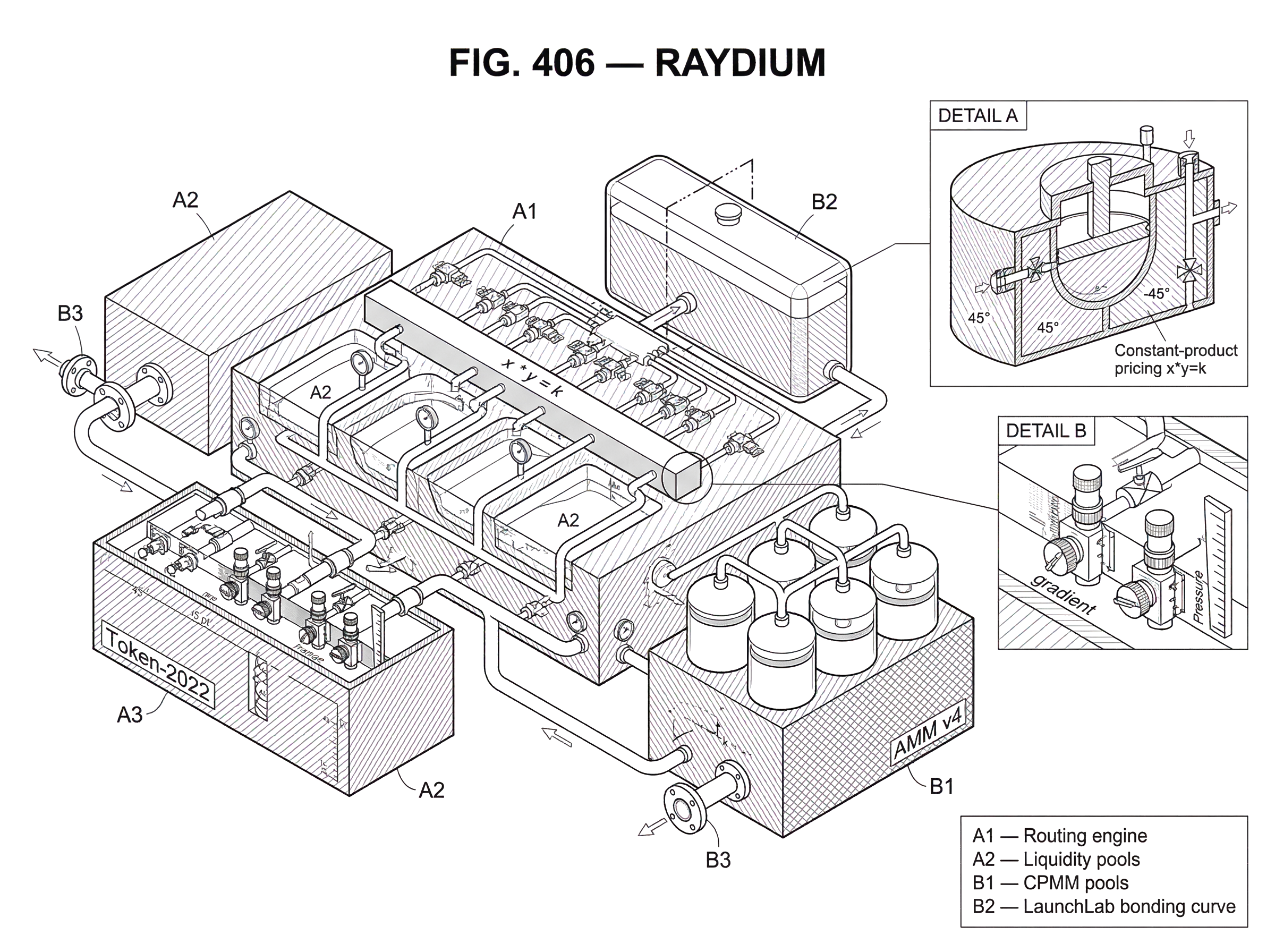
At the center of Raydium are liquidity pools. A pool holds two assets, and the protocol uses a pricing rule to quote trades against those reserves. For Raydium’s constant-product pools, the rule is the classic x * y = k, where x and y are the pool’s token reserves and k is the invariant the pool tries to preserve. The intuition is straightforward: if a trader removes some of one token from the pool, they must add enough of the other token that the product stays in line. That mechanism is what moves the price.
Here is the consequence that matters to users. You do not negotiate with another trader directly. You accept the pool’s current price, plus any slippage caused by the size of your trade relative to the pool depth. Deep pools tend to move less when you trade against them. Thin pools move more. So Raydium’s usefulness depends heavily on liquidity being present where traders want it.
A simple example makes this concrete. Imagine a SOL-USDC pool. A trader wants to buy SOL using USDC. The trade adds USDC to the pool and removes SOL from it. Because the pool now has relatively more USDC and less SOL than before, the next unit of SOL becomes more expensive. Nothing about this requires an order book on the other side of the trade. The pool itself is the immediate counterparty, and the price update is just the mechanism responding to the changed reserve ratio.
That basic structure makes Raydium attractive to ordinary swappers because the user experience is simple: connect a wallet, choose tokens, review the quoted route and slippage, and submit the transaction. But the same structure also makes Raydium useful to builders, because the protocol exposes routing and developer tooling through an app, APIs, SDKs, and open-source repositories.
Why does Raydium offer CPMM, CLMM, and different pool designs?
| Pool model | Capital efficiency | Management | Best for | Main risk |
|---|---|---|---|---|
| CPMM (constant product) | Full-range lower efficiency | Low | New or volatile tokens | Higher slippage for large trades |
| CLMM (concentrated) | High efficiency in range | Active monitoring required | Stable pairs or targeted depth | Range-exit impermanent loss |
| AMM v4 (legacy) | Moderate efficiency legacy | Low | Older integrations and pools | Legacy order-book assumptions |
The interesting part of Raydium is not merely that it has pools. It is that it offers different pool designs because liquidity providers do not all want the same trade-off between simplicity and efficiency.
Raydium’s current constant-product standard is CPMM. This is the passive model: liquidity is spread across the full price curve automatically, so providers do not need to choose a range. That makes CPMM the easier default for new markets, volatile assets, and users who want exposure without managing a position actively. Raydium describes CPMM as the standard choice for new pool creation, and it supports Solana-specific tooling such as Anchor and Token-2022.
Raydium also has CLMM, its concentrated liquidity model. The idea here is to stop wasting capital on prices where trades are unlikely to happen. Instead of supplying liquidity across all possible prices, the provider chooses a range where they expect trading to occur. If market price stays inside that range, the position is more capital efficient: the same amount of deposited value can create tighter depth around the current price and potentially earn more fees per dollar deployed.
But that efficiency comes from a stricter condition. A CLMM position only works as intended while price remains in range. If price moves outside the selected band, the position stops earning swap fees until the provider adjusts it or price returns. This is why concentrated liquidity is better suited to stable pairs, established assets, or providers willing to monitor positions. It is not “free yield from better math.” It is a more targeted way to deploy capital, with more management burden and potentially sharper impermanent loss dynamics inside the chosen range.
Raydium still also has AMM v4, a legacy constant-product program. Historically, Raydium’s v4 pools had hybrid behavior tied to central limit order books such as Serum and later OpenBook. That history matters because many people still associate Raydium with order-book sharing. But current documentation is clear that v4 pools today should be understood as traditional AMMs, not as automatically sharing idle liquidity with an order book in the old way.
What happens to my tokens when I provide liquidity on Raydium?
If you provide liquidity on Raydium, you are not simply depositing tokens and collecting a generic return. You are making a market. Your capital sits in a pool so traders can swap against it, and the fees those traders pay are the revenue source for your position.
That is why the key risk is structural, not incidental. When the relative price of the two assets changes, the pool rebalances your holdings mechanically. You usually end up with more of the asset that fell in relative price and less of the asset that rose. Compared with simply holding both tokens outside the pool, this can leave you worse off. That gap is called impermanent loss, and it becomes real when you withdraw. In concentrated liquidity, the same basic force exists, but it can be more pronounced because your capital is focused into a narrower active zone.
Seen from first principles, fees and impermanent loss are two sides of the same system. Fees exist because traders are changing the composition of the pool. Impermanent loss exists for the same reason. So providing liquidity on Raydium makes sense when you believe trading fees, incentives, or strategic exposure outweigh that rebalancing cost.
Raydium extends this with permissionless farms, which let token incentives be attached to pools, and Burn & Earn, which is designed for liquidity that is meant to remain permanently locked while still accruing fees. These tools are useful mainly because they change the incentives around liquidity, not because they alter the underlying AMM mechanics.
How does Raydium’s LaunchLab take a token from sale to tradable liquidity?
Raydium is also used by token creators through LaunchLab, its token launch platform built around bonding curves. A bonding curve is a pricing mechanism where the token price changes according to a formula as more tokens are bought. The point is to let a market form before a standard AMM pool is live.
The useful part is what happens next. When a launch reaches its target, the token “graduates,” and liquidity is automatically migrated into a Raydium pool. Raydium says the LP is burned in that process, which is meant to make the resulting liquidity structure more durable rather than dependent on a creator later withdrawing it.
This helps explain who Raydium is for without forcing a separate category. Traders use it because they want broad Solana token access and routed swaps. Liquidity providers use it because they can choose between passive full-range exposure and more active concentrated strategies. Token teams use it because Raydium gives them a path from launch to tradable liquidity without needing a centralized listing process.
How does Raydium routing and integrations find efficient swap paths?
| Integration | Primary use | Visibility | Effort | Notable constraint |
|---|---|---|---|---|
| App UI | End-user swaps and routing | High user-facing visibility | Minimal | Asset quality varies |
| API / SDK | Programmatic routing and swaps | Public endpoints and libs | Moderate | Legacy docs and versioning |
| Open-source repos / IDs | Deep protocol integration | Full source and IDs | High | Verify program IDs before use |
Raydium is not only an app interface. It also operates as routing infrastructure. Its routing engine can search across Raydium pools to find an efficient swap path, and that functionality is exposed through the app, API, and SDK. This matters because modern on-chain trading is often fragmented across many pools and fee tiers. A “swap” is frequently a path through liquidity, not a single direct exchange.
For developers, Raydium is unusually legible compared with many black-box trading venues. It has public code repositories for AMMs, CLMM, SDKs, and UI components. Its integration tooling includes published program IDs and client libraries. That does not remove Smart-contract or integration risk, but it does mean developers can inspect how the pieces fit together and build directly on top of them.
There are practical constraints. Some developer tooling reflects changing generations of the protocol, including archived SDK material and legacy program versions. And because Raydium is permissionless, integration quality is not the same as asset quality. A well-integrated pool can still contain a bad token. The openness that makes Raydium composable also means users must verify what they are trading.
What are the main risks when using Raydium (trading and providing liquidity)?
| Risk | How it arises | Impact | Mitigation |
|---|---|---|---|
| Permissionless pools | Anyone can create pools | Scam tokens and low liquidity | Verify token and liquidity |
| Liquidity provision | Automated pool rebalancing | Impermanent loss on withdrawal | Use fees/incentives or monitor |
| Smart-contract or admin risk | Compromised privileged keys | Large fund theft or exploit | Prefer audits and key hygiene |
Raydium’s design gives users direct access to markets, but it does not remove the usual risks of decentralized trading. Permissionless pool creation means scam tokens, spoofed assets, or low-liquidity markets can appear alongside legitimate ones. Liquidity provision introduces impermanent loss and strategy risk. Smart-contract systems also carry operational and security risk, and Raydium has previously experienced a serious exploit linked to compromised privileged access, after which the protocol reported changes to remove the exploited admin controls.
The important distinction is that these are not side issues separate from how Raydium works. They arise from the same properties that make it useful: open access, composability, on-chain execution, and programmable liquidity.
Conclusion
Raydium is best understood as Solana liquidity infrastructure: a decentralized exchange where swaps, liquidity provision, and token launches all meet around shared on-chain pools. Its core idea is simple (use programmable liquidity instead of matching individual counterparties) but the product becomes powerful because it offers different ways to deploy that liquidity, from passive constant-product pools to actively managed concentrated positions.
If you remember one thing, remember this: Raydium is not just a place to trade tokens. It is a system for creating and routing liquidity on Solana, which is why traders, LPs, builders, and token issuers all end up using the same underlying rails.
How do you trade through a DEX or DeFi market more effectively?
Trade through a DEX more effectively by checking on-chain liquidity, quoted price impact, and the execution options that control slippage. On Cube Exchange, you can fund your account, inspect the quoted swap or market entry, and choose an order type that matches your need for immediacy or price control.
- Deposit fiat or a supported crypto into your Cube account using the fiat on‑ramp or a direct transfer.
- Open the swap or market/order flow for the token pair you want and compare the quoted route's estimated price impact and available pool depth (TVL) or liquidity metric.
- Choose an execution type: use a limit order to lock a target price or a market order for immediate fill; set a slippage tolerance and transaction deadline that match your risk.
- If the estimated price impact is large (for example >1% for small caps or >2% for thinner pairs), reduce the size, split into multiple orders, or use a tighter limit; then review fees and submit.
Frequently Asked Questions
Concentrated Liquidity (CLMM) concentrates your capital into a chosen price band so the same deposited value provides tighter depth and can earn more fees per dollar while price stays inside that band; the trade-off is that if price moves outside your selected range the position stops earning fees and can experience larger impermanent-loss-like effects until you adjust it.
Raydium’s LaunchLab uses bonding-curve mechanics to form a market during a token sale, and when a launch reaches its target the token “graduates” and liquidity is automatically migrated into a Raydium pool with the LP burned to make the resulting liquidity more durable.
No - while Raydium’s AMM v4 historically had hybrid behavior tied to Serum/OpenBook order books, current documentation and the article say v4 pools are now to be understood as traditional AMMs rather than automatically sharing idle liquidity with an order book.
Key risks are the permissionless nature (which allows scam or low-liquidity tokens), liquidity-provider risks like impermanent loss and strategy risk, and smart-contract/operational risk; Raydium has previously suffered a significant exploit tied to compromised privileged access, so past incidents and on‑chain composability create real safety considerations.
Some Raydium developer artifacts and SDK repositories in the public record have been archived or show snapshot metadata issues, and program IDs or SDK versions listed in those repos are not guaranteed to be a canonical, up‑to‑date source - integrators should verify program IDs and endpoints from an authoritative Raydium source before going to production.
Impermanent loss happens because the AMM mechanically rebalances a pool’s token composition as prices change, leaving an LP with more of the depreciated token and less of the appreciated token compared with simply holding both assets; fees offset that rebalancing but do not eliminate the effect.
Practical integration caveats include that some tooling expects SOL to be wrapped as WSOL manually and that certain Raydium repositories specify older Solana/Anchor dependency constraints, so developers must handle WSOL conversion and pay attention to the repo’s stated environment/dependency requirements.
Related reading