What Is a Stablecoin? How Stablecoins Work, Keep a Peg, and Break
Learn what a stablecoin is, how stablecoins keep a peg, the mechanics behind USDC, USDT, DAI, and where stablecoin designs can fail.
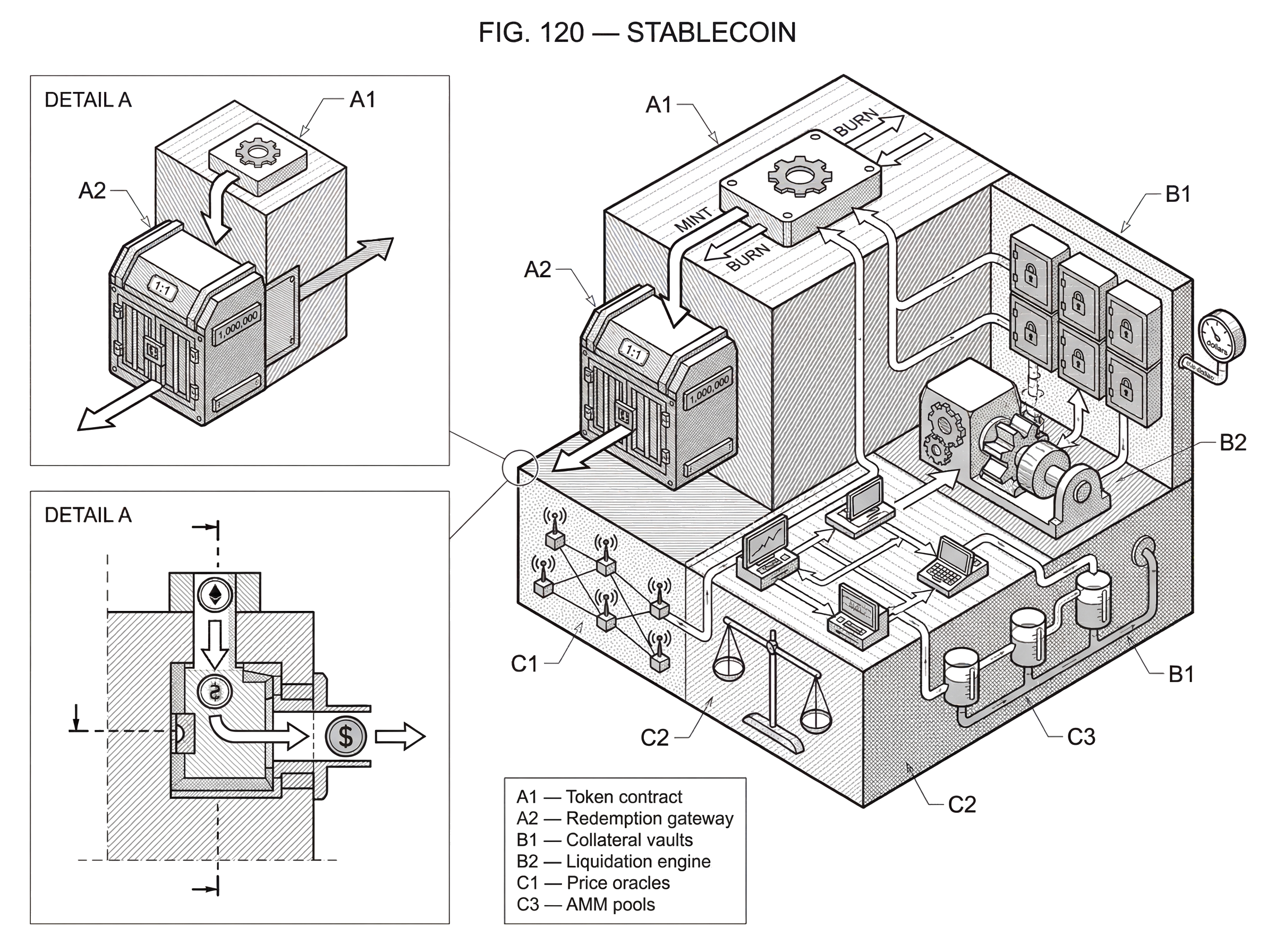
Introduction
Stablecoin is the name for a token designed to stay close to a reference value, usually a fiat currency such as the U.S. dollar. That sounds almost trivial until you notice the tension inside it: blockchains are good at moving digital assets without centralized ledgers, but most native cryptoassets swing in price too much to function as ordinary money. Stablecoins exist to solve that mismatch. They try to give users something that behaves more like cash while remaining usable inside wallets, exchanges, smart contracts, and cross-border payment flows.
The key idea is simple: a stablecoin is not trying to be an asset whose price discovers itself freely in the market. It is trying to anchor itself to something else. Once you see that, most of the design questions become clear. What is the anchor? What mechanism pulls the token back when its market price drifts? Who can create or destroy supply? And what assumptions must be true for users to believe the peg will hold tomorrow, not just today?
That is why “stablecoin” is a category, not a single mechanism. Some stablecoins are issued against off-chain reserves and promise redemption at 1:1 for dollars or euros. Some are created on-chain by locking more volatile crypto collateral in vaults and borrowing stablecoins against it. Some try to maintain stability mostly through market incentives and supply adjustments rather than strong collateral backing. Those designs can all produce a token that looks similar in a wallet, but they do not create trust in the same way, and they do not fail in the same way.
How do stablecoins maintain their peg?
| Mechanism | How it works | Primary actors | Peg speed | Main weakness |
|---|---|---|---|---|
| Fiat redeemability | Redeem token for fiat 1:1 | Issuer, market‑makers | Fast if accessible | Banking and custody risk |
| Mint & arbitrage | Create supply at peg to sell | Issuer, traders | Fast with deep issuance | Issuer discipline required |
| Overcollateralization | Mint against volatile crypto collateral | Vaults, liquidators, oracles | Variable; needs liquidations | Oracle or liquidation failure |
| Algorithmic incentives | Supply or incentive adjustments | Traders, speculators | Slow or fragile | Confidence‑dependent collapse |
A stablecoin is stable only if there is a credible way for price deviations to be corrected. The mechanism matters more than the label. If a token trades at 0.97 dollars and there is a reliable way to buy it cheaply and redeem it for 1.00 dollar of value, arbitrage pushes the price back up. If it trades at 1.03 and authorized participants can create new units at roughly 1.00, sell them, and capture the spread, that extra supply pushes the price back down. In both directions, stability comes from a convertibility path between the token and its backing or issuance mechanism.
This is the compression point for understanding stablecoins: the peg is not a property of the token by itself; it is a property of the redemption and issuance system around the token. A token contract can keep balances and transfers. It cannot, by itself, guarantee that a market will value one token at one dollar. That guarantee depends on reserves, collateral rules, liquidations, governance, market makers, arbitrageurs, and the practical ability to move between token and backing asset.
This also explains why “stable” never means “risk-free.” Stability is always conditional. A fiat-backed token depends on reserve sufficiency, custody, and redemption operations. A crypto-backed token depends on collateral quality, overcollateralization, price oracles, and liquidation machinery. An algorithmic design depends on market confidence in future support mechanisms. The token may look the same on-chain in all three cases, but the source of trust is completely different.
How does a token standard differ from the backing that gives a stablecoin value?
On many smart-contract chains, a stablecoin is implemented as a standard fungible token. On Ethereum, that often means an ERC-20 token with familiar methods such as balanceOf, transfer, approve, and transferFrom. That standardization matters because stablecoins are useful largely through interoperability. Wallets, exchanges, lending protocols, DEXs, and payment apps can support the token without custom integration logic for every issuer.
But ERC-20 only standardizes how the token is moved and approved on-chain. It does not say anything about what backs the token, who can mint it, how redemption works, or whether accounts can be frozen. The same separation appears on other chains through different token frameworks. On Solana, stablecoins commonly use the SPL Token program, where a mint defines supply and token accounts hold balances. Supply is controlled by mint authorities, and the program also supports features such as multisig authorities and optional freeze authority. In Cosmos-based systems, stablecoin-like assets may be represented through the chain’s native bank module, where total supply is tracked directly and minting or burning can be restricted to specific module accounts. In each case, there is a transport layer for balances and transfers, and then a separate policy layer that determines what the asset actually means.
That distinction is easy to miss because users mostly interact with the token surface. You open a wallet and see a balance. You swap it on a DEX. You deposit it into a lending market or a vault. But if you are asking whether the stablecoin is sound, the token interface is not the main question. The deeper question is: what process created these units, and what process destroys them at par?
A concrete example helps. Suppose a company issues a dollar stablecoin on Ethereum as an ERC-20 token. When an approved customer wires 1,000,000 dollars to the issuer, the issuer mints 1,000,000 tokens to that customer’s blockchain address. Later, when the customer redeems, the customer sends 1,000,000 tokens back, the issuer burns those tokens, and wires back 1,000,000 dollars. The token contract records balances and emits standard Transfer events, but the peg comes from the off-chain promise that minting and burning correspond to actual dollars moving in and out of reserve accounts. Without that off-chain convertibility, the ERC-20 contract would just be a ledger entry with a name.
How do fiat‑backed stablecoins use redemption to keep a peg?
| Issuer | Redemption access | Reserve disclosure | Operational controls | Primary risk |
|---|---|---|---|---|
| USDC (Circle) | Direct redeem via Circle Mint (institutions) | Weekly disclosures; monthly assurance | Address blocklisting; freeze powers | Banking or custody disruption |
| USDT (Tether) | Secondary market widely used | Circulation published; reserve composition contested | Multi‑chain issuance, daily metrics | Reserve quality and disclosure concerns |
| BUSD (Paxos) | Redemption allowed; new minting halted | Monthly attestations historically published | Product winding down; conversion paths | Operational wind‑down and reporting changes |
The most intuitive stablecoin design is the fiat-backed model. Here, each token is meant to correspond to a claim on reserve assets held off-chain. The reason this model tends to be easiest to understand is that its stabilization mechanism resembles a money-market instrument more than a purely crypto-native asset. If the token can reliably be redeemed 1:1 for fiat, then market participants have a strong reason to buy below peg and sell above peg.
USDC is a clear example of the model as described by its issuer. Circle states that USDC is redeemable 1:1 for U.S. dollars and says reserves are held separately from operating funds for the benefit of stablecoin holders. Circle also publishes reserve disclosures and monthly third-party assurance reports stating that reserves exceed USDC in circulation. Mechanically, that matters because a fiat-backed stablecoin is only as credible as the path from token back to fiat. Redemption is not a side feature; it is the central stabilizer.
There is an important practical nuance, though. Not every holder usually has direct access to minting and redemption. Circle’s terms distinguish between customers with a Circle Mint account, who can redeem directly, and holders in the secondary market, who cannot redeem until they onboard. That means market price support often works through institutions and market makers rather than every wallet holder individually. The peg can still be strong if the redemption channel is deep and reliable, but accessibility to that channel affects how quickly arbitrage closes deviations.
This is also where stablecoin trust becomes operational rather than purely mathematical. The relevant questions are not just whether reserves exist in aggregate, but whether they are liquid, segregated, and available under stress; whether attestations are frequent and meaningful; whether issuance and redemption continue during market volatility; and whether the issuer can freeze or block specific addresses. Circle’s USDC terms explicitly state that on-chain transfers are irreversible, that the issuer may block certain addresses, and that activities may be suspended in some circumstances such as forks or security issues. Those powers do not make the token nonfunctional, but they do mean the asset carries issuer and policy risk alongside peg mechanics.
Tether illustrates why these details matter. Tether states that its tokens are pegged 1-to-1 with matching fiat currencies and backed by reserves, and it publishes circulation data. But reserve quality and disclosure have long been central points of scrutiny. The New York Attorney General’s settlement with iFinex and Tether documented that Tether changed its public description from every token being backed 1:1 by U.S. dollars to being backed by broader “reserves,” including cash equivalents, other assets, and receivables. The settlement also described periods in which backing and public disclosures were materially contested. The lesson is not merely historical. It shows the exact place where fiat-backed stablecoins can break: not at the token transfer layer, but at the reserve, custody, and disclosure layer that gives the token meaning.
How do crypto‑backed stablecoins use overcollateralization to stay stable?
A second design keeps the backing on-chain. Instead of trusting an issuer to hold dollars in a bank or fund structure, users lock crypto collateral into smart contracts and generate stablecoins against it. Because the collateral itself is volatile, the system requires overcollateralization. If a user wants to mint 100 dollars’ worth of stablecoins, they may need to lock substantially more than 100 dollars of collateral so that normal price declines do not immediately make the system underbacked.
MakerDAO’s Dai is the canonical example. Maker describes the protocol as allowing anyone to generate Dai against crypto collateral through Vaults. The mechanism is conceptually straightforward. A user deposits approved collateral into a Vault. The protocol allows the user to mint Dai up to some limit determined by risk parameters. If collateral value falls too far, the position can be liquidated so the system can retire debt and preserve backing. The peg is supported not by an issuer redeeming tokens for bank dollars on demand, but by a managed balance between collateral value, debt limits, liquidation rules, fees, and governance.
This design changes where trust lives. You rely less on a corporate reserve manager and more on smart contracts, collateral policy, and oracle inputs. The system needs accurate prices, because liquidation decisions depend on knowing whether collateral still safely exceeds issued stablecoins. It needs liquidation infrastructure, because overcollateralization only protects the peg if unsafe positions can actually be closed before losses spread. And it needs governance, because accepted collateral types and risk parameters are not timeless truths; they are choices that affect solvency.
Maker’s documentation makes this explicit. Multi-Collateral Dai allows different Ethereum-based assets to be used as collateral if MKR governance approves them and sets corresponding risk parameters. That gives the system flexibility, but also means peg robustness depends on ongoing human governance. Even in a highly automated design, stability is not automatic. It is produced by a set of maintained rules.
A worked example makes the mechanism clearer. Imagine a user locks 150 dollars of approved crypto collateral into a vault and mints 100 Dai. At that moment, the system has a cushion: even if collateral drops somewhat, the vault is still overcollateralized. If Dai trades slightly above a dollar, users are incentivized to mint more Dai against collateral and sell it, increasing supply. If collateral prices fall sharply and a vault approaches its minimum collateral ratio, the protocol can liquidate the collateral to cover the outstanding Dai debt. The peg survives not because each Dai is redeemable for a bank dollar, but because each unit of Dai is embedded in a debt system whose solvency is defended by collateral buffers and liquidation.
That said, crypto-backed does not mean immune to instability. If collateral crashes faster than liquidations can clear, or if oracle prices fail, or if governance chooses poor collateral, the backing can weaken. The failure modes are different from fiat-backed stablecoins, but they are real.
Why do algorithmic stablecoins rely on market confidence, and how can that fail?
The most controversial design is the algorithmic stablecoin, where strong collateral backing is reduced or absent and stability depends heavily on market incentives, reflexive expectations, and supply-adjustment mechanisms. These systems often present themselves as more capital-efficient because they do not require each stablecoin to be matched by a full dollar of reserves or heavy overcollateralization. But that efficiency usually comes by replacing hard backing with softer assumptions about market behavior.
The central weakness is easy to state from first principles. If a stablecoin falls below peg, some actor must have a reason to buy it and support its price. In a collateralized system, that reason comes from a redemption path into reserves or collateral. In a lightly collateralized or uncollateralized algorithmic system, the reason often comes from the belief that another token, future seigniorage, or future demand will make support profitable. That can work in calm conditions. Under stress, it can become circular: the system is stable if markets believe it is stable.
The TerraUSD collapse is the clearest demonstration of what breaks when this assumption fails. Nansen’s on-chain analysis of the UST de-peg argues that the event was not a single-attacker story but a multi-actor exploitation of visible fragilities, especially shallow stablecoin liquidity on Curve and large flows from Anchor through Wormhole into Ethereum, followed by swaps and exchange arbitrage. The important conceptual point is not the exact timeline, but the mechanism of failure. Once enough holders tried to exit at the same time, the system needed deep confidence and deep liquidity to absorb redemptions. It did not have both. The peg was not defended by robust reserve redemption in the way a fiat-backed token is, nor by clear overcollateralization and liquidation buffers in the way Dai is. Confidence itself had become part of the backing.
That is why algorithmic stablecoins should not be treated as simply another cosmetic variant. They are a different risk category. They may look like dollars on a screen, but their path back to a dollar-equivalent asset can be much weaker.
What are stablecoins used for in crypto markets?
Stablecoins became important because blockchains needed a unit that could serve as working capital. Traders use them as quote assets and collateral. Payment companies use them to move dollar-like balances continuously across time zones. DeFi protocols use them as the base assets for lending, borrowing, margining, and liquidity pools. Treasury managers often use them as the on-chain cash leg of their operations. Their value is not only that they are less volatile than other cryptoassets, but that they are programmable and interoperable in places where bank dollars are hard to move directly.
This is why standard token compatibility matters so much. An ERC-20 stablecoin can plug into wallets, DEXs, lending markets, and tokenized vaults. If a yield product accepts a stablecoin as its underlying asset, an ERC-4626 vault can standardize how users deposit the stablecoin and receive shares in return. The stablecoin remains the relatively steady unit; the vault share becomes the yield-bearing wrapper around it. That layering matters because many users no longer hold only “plain stablecoins.” They hold wrapped, deposited, lent, or LP-position versions of them.
Stablecoins also matter because they improve market structure. Curve’s StableSwap design exists specifically because stablecoins need low-slippage trading against other similarly pegged assets. The StableSwap invariant interpolates between constant-sum and constant-product behavior so swaps near balance have much lower slippage than generic AMMs. That is not a side detail. If stablecoins are to function as near-cash instruments on-chain, then converting between them must usually be cheap and predictable. Liquidity design is part of peg quality.
What are the main risks and failure modes of stablecoins?
| Risk type | What it is | Typical cause | Example mitigation | Affects designs |
|---|---|---|---|---|
| Peg risk | Market price deviates from target | Shallow liquidity or sudden flows | Deep redeem/mint channels; market‑makers | All designs |
| Reserve/collateral risk | Backing becomes insufficient or illiquid | Poor asset quality or concentration | Transparent attestations; liquid reserves | Fiat‑backed and crypto‑backed |
| Issuer risk | Operator exercise or failure | Freezes, insolvency, regulatory action | Clear policies; custody separation | Fiat‑backed central issuers |
| Oracle risk | Bad price feeds trigger wrong actions | Manipulation or staleness | Robust aggregation; staleness checks | Crypto‑backed systems |
| Integration risk | Assumptions break in composable apps | Token semantics or API mismatches | Standards, careful integrations, audits | Ecosystem users and protocols |
The word “stablecoin” can obscure the fact that these assets concentrate several different risks into one object. There is peg risk, where market price deviates from the target. There is reserve or collateral risk, where backing is insufficient or illiquid. There is issuer risk, where a centralized operator fails operationally or exercises discretionary powers such as freezing addresses. There is oracle risk in crypto-backed systems, where bad pricing data can trigger or prevent liquidations incorrectly. And there is integration risk, where protocols assume too much about token behavior.
That last category is more technical but still important. On Ethereum, many stablecoins use ERC-20, which means integrations often rely on approve and transferFrom for contract-based spending. The ERC-20 standard warns about known allowance race issues and requires callers to handle boolean return values correctly. These details sound small, but stablecoins are so widely used that implementation mismatches can propagate through the ecosystem. A “safe asset” at the economic layer can still create failures through poor token integration.
Cross-chain deployment adds another layer. A stablecoin issued on Ethereum as an ERC-20 may exist on Solana through SPL Token semantics, or on Cosmos-like systems through native banking modules or ERC-20-style compatibility layers. The economic promise may be “the same dollar token,” but the operational controls differ by chain: mint authorities, freeze powers, token-account conventions, or module permissions. So even when the brand is shared, the exact trust and failure surface can vary by environment.
A reader might reasonably ask whether stablecoins are really money. The careful answer is: they are best understood as tokenized monetary claims or synthetic money-like instruments, depending on design. Some are close to digital bearer representations of redeemable fiat claims. Some are on-chain debt instruments stabilized by collateral systems. Some are more like market-structure experiments that temporarily imitate money until stress reveals their limits. Calling them all “digital dollars” is often useful in casual speech, but mechanically it hides the crucial differences.
Conclusion
A stablecoin is a token designed to stay near a reference value, usually 1 fiat unit, but its stability never comes from the token alone. It comes from the mechanism that creates and destroys supply at that reference value: reserve redemption, overcollateralized borrowing and liquidation, or weaker market incentives that may fail under pressure.
If you remember one thing, remember this: a stablecoin is only as strong as its path back to the asset it claims to represent. The wallet balance is the visible surface. The real substance is the redemption system underneath.
How do you evaluate a token before using or buying it?
Check a token’s contract rules, issuer disclosures, peg mechanics, and market liquidity before using or buying it. On Cube Exchange you can run these checks, fund your account, and execute the trade in one workflow once you confirm the token’s design and risks.
- Inspect the token contract and policy on a chain explorer (Etherscan, Solscan): confirm who can mint or burn, whether a freeze or pause authority exists, and whether supply is capped.
- Review issuer disclosures and attestations: download recent reserve/attestation reports, read the redemption terms, and note whether retail redemption is available or limited to institutional accounts.
- Measure on‑chain liquidity and slippage: check DEX pool depth and 24‑hour volume for the token pair you’ll use and estimate slippage for your intended size.
- Fund your Cube Exchange account and place the trade: deposit fiat or a supported stablecoin, open the relevant market, choose a limit order for thin liquidity or a market order for immediate execution, then review price impact and fees.
Frequently Asked Questions
Price deviations are corrected only when there is a credible convertibility path: arbitrageurs buy tokens below peg and redeem them for the anchor asset, or authorized parties mint and sell tokens when price is above peg, so supply/demand moves push the market back toward the target.
The ERC‑20 (and similar) token standards only define on‑chain transfer and approval mechanics; they do not specify what backs a token, who may mint or redeem it, or how reserves are attested, so a token contract cannot by itself guarantee a dollar peg.
fiat‑backed stablecoins rely on off‑chain reserves and a redemption promise (so issuer/custody and reserve liquidity matter), while crypto‑backed stablecoins keep collateral on‑chain and depend on overcollateralization, price oracles, liquidation mechanics, and governance - each design trades issuer/custody risk for oracle/liquidation/governance risk.
Algorithmic stablecoins depend heavily on market confidence and incentive mechanisms rather than strong collateral; when confidence, liquidity, or incentives fail (as in the TerraUSD de‑peg), the system can unravel because there is no robust redemption or collateral buffer to absorb mass exits.
Accessibility matters because not all holders may redeem directly; if only institutional customers can access a mint/redemption channel, price support will rely on those institutions and market makers, which can slow or weaken arbitrage closure compared with universal direct redemption.
Overcollateralization creates a buffer so vaults remain solvent despite normal price moves, and liquidation of undercollateralized positions retires debt to preserve backing; however this protection can fail if collateral falls faster than liquidations execute, or if oracles and liquidation infrastructure malfunction.
Token standards across chains (ERC‑20 on Ethereum, SPL on Solana, Cosmos bank module, etc.) provide compatible transfer semantics but differ in policy controls - e.g., mint authorities, freeze powers, module permissions and account models - so the same branded stablecoin can behave differently and carry different trust assumptions on different chains.
StableSwap-style pools reduce slippage between similarly pegged assets by using an invariant that blends constant-sum behavior near parity with constant-product behavior away from it, making cheap predictable swaps between stablecoins an important part of on‑chain peg usability.
Related reading