What Is Liveness in Consensus?
Learn what liveness means in consensus: why progress can fail, how it differs from safety, and which assumptions let blockchains keep moving.
Introduction
Liveness is the property of a consensus system that says progress does not stop forever. In a blockchain, that usually means the chain keeps producing blocks, honest transactions do not wait indefinitely, and (where the protocol offers finality) new blocks eventually become finalized. This matters because a system can be perfectly safe in the narrow sense of never confirming conflicting histories and still be unusable if it stalls.
That contrast is the right place to start. Many readers first learn consensus through dramatic failures of safety: double spends, conflicting commits, chain splits. But in real systems, a quieter failure is often just as damaging: everyone agrees not to do the wrong thing, yet nobody can move forward. A halted exchange, a validator set stuck between rounds, a finality gadget that stops finalizing after a partition; these are liveness failures.
The basic idea sounds informal: something good eventually happens. But to understand liveness in consensus, you need to make “eventually” and “happens” precise. The key move is to think in terms of executions of a distributed system: sequences of states, messages, timeouts, votes, and local decisions. Then liveness becomes a statement not about a single instant, but about what can still happen from any finite point onward.
Formally, a property P is a liveness property if every finite partial execution can be extended to a full execution that satisfies P. That definition comes from classic distributed systems theory, and it captures the intuition exactly: no finite prefix has already made success impossible. If a property fails, you cannot point to a finite moment and say “the damage is done forever.” There is always still some continuation in which the good outcome occurs.
That may feel surprisingly weak. And it is. But that weakness is not a bug; it is what separates liveness from Safety.
Liveness vs. safety in consensus: how do they differ?
| Property | Witness | Detection | Proof method | Example |
|---|---|---|---|---|
| Safety | Finite bad prefix | Pinpoints violation quickly | Invariant / induction | Double spend |
| Liveness | No finite witness | Long stalls are ambiguous | Eventuality / well‑founded proofs | Stalled finality |
Safety and liveness divide correctness into two different shapes. A safety property says something bad never happens. A liveness property says something good eventually happens. The difference is not just wording. It changes what counts as evidence.
If safety is violated, there is a finite witness. A blockchain that finalized two conflicting blocks at the same height has already failed, and some finite prefix of execution contains the proof of that failure. This is why safety arguments often center on invariants: once broken, the violation is permanent and detectable.
Liveness is the opposite. If a chain has not finalized a block yet, that does not show liveness has failed. Maybe the needed messages are delayed. Maybe a new round will elect a responsive leader. Maybe timeout growth will eventually outrun the network delay. A liveness failure is therefore much harder to certify from a finite observation. You can observe a long stall, but unless your specification includes a time bound, you usually cannot say from finite evidence alone that progress is impossible forever.
This is the deepest conceptual point: safety excludes bad prefixes; liveness excludes hopelessness. A liveness property says no finite history is irredeemable. However messy the run has been so far, there remains some continuation that reaches the promised good state.
A classical result makes this relationship exact. In the natural topology where executions are grouped by shared finite prefixes, safety properties are the closed sets and liveness properties are the dense sets. You do not need topology to use liveness in practice, but the picture is helpful. Safety is about what is ruled out by finite observations. Liveness is about the fact that every basic “neighborhood” of partial runs still contains some successful continuation.
There is an equally important consequence: every property can be decomposed into a safety part and a liveness part. In other words, arbitrary correctness conditions can be written as the intersection of “nothing bad ever happens” and “something good eventually happens.” That is why consensus papers and protocol proofs so often separate their claims this way. It is not a stylistic convention. It reflects a real structural split in what must be shown.
What does liveness mean for blockchain users and validators?
In a blockchain, “progress” can refer to several related outcomes, and it helps to keep them separate.
At the most basic level, liveness means the protocol does not deadlock: validators continue to exchange messages and the protocol keeps advancing through rounds, views, or slots until a block is produced. In a longest-chain protocol, that may mean the chain keeps growing. In a BFT-finality protocol, it may mean the network eventually commits or finalizes a new block.
At the user level, liveness is often phrased as a transaction property: if an honest user submits a valid transaction to honest participants, the transaction is eventually included in the chain. Some protocol analyses make this more specific by proving chain growth and then using it to derive transaction inclusion under assumptions about mempool dissemination and proposer behavior.
These are related, but not identical. A system can keep producing empty blocks and still be “live” in a narrow protocol sense while being weak from the user’s point of view. Conversely, a chain can keep extending while a finality layer stalls, so block production remains live but economic finality does not. The practical meaning of liveness therefore depends on the layer you are talking about.
That is why modern consensus research often emphasizes that liveness claims are only meaningful together with their assumptions and their exact assertion. “The protocol is live” is incomplete. Live in what sense? Producing blocks? Finalizing checkpoints? Including all honest transactions? Recovering after leader failure? Doing so eventually, or within a bounded time?
Why do timeout growth strategies restore liveness in BFT protocols?
Consider a round-based BFT protocol with a designated proposer in each round. Validators wait for a proposal, then exchange votes, then commit if a quorum forms. If the proposer is faulty or the network is slow, the round may fail and the protocol moves to a higher round with a larger timeout.
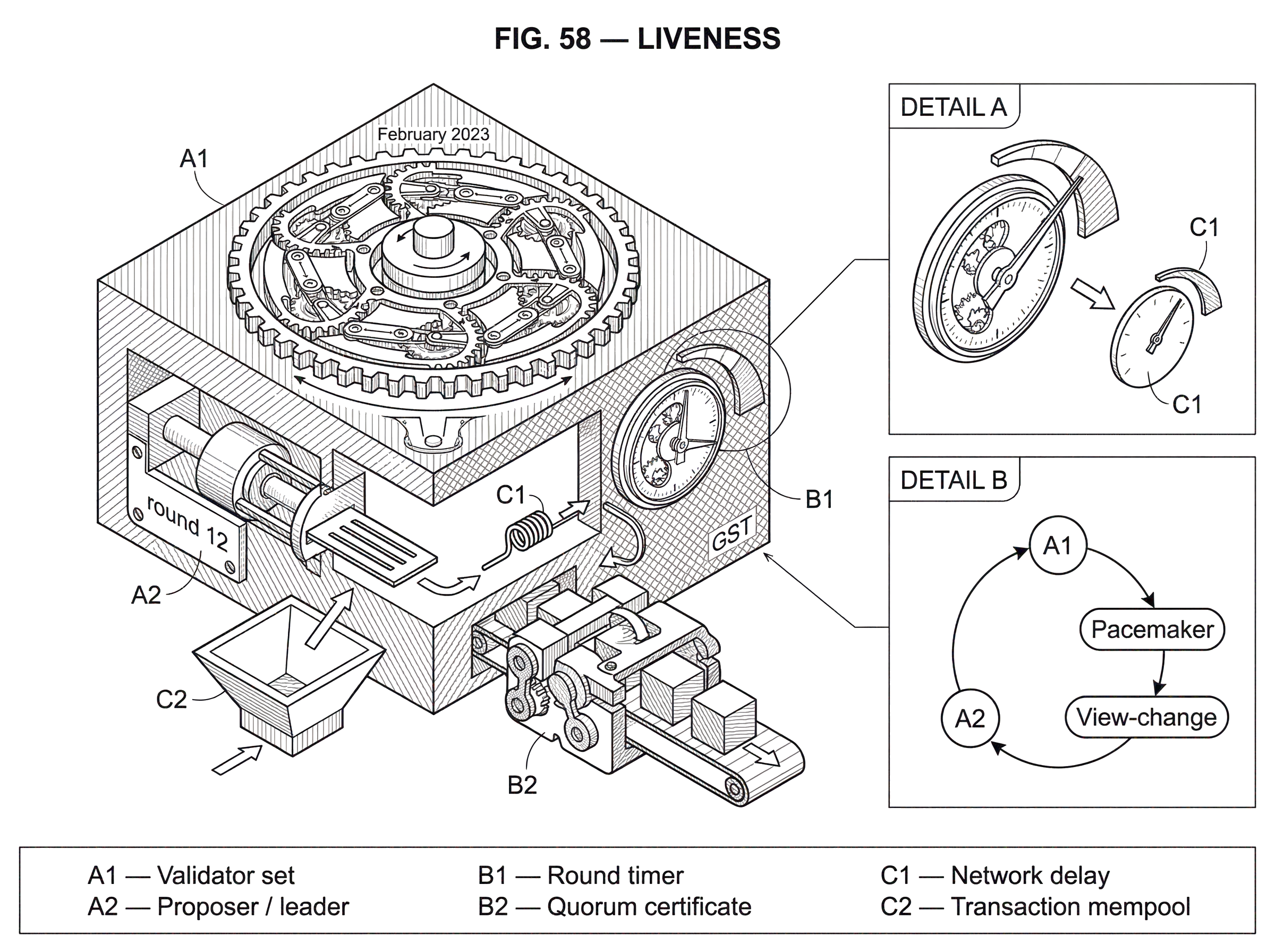
Now imagine the network is unstable for a while. In round 12, the proposer is honest, but messages arrive too slowly for enough validators to see the proposal before their timers expire. Some vote; others move on. No quorum forms. Round 13 has a faulty proposer who sends conflicting messages, so again there is no commit. Round 14 has an honest proposer, but timers are still too short relative to actual message delay. Again, no progress.
At first glance, this looks like the protocol is broken. But here is the mechanism that restores liveness under partial synchrony. The protocol keeps increasing round lengths. Partial synchrony means there exists some unknown bound Δ on message delay after the network stabilizes, even though validators do not know that bound in advance. Once the timeout becomes long enough relative to Δ, an honest proposer can get a proposal to enough validators, receive their votes back, and assemble the quorum needed to advance. The protocol does not need to know Δ; it only needs a strategy that eventually exceeds it.
This is why timeout growth is not an implementation detail. It is often the core liveness mechanism. Tendermint states this explicitly: each round is longer than the previous one by a fixed increment so the network can eventually make progress in a partially synchronous environment. HotStuff makes a similar move through a pacemaker and proves progress after GST, the global stabilization time after which the network behaves with bounded delay.
The important lesson is that liveness is rarely “caused” by voting alone. Voting gives you a way to certify agreement once enough messages arrive. Liveness comes from the part of the design that ensures enough messages eventually can arrive within the protocol’s waiting rules.
What does the FLP impossibility mean for blockchain liveness?
| Model | Liveness guarantee | Extra needed | Practical escape |
|---|---|---|---|
| Fully asynchronous | No guaranteed termination | None (deterministic) | Add assumptions or randomness |
| Partial synchrony | Progress after GST | Unknown bounded delay | Timeout growth / pacemaker |
| Randomized algorithms | Probabilistic termination | Unpredictable coins | Ben‑Or style randomness |
| Failure detectors | Eventual termination | Unreliable detector output | Use unreliable FD oracles |
There is a famous reason consensus protocols talk so much about synchrony assumptions. In the FLP result, Fischer, Lynch, and Paterson showed that in a completely asynchronous deterministic system, no consensus protocol can guarantee termination if even one process may crash.
Completely asynchronous here means something very strong: there are no bounds on message delay, no bounds on relative process speed, and no synchronized clocks. Messages are reliable, but they may be delayed arbitrarily long. Under those conditions, a protocol can always be kept in a state where it has not yet been forced to decide. FLP proves that there is an admissible execution in which termination never occurs.
This is a liveness impossibility, not a safety impossibility. Consensus may still remain safe forever: no conflicting decision is made. What cannot be guaranteed is eventual decision. And the result is stronger than many first assume, because the paper only asks for a very weak liveness condition (roughly, that some process eventually decides) yet even that cannot be guaranteed in full asynchrony with one crash fault.
This is the central constraint behind practical protocol design. If a blockchain claims liveness, it must be buying that guarantee with extra assumptions or extra machinery. The usual escape hatches are well known: partial synchrony, randomization, failure detectors, economic assumptions, stake-majority assumptions, or explicit recovery procedures. But there is no free version where deterministic consensus is both fully asynchronous and unconditionally live in the FLP model.
So when a protocol paper says “live,” the next question should be: under what model? That question is not legal fine print. It is the whole substance of the claim.
Which assumptions are required for consensus liveness?
| Assumption | Role | Typical form | Example |
|---|---|---|---|
| Timing | Bounds message delay | Partial synchrony | Tendermint / HotStuff |
| Fault threshold | Limits adversary power | <1/3 Byzantine or honest majority | Tendermint / Ouroboros |
| Leader mechanism | Gives honest chance to lead | Round‑robin / VRF | HotStuff / BABE |
| Recovery path | Unblocks failed rounds | View‑change / pacemaker | HotStuff / Tendermint |
| Incentives | Encourage availability | Slashing and rewards | Cosmos slashing |
There are a few recurring supports under almost every practical liveness guarantee.
The first is some form of timing assumption. Tendermint assumes partial synchrony with an unknown upper bound on message delay. HotStuff guarantees progress only after GST. Ouroboros Praos is analyzed in a semi-synchronous setting with adversarially controlled but bounded delay unknown to participants. BABE similarly works under a partial-synchrony model and spends substantial effort on slot synchronization because local disagreement about time can itself block progress.
The second is a fault threshold. In many BFT protocols, liveness requires fewer than one-third Byzantine faults by voting power. Tendermint is explicit: if less than one-third of voting power is Byzantine, the protocol does not deadlock. In proof-of-stake longest-chain systems, the statement is usually framed as an honest majority of stake or enough honest slot leaders over time to guarantee chain growth.
The third is a leader or proposer mechanism that eventually gives control to an honest participant under conditions where others can hear it. This can be round-robin leadership, randomized leader election, VRF-based slot assignment, or a rotating proposer schedule. The point is not merely fairness. The point is that liveness needs recurring opportunities for an honest coordinator to gather the quorum or extend the chain.
The fourth is a recovery path after failed rounds. view change in PBFT-family protocols, pacemakers in HotStuff, unlocking rules in Tendermint, fork choice in longest-chain protocols, and local clock adjustment in BABE all serve this role. A protocol that only works when everything goes right is not live in any useful sense.
The fifth is often incentive support. Consensus theory defines liveness at the level of executions, but deployed blockchains also have to shape validator behavior. Cosmos is a clear example: its slashing module tracks validator signing over a sliding window and jails validators that miss too many blocks. That does not prove liveness mathematically. What it does is reduce the frequency of a common operational cause of liveness loss: validators being absent, misconfigured, or intermittently offline.
These supports belong to different layers. Timing is a network model assumption. Fault thresholds are adversary assumptions. leader selection and view change are protocol mechanisms. Slashing is economic enforcement. Real liveness usually depends on all of them lining up.
How do Tendermint, HotStuff, and PoS protocols preserve liveness?
Different consensus families solve the “keep going” problem in different ways, but the mechanism is usually easier to see if you ask what would otherwise make the system stall.
In Tendermint-style protocols, the danger is that validators become locked on different blocks across rounds and can no longer form the supermajority needed to commit. The protocol addresses this with locking and proof-of-lock information. A validator that has locked on a prior block prevotes that block, but later evidence can justify unlocking. That mechanism exists partly for safety, because locks prevent conflicting commits, but also for liveness, because validators need a disciplined way to converge again instead of remaining permanently split by old locks.
In HotStuff, the danger is cumbersome leader replacement. Earlier BFT protocols made view change expensive and structurally complex, so changing leaders under failure could itself become the bottleneck. HotStuff’s three-phase core lets a new leader extend the highest quorum certificate it knows. This simplifies view change and achieves linear communication per view. The liveness point is not just efficiency. Faster, simpler view change reduces the protocol’s chance of getting stuck in leader-transition churn after stabilization.
The HotStuff paper also makes a revealing negative point: if you try to compress the protocol to two phases, you can get infinite non-deciding executions unless you reintroduce synchronous waiting. In other words, removing a phase seems cheaper, but the missing phase was carrying liveness structure. This is a useful general lesson. In consensus, steps that look redundant are often the pieces that let progress recover after adversity.
In proof-of-stake chain-growth protocols such as Ouroboros Praos and BABE, the concern is different. There is no single round where everyone must converge on one proposal before moving. Instead, liveness depends on honest leaders being selected often enough and their blocks propagating quickly enough that the honest chain keeps growing. BABE’s formal properties like chain growth, common prefix, and existential chain quality fit together here: chain growth gives progress, common prefix controls divergence, and chain quality ensures adversarial blocks do not dominate long stretches. Under those conditions, one can derive user-facing liveness statements such as eventual inclusion of transactions seen by honest parties.
How do operational faults cause real-world liveness failures?
Theory tells you when liveness is impossible or provable. Incidents tell you how it fails in the field.
A useful example comes from Solana’s February 2023 outage report. The immediate cause was not a failure of the abstract idea of consensus, but a propagation-layer breakdown. An abnormally large block generated recovery shreds that external shred-forwarding services rebroadcast in loops. Those duplicate shreds saturated deduplication filters, overwhelmed Turbine (the network’s primary block propagation path) and forced fallback to the much slower Block Repair mechanism. Consensus finalization slowed dramatically, and validators entered a safety state called vote-only mode when optimistic confirmations got too far ahead of finalized blocks.
This kind of event teaches an important point about liveness: progress is end-to-end. It is not enough for the voting rule to be sound. The network layer must deliver data fast enough, local resource limits must not collapse under adversarial or malformed traffic, and fallback paths must be able to recover without themselves becoming the dominant bottleneck. A consensus protocol can be live on paper and still stall because the machinery that feeds it proposals, blocks, or votes is overloaded.
The same principle explains why Ethereum’s proof-of-stake specifications list remaining live through major network partitions and large validator outages as an explicit design goal. Liveness is not an ornament added after safety. It is a system-level objective that shapes fork choice, validator participation rules, client behavior, and recovery assumptions.
Common misunderstandings about liveness and what they imply for users
A common misunderstanding is to treat liveness as meaning fast. Usually it does not. Classical liveness is an eventuality claim, not a latency bound. A protocol may be live and still take an arbitrarily long time before the good thing happens, so long as under the model it eventually does happen. If you want bounded response (say, every honest transaction is included within t seconds) you are asking for a stronger property and stronger assumptions.
Another misunderstanding is to think liveness is the mirror image of safety. It is related, but not symmetric in all the ways people expect. Safety violations can be pinned to finite bad prefixes. Liveness failures usually cannot. This affects monitoring too. Detecting a safety failure on-chain can be crisp. Detecting a true liveness failure often requires thresholds, timeouts, and operational judgment because “not yet” and “never” look the same for a while.
A third misunderstanding is to think incentive penalties are liveness. They are not. Slashing downtime, as in Cosmos, is a governance and incentive tool that encourages availability. It helps align behavior with the assumptions needed for liveness, but it does not by itself create a protocol-level progress guarantee. If the network is partitioned badly enough, or if the synchrony assumptions do not hold, no amount of slashing changes the impossibility.
A fourth is to ignore the exact assertion being proved. Some papers prove the protocol does not deadlock. Others prove chain growth. Others prove eventual transaction inclusion. Others prove only progress after stabilization. These are all liveness-flavored statements, but they are not interchangeable.
How strong are different liveness guarantees and what do they require?
The general definition of liveness is broad: every finite partial execution has some extension in P. There are stronger variants. Alpern and Schneider define uniform liveness, where there exists a single continuation pattern that works after any prefix, and absolute liveness, which is stronger still. Many familiar eventuality properties are liveness properties without satisfying these stronger forms.
For blockchain readers, the takeaway is simple: not all progress guarantees have the same force. “Eventually possible” is weaker than “eventually guaranteed under this scheduler fairness assumption,” which is weaker than “guaranteed after GST with bounded delay,” which is weaker than “within a known time bound.” Stronger liveness claims are usually more useful operationally, but they require tighter models and more protocol machinery.
This is also why comparative work on consensus liveness keeps finding ambiguous or problematic claims. Some stated assumptions are too weak for any meaningful liveness assertion to hold; others are so strong that liveness becomes trivial. The interesting design space is in between: assumptions weak enough to model the real internet, but strong enough that progress is actually recoverable.
Conclusion
Liveness is the progress side of consensus: the promise that the system will not stall forever. At a formal level, it means no finite execution prefix has made success impossible. In blockchains, that becomes the practical claim that blocks keep getting produced, finality keeps advancing, or honest transactions eventually get included.
The crucial thing to remember is that liveness never comes for free. FLP shows why pure asynchrony cannot guarantee it. Real protocols regain it by adding structure: partial synchrony, proposer rotation, timeout growth, view changes, quorum certificates, stake assumptions, clock synchronization, and sometimes incentives that keep validators online. If safety asks, “Can the system avoid contradiction?”, liveness asks the equally important question: Can it still move?
What should you understand about liveness before trading, depositing, or withdrawing?
Before trading, depositing, or withdrawing on a chain, know how that chain guarantees progress (finality, chain growth, or only eventual inclusion). On Cube Exchange you can use that knowledge to pick execution and withdrawal steps that reduce risk: fund your account, choose execution types consistent with the chain’s liveness model, and delay large withdrawals until the chain’s finality threshold is met.
- Check the chain’s liveness model in the project docs or a block explorer: does it provide finality (a finality gadget) or only probabilistic chain growth, and what confirmation counts are recommended?
- Inspect recent finalization and reorganization metrics on a public explorer or explorer-provided stats (average time-to-finality, recent reorgs). If finality is frequently delayed, reduce exposure and avoid large immediate withdrawals.
- Fund your Cube Exchange account via fiat or a supported crypto deposit. For trades on assets with weak or delayed finality, prefer limit orders to control execution price and reduce slippage during short stalls.
- For withdrawals, send a small test amount first. For large transfers, wait for the protocol’s documented finality threshold or the recommended confirmation count before treating the on-chain state as final and withdrawing larger sums.
Frequently Asked Questions
FLP shows that in a completely asynchronous deterministic system - even with just one crash fault - no consensus protocol can guarantee eventual decision (termination); safety can still hold but liveness cannot be ensured without extra assumptions. Practical protocols therefore add assumptions or mechanisms such as partial synchrony, randomization, failure detectors, or economic/stake models to regain liveness.
Under partial synchrony there exists some unknown bound Δ on message delay after the network stabilizes; protocols increase round timeouts (or use a pacemaker) so that eventually a timeout exceeds Δ, allowing an honest proposer to reach enough validators and form a quorum, restoring progress - Tendermint explicitly lengthens rounds and HotStuff uses a pacemaker and GST-based argument.
A safety violation has a finite witness that can be pointed to immediately, but a liveness failure usually cannot be certified from any finite observation because "not yet" can look like "never"; detecting true liveness failure therefore requires explicit time bounds or operational judgment rather than a single finite proof.
No. Slashing and penalties are operational tools that discourage validator absence or misconfiguration and thus help satisfy the behavioral assumptions behind liveness, but they do not replace the protocol-level timing or fault assumptions; if those assumptions (e.g., partial synchrony) are violated, slashing cannot by itself guarantee progress.
Yes - formally a protocol can be "live" in a narrow sense (e.g., keep producing blocks) while being unusable for users if those blocks are empty or if a finality layer stalls; user-facing liveness (transaction inclusion and finalized confirmations) depends on the specific layer and exact liveness claim.
Typical liveness proofs rely on a bundle of assumptions and mechanisms: a timing model (often partial synchrony), a fault threshold (e.g., <1/3 Byzantine voting power), leader/proposer selection that eventually favors honest coordinators, explicit recovery paths (view-change, pacemaker, unlock rules), and often incentive mechanisms to keep validators online.
Real-world liveness outages are often caused by operational problems in the propagation and resource layers rather than a theoretical protocol flaw - for example, Solana’s Feb 2023 outage involved oversized blocks and rebroadcasted recovery shreds that saturated deduplication and the Turbine propagation path, slowing finalization and forcing validators into vote-only mode.
There are stronger variants of liveness (e.g., uniform liveness and absolute liveness) beyond the textbook eventuality definition; many blockchain liveness statements are ordinary eventuality claims and do not satisfy these stronger forms, and obtaining stronger guarantees requires tighter models and extra protocol machinery.
Different consensus families use different mechanisms: Tendermint leverages locking/unlocking plus increasing timeouts to avoid deadlock; HotStuff uses a three-phase core and a pacemaker to simplify and speed up view change (and warns that two-phase variants can livelock without synchronicity); longest-chain PoS designs rely on honest leader frequency and chain-growth/chain-quality arguments to ensure progress.
Related reading