What is Base?
Learn what Base is, why it exists, how this Ethereum Layer 2 works, and how its OP Stack design enables cheaper onchain apps and payments.
Introduction
Base is an Ethereum Layer 2, incubated by Coinbase, that aims to make building and using onchain applications cheaper, faster, and more accessible. That description sounds simple, but it hides the real puzzle: if Ethereum already exists, why build another chain on top of it instead of just using Ethereum directly? The answer is that Ethereum is valuable partly because it is secure and widely shared, but that same shared security makes blockspace scarce and expensive. Base exists to move most user activity off Ethereum’s main execution path while still anchoring itself to Ethereum for security and compatibility.
That tradeoff explains almost everything about Base. It wants the familiar programming model of Ethereum (the EVM, Ethereum transaction rules, and existing tooling) but with lower costs and a smoother developer and user experience. At the same time, it is not trying to be a completely independent alternative to Ethereum. Base’s own specification says it inherits Ethereum’s EVM semantics, transaction rules, and L1-anchored security. It was originally built on the OP Stack, and after the Jovian hard fork follows its own Base Chain specification.
Base is also more than just a chain in the narrow protocol sense. Its public-facing materials present it as “an open stack for the global economy” and organize the ecosystem around products such as Base Chain, Base Account, Mini Apps, Base App, and Base Pay. That matters because Base is best understood not only as scaling infrastructure, but as an attempt to turn Ethereum-style apps into something that feels closer to mainstream internet products: lower-friction payments, social interactions, wallet-based identity, and app distribution in one environment.
Why build Base instead of using Ethereum mainnet?
| Platform | Cost | Speed | Security model | Best for |
|---|---|---|---|---|
| Ethereum mainnet | High fees | Slower under load | L1 consensus finality | High-value settlement |
| Base (Layer 2) | Low fees | Faster confirmations | L1-anchored rollup security | Frequent micro-interactions |
Ethereum gives developers a neutral settlement layer and a shared execution environment. The hard part is that this environment is scarce. When many people want to use the network at once, fees rise and confirmation becomes less comfortable for everyday activity. That is tolerable for infrequent, high-value actions. It is much worse for apps that want frequent payments, social interactions, gaming actions, or small-value trades.
Base addresses this by shifting execution to a Layer 2. In plain language, that means users transact on Base instead of putting every step directly on Ethereum mainnet. The chain processes transactions in its own environment, then relies on Ethereum as the deeper settlement and security layer. The point is not to escape Ethereum, but to use Ethereum more efficiently.
This is the key idea that makes Base click: Base is a compression layer for Ethereum activity. Instead of asking Ethereum to execute every user action individually at mainnet prices, it groups and manages activity off the main path, while keeping the result tied back to Ethereum. Lower fees are the visible consequence. The more fundamental consequence is that applications can be designed around frequent interaction rather than fee avoidance.
That is why Base’s docs emphasize not only network infrastructure but also payments, accounts, mini apps, token launches, bridging, and developer incentives. If transactions are cheap enough and the developer surface looks like Ethereum, then the kinds of products that make sense onchain change. A chain optimized only for occasional asset transfers feels like infrastructure. A chain with lower-cost execution plus distribution and identity primitives starts to look like an application platform.
How does Base work under the hood as an L2 rollup?
At the protocol level, Base Chain defines how nodes derive and execute blocks, how transactions are propagated, and how state transitions are verified. Those are the basic questions every blockchain has to answer: what counts as the next block, how transactions get into it, and how everyone agrees on the resulting state.
Base’s design starts from compatibility. Its specification says Base inherits Ethereum’s EVM semantics and transaction rules. This means a developer who already knows how Ethereum smart contracts behave does not need a new execution model. A Solidity contract that makes sense on Ethereum should, in broad terms, make sense on Base as well. Wallets, explorers, indexers, and many familiar tools can therefore work with much less adaptation than if Base had invented a different virtual machine.
The second design choice is that Base is L1-anchored. The phrase can sound vague, but the intuition is straightforward: the deepest source of final trust is still Ethereum. Base has its own block production and transaction flow, but it does not ask users to trust an entirely separate security universe. This is also why running a Base node requires Ethereum Layer 1 endpoints such as an L1 execution RPC and beacon endpoints. A Base node is not isolated; it must read Ethereum to understand and verify the rollup’s state and data dependencies.
The third design choice is lineage. Base was built on Optimism’s OP Stack, which is a modular framework for Ethereum Layer 2 chains. The OP Stack organizes a rollup into components such as execution, consensus, data availability, and settlement. Base’s own docs and repos make this dependence explicit: the node software describes Base as an Ethereum L2 built on Optimism’s OP Stack, and the contracts repository notes that Base primarily uses Optimism’s bedrock contracts. In other words, Base is not a clean-room reinvention. It is an OP Stack chain with Base-specific operational and product direction.
A useful mental model is to think of Ethereum as the court of final appeal, while Base is the fast-moving city where most daily activity happens. The analogy explains why Base can be cheaper and more responsive while still drawing security from Ethereum. Where it fails is that courts and cities are institutionally separate, whereas Base is technically entangled with Ethereum through contracts, data, and rollup rules.
What happens step-by-step when I make a transaction on Base?
Imagine a user opens an app on Base to swap tokens, mint a collectible, or send a payment. The transaction is submitted to Base rather than directly to Ethereum mainnet. Base’s infrastructure propagates the transaction, and the chain includes it in a Base block according to its own block production process. From the user’s perspective, the important effect is speed and lower cost. From the protocol’s perspective, the transaction has been executed under Ethereum-style rules, but not yet as a standalone mainnet transaction.
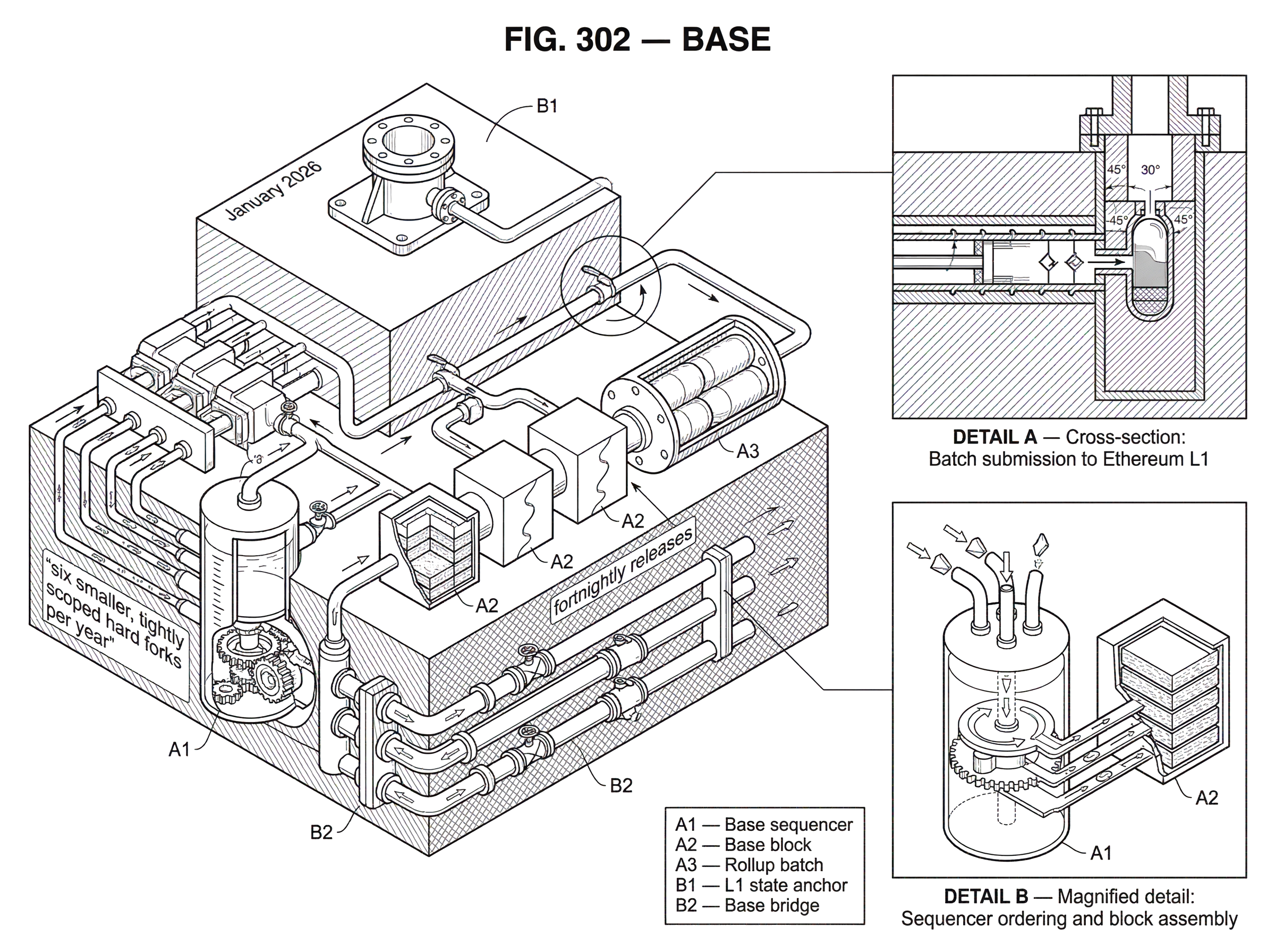
Now zoom out one level. Base does not treat that action as something that must permanently live only inside its own world. Instead, the rollup system anchors the resulting state to Ethereum. That anchoring is what lets Base offer lower-cost activity without becoming just another independent chain with a separate trust base. The exact operational details involve the rollup protocol, batch submission, and state verification, but the mechanism that matters for intuition is this: users get a cheaper execution environment because Base amortizes interaction across Ethereum rather than spending full Ethereum cost on every action.
This also explains why bridging matters so much. Base’s docs explicitly support bridging from Ethereum and from Solana. If the chain is useful, assets and users must be able to move into it. A bridge is not a side feature here. It is part of the mechanism by which Base becomes economically connected to the wider ecosystem. But it also introduces risk, because anything that manages asset movement across domains becomes a high-value target.
What are the trade-offs of Base’s simple, fast-upgrade design?
| Upgrade cadence | Change size | Operator burden | Main risk | Primary benefit |
|---|---|---|---|---|
| Frequent small upgrades | Small releases | Requires frequent updates | Coordinate upgrades often | Faster fixes |
| Infrequent large upgrades | Large releases | Less frequent updates | Bigger regressions | Simpler operations |
One of the most revealing documents about Base is its protocol specification, because it states its design philosophy plainly. The spec says Base is opinionated, meaning it chooses a single best solution in the name of simplicity. It also says the stack should be maximally simple, focused enough that the protocol and codebase should be understandable by a single developer.
That is not just an aesthetic preference. In blockchain systems, complexity is one of the main ways risk enters. More optionality means more edge cases, more coordination problems, and more room for implementation mismatch. By choosing a narrower path, Base is trying to reduce ambiguity for implementers and operators. The benefit is clarity and speed. The cost is that there is less room for many competing interpretations of how the system should behave.
The same philosophy shows up in Base’s upgrade cadence. Rather than shipping infrequent, very large changes, the spec says Base targets six smaller, tightly scoped hard forks per year with fortnightly releases. The idea is that operational risk can be reduced by shipping smaller changes more often instead of accumulating massive upgrades. That can make sense from first principles: smaller deltas are easier to reason about than giant leaps.
But the tradeoff is real. Frequent upgrades mean operators, infrastructure providers, and integrators must stay current. If you run nodes, index data, maintain wallets, or build production apps on Base, the chain’s speed of iteration becomes part of your operational burden. A fast-moving protocol can improve quickly, but it asks its ecosystem to improve quickly with it.
How is Base related to the OP Stack and Optimism?
| Aspect | Who defines it | Examples | Upgrade flow |
|---|---|---|---|
| Inherited (OP Stack) | Optimism / OP Stack | Execution, contracts, tooling | Registry-based inheritance |
| Base-specific | Base team (Coinbase) | Base App, Base Pay, Mini Apps | Base-controlled hard forks |
Base is deeply tied to the OP Stack and, by extension, to the broader Superchain vision associated with Optimism. This relationship matters because it tells you which parts of Base are fundamental and which parts are inherited convention.
The fundamental part is that Base is an Ethereum Layer 2 with Ethereum-compatible execution and L1 anchoring. The inherited part is much of the rollup framework and surrounding ecosystem machinery. The OP Stack is presented by Optimism as a standardized, shared, open-source stack for building production-ready Layer 2 blockchains. Its modular architecture includes execution, consensus, data availability, and settlement layers. Base benefits from that shared development model instead of having to design every component from scratch.
This also means Base is not isolated from governance and upgrade patterns in the wider OP Stack ecosystem. Optimism’s documentation describes the superchain-registry as the source of truth for OP Stack chain classification and configuration changes, and explains how op-node and op-geth can inherit hard fork activation times from registry configuration. More broadly, Optimism governance materials show that protocol upgrades in the Superchain context are not merely local engineering choices; they can be shaped by the wider Collective’s structures, including the Token House and Citizens’ House in some cases.
That does not mean “Optimism governs Base” is a sufficient summary. It means Base sits in a layered dependency relationship. Some of its behavior is specified by Base itself. Some of its software lineage and operational assumptions come from the OP Stack. Some of the broader standards, upgrade flows, and ecosystem incentives are shared with the Superchain vision. If you want to understand Base, you have to see all three layers at once.
What benefits do developers and users get from using Base?
The user-facing promise of Base is not abstract scaling. It is that onchain interactions can feel normal enough to support everyday products. That is why the official docs group features around payments, accounts, mini apps, AI agents, token launches, and bridges. The homepage frames Base App as an “everything app” that combines social networking, apps, payments, and finance in one place.
For developers, the practical attraction comes from three causes working together. First, Ethereum compatibility lowers migration costs. Existing smart-contract patterns, wallets, and tooling remain useful. Second, lower-cost execution makes more application designs economically viable. Third, Base invests in onboarding infrastructure: explorers such as BaseScan, data indexers, GitHub repositories, Discord support, block explorer links, funding programs, builder rewards, grants, and gas credits.
This package matters because a chain rarely succeeds on throughput alone. Developers need software clients, deployment paths, contract artifacts, support channels, and predictable tooling. Base’s repos reflect that operational seriousness. There is an official node repository with Docker builds and instructions for running your own Base node, including support for reth, geth, and nethermind. There is an official contracts repository for Base scripts and contracts, alongside a separate repository for deployment artifacts. Even if many users never touch these components directly, they are part of what makes the chain legible and usable to the ecosystem.
What assumptions does Base’s value proposition rely on?
Base’s value proposition depends on several assumptions holding at once. The first is that Ethereum remains the right place to anchor security and settlement. If Ethereum lost its role as the trusted base layer, then “Ethereum-compatible and Ethereum-anchored” would no longer be such a powerful design choice.
The second assumption is that rollup complexity remains manageable. Base reduces user-facing cost by introducing a layered architecture: L2 execution, L1 anchoring, bridge contracts, node software, batch submission, and upgrade coordination. That complexity is often worth it, but it does not disappear. It moves. Users see cheaper transactions. Operators and protocol designers inherit more moving parts.
The third assumption is that central points of coordination can evolve safely. Base’s materials emphasize openness, but the operational reality of any modern L2 includes sequencer behavior, software release coordination, infrastructure routing, and managed product surfaces. The official status page shows this in practice. It has reported periods of heavy transaction volume resulting in inclusion delays, degraded performance in mainnet and the transaction pool, and infrastructure incidents such as Flashblocks websocket connectivity problems. None of that is unusual for a live network, but it is a reminder that low fees do not eliminate operational bottlenecks.
There is also a difference between protocol risk and ecosystem risk. Base can inherit Ethereum semantics and use battle-tested OP Stack components, yet users can still lose money through applications built on top. A concrete example comes from the January 2026 SwapNet exploit affecting Matcha Meta users on Base and other chains. Matcha Meta’s post-mortem says the core issue was not that Base itself failed. The exposure came from users bypassing the safer One-Time approval flow and granting direct, effectively unlimited approval to the vulnerable SwapNet contracts. This is an important distinction: a secure chain does not imply a secure app, and a secure app default does not protect users who opt into riskier approval patterns.
That example teaches a broader lesson. On Base, as on Ethereum, many practical risks come from composability. Tokens, routers, aggregators, bridges, and wallets interact. Each interaction expands what is possible, which is the source of crypto’s flexibility. It also expands what can fail.
What are Base’s node, security, and operational requirements?
Base’s public materials show a network that takes operator and security processes seriously, while also making clear that this is a live, evolving system rather than a finished appliance. The node repository includes substantial hardware guidance, supported clients, required L1 endpoints, and notes that Snap Sync is experimental. The production reference configurations are not trivial hobby setups; they imply serious infrastructure needs for full participation.
On the security side, Coinbase extends its HackerOne bug bounty program to cover the Base network, Base bridge contracts, and Base infrastructure, while Optimism maintains its own Immunefi Bedrock bounty. That layered bounty structure mirrors the layered technical architecture. Base-specific components have one reporting path; shared OP Stack components have another adjacent one. The immediate consequence is improved disclosure coordination. The deeper consequence is that Base’s security model is partly local and partly inherited from the software ecosystem it builds on.
Still, there are limits to what this proves. A bug bounty is evidence of process, not proof of invulnerability. Likewise, a status page with incident reporting is evidence of operational transparency, not proof that outages will be minor. Base appears to be building the institutions a serious chain needs: specs, repos, security intake, node instructions, and public incident reporting. But every one of those institutions exists because failure modes are real.
What is Base in one sentence?
Base is best understood as an Ethereum-compatible rollup platform that tries to make onchain apps cheap and mainstream enough to behave like everyday internet products, while still anchoring trust in Ethereum.
That sentence is worth unpacking. Ethereum-compatible explains why developers can reuse existing skills and tools. Rollup platform explains the mechanism for lower-cost execution. Apps cheap and mainstream enough explains why Base talks so much about payments, accounts, mini apps, and consumer products instead of only block production. Anchoring trust in Ethereum explains why Base is not trying to replace Ethereum, but to extend it.
Conclusion
Base exists because Ethereum’s security and openness are valuable, but Ethereum’s raw blockspace is too scarce and expensive for many everyday applications. By moving execution to a Layer 2 while keeping Ethereum compatibility and L1 anchoring, Base tries to preserve what makes Ethereum useful and relax what makes it hard to use at scale.
Its core logic is simple enough to remember: keep Ethereum as the trust base, move most activity somewhere cheaper, and make the resulting environment good enough for real applications and ordinary users.
Everything else follows from that choice.
- the OP Stack lineage
- the focus on product surfaces
- the frequent upgrades
- the bridges
- the node software
- the ecosystem incentives
How do you move funds to or from Base more safely?
Move funds to or from Base safely by first verifying the exact asset and network, doing a small test transfer, and checking fees and finality before sending the full amount. On Cube, the workflow stays on-platform: fund your Cube account, select the Base transfer flow, run a test transfer to confirm address, fees, and arrival behavior, then complete the full transfer.
- Fund your Cube account with the coin or token you plan to move (use the fiat on-ramp or deposit the specific crypto).
- Open Cube’s transfer flow, choose the direction (send to Base or receive from Base), and select the exact asset plus the Base network as the destination.
- Paste the destination address and verify it carefully (match the first/last characters, ENS name, or QR code). Check the token contract or symbol to avoid a wrong-asset transfer.
- Send a small test transfer (for example ~$10). Observe the bridge/transfer fees, expected arrival time, and whether an on-chain approval was required.
- After the test clears and you confirm the funds are usable on Base, repeat the transfer for the remaining balance or split it into multiple transfers if limits or fees warrant.
Frequently Asked Questions
Base anchors its state to Ethereum by operating as a rollup: it executes transactions on L2, bundles them, and submits batches/proofs to Ethereum so final trust comes from L1; Base nodes therefore must read Ethereum (e.g., an L1 execution RPC and beacon endpoints) to verify the rollup’s state and data dependencies.
Base’s spec prioritizes a single, simple design to reduce ambiguity and implementation risk, but that philosophy is paired with a fast upgrade cadence (targeting six small hard forks per year and fortnightly releases), which shifts burden onto operators, indexers, and integrators who must stay current.
Base was originally built on Optimism’s OP Stack and uses many of Optimism’s Bedrock components and shared tooling; it therefore inherits OP Stack conventions, can participate in the Superchain registry model, and sits in a layered dependency relationship with Optimism rather than being an isolated, independent reimplementation.
A secure L2 does not eliminate application-level risks: Base retains Ethereum semantics but users can still lose funds through unsafe approvals or buggy dapps, as illustrated by the SwapNet incident described in Matcha Meta’s post‑mortem where users who granted direct approvals were exploited even though Base itself did not fail.
Running a production Base node involves nontrivial infrastructure: the official node repository and docs include hardware guidance, supported clients (reth/geth/nethermind), required L1 endpoints, and warn that features like Snap Sync are experimental, so operators should expect substantial operational requirements.
Bridges are central to Base’s utility because assets and users must move into the rollup for it to function as an application platform, but bridges also concentrate risk - anything that moves assets across domains becomes a high‑value target and a potential source of losses.
Public Base landing pages and docs emphasize incubation by Coinbase and product surfaces but do not publish full protocol governance, tokenomics, or detailed decentralization guarantees on the homepage, so questions about on‑chain governance and token economics remain unresolved in those materials.
Yes - Base aims for Ethereum compatibility: its specification inherits EVM semantics and Ethereum transaction rules so most existing Solidity contracts, wallets, explorers, and tooling should work with less adaptation than a non‑EVM chain.
Related reading