What Is a Virtual Machine in Blockchain?
Learn what a blockchain virtual machine is, why it exists, and how VMs like the EVM, WASM, Move, and Plutus execute smart contracts deterministically.
Introduction
Virtual machine is the name for the execution environment that a blockchain uses to run programs and decide how transactions change state. That sounds like a software implementation detail, but it is actually much closer to the chain’s mechanical heart. If a blockchain supports anything beyond simple transfers, it needs a way for many independent nodes to execute the same logic, under the same rules, and still arrive at exactly the same post-transaction state.
That requirement creates a strange design problem. Normal computers are built to use as much freedom as possible: different processors, different operating systems, different compilers, caching strategies, system calls, clocks, and threads. A blockchain wants almost the opposite. It wants many machines in many places to behave as if they were one machine for the narrow purpose of transaction execution. A virtual machine is the layer that makes that possible by defining a common instruction set, memory model, execution semantics, and resource limits.
The key idea is simple: a blockchain virtual machine is not mainly there to make programs run fast. It is there to make program execution portable, deterministic, and meterable. Portability means different nodes can implement the same VM and still run the same contracts. Determinism means the same input state and the same transaction produce the same output everywhere. Meterability means the chain can bound computation and charge for it, so execution cannot run forever or consume unpriced resources.
Once that clicks, many design choices that look arbitrary start to make sense. Why define a special bytecode instead of letting contracts run native CPU instructions? Why restrict access to files, network, and wall-clock time? Why charge gas or some equivalent fee for each operation? Why care so much about stack depth, memory growth, or whether a feature is deterministic across machines? The answer is always the same: on a blockchain, execution is part of consensus.
What is a blockchain virtual machine and why is it called an "imaginary computer"?
A useful way to think about a VM is as an imaginary computer specified in rules rather than built in silicon. The specification says what instructions exist, what they do, how memory behaves, how errors happen, and what counts as a valid program.
Any real implementation must emulate that same imaginary computer closely enough that the outcome is identical.
- written in Rust
- C++
- JavaScript
- Go
- something else
This is why VM specifications focus on semantics, not just syntax. It is not enough to say that there is an ADD instruction or a CALL instruction. The important question is what state changes when that instruction executes, what happens on overflow, how much it costs, whether it can fail, whether it can invoke other code, and what gets committed if the overall transaction later reverts. In blockchain systems, these details are not runtime quirks. They are consensus rules.
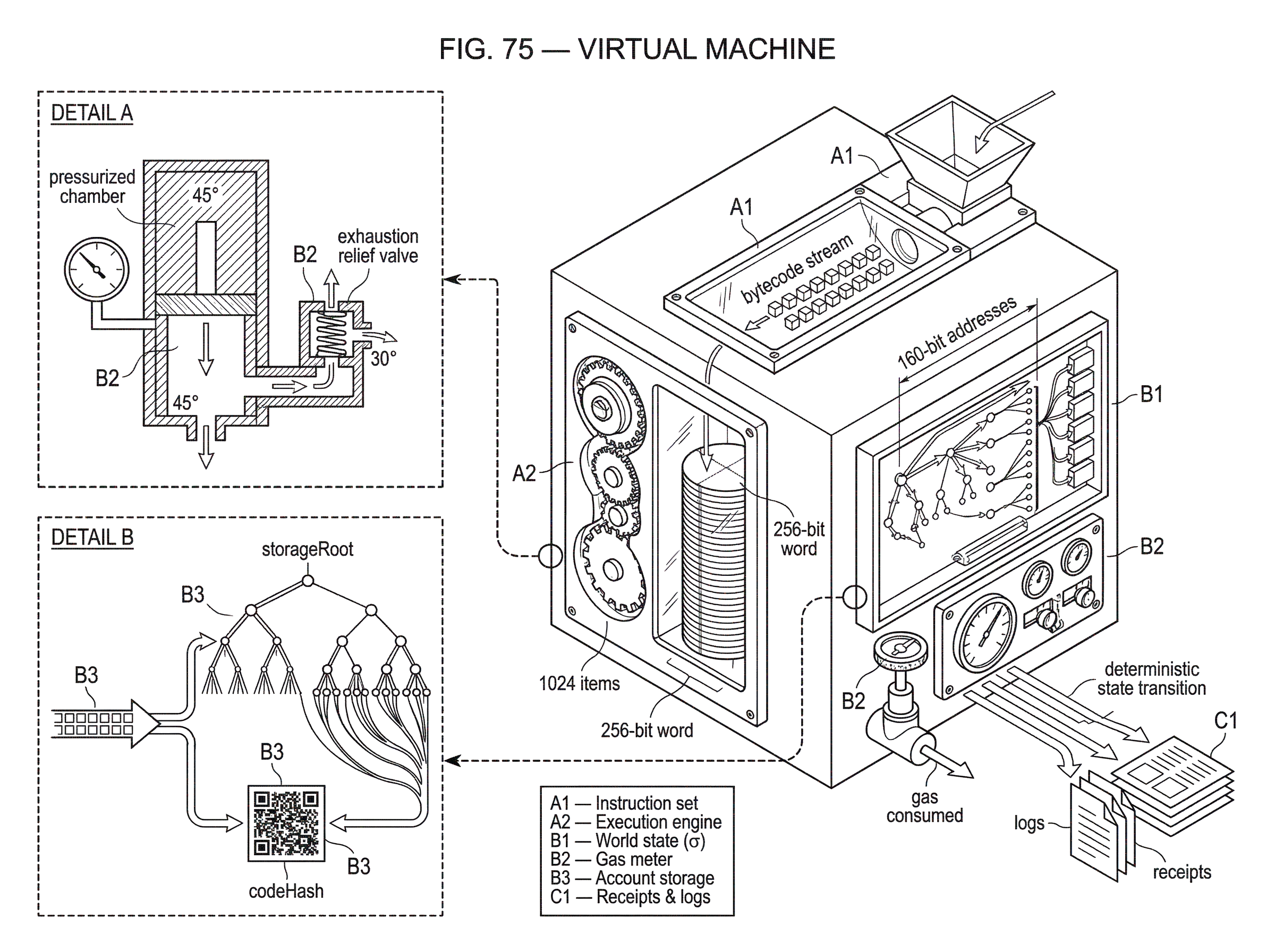
Ethereum makes this especially explicit. Its execution model is formalized as a state transition function: the post-transaction state σ[t+1] is Υ(σ[t], T), where σ is world state and T is a transaction. That notation matters because it strips away the implementation language and reveals the core claim: execution is a deterministic transformation from one valid state to the next. The VM is the mechanism that performs that transformation.
Other systems package the same idea differently. WebAssembly defines a virtual instruction set architecture with precise validation and execution semantics. Move defines typed bytecode that is statically verified and then executed by an interpreter. Plutus Core plays a similar role in Cardano’s execution model. Bitcoin Script is much narrower than a general-purpose smart contract VM, but it still defines an abstract execution environment for validating spending conditions. The family resemblance is the point: the VM is the contract between program authors, node implementers, and consensus.
Why do blockchains use a VM instead of running native CPU code?
| Approach | Determinism guarantee | Host access | Execution bounds | Protocol updates |
|---|---|---|---|---|
| Native execution | Weak across platforms | Full ambient access | Unbounded unless sandboxed | Harder to upgrade safely |
| Virtual machine | Strong by specification | Restricted via imports | Metered and bounded | Explicit VM-level changes |
At first glance, it may seem wasteful to avoid native machine code. Real processors already know how to run programs. Why add a virtual layer?
The first reason is consensus safety. Native execution depends on architecture, compiler behavior, operating system services, and often undefined or implementation-specific behavior. A blockchain cannot tolerate that ambiguity. If one validator gets result A and another gets result B from the same transaction, the network has a consensus failure. A VM narrows the execution environment until those differences are ruled out or made irrelevant.
The second reason is sandboxing. Smart contracts should not have ambient authority over the machine running them. WebAssembly states this principle cleanly: code has no ambient access to the host environment, and any interaction with I/O or system resources must come through explicitly imported functions supplied by the embedder. That same principle appears across blockchain VMs in different forms. Contracts do not get arbitrary filesystem access, open network sockets, or read the local clock whenever they want, because those capabilities would either break determinism or create unacceptable security risks.
The third reason is resource accounting. A general computer is allowed to be busy, inefficient, or even stuck. A blockchain cannot allow one transaction to consume unbounded time or memory because every validating node would need to reproduce that work. Ethereum solves this by making computation gas-metered; the EVM is quasi-Turing-complete, but execution is bounded by gas. That combination is subtle but essential. The language can express loops and rich logic, but no single execution gets infinite runtime because it must keep paying for each step.
The fourth reason is upgradability at the protocol boundary. When a chain changes its fee schedule, adds an opcode, introduces a new transaction type, or changes refund behavior, it is changing the VM contract. That is easier to reason about when execution has an explicit abstract layer. The Yellow Paper, for example, defines the core EVM semantics, while specific hard forks and EIPs adjust details like base fees, refund caps, and typed transactions over time.
How does a VM convert code and transactions into deterministic state transitions?
Every blockchain VM sits between two things: a representation of current state and a sequence of instructions that may alter that state. The VM’s job is to say what changes, in what order, and under what conditions.
Ethereum gives a clean example. The world state σ maps 160-bit addresses to account states. An account state contains four fields: nonce, balance, storageRoot, and codeHash. That tells you something important about the EVM’s design. Code is attached to accounts, persistent storage is separate from temporary execution memory, and the chain commits to the state through authenticated trie roots. The VM does not just run code in a vacuum; it runs code against a structured global state that is itself part of what blocks commit to.
When a transaction arrives, the VM does not simply “execute a program.” It executes in an environment: sender, recipient or creation target, input data, gas budget, value transferred, and block context. During execution, it may allocate transient memory, read and write persistent storage, emit logs, call other contracts, or halt with success or failure. The result is not just a return value. It is a new global state, plus auxiliary artifacts such as receipts and logs.
That distinction matters because blockchain programs are not like normal command-line programs. Their purpose is usually not to print output for a local user. Their purpose is to propose a state transition that every validator can verify. Logs, receipts, status codes, storage writes, balance transfers, and gas consumed are all part of that verifiable outcome.
A concrete example makes this easier to see. Suppose Alice sends a transaction to a token contract asking to transfer 10 units to Bob. The VM begins from the current state, where the contract’s code and storage already exist. It loads the contract code, passes in the calldata describing the transfer, and starts interpreting bytecode. The contract checks Alice’s balance in storage, subtracts 10 if the balance is sufficient, adds 10 to Bob’s balance, perhaps emits a transfer log, and eventually halts. If everything is valid and there is enough gas, those storage updates become part of the new committed state. If the contract runs out of gas or explicitly reverts, the persistent writes are discarded, but gas spent on attempted execution is still charged. The chain therefore gets both safety and accountability: failed execution does not create partial state changes, but it is not free.
How do stack, memory, and persistent storage differ in blockchain VMs?
Different VMs expose different computational models, but most divide execution resources into layers with different costs and lifetimes.
The EVM is a stack machine. It has a stack with depth up to 1024 items, and each item is a 256-bit word. Instructions mostly push, pop, duplicate, swap, and transform stack values. This looks unusual if you are used to high-level languages, but it makes the execution format compact and regular. It also reflects Ethereum’s design priorities: a simple, portable abstract machine with fixed-size word operations that fit cryptographic data comfortably.
The EVM also has transient memory, which exists during execution and can be expanded, and persistent storage, which belongs to a contract account and survives across transactions. That difference is foundational. Memory is cheap relative to storage because it disappears after execution. Storage is expensive because changing it changes global state, and global state must be maintained, authenticated, and replayable by the network. Ethereum’s developer docs now also distinguish transient storage, a per-transaction key-value area shared across internal calls during the same transaction but cleared at the end. That is an example of a VM evolving to create a middle layer between ephemeral memory and expensive persistent storage.
WebAssembly is also a stack machine at the semantic level, but its memory model is different. It provides linear memory, a contiguous mutable byte array that can grow dynamically; out-of-bounds accesses trap. That model is closer to conventional systems programming and is one reason WASM appeals to chains that want broader language support and faster execution. But raw WASM is not automatically suitable for consensus. A blockchain embedder still has to define what imports exist, how metering works, and which features are allowed in order to preserve determinism.
Move takes a different path. Its executable format is typed bytecode, and the VM’s safety story depends heavily on static verification. The key mechanism is not just “here is memory” but “here is what values are allowed to mean.” Move resources are first-class values with linear-style constraints: they cannot be copied or implicitly discarded, only moved. That is a VM design choice aimed directly at digital assets. Instead of encoding scarcity only as application logic, the execution model and type system help enforce it.
This is a good place to separate fundamental design from convention. Stack versus register machine, 256-bit words versus typed values, trie-backed storage versus UTXO-attached scripts; these are conventions of particular VM families. What is fundamental is that the machine must define execution state precisely enough that every node can replay it and agree on the result.
How does gas metering stop infinite execution and tie into transaction fees?
In ordinary computing, performance is mainly an engineering concern. In blockchains, it becomes a correctness concern because every unit of computation is replicated across the network. If execution is not metered, an attacker can submit transactions that consume huge validator resources for little cost.
This is why gas is not just a pricing trick. It is a termination and fairness mechanism. In Ethereum, every operation has a gas cost, transactions specify gas they are willing to buy, and execution halts when that budget is exhausted. Because gas is charged as execution proceeds, a contract cannot force the network to perform unlimited work. The EVM is therefore expressive but bounded.
After EIP-1559, Ethereum’s fee mechanism also separated inclusion economics into two parts: a baseFee per gas unit, burned by the protocol, and a priority fee or tip that incentivizes validators. That fee design is not the VM itself, but it directly shapes execution because every transaction included in a block must pay the base fee for gas consumed. The deeper point is that metering and fee policy are tightly coupled: the VM measures resource usage, and the protocol decides how that measurement turns into payment and inclusion incentives.
Other VM ecosystems solve the same problem with different machinery. CosmWasm, for example, embeds a WASM-based contract model inside the Cosmos SDK via the x/wasm module. Even when an introduction page emphasizes security and interoperability rather than instruction-level details, the same need is present underneath: contracts must execute in a sandbox with bounded, chargeable resource use. Without that, replicated execution would be economically unstable.
A common misunderstanding is to think gas only reflects wall-clock runtime. It does not. Gas schedules are modeling choices. They approximate the relative burden of different operations (computation, memory expansion, storage access, cryptography, and state growth) but they are not identical to physical time on any one machine. That is why gas schedules sometimes change over protocol versions: the protocol is recalibrating incentives and DoS resistance, not discovering a timeless law of nature.
How do contract calls create reentrancy and shared control‑flow vulnerabilities?
| VM | Dynamic dispatch | Call resolution | Reentrancy risk | Common mitigation |
|---|---|---|---|---|
| EVM | Allows dynamic calls | Runtime resolved | High if unchecked | Checks-effects-interactions pattern |
| Move | No dynamic dispatch | Statically resolved | Low to none | Static call targets and verifier |
| WASM (CosmWasm) | Depends on embedder | Embedder-provided imports | Medium depending on design | Restrict host imports usage |
Smart contracts become useful when they can call each other. The moment a VM supports composability, however, execution becomes much less like a straight-line program and much more like a tree of nested control transfers.
In Ethereum, message calls let one contract invoke another, sometimes transferring value and execution context along the way. This is powerful because it enables reusable protocols, token standards, modular applications, and rich settlement logic inside a single transaction. But it also creates a sharp security edge: if contract A hands control to contract B before A has restored its own invariants, B may call back into A unexpectedly.
That is the mechanism behind reentrancy. The DAO exploit is the classic example. The attacker used recursive calling so a split function was re-entered before prior state updates had fully secured the balance accounting, allowing ether to be extracted multiple times in one transaction. The important lesson is not merely “there was a bug.” It is that VM design choices about external calls, shared transaction context, and rollback semantics create whole classes of bugs that developers must reason about.
Not all VMs make the same tradeoff. Move explicitly forbids dynamic dispatch and uses an acyclic module dependency model with statically determined call targets. The design consequence, according to the Move paper, is that there is no equivalent to the EVM’s reentrancy class of vulnerabilities. This does not make smart contracts “safe” in a general sense, but it shows how changing the VM’s control-flow model changes the attack surface. The VM is not neutral plumbing; it shapes what kinds of mistakes are easy or hard to make.
What makes deterministic smart contract execution difficult?
The most important property of a blockchain VM is also the easiest to underestimate: determinism. Two honest nodes must not merely run “similar” executions. They must derive the same committed result.
That requirement rules out many features common in ordinary execution environments. Floating-point behavior can vary in subtle ways. Thread scheduling creates nondeterminism. System clocks differ. Randomness from the host cannot be trusted. File and network I/O depend on local environment. Even compilation pipelines can introduce ambiguity if the actual semantics depend on optimizer behavior instead of the VM specification.
WebAssembly is a useful comparison here. As a standard, it is designed to be safe and portable, with formal validation and execution semantics. But the spec also makes clear that host interaction is provided by the embedder, not by ambient access. For blockchain use, that matters because the chain can define a deterministic subset and a tightly controlled host interface. The eWASM effort was built around exactly this idea: keep the portability and tooling advantages of WebAssembly, but constrain it into a deterministic smart contract environment.
Even then, determinism does not come for free. If a VM relies on host-provided functions, those functions must themselves be specified carefully. If execution is translated to machine code for speed, implementers must still preserve exact semantics. WASM’s own security considerations note that machine-code execution can expose hardware-level side channels; the embedder must handle mitigation and isolation. That is a reminder that a VM specification can narrow the problem, but deployment context still matters.
How does the VM shape developer tooling, languages, and security practices?
The VM is not only for validators. It is also the target that compilers, languages, tooling, and application design converge on.
In Ethereum, developers usually write Solidity or Vyper, but what ultimately runs is EVM bytecode. In Cardano, authors write Haskell-flavored code that becomes Plutus Core for on-chain validation. In Move ecosystems such as Diem’s design and Aptos’s implementation, developers target Move modules and bytecode verified by the VM. In CosmWasm, developers write Rust that compiles to WASM for execution inside the chain’s contract runtime.
That compilation boundary matters because it determines what abstractions are trustworthy. If the VM is weakly typed and dynamic, languages and tools must rebuild safety guarantees above it. If the VM is strongly typed or resource-aware, some guarantees can be enforced closer to the execution layer. If the VM’s call model is highly composable and dynamic, developers need patterns and audits to avoid reentrancy and unexpected control flow. If the VM supports only narrow scripting, as in Bitcoin Script, the upside is a much smaller execution surface but also far less expressiveness.
This is why VM choice influences an ecosystem’s programming culture. EVM ecosystems built a large industry around static analyzers, formal verification, debuggers, symbolic execution, and security patterns partly because the VM’s flexibility leaves many invariants to contract authors. Move pushes some asset-safety properties into the language and verifier. WASM-based environments often emphasize compiler reuse and multi-language development. None of these choices are free; each shifts complexity between protocol, compiler, developer, and auditor.
How do VMs like EVM, WASM, Move, and Plutus differ and why does it matter?
| VM family | Execution model | Typing | Metering | Best for |
|---|---|---|---|---|
| EVM | Stack-based bytecode | Dynamic words/bytes | Gas per opcode | General-purpose composability |
| WASM | Linear memory stack machine | Host-typed via language | Metered by embedder | Multi-language performance |
| Move | Typed bytecode modules | Strong static typing | Gas metered per op | Asset safety and verifiability |
| Plutus Core | Functional language bytecode | Strong static typing | Resource accounting per script | EUTXO predictability and proofs |
| Bitcoin Script | Constrained stack scripting | Untyped stack values | Simple fees per tx | Simple spending conditions |
It is easy to hear “virtual machine” and picture Ethereum. That is too narrow.
Bitcoin Script is intentionally not a general-purpose smart contract VM. It is a constrained scripting system used during transaction validation. Its limited expressiveness is part of its security model. Cardano’s Plutus Core lives inside an extended UTXO model, where script validity depends on the transaction and its inputs; this makes off-chain validation more predictable, though concurrency can still cause failures when expected inputs are consumed elsewhere. CosmWasm places a WASM-based VM inside the Cosmos SDK with strong emphasis on module integration and IBC. Solana’s ecosystem speaks of the Solana Virtual Machine and a parallel runtime orientation, showing that some systems treat execution not just as single-threaded replay but as a scheduling problem over non-overlapping state access. Move-based systems center the VM around resources, modules, and bytecode verification.
These are not cosmetic differences. They answer different questions about what the chain is optimizing for: maximal composability, analyzability, performance, multi-language support, asset safety, off-chain predictability, or parallel execution. A VM is therefore best understood not as “the place code runs” but as the chain’s opinionated model of computation.
What are the limits and trade‑offs of using a VM for blockchain execution?
A VM does not solve every execution problem.
First, determinism at the VM level does not guarantee that contracts are logically correct. The DAO exploit happened on a deterministic VM. Every node agreed on the wrong outcome because the contract logic allowed it. A VM can prevent some bug classes, but it cannot make application invariants true by default.
Second, metering is an approximation. Gas schedules can be mispriced, letting some operations become denial-of-service vectors or making some legitimate patterns unnecessarily expensive. This is why VM economics evolve over time.
Third, a VM does not eliminate the host environment completely. Clients still need implementations, consensus integration, databases, networking, and often JIT or interpreter engineering. Ethereum after proof-of-stake, for example, separates execution semantics from consensus-layer fork choice and data such as prevRandao; the execution layer depends on beacon-chain events to know the canonical head. The VM remains central, but it lives inside a larger protocol machine.
Fourth, more expressive VMs often increase audit difficulty. Richer control flow, dynamic calls, shared mutable state, and cross-contract composition create power and complexity together. Simpler environments reduce flexibility but can be easier to reason about.
Conclusion
A virtual machine in blockchain systems is the formally defined execution environment that turns transactions and contract code into deterministic state transitions. Its job is not just to run programs, but to make replicated execution possible by constraining how code executes, what resources it can use, and how those resources are charged.
If you remember one thing, remember this: on a blockchain, the VM is part of consensus. It is the shared imaginary computer that every node must agree on.
Everything else flows from that fact.
- gas
- bytecode
- storage rules
- call semantics
- compiler targets
- even whole security cultures
How does this part of the crypto stack affect real-world usage?
Virtual Machine affects how a network or execution environment behaves in practice, so it should inform your setup before you trade or move funds on Cube Exchange. The safe workflow is to verify network assumptions first and only then fund the related market.
- Identify the chain or asset whose behavior depends on this execution or scaling concept.
- Check the compatibility, throughput, or tooling constraint Virtual Machine implies for wallets, transfers, or market access.
- Confirm you are using the correct asset, network, and settlement path before funding the account.
- After those checks, open the relevant market on Cube and place the trade with the network constraint in mind.
Frequently Asked Questions
Because native execution depends on architecture, compilers, OS services and other implementation-specific behaviors that can differ across validators, blockchains use a VM and bytecode to narrow the execution environment for consensus safety, sandboxing, resource accounting, and easier protocol upgrades.
Gas metrically charges each operation and halts execution when the provided budget is exhausted, so contracts can express loops and complex logic without allowing unbounded runtime or denial-of-service attacks; fee mechanisms (e.g., EIP-1559’s baseFee and priority fee) then map gas consumed into protocol-level payments and inclusion incentives.
In the EVM, transient memory is per-execution ephemeral RAM that disappears at the end of the call, persistent storage belongs to a contract account and survives across transactions and is expensive to change, and 'transient storage' is a per-transaction key-value area that persists across internal calls but is cleared at transaction end.
When contracts can call one another and transfer control, a callee can reenter the caller before the caller has restored its invariants, which is the mechanism behind reentrancy exploits like the DAO case; some VM designs (e.g., Move’s static call model) aim to eliminate that class of vulnerabilities by restricting dynamic dispatch.
Determinism is hard because many ordinary execution features are nondeterministic across machines - floating-point behavior, thread scheduling, local clocks, host I/O, and host-provided functions can differ - so a blockchain VM must restrict or carefully specify these aspects to ensure identical results across validators.
VM design influences what guarantees live at the protocol layer versus what must be provided by languages and tooling: EVM’s flexible, dynamic model pushed a large ecosystem of analyzers and formal tools, Move encodes resource safety into types and a verifier, and WASM-based VMs prioritize multi-language support but require embedder rules for determinism and metering.
Changing gas costs, adding opcodes, or otherwise modifying execution semantics is effectively changing the VM contract and requires coordinated protocol updates (EIPs/hard forks); implementations and clients must follow the versioned EIP rules because such changes alter how transactions are interpreted and charged.
Raw WebAssembly is portable and formally specified, but it is not automatically suitable for consensus because an embedder must define a deterministic subset, imports, sandboxing, and metering; without those embedding rules (and host-side mitigations for hardware side-channels) WASM could break determinism or expose unsafe host interactions.
Related reading