What is Optimism?
Learn what Optimism is, how its OP Stack rollup works, why withdrawals take 7 days, and how OP Mainnet and the Superchain fit together.
Introduction
Optimism is an Ethereum Layer 2 system designed to make blockspace cheaper and faster while still anchoring security to Ethereum. That sounds simple enough, but it hides the real puzzle: if Ethereum is expensive because every node re-executes every transaction, how can another chain process far more activity without just becoming a separate, weaker system?
Optimism’s answer is to move most execution off Ethereum, keep the important commitments on Ethereum, and create a mechanism for challenging bad results. In other words, it changes where computation happens without changing where final truth is enforced. That is the core idea behind an optimistic rollup, and Optimism is one of the major implementations of that idea.
Today, the name “Optimism” refers to more than a single chain. It includes OP Mainnet, the flagship Layer 2 network, and the OP Stack, an open-source, modular rollup stack used to build other chains as well. Optimism’s broader vision is the Superchain: an ecosystem of chains built on shared standards, upgrades, and tooling. If you have heard of Base running on the OP Stack, that is part of this picture.
The most useful way to understand Optimism is not as “a faster Ethereum” but as a specific bargain. Users get lower fees and quicker confirmations on Layer 2. In return, they accept a different operational path: a sequencer orders transactions off-chain, data is posted back to Ethereum, and withdrawals back to Ethereum take time because the system needs room to detect and dispute invalid state transitions. Once you see that bargain clearly, the rest of the design starts to make sense.
Why does Optimism exist? How it addresses Ethereum’s scalability and verification limits
| Approach | Security | Cost | Data availability | Best for |
|---|---|---|---|---|
| Ethereum L1 | Max decentralization | High fees | On-chain data | Final settlement, high-value txs |
| Sidechain | Weaker validator security | Low fees | Separate DA | High-throughput apps |
| Optimistic rollup (Optimism) | L1 dispute backstop | Low fees | L1 data availability | EVM-compatible scaling |
| ZK rollup | Cryptographic finality | Low-to-medium fees | On-chain or compressed DA | Instant finality, complex proofs |
Ethereum’s bottleneck is not that it cannot store enough interest from users. It is that decentralized verification is expensive. Every transaction competes for scarce blockspace because many independent nodes must be able to verify the same state transition under the same rules. That shared verification is what gives Ethereum its neutrality and safety, but it also makes transaction capacity limited and fees volatile.
A natural temptation is to move activity to a faster chain. But that usually changes the trust model. If a chain is cheaper only because fewer actors verify it, then the savings come partly from giving up some of what made Ethereum valuable in the first place. Optimism exists to avoid that tradeoff as much as possible. It tries to preserve Ethereum as the base layer for data availability and final dispute resolution while moving routine execution elsewhere.
Here is the mechanism. Users transact on Layer 2 instead of directly on Ethereum. A Layer 2 operator orders these transactions and executes them quickly. Then the resulting transaction data and chain commitments are posted to Ethereum. Because the relevant data lives on Ethereum, anyone can reconstruct the Layer 2 state from Layer 1 data. And because claims about the Layer 2 state can be challenged, the operator is not supposed to have the final word merely because it produced the first answer.
That is why the word optimistic matters. The system is called optimistic because it provisionally accepts published results unless someone proves they are wrong. It does not require every Layer 2 transaction to be fully proven on Ethereum up front. Instead, it assumes validity by default and falls back to dispute resolution when needed. This saves cost, but it also creates the need for challenge windows and fault proofs.
How does Optimism balance fast on‑chain UX with slower final settlement?
A good way to think about Optimism is as a chain with two clocks.
The first clock is the user-experience clock. On OP Mainnet, transactions can be ordered and included quickly by the sequencer, giving users fast feedback and lower fees than Ethereum mainnet. This is the clock most applications care about moment to moment.
The second clock is the settlement clock. Eventually, the Layer 2 data and outputs must be posted to Ethereum, where the broader security model lives. If a dispute arises, Ethereum is the court of final appeal. This clock is slower, but it is the reason the system can credibly say it inherits Ethereum’s security properties in an important sense: not because Ethereum executes every Layer 2 transaction directly, but because Ethereum holds the data and the enforcement layer needed to contest fraud.
This two-clock structure explains many user-visible features that otherwise seem arbitrary. Why are transactions on Optimism fast even though withdrawals to Ethereum can take days? Because those are different stages in the system. Fast inclusion reflects sequencer ordering on Layer 2. Slow withdrawal finality reflects the time needed to allow potential disputes before funds are released on Layer 1.
It also explains why Optimism is not simply “Ethereum but cheaper.” The system is cheaper because it compresses many user actions into a smaller Layer 1 footprint. But the compression only works because not every action is fully adjudicated on Ethereum immediately. The challenge process is the backstop that makes this deferred verification acceptable.
How does Optimism’s architecture work (sequencer, batcher, proposer, challenger)?
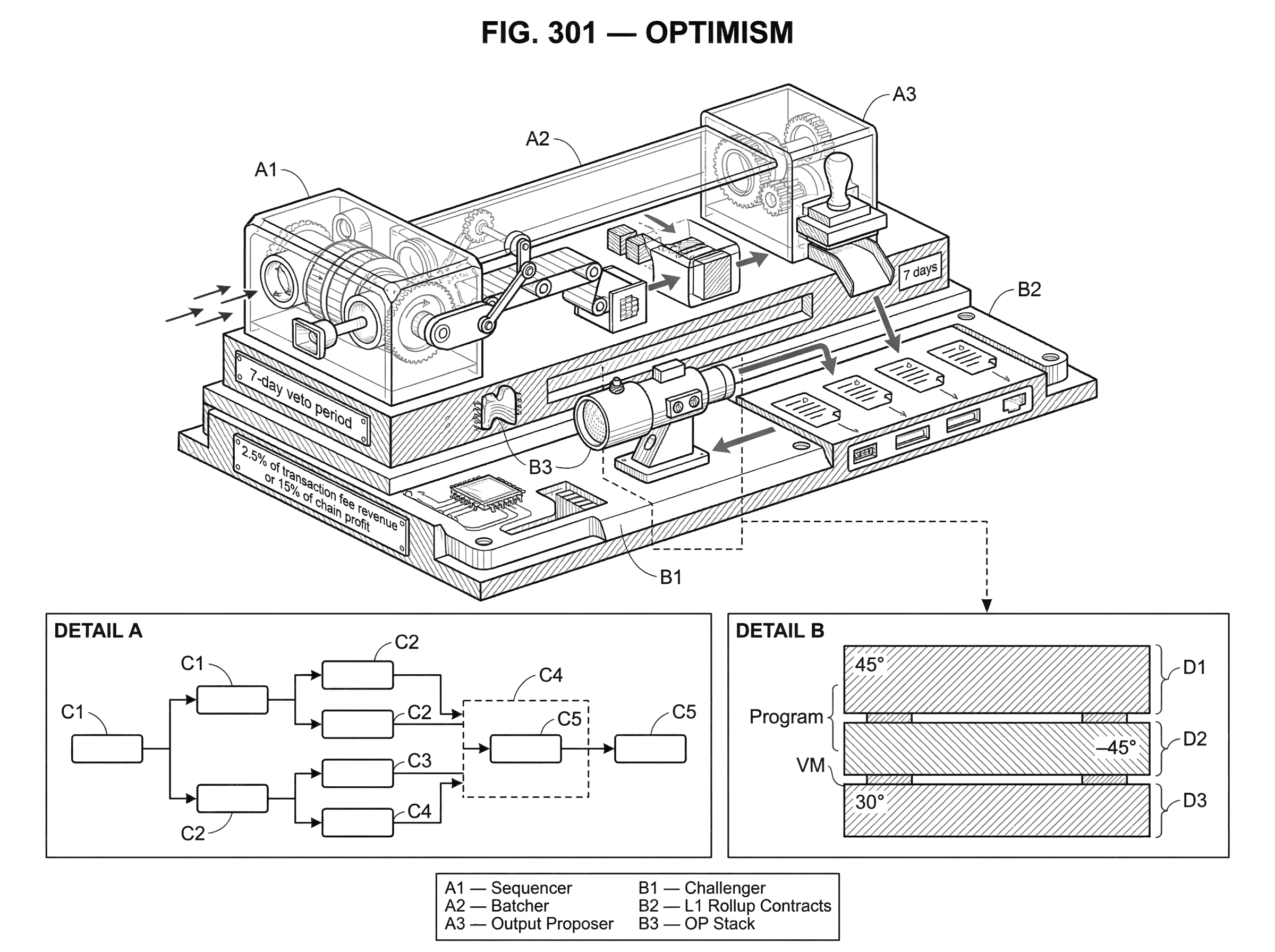
At a high level, an OP Stack chain has a few core moving parts: Layer 1 smart contracts on Ethereum, a sequencer, a batch submitter, an output proposer, and a challenger. These are not just implementation details. Together, they define who does what, where trust is placed, and how that trust is limited.
The sequencer is especially important. Optimism’s docs describe it plainly as a single privileged node that accepts and derives user transactions to construct the Layer 2 blockchain. That gives the system a clear performance advantage: one party can order transactions quickly without needing a decentralized consensus protocol for every block. But it also makes the centralization tradeoff equally clear. If the sequencer is privileged, then ordinary operation depends on it for liveness and ordering.
That does not mean the sequencer can arbitrarily rewrite reality forever. The constraint is that Layer 2 state must be derivable from data posted to Ethereum, and invalid claims can in principle be disputed. But it does mean the sequencer has meaningful short-term power over transaction ordering and user experience. Optimism improves scalability partly by simplifying the live path of block production, then relying on Ethereum and the dispute system to constrain abuse.
The batcher takes Layer 2 transaction data and submits it to Ethereum. This is the link that turns an off-chain execution environment into a rollup rather than an isolated sidechain. By using Ethereum as the data availability layer, the OP Stack allows any node to derive the Layer 2 state from Layer 1. That point is fundamental. If the transaction data were not available on Ethereum, outside observers could not independently reconstruct what happened, and the rollup security model would weaken sharply.
The proposer submits Layer 2 outputs to Ethereum. These outputs are commitments about the Layer 2 state, and they are the objects that can later be challenged if they are wrong. The system therefore separates raw transaction data publication from state-claim publication. That separation matters because the network needs both: data so others can recompute the chain, and commitments so there is a concrete claim to accept or dispute.
The challenger watches those claims and disputes invalid ones. This is the adversarial part of the design. Optimism does not stay secure because everyone is assumed honest. It stays secure, to the degree the model works as intended, because honest participants have a path to challenge dishonest outputs using data already available on Ethereum.
What happens when you swap on Optimism and later withdraw to Ethereum?
Suppose a user makes a token swap on OP Mainnet. The user sends a transaction to the Layer 2 network, and the sequencer quickly includes it in an L2 block. From the user’s perspective, the experience feels much more like using a fast application backend than waiting for Ethereum mainnet confirmation. The swap executes, balances update on Layer 2, and the application can respond almost immediately.
What made that possible is that the expensive part of Ethereum’s consensus path was avoided in the moment. The transaction did not need to be executed by Ethereum validators right away. Instead, the sequencer ordered it locally, and the chain progressed on Layer 2.
Later, the batcher posts the relevant Layer 2 transaction data to Ethereum. Now the data needed to reconstruct this stretch of Layer 2 history exists on Layer 1. Separately, a commitment to the resulting Layer 2 state is proposed on Ethereum. At that stage, the system is saying, in effect: “given this posted data, here is the resulting L2 state we claim is correct.”
If no one successfully disputes that claim, the output survives and becomes the basis for finality in the rollup’s security model. If someone believes the output is wrong, the fault-proof machinery exists to challenge it. The dispute does not require Ethereum to rerun the entire chain blindly. Instead, the system narrows disagreement until a specific disputed computation step can be checked on-chain.
Now imagine the user wants to withdraw ETH back to Ethereum. This is where the system’s second clock becomes visible. A withdrawal is initiated on Layer 2, then later proved and finalized on Layer 1. On OP Mainnet, the user-facing docs state that the withdrawal finalization period is 7 days. That delay is not a random inconvenience. It exists because Ethereum must have time to hear objections if the Layer 2 state or withdrawal claim was fraudulent.
So the same design that makes the swap cheap is also why exiting to Ethereum is slow. Optimism compresses many transactions into a cheaper execution layer, but the cost of that compression is delayed finality when funds cross back to the stricter settlement layer.
How do fault proofs and the interactive dispute game catch fraud on Optimism?
The heart of Optimism’s security model is its fault proof system. The key idea is simple: if someone posts an invalid claim about Layer 2 state, another party should be able to challenge that claim on Ethereum without Ethereum having to execute the entire Layer 2 chain itself.
The OP Stack specification breaks a fault proof into three components: a Program, a VM, and an Interactive Dispute Game. This division is more than architecture neatness. It is what makes the system modular and upgradeable.
The Program is the stateless verifier for the disputed rollup transition. Given commitments to the necessary Layer 1 inputs and the disputed claim, it deterministically computes what should have happened. The docs describe the default fault proof program as op-program, combining the consensus and execution logic into a single deterministic process. Determinism is essential here: if the same inputs could produce different outputs for different participants, there would be no stable object to dispute.
The VM, or fault-proof virtual machine, is the environment used to prove execution traces step by step. Optimism’s fault-proof design expects the VM to support on-chain verification of a single execution-trace step. That sounds narrow, but that narrowness is deliberate. Verifying an entire computation on Ethereum would be too expensive. Verifying one carefully isolated step is much more tractable.
The interactive dispute game is how the system gets from “we disagree about a long computation” to “here is one specific instruction Ethereum can check.” The dispute is resolved by bisection. Each round narrows the contested execution trace until the disagreement is reduced to a single step. At that point, on-chain verification can decide who was wrong.
This is the compression point for understanding Optimism’s dispute design: Ethereum does not need to replay the whole Layer 2 computation; it only needs a way to force disputing parties to isolate the exact point of disagreement. Once that point is small enough, Ethereum can verify it directly.
The specification also introduces a pre-image oracle, which is the only communication channel between the Program and the VM. In plain language, the proof system needs access to specific pieces of input data, and the pre-image oracle is the mechanism for requesting and serving those inputs through a minimal interface. This detail matters because it keeps the proving interface small and auditable, rather than letting the proof environment depend on vague off-chain context.
Some caution is needed here. The dispute-game interface is still described in the spec as actively changing, and the timed, bonded bisection game is noted as still in development in that reference material. So the broad mechanism is well specified, but some exact interface and operational details remain an evolving part of the stack rather than a forever-frozen design.
Why are deposits to Optimism easier than withdrawals back to Ethereum?
| Flow | Direction | Initiated on | Finalization delay | Complexity |
|---|---|---|---|---|
| Deposit | L1 → L2 | Ethereum (L1) | Immediate on L2 | Low |
| Withdrawal | L2 → L1 | Layer 2 | 7 days (challenge window) | Higher (fraud-proof) |
| Two-step withdrawal | L2 → L1 (two-step) | Layer 2 | Proof on L1 then 7 days | Reduced risk, extra steps |
Optimism becomes much easier to understand when you stop thinking of bridging as merely “moving tokens” and instead see it as passing authenticated messages between two execution domains.
A deposit is a transaction initiated on Ethereum and executed on Layer 2. The docs describe deposited transactions as L1-initiated transactions that run on L2 and can be used to submit arbitrary Layer 2 transactions from Layer 1. That is why deposits can feel relatively straightforward: Ethereum is the source of truth, so instructing Layer 2 to credit or execute something is conceptually simple.
A withdrawal runs the other direction. It starts on Layer 2 and is later finalized on Layer 1. That is harder, because Ethereum must decide whether to trust a claim originating from the cheaper execution layer. The answer is: not immediately. The claim must survive the fault-proof period first.
Optimism’s docs also note that withdrawals can be used to send arbitrary messages on Layer 1 via the OptimismPortal. This is important because the bridge is not just a token tunnel. It is a generalized cross-domain messaging system. The same mechanism that releases ETH can also trigger arbitrary L1-side calls once the withdrawal is proved and finalized.
That power is useful, but it also explains why bridge design is security-critical. A bridge is not just escrow plus accounting. It is a boundary where one domain authorizes effects in another domain. If that boundary is wrong, losses can be severe. Optimism’s Bedrock security materials are unusually direct on this point: cross-chain bridge security is hard, and some of the redesign effort focused on making exploitation more difficult rather than pretending risk disappears.
One concrete example is two-step withdrawals in Bedrock. Optimism described this as a hardening measure in which a withdrawal is initiated on OP Mainnet, proved on Ethereum earlier, and then finalized after the standard 7-day waiting period. The aim is not magic finality. The aim is to structure the bridge path so Ethereum can validate the withdrawal claim before release while preserving the challenge window.
Why does Optimism aim for Ethereum‑equivalence and a modular OP Stack?
A recurring Optimism design goal is to stay as close to Ethereum as possible. Bedrock was explicitly framed as an effort to reduce custom code, reuse Ethereum code where feasible, and get close to 100% Ethereum equivalence. That phrase matters because developer friction is often less about raw throughput than about edge cases. If a Layer 2 behaves almost exactly like Ethereum, existing wallets, tooling, smart contracts, and developer intuitions carry over more cleanly.
This has two consequences. The first is practical: less custom machinery means less code to maintain and fewer places for subtle bugs to hide. The second is strategic: if Ethereum changes, a more Ethereum-equivalent rollup can track those changes more easily. Optimism’s design philosophy has therefore been not merely “scale Ethereum” but “scale Ethereum in a way that keeps the execution environment legible to Ethereum-native developers.”
The other major design principle is modularity. The OP Stack is described as a modular Layer 2 rollup stack, and that modularity shows up clearly in the fault-proof architecture. The stack is intended to support alternative components over time, including a possible multi-proof future that may incorporate validity-proof approaches alongside fault-proof mechanisms.
That does not mean every proof model is already interchangeable in production today. It means the architecture is deliberately trying not to hard-code one eternal proving method into the entire system. This is one of the reasons the OP Stack is better understood as infrastructure, not just as “the software behind one rollup.”
What is the difference between OP Mainnet, the OP Stack, and the Superchain?
There are three layers to the Optimism story, and confusing them leads to most misunderstandings.
OP Mainnet is the flagship Layer 2 blockchain: the network users and applications interact with directly.
The OP Stack is the software framework used to build OP Mainnet and other rollup chains. Optimism describes it as open-source and modular, and the docs position it as the stack chain operators use to deploy L2s with components like the sequencer, batcher, proposer, challenger, and L1 contracts.
The Superchain is the ecosystem idea built on top of that shared stack. According to Optimism’s governance and product materials, the Superchain is a network of chains running the OP Stack that share standards, upgrades, and some economic coordination. This is why chains such as Base can be discussed both as independent networks and as part of a broader Optimism-aligned system.
This matters because Optimism is not pursuing scale only by making one chain bigger. It is also pursuing scale by standardizing many chains around a common technical base. That changes the problem from “how do we fit everything into a single rollup?” to “how do we let many chains share security assumptions, upgrades, and interoperability standards without fragmenting too badly?”
The economic piece is part of that coordination. Optimism governance materials and the Standard Rollup Charter describe a fee split for participating standard rollups: the greater of 2.5% of transaction fee revenue or 15% of chain profit, with profit defined there as fee revenue minus L1 submission cost. The idea is that sequencer revenue from participating OP Chains flows back to the Optimism Collective to support the broader ecosystem.
That is a meaningful distinction from a pure software-license relationship. Because the OP Stack is MIT-licensed, anyone can fork or deploy it. Joining the Superchain is therefore not mainly about permission to use the code. It is about opting into a shared governance, upgrade, and economic framework.
How are governance and protocol upgrades handled on Optimism?
Because the OP Stack is open-source, it is easy to imagine Optimism as purely code plus market adoption. In practice, protocol evolution also depends on governance.
Optimism’s upgrade docs describe a process in which protocol upgrades are drafted by core contributors, reviewed by an independent Developer Advisory Board, and then pass through a 7-day veto period during which affected stakeholders can override the decision. The stated aim is to avoid unilateral control by any single entity while still keeping upgrades operationally manageable.
This matters because rollups are not static artifacts. They have activation timestamps, client upgrades, governance reviews, and operational risks. The network-upgrade docs warn node operators that upgrades activate by timestamp and that failing to upgrade in time can cause chain divergence requiring a resync. In other words, Optimism is not only a theory of scaling; it is also a living software system with release discipline and governance overhead.
That is especially relevant in a Superchain setting. If many chains share a common stack, upgrades become both more powerful and more delicate. A good upgrade can improve many chains at once. A bad one can create correlated risk across many chains. Shared infrastructure increases leverage in both directions.
What are common real‑world uses for Optimism?
The mechanism would not matter much if it were only an academic design. In practice, people use Optimism because it makes Ethereum-native applications more affordable to run and easier to use.
For end users, that usually means lower transaction fees and faster confirmation than Ethereum mainnet for activities like swaps, payments, NFT interactions, gaming actions, and general smart-contract use. For developers, it means deploying applications in an environment intended to feel close to Ethereum while avoiding Ethereum’s worst fee pressure. For companies and chain operators, the OP Stack adds another option: not just building on a chain, but launching a chain with a known rollup architecture and ecosystem alignment.
That practical split is important. Optimism serves both application builders and chain builders. OP Mainnet is where many applications start. The OP Stack is what teams use when they want more sovereignty over fees, branding, configuration, or ecosystem strategy while still staying inside a shared technical family.
What assumptions does Optimism’s security and design depend on?
| Assumption | If it fails | User impact | Mitigation |
|---|---|---|---|
| Watchers and challengers | Fraud goes undetected | Loss of funds; loss of trust | Incentivize watchers; monitoring |
| Sequencer availability & honesty | Censorship or incorrect ordering | Poor UX; stalled or reordered txs | L1 fallback paths; decentralization roadmap |
| Withdrawal latency (challenge window) | Impossible to get instant L1 finality | Cannot exit quickly; liquidity strain | Liquidity bridges; pooled exit services |
| Shared-governance cohesion | Chains fork or opt out | Fragmented upgrades; correlated risk | Economic incentives; Charter rules |
Optimism’s design is powerful, but it is not free lunch.
The first assumption is about watchers and challengers. Optimistic systems only work as intended if invalid claims can actually be contested. The security model is therefore not “nobody can cheat,” but “cheating can be detected and punished before it finalizes.” If the challenge machinery is unavailable, poorly incentivized, or too centralized, the practical security picture becomes weaker than the abstract design suggests.
The second assumption is about the sequencer. The docs are explicit that the sequencer is a single privileged node in the current model. That creates clear liveness and ordering tradeoffs. Users may still have fallback paths for certain interactions through Layer 1, and deposits from EOAs can provide resilience even if the sequencer is down, but ordinary UX still depends heavily on this centralized operator role.
The third assumption is about withdrawal latency. The 7-day withdrawal window on OP Mainnet is the price of the optimistic security model. If a user needs immediate native finality back on Ethereum, Optimism does not give that by default. Applications can build liquidity solutions around the delay, but the protocol-level mechanism itself is intentionally slow on exits because speed there would undercut the challenge process.
The fourth assumption is social as much as technical: the shared-governance model of the Superchain must remain attractive enough that chains continue coordinating rather than simply forking the stack and going their own way. Open-source modularity is a strength, but it also means ecosystem cohesion cannot be taken for granted.
Conclusion
Optimism is best understood as a way to shift execution away from Ethereum without shifting final accountability away from Ethereum. It does this by letting a fast Layer 2 sequencer handle day-to-day transaction flow, posting the relevant data and commitments to Ethereum, and relying on fault proofs to challenge invalid results.
Everything else follows from that choice. Cheap transactions come from not proving everything on Layer 1 immediately. Slow withdrawals come from leaving time to dispute fraud. The OP Stack exists because once you build this architecture well, it can power not just one chain but many. And the Superchain exists because shared standards, upgrades, and economics can turn a rollup design into a broader ecosystem strategy.
If you remember one thing tomorrow, remember this: Optimism is not trying to replace Ethereum. It is trying to let Ethereum support far more activity by moving the work off-chain while keeping Ethereum as the place where disputes are settled.
How do you get Optimism exposure?
Buy the OP token (Optimism’s native token) on spot markets to get direct exposure to the Optimism ecosystem. On Cube Exchange the typical path is: fund your account, open the OP spot market, and place an order; the steps below show that exact workflow on Cube.
- Deposit fiat via the on‑ramp or transfer a supported stablecoin (USDC/USDT) into your Cube account.
- Open the OP/USDC or OP/USDT spot market from Cube’s markets list.
- Select an order type: use a limit order for price control or a market order for immediate execution; for low liquidity pairs prefer a limit order with a small price offset.
- Enter the OP amount or how much USDC/USDT you want to spend, review estimated fill, fees, and slippage, then submit the order.
- After the trade, set a stop‑loss or take‑profit order if you want automated downside protection or target exits.
Frequently Asked Questions
Because Optimism provisionally accepts Layer 2 outputs and then gives observers time to detect and dispute invalid claims, OP Mainnet enforces a 7‑day withdrawal finalization period so Ethereum has time to hear and resolve any challenges before funds move back to L1.
Optimism posts Layer 2 transaction data and state commitments to Ethereum so anyone can reconstruct L2 state, and it relies on an optimistic model plus fault proofs (challenges) to catch invalid claims rather than having Ethereum re‑execute every transaction.
The sequencer is a single privileged node that orders and publishes L2 transactions quickly, which improves performance but creates a short‑term centralization dependency for liveness and ordering; that power is mitigated by posting data to L1 and by the protocol’s dispute mechanisms.
A fault proof is split into a Program (deterministic verifier), a VM that can prove single execution steps on‑chain, and an interactive dispute game that bisects contested execution traces until a single step can be verified by Ethereum; a pre‑image oracle is used to fetch required inputs during the proof.
A deposit is an L1‑initiated transaction executed on L2 (straightforward because Ethereum is the source of truth), while a withdrawal originates on L2 and must survive the L1 challenge/fault‑proof period before being finalized on Ethereum, which makes withdrawals slower and asymmetric compared with deposits.
Optimism’s governance process has core contributors propose upgrades, a Developer Advisory Board reviews them, and upgrades pass subject to a 7‑day veto period; node operators must upgrade by activation timestamps or risk chain divergence.
Optimism’s security model assumes active, incentivized watchers/challengers who will dispute invalid outputs, an operational sequencer (whose central role creates liveness and ordering assumptions), the enforced withdrawal latency (the challenge window), and continued social coordination around shared Superchain governance.
OP Mainnet is the flagship Layer 2 network users interact with, the OP Stack is the open‑source modular rollup software used to build chains, and the Superchain is the ecosystem of OP Stack chains that opt into shared standards, upgrades, and a fee‑sharing framework (e.g., the documented fee split rule).
Related reading