What is a Smart Contract?
Learn what smart contracts are, why blockchains use them, how on-chain execution works, and where smart contract trust and automation break down.
Introduction
Smart contracts are programs that run on a blockchain and enforce pre-specified rules for how digital state can change. That sounds straightforward, but it hides the interesting question: why did blockchains need this idea at all?
Ordinary software already automates business logic. Banks, exchanges, games, and marketplaces all run code that updates balances, permissions, and records. The difference is that ordinary software runs under the control of some operator. If you use a trading app, the company decides what code runs, when it changes, and which database entry counts as truth. A smart contract tries to move part of that logic into a shared execution environment where the rules are public, the results are replicated by many nodes, and changing the rules is intentionally difficult.
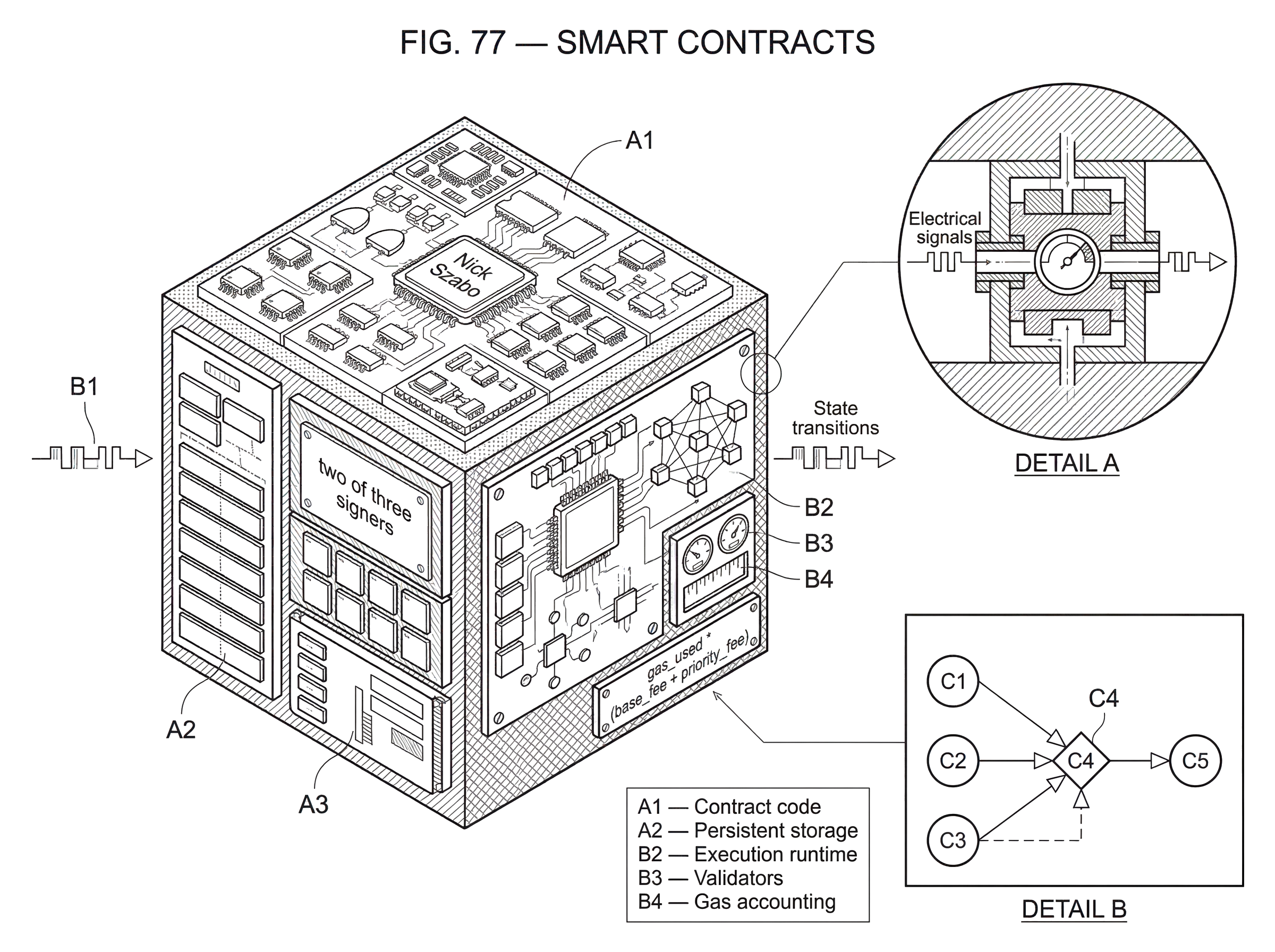
That shift is the point. A smart contract is not merely automation; it is automation in an environment designed so that multiple parties can rely on the same execution without trusting a single intermediary to carry it out faithfully. Nick Szabo’s early formulation remains useful here: a smart contract is a set of promises, specified in digital form, including protocols within which the parties perform on these promises. In later blockchain systems, those protocols became on-chain programs that hold assets, check conditions, and update state according to code everyone can inspect.
The core intuition is simple: if assets and rules both live in the same shared system, then some agreements can be enforced by execution rather than by later dispute. That is why smart contracts became central to blockchains. They let a network do more than record transfers. They let it host applications whose rules are part of the ledger itself.
What problems do smart contracts solve for blockchains and users?
| Option | What it enforces | Guarantee | Typical cost | Best when |
|---|---|---|---|---|
| Off-chain coordination | Agreements off-ledger | Legal or manual enforcement | Human mediation cost | Complex subjective terms |
| On-chain smart contracts | Programmatic state rules | Deterministic enforcement | Deployment plus gas costs | Algorithmic conditions |
| Hybrid (on-chain settlement) | Off-chain logic, on-chain settlement | Finality for settlement | Integration complexity | When settlement finality matters |
Before smart contracts, blockchains were mostly good at one narrow thing: moving a native asset according to simple validity rules. That is already valuable. Bitcoin, for example, showed that a distributed network can agree on who owns which coins without a central operator. But many economic relationships need more than simple transfers. They need conditional transfers, shared control, delayed release, issuance rules, collateral checks, auctions, voting logic, or restrictions on who may do what and when.
You can always handle those conditions off-chain with contracts, institutions, and manual coordination. But then the blockchain becomes just a settlement rail underneath a thicker layer of trust. Someone has to interpret the agreement, decide whether a condition was met, and push the right transaction. If the parties disagree, enforcement moves outside the system.
Smart contracts try to collapse some of that gap. If the relevant conditions can be expressed algorithmically, then the blockchain itself can evaluate them. This matters most when the costly part of an agreement is not writing down the promise but making performance happen as specified. A vending machine is the old analogy: if you insert the right amount and press the right button, the machine dispenses the product automatically. You do not need a cashier to interpret the contract after the fact. The analogy explains the enforcement idea well. Where it fails is that blockchains deal mostly with digital state, not physical delivery, and many real agreements depend on facts no chain can observe by itself.
So the real problem smart contracts solve is narrower than the hype suggests and more useful than the slogan suggests. They reduce the need to trust a central operator for algorithmically specifiable commitments over shared digital assets and shared digital state.
What is a smart contract (how code and state form an on‑chain program)?
On a modern smart-contract platform, a contract is usually two things at once: code and state.
The code defines what operations are allowed. The state stores the contract’s current facts: balances, owners, votes, deadlines, collateral amounts, configuration, and so on. Users send transactions to the contract’s address. Nodes in the network execute the contract code against the current state, and if the transaction is valid, the state changes in a way every validating node can reproduce.
That is the mechanical heart of the idea. A smart contract is not a PDF agreement stored on-chain. It is not “smart” because it understands intentions. It is a stateful program whose transitions are constrained by consensus rules.
Ethereum made this model famous by treating contracts as accounts in a global state. An Ethereum account contains fields such as a nonce, balance, code, and persistent storage. A contract account is simply an account with code attached, and that code runs when the contract receives a message or transaction. Formally, Ethereum describes execution as a state transition: a prior world state plus a transaction yields a next world state. That formalism matters because every node must compute the same result from the same inputs.
The language around smart contracts can be misleading here. People often say “the contract executes itself.” That is only partly true. The contract does not wake up on its own in the abstract. Someone submits a transaction, pays for execution, and causes the network to evaluate the code. What is self-enforcing is not spontaneous action but the fact that, once invoked under valid conditions, the network applies the program’s rules rather than an operator’s discretion.
Why must smart contract execution be deterministic?
If many nodes are going to run the same contract, they must all get the same answer. This requirement is deeper than most first encounters with smart contracts suggest. In ordinary computing, a program can read the current time, call an external API, inspect a local file, or use randomness from the operating system. In blockchain execution, those conveniences are dangerous. If different nodes observe different inputs, they will disagree about the resulting state, and consensus breaks.
That is why smart contract execution must be deterministic. Given the same pre-state and the same transaction input, every validator must derive the same post-state. This is the invariant around which the rest of the design is built.
From this follow several consequences. Contracts cannot freely access off-chain data on their own. They cannot just ask “what is the weather?” or “what is the ETH/USD price right now?” because different nodes would not have a consensus-safe answer unless that data is brought on-chain in a controlled way. Contracts also cannot run forever. The network needs bounded execution, so platforms meter computation and reject or halt work that exceeds limits.
This is also why smart contracts feel more constrained than ordinary backend code. Those constraints are not an accident or a temporary tooling problem. They are what make shared execution possible.
How does on‑chain smart contract execution actually work?
The easiest way to make this concrete is to follow a simple example. Imagine a shared wallet that requires any two of three signers to approve a transfer.
The contract stores three authorized public keys and a threshold value of two. It may also store a record of pending transactions so approvals can accumulate over time. When someone proposes sending funds, they submit a transaction to the contract with the destination, amount, and perhaps an identifier for the proposal. The contract records that proposal in storage but does not yet release funds, because only one approval exists.
A second signer later submits another transaction approving the same proposal. Now the contract checks the stored approvals against its threshold rule. If the count reaches two, the contract marks the proposal executable and transfers the funds. No bank employee interprets whether the threshold was met. No single signer can unilaterally move the assets. The mechanism is just state plus code: store approvals, count valid signers, release funds only when the invariant is satisfied.
This example is simple, but it shows why contracts are useful. The parties are not outsourcing trust to an operator. They are outsourcing execution to a public state machine whose behavior is visible in advance.
On Ethereum, this execution happens inside the Ethereum Virtual Machine, or EVM. The EVM is a stack-based Virtual Machine with persistent storage attached to accounts. Transactions provide input data and gas. The network executes bytecode instruction by instruction, updates storage if execution succeeds, and records the resulting state root in the block. If execution halts exceptionally, such as by running out of gas, the intended state changes are reverted, though the user still pays for the computational work consumed.
That last point is important. Smart contract execution is not free-form computation; it is priced computation under consensus.
How does gas control and price smart contract execution?
A beginner often sees gas as an annoying fee mechanism. It is more fundamental than that. Gas is how a platform makes general computation safe enough to expose to the public.
Ethereum deliberately chose a highly expressive, quasi-Turing-complete execution model. That means contracts can encode very general logic, but it also means the platform must defend itself against infinite loops, excessive computation, and denial-of-service attacks. The main solution is economic rather than purely syntactic: each instruction has a gas cost, each transaction specifies a gas limit, and execution stops if the gas is exhausted.
This creates a hard bound on how much work any transaction can force the network to perform. If a transaction runs out of gas, its state changes revert, but the gas spent is still consumed. That rule prevents users from making validators do arbitrary work for free.
Gas also prices scarce blockspace. On Ethereum today, users effectively pay for gas_used * (base_fee + priority_fee), where the base fee is protocol-set per block and burned, and the priority fee is the tip that incentivizes inclusion. This fee machinery is often discussed as economics, but at a deeper level it is part of execution design. A smart contract platform cannot be open to anyone and support arbitrary computation unless it has a credible way to meter and price resource use.
Other platforms solve the same problem differently. Solana programs, Cardano’s Plutus scripts, CosmWasm contracts, Polkadot ink! contracts, and Move-based systems such as Aptos all support on-chain programmable logic, but they differ in their state models, runtimes, and resource accounting. The unifying idea is not “EVM-style code.” It is publicly validated programmatic state transitions under constrained execution.
Which blockchains support smart contracts and how do their models differ?
| Platform | State model | Expressiveness | Best for | Typical limits |
|---|---|---|---|---|
| Bitcoin | UTXO scripting | Limited (no loops) | Spending conditions | Simple, safe policies |
| Ethereum (EVM) | Account global state | Turing-complete | DeFi, composable apps | Gas, node load |
| Cardano (Plutus) | EUTXO with scripts | Turing-complete via Haskell | Predictable validation | Haskell toolchain required |
| Solana | Program + accounts | High-performance BPF | Low-latency apps | Concurrency complexity |
| Wasm / Move chains | Wasm or Move objects | Safe modular execution | Custom chains and apps | Diverse tooling ecosystems |
Ethereum is the canonical example because it made general-purpose smart contracts mainstream, but the idea is not specific to Ethereum’s architecture.
Bitcoin already had a limited scripting system. Bitcoin Script is stack-based and intentionally not Turing-complete: no loops, narrow expressiveness, validation-oriented design. That restriction is not a defect in the way a missing feature in a normal app would be a defect. It is a design choice on the expressiveness-versus-safety spectrum. Bitcoin uses scripting to express spending conditions, not to host arbitrary general applications.
Cardano’s Plutus takes a different route through the extended UTXO model. There, transaction validity depends on scripts attached to outputs and on the transaction’s inputs, which gives developers stronger local reasoning about what a transaction will do if the needed inputs remain available. Solana separates code and state more explicitly: programs are deployed separately from the accounts whose data they manipulate, and programs compose through cross-program invocation. CosmWasm and ink! compile smart contracts to WebAssembly-based environments. Aptos uses Move, a language and execution model shaped strongly by resource semantics.
These systems are not cosmetic variations. They express different answers to the same underlying question: how should a decentralized system expose programmable state changes without sacrificing too much safety, performance, or verifiability?
So when people say “smart contract,” the concept to keep in mind is not a specific language like Solidity. It is an architectural role: code that the network itself validates and executes as part of state transition.
What real use cases do smart contracts enable?
The obvious use is asset transfer under conditions. Tokens are the clearest example. A fungible token contract keeps a ledger in its own storage and updates balances according to transfer rules. An NFTs contract records ownership and transfer permissions for unique items. A vault contract may accept deposits and mint claims against pooled assets. A governance contract may count votes and, if conditions are met, queue or execute a protocol change.
Notice the common mechanism. The contract is the rulebook for a shared state. Instead of relying on a company database to define balances or permissions, the contract itself defines how those values change.
This is why smart contracts became the foundation for DeFi. Lending markets, decentralized exchanges, derivatives, automated liquidations, staking systems, and stablecoin mechanisms all depend on contracts holding assets and updating rights according to explicit formulas and thresholds. It is also why multisig wallets are contract-based on many chains: the wallet itself is a programmable policy, not merely a keypair.
Szabo’s earlier idea of smart property also appears here. If control over an asset depends on possession of the right cryptographic authorization, then transfer of control can be partly automated by the system. On-chain tokens are the pure digital case. More ambitious versions try to connect on-chain rights to off-chain objects or services, but that connection is only as strong as the external enforcement around it.
When and why do smart contracts fail or become unreliable?
The most important limitation is that smart contracts only directly control what the chain itself can represent. If a contract manages an ERC-20 token, it can enforce transfer rules exactly because the token ledger is on-chain. If the contract is supposed to respond to wheat prices, court rulings, election results, shipping arrivals, or whether a real apartment was actually vacated, then the chain needs outside information.
That is where oracles enter. An oracle is a mechanism for bringing off-chain data on-chain so contracts can use it. But the moment you do that, your trust model changes. The contract may still execute deterministically once the data is supplied, yet the truth of the input now depends on the oracle design. This is why “code is law” is too blunt. More often, code is law conditional on the correctness of inputs and the adequacy of the specification.
There is another limitation that is more conceptual than technical: many agreements are incomplete or intentionally flexible. They rely on standards such as reasonableness, best efforts, material adverse change, good faith, or human interpretation of context. Those are not bugs in legal systems. They are adaptations to a messy world. A smart contract can only enforce what has been made precise enough to compute.
Szabo emphasized this early: smart contracts can secure many algorithmically specifiable relationships. The phrase matters. It is not all relationships. It is the subset whose relevant conditions can actually be expressed in code.
How does smart contract immutability create both benefits and risks?
A deployed smart contract is often treated as immutable by default. On Ethereum, contracts cannot simply be deleted or edited like a web app backend. That gives users confidence that the rules they inspected are the rules that will run. But it also means bugs can become durable infrastructure.
This is not a theoretical concern. Smart contract history is full of failures caused by flawed assumptions, bad access control, unsafe external calls, broken upgrade paths, oracle manipulation, and subtle logic errors. Reentrancy became famous because contract composition means one contract can call another before finishing its own accounting. Access-control mistakes have caused some of the largest losses in practice. The Parity multisig library incident showed how shared contract components and initialization mistakes can freeze enormous amounts of value. Bridge exploits such as Wormhole showed how a flaw in contract logic can create unbacked assets and systemic contagion across protocols.
The mechanism behind these failures is usually not mysterious after the fact. A contract allowed a state transition that its designers did not intend. What makes smart contracts uniquely unforgiving is that the state transition is public, valuable, and often irreversible once consensus accepts it.
That is why smart contract development puts unusual weight on audits, testing, formal reasoning, and well-reviewed libraries. Solidity’s own documentation stresses code review, testing, audits, and correctness proofs. Formal EVM semantics such as KEVM exist because implementers and researchers want machine-checkable ways to reason about execution. Production teams often rely on battle-tested libraries such as OpenZeppelin not because reuse is fashionable, but because reducing custom logic reduces the space of unknown failure modes.
How do smart contracts change where you must place trust?
| Component | You still trust | Failure mode | Mitigation |
|---|---|---|---|
| Consensus | Protocol correctness and liveness | Censorship or chain forks | Diverse validators and clients |
| VM and clients | Correct bytecode execution | Implementation bugs | Conformance tests, formal specs |
| Compiler and toolchain | Source-to-bytecode fidelity | Compiler-introduced bugs | Reproducible builds, audits |
| Oracles | Correctness of external data | Data manipulation or relay faults | Decentralized feeds, attestations |
| Privileged keys | Upgrade and admin authorities | Key compromise or misuse | Multisig, timelocks, audits |
A common misunderstanding is that smart contracts “remove trust.” They do not. They rearrange it.
You may trust the on-chain execution more and a central operator less. But you still trust many things: the protocol’s consensus, the correctness of the virtual machine implementation, the compiler, the contract code, the upgrade keys if any exist, the oracle network if off-chain data matters, the key management of privileged roles, and the social governance around emergencies. Even identity is tricky. Szabo pointed out long ago that certificates do not magically prove real-world identity; they prove that some authority made some claim at some time. Binding keys to people, organizations, and legally meaningful rights remains an open problem in many settings.
So the honest claim is not that smart contracts eliminate trust. It is that they can reduce certain kinds of discretionary trust and replace them with transparent, mechanically enforced rules; at the cost of new technical trust assumptions.
What is composability in smart contracts and why does it matter for protocols?
One feature of blockchain smart contracts that is easy to overlook at first is that they are often public and callable by other contracts. On Ethereum, contracts can call other contracts and even deploy new ones. This means protocols can act like open infrastructure rather than closed applications.
That property has huge consequences. A decentralized exchange can become a building block inside a lending market. A token standard can become a shared interface used by wallets, marketplaces, and vaults. A multisig can become the administrative controller of another protocol. A governance contract can own an upgrade contract which in turn controls the logic behind an application.
Composability is powerful because it lets systems inherit functionality instead of rebuilding it. But it also creates dependency chains. If your contract depends on another contract’s behavior, then its assumptions about callbacks, failures, upgrades, and pricing need to be correct. This is one reason external calls are so dangerous and so central to smart contract security.
Conclusion
A smart contract is best understood as shared, consensus-validated program logic that controls blockchain state according to pre-specified rules. Its importance does not come from the code being “smart.” It comes from the fact that multiple parties can rely on the same execution without handing discretion to a single operator.
That works well when the commitments are algorithmically specifiable and the relevant assets or facts are available on-chain. It works less well when the agreement depends on messy human judgment or uncertain off-chain data. The power of smart contracts is real, but so are their limits: determinism constrains them, gas prices them, immutability hardens them, and bugs weaponize them.
The short version to remember tomorrow is this: smart contracts let blockchains enforce rules, not just record transfers; but only the rules that can actually be computed and trusted inside the system’s execution model.
How does this part of the crypto stack affect real-world usage?
Smart Contracts affects how a network or execution environment behaves in practice, so it should inform your setup before you trade or move funds on Cube Exchange. The safe workflow is to verify network assumptions first and only then fund the related market.
- Identify the chain or asset whose behavior depends on this execution or scaling concept.
- Check the compatibility, throughput, or tooling constraint Smart Contracts implies for wallets, transfers, or market access.
- Confirm you are using the correct asset, network, and settlement path before funding the account.
- After those checks, open the relevant market on Cube and place the trade with the network constraint in mind.
Frequently Asked Questions
A user (or another contract) submits a transaction that includes input data and pays for execution; network validators run the contract code against the current state, and if the transaction is valid all nodes reproduce the same state transition. Contracts do not spontaneously run on their own - their code executes only when invoked and paid for.
Not by itself - contracts cannot freely read off‑chain facts; they need data to be brought on‑chain by an oracle or another controlled mechanism, and when you rely on oracles your trust assumptions shift because the correctness of execution then depends on the oracle design.
Execution must be deterministic so every validator produces the same post‑state from the same pre‑state and transaction; that requirement prevents contracts from using arbitrary external inputs and forces bounded, metered computation so nodes cannot disagree or be forced to do unbounded work.
Gas is the platform's metering mechanism: it assigns a cost to each instruction to prevent infinite loops, denial‑of‑service, and excessive computation while also pricing scarce blockspace; users still pay gas when execution runs out and is reverted, and modern fee models separate a protocol base fee from a tip that rewards validators.
No - the technology rearranges trust rather than eliminating it: you replace some discretionary trust in operators with new technical trusts such as the consensus protocol, virtual machine implementation, compiler correctness, oracle feeds, key management, and any privileged upgrade keys or governance processes.
Contracts are immutable by default, so bugs and unintended behaviors can become permanent unless the code was designed with an upgrade pattern or governance mechanism; real incidents (e.g., Parity multisig, bridge exploits) show how durable bugs can freeze or lose large amounts of value and why audits and careful patterns matter.
Different platforms place different weight on expressiveness versus safety: Bitcoin Script deliberately limits expressiveness for validation safety, Ethereum opts for generality with economic metering (gas), and models like EUTXO, Solana's program/state separation, CosmWasm, and Move each expose different trade‑offs for local reasoning, composability, and resource accounting.
Composability lets contracts call and reuse each other, turning protocols into building blocks that accelerate innovation, but it also creates dependency chains where one contract's bugs, upgrade decisions, or unexpected callbacks can cascade into others - making careful assumptions about external calls and dependencies essential for security.
Prefer on‑chain contracts when the rules and relevant facts can be expressed algorithmically and the assets or rights live on‑chain; do not rely on smart contracts when agreements require subjective judgment, messy human interpretation, or control over physical objects unless a reliable off‑chain enforcement or oracle mechanism is in place.
Related reading