What is TRON?
Learn what TRON is, how its DPoS consensus, Super Representatives, TVM, and Bandwidth/Energy resource model work, and why the network feels fast.
Introduction
For the token explainer, see TRX.
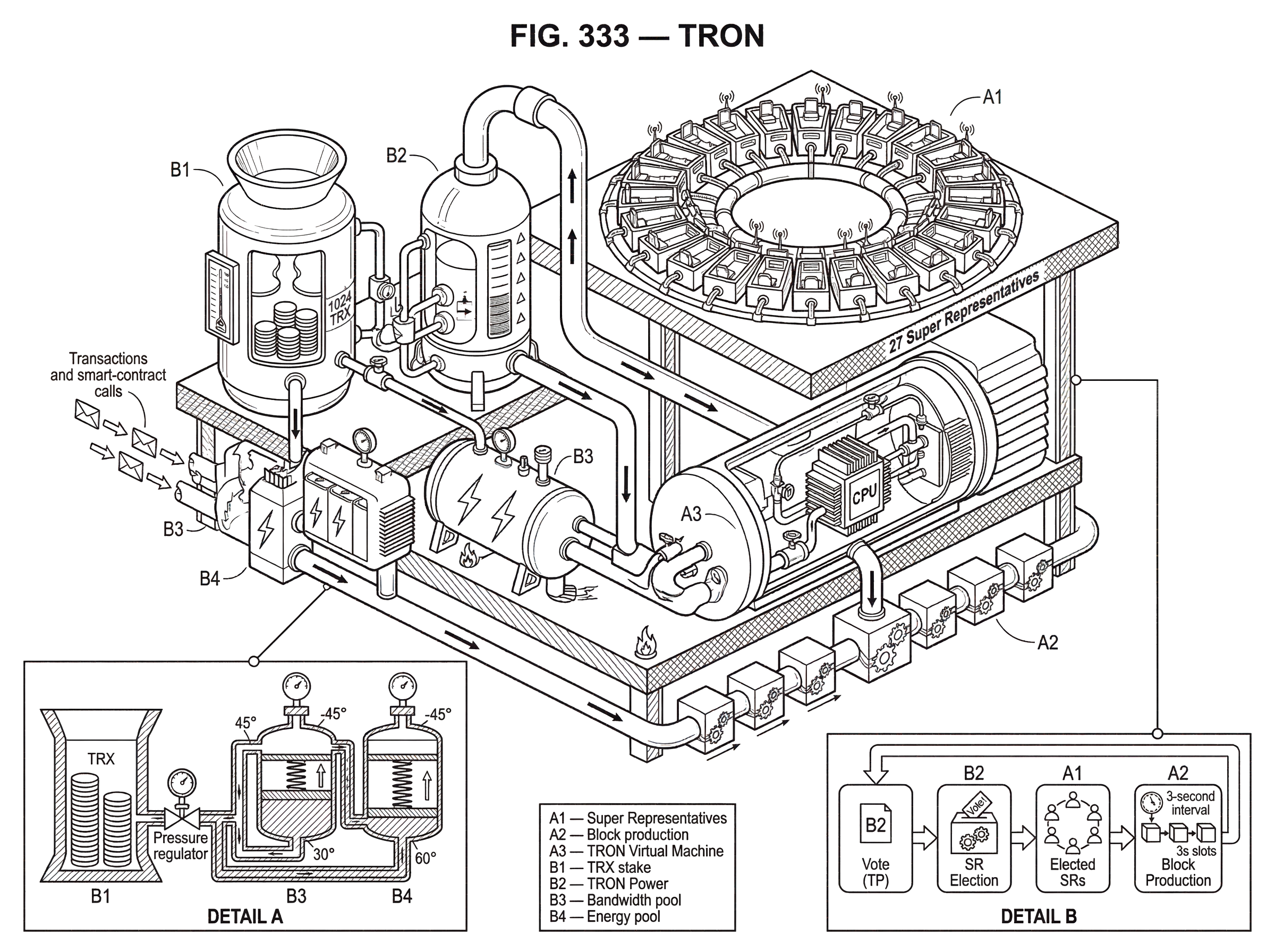
TRON is a blockchain network designed to make digital payments and smart-contract activity fast, inexpensive, and easy to integrate into applications. The interesting thing about TRON is not just that it supports tokens and decentralized apps (many chains do that) but how it tries to lower friction. Instead of making every action feel like a direct fee payment, TRON turns network usage into a resource-allocation problem: stake the native token TRX, receive resources such as Bandwidth and Energy, and spend those resources when you transact.
That choice shapes almost everything else. It affects how users experience fees, how developers think about scaling, why TRON’s smart-contract environment feels familiar to Ethereum developers, and why the network’s governance is concentrated in a relatively small set of elected block producers called Super Representatives. If you understand that TRON is trying to be a high-throughput smart-contract chain where access to computation and storage is mediated by staked resources rather than only by per-transaction payment, most of the rest starts to click.
At the protocol level, TRON combines three ideas. It uses Delegated Proof of Stake rather than open-ended validator participation. It runs smart contracts on the TRON Virtual Machine, which is designed to be highly compatible with the Ethereum tooling world. And it prices activity through a resource model built around Bandwidth, Energy, and voting power. Those are not separate features pasted together. They are the mechanism by which TRON tries to produce quick blocks, relatively predictable costs, and a user experience that can make frequent token transfers practical.
What problem does TRON try to solve with stake‑backed resources?
A general-purpose blockchain has to do three things at once. It has to decide who can add the next block, it has to execute user actions in a deterministic way, and it has to ration scarce shared resources so one user cannot crowd out everyone else. Different networks solve that triangle differently. Bitcoin makes deliberate tradeoffs in favor of simplicity and conservatism. Ethereum exposes a more expressive execution environment and uses a gas market to price computation. TRON’s design starts from a different intuition: if the chain is meant to support frequent token movement and application traffic, then users and applications need a way to reserve capacity rather than bidding afresh for every action.
That is why TRON’s core mechanism is not “fees” in the everyday sense. It is better understood as prepaid access to network capacity. A plain transfer consumes Bandwidth, which is tied to transaction size in bytes. Smart-contract execution consumes Energy, which measures computation in the TRON Virtual Machine. If you have enough of those resources, the action can proceed without the experience of paying an ordinary cash fee at the moment of use. If you do not, the protocol falls back to burning TRX to cover the shortfall.
This is not the same as saying TRON has no fees. The official documents are careful here. Transactions and contract calls consume resources, and if those resources are insufficient, TRX is burned. So the right picture is not “free blockchain,” but resource-first pricing with token burn as the overflow path. That model is especially relevant for wallets, payment applications, and stablecoin flows where many transactions may be small and frequent.
How does TRON’s DPoS consensus and Super Representative system work?
| Aspect | TRON (DPoS, 27 SRs) | Large validator set |
|---|---|---|
| Block cadence | ≈3 second slots | Variable by protocol |
| Finality model | SR confirmations (70% approval) | Probabilistic or delayed finality |
| Throughput predictability | High and predictable | Less predictable under load |
| Governance & upgrades | On-chain SR parameter votes | Offline coordination or hard forks |
| Trust assumption | Higher reliance on small SR set | Distributed trust across many validators |
TRON uses Delegated Proof of Stake, or DPoS. The simple intuition is that not every staker produces blocks. Instead, token holders vote, and a small elected set of nodes takes responsibility for block production. On TRON, the key group is the set of 27 Super Representatives, usually shortened to SRs. They are the block producers.
Mechanically, voting power comes from staking TRX. The docs describe this voting power as TRON Power, or TP, with a one-to-one relationship: stake 1 TRX, receive 1 TP. Those votes are used to rank candidates. The top 27 become SRs for the next epoch, while lower-ranked candidates up to rank 127 still matter because they can receive vote rewards as SR partners, even though they do not produce blocks.
Block production is deterministic rather than competitive. TRON treats each 3-second interval as a slot, and the 27 SRs take turns producing blocks in round-robin order. That has an important consequence. In systems with a small scheduled producer set, throughput and latency can be more predictable because the protocol does not need an open competition among thousands of validators to decide who speaks next. The cost is that the system depends more heavily on the honesty and operational reliability of a small governing set.
The docs also define a notion of solidified or irreversible blocks based on approval by more than 70% of SRs through subsequent block production. The exact wording in the developer documentation appears internally inconsistent in one place, so it is safest to keep the high-level point: TRON’s finality model is tied to continued confirmation by the elected SR set rather than to the probabilistic accumulation of proof-of-work. In practice, that means users often experience quick block times and relatively fast practical finality, but the trust assumptions are different from more decentralized validator systems.
This governance structure is not only about liveness. It also governs change. TRON’s current 27 SRs form the committee that can vote on protocol proposals affecting dynamic network parameters. The protocol documentation emphasizes that many parameter changes can be proposed and approved on-chain without requiring a traditional hard fork process for every adjustment. That makes the network adaptable, but it also means that the people with decisive control over block production are the same people with decisive influence over many protocol settings.
How do Bandwidth and Energy make TRON different from a normal fee market?
| Metric | Stake (prepaid resources) | Burn (pay-as-you-go) |
|---|---|---|
| When cost is paid | At stake time | At transaction time |
| Resource access | Allocated Bandwidth and Energy | TRX burned to cover shortfall |
| Predictability | More predictable if stake stable | Variable with usage spikes |
| Best for | High-volume recurring actions | Infrequent or sporadic use |
| Reclaim delay | 14-day unstake period | No lock, immediate effect |
The most distinctive thing about TRON for everyday users is its resource model. There are three system resources to keep in view: Voting Right through TP, Bandwidth, and Energy. Voting Right governs SR elections. Bandwidth covers ordinary transaction data. Energy covers smart-contract computation.
Here is the mechanism in plain language. Every transaction occupies bytes in the chain’s data structures, so the network charges for bytes using Bandwidth. The developer docs state that 1 byte consumes 1 unit of Bandwidth. Smart-contract execution is more expensive because it requires the virtual machine to run instructions, touch state, and potentially branch through complex logic. That consumption is measured in Energy. The protocol allocates both Bandwidth and Energy primarily through staking TRX.
This is the key invariant: staking converts a liquid token into a claim on recurring network capacity and governance weight. If many users stake, they are not just locking assets. They are dividing up a fixed daily pool of network resources. The resource model docs describe fixed daily supplies for Bandwidth and Energy distributed proportionally according to how much TRX is staked for those purposes. That means the amount of useful capacity you get per staked token is not absolutely fixed; it depends on the total amount staked by everyone else.
There is also a free tier, but it is limited. The whitepaper mentions 5000 free daily Bandwidth Points, while the more detailed resource-model documentation states that each external account receives 600 free Bandwidth per day. Given the mismatch, the safest conclusion is not to rely on a specific “free” figure without checking current docs or on-chain parameters. What matters conceptually is that TRON provides some baseline transaction capacity to accounts, then encourages heavier users to stake for more.
If an account lacks enough Bandwidth or Energy, the protocol burns TRX to make up the difference. So staking and burning are two paths to the same end: access to blockspace and computation. Staking is the reservation path; burning is the spot-purchase path.
That distinction matters for application design. Suppose a wallet provider or payments app expects a large number of token transfers every day. On a chain with only direct fees, the operator simply pays those fees transaction by transaction. On TRON, the operator can instead stake a stock of TRX to obtain Bandwidth and Energy, then use or delegate those resources to reduce marginal transaction costs. The network is, in effect, offering a choice between owning capacity and renting capacity on demand.
How does sending a TRC‑20 token on TRON use Bandwidth and Energy?
Imagine a user wants to move a token on TRON. If the token is a simple asset transfer that does not involve a smart contract in the way a TRC-20 transfer does, the main resource pressure may be Bandwidth, because the chain must store and relay the transaction bytes. If the user has enough staked Bandwidth (or enough free daily Bandwidth) the transfer can go through without feeling like a direct fee payment.
Now change the example to a TRC-20 token transfer. That looks simple from the wallet interface, but under the hood it is a smart-contract call. The network must execute contract code in the TVM, check balances in contract storage, update state, emit logs, and finalize the result. That means the action consumes Energy as well as Bandwidth. If the account has staked or delegated Energy, the call draws down that resource. If not, the protocol burns TRX according to the Energy price.
This is why two actions that both appear as “send token” to a user can have different economic behavior. The visible operation is similar; the hidden mechanism is not. TRON makes that difference especially important because the chain supports both native-style token mechanisms such as TRC-10 and smart-contract tokens such as TRC-20.
What is the TRON Virtual Machine (TVM) and how is it EVM‑compatible?
TRON’s contract platform is the TRON Virtual Machine, or TVM. The most useful way to think about TVM is as an execution environment designed to lower migration costs for developers already familiar with Ethereum’s ecosystem. The official whitepaper describes TVM as lightweight, Turing-complete, and initially forked from the EVM, with high compatibility with Solidity-based development.
That compatibility is strategically important. A smart-contract platform does not only compete on raw throughput. It competes on the difficulty of getting developers, wallets, explorers, libraries, and auditing habits to work on it. By being EVM-like, TRON reduces the amount of conceptual retraining needed to deploy familiar token contracts and application patterns.
But TVM is not just EVM with a different logo. The cost model differs because TRON uses Energy rather than Ethereum’s gas denomination. In principle those play similar roles: they meter computation to prevent abuse and price execution. In practice, the user experience differs because Energy can be obtained via staking and delegation instead of always being purchased at execution time.
TRON also adds a further control layer through its Dynamic Energy Model. This is one of the more revealing pieces of the protocol because it shows what problem the designers were worried about. If a contract becomes extremely popular, it can consume a disproportionate share of network resources. The resource-model docs say that a contract whose basic Energy use crosses a threshold in a maintenance cycle can face punitive additional consumption through an energy_factor, with effective Energy computed as base usage multiplied by 1 + energy_factor.
The idea is straightforward: highly resource-intensive hotspots should become more expensive, discouraging concentration and reducing the chance that a single application monopolizes execution capacity. The consequence is less straightforward: developers face more complex cost predictability, especially for popular contracts. A contract that is cheap when lightly used may become noticeably more expensive under heavy demand. So TRON’s resource model is not simply “cheap contracts.” It is conditional cheapness subject to capacity-sharing rules and dynamic penalties.
TRC‑10 vs TRC‑20 tokens; what are the differences and trade‑offs?
| Feature | TRC-10 | TRC-20 |
|---|---|---|
| Implementation | Native protocol token | Smart contract token (TVM) |
| Typical transfer cost | Lower per transfer | Higher (consumes Energy) |
| Programmability | Limited parameters only | Full custom logic and composability |
| Best for | Simple issuance and transfers | DeFi and composable tokens |
| Issuance requirement | 1024 TRX to issue | Deploy contract (no fixed issuance fee) |
TRON supports multiple token forms, and the difference between them tells you something about the chain’s design priorities. The two standards emphasized in the official materials are TRC-10 and TRC-20.
TRC-20 is the easier one to place if you know Ethereum. It is TRON’s smart-contract token standard and is described as fully compatible with ERC-20 at the interface level. That means many familiar wallet and tooling patterns carry over. A TRC-20 token is ultimately code running in TVM, so transfers and approvals are contract interactions and therefore consume Energy.
TRC-10 reflects a different design instinct. It is a token mechanism more directly integrated with the protocol and accessible via APIs rather than requiring a custom contract for basic issuance and transfer logic. The whitepaper states that issuing a TRC-10 token requires 1024 TRX, and it notes that TRC-10 transfers are much cheaper than TRC-20 transfers. The reason is mechanical rather than magical: if a token’s behavior is handled more natively by protocol machinery, less general-purpose computation is needed than with a full contract execution path.
This split lets builders choose between lower-cost simplicity and higher-flexibility programmability. If all you need is a transferable token with basic issuance parameters, a more native model can be cheaper. If you need composability with DeFi patterns, custom logic, or contract-controlled supply and permissions, TRC-20 is the more natural choice.
How does staking and delegation create TRON Power, Bandwidth, and Energy?
Staking on TRON is not merely a yield feature. It is the bridge between token ownership and protocol rights. When you stake TRX, you gain TP for governance and gain access to Bandwidth or Energy for operations. In newer documentation this is described under Stake 2.0, which also adds more explicit mechanics around delegation and unstaking.
Delegation is especially important because it lets one account provide Bandwidth or Energy to another account without transferring ownership of the underlying TRX. That is useful for applications that want to subsidize user actions. A service can stake TRX, obtain Energy, and delegate that Energy so that end users can interact with contracts without constantly buying execution capacity themselves.
This gives TRON a practical pattern for consumer-style blockchain apps: the app operator can internalize resource management, while the user sees a smoother experience. But the mechanism has real constraints. Only Energy and Bandwidth can be delegated, not voting rights. Delegated resources must come from eligible stake, and delegated stake cannot be unstaked until delegation is canceled. Unstaking itself is not immediate: the staking docs describe a 14-day pending period before the unstaked TRX can be withdrawn, and they note that this period is governed by an adjustable network parameter.
That delay tells you what staking means economically. It is not just a settings toggle. It is a commitment of balance-sheet capacity in exchange for recurring network rights. The waiting period exists because otherwise the system would offer the benefits of locked stake without the discipline of actual lockup.
How do TRON’s issuance, rewards, and burn mechanics affect TRX supply?
TRON’s economics are easier to understand if you separate issuance from net supply change. The protocol issues rewards to block producers and voters. At the same time, the network burns TRX when users consume resources without sufficient staked allocation.
Some official documents present reward figures that differ from older whitepaper numbers, and the newer tokenomics and SR docs stress that these parameters can be changed through governance proposals. That means a single hard-coded reward figure is less important than the structure: TRON has ongoing issuance to reward SRs and voting participation, and it has ongoing burn tied to transaction and smart-contract usage. The net effect on supply depends on which side is larger over time.
The tokenomics documentation explicitly describes this as a dual-track circulation adjustment mechanism: issuance on one side, burning on the other. It further notes that TRON’s supply has, at points, become net deflationary when burn exceeds issuance. The main lesson is that TRX is not governed by a fixed once-and-for-all monetary rule in the way some simpler protocols are. Its supply dynamics depend on parameter choices, staking behavior, and actual network usage.
That also means the economics of using TRON are bound up with the economics of holding TRX. If transaction demand is high, burn pressure rises. If staking participation is high, governance concentrates among engaged holders and resource access becomes more dependent on stake allocation. The chain’s operating model and token model are tightly coupled.
What infrastructure and node software power TRON (java‑tron, APIs, storage choices)?
TRON is not just a ledger; it is an implementation stack. The official Java implementation, java-tron, is the main node software. It exposes HTTP APIs, gRPC, and JSON-RPC interfaces, and it can be run as a full node or configured as a witness node for SR block production. The existence of a protocol repository with API and message definitions, plus developer tooling and hosted services, matters because it lowers the friction of integration for wallets, exchanges, and applications.
The architecture described in the whitepaper divides the system into Storage Layer, Core Layer, and Application Layer, with Google Protocol Buffers used for interfaces and serialization. That sounds abstract, but the practical point is simple: TRON was designed to be consumed both by end-user apps and by infrastructure operators. Running the network requires stable node software, maintenance tooling, and a consistent API surface for broadcasting transactions and reading chain state.
The storage choices also reveal performance priorities. The whitepaper describes the use of LevelDB and an in-memory KhaosDB to hold recent forked chains so witnesses can switch chains quickly when needed. That is the kind of engineering decision you make when short block times and fast fork handling matter operationally.
What are TRON’s strengths and the trade‑offs or assumptions behind them?
TRON’s strengths follow directly from its design choices. A small scheduled producer set can support quick blocks and predictable throughput. A stake-based resource model can make repeated usage feel cheaper and more manageable than a pure fee auction. EVM compatibility lowers migration cost for contracts and tooling. Delegation lets applications sponsor user activity in a relatively direct way.
But the same mechanisms create dependencies. DPoS with 27 SRs is easier to coordinate than a very large validator set, yet it also makes governance and operational trust more concentrated. If your theory of blockchain value puts heavy weight on broad validator participation and minimization of privileged actors, TRON asks you to accept a tighter governing circle.
The resource model also shifts complexity rather than eliminating it. Users may avoid direct fees when resources are available, but someone still has to manage stake, delegation, Energy estimation, and changing network parameters. For high-throughput dApps, the Dynamic Energy Model means popularity itself can raise costs. So the cost model is not purely linear, and developers need to plan for execution becoming more expensive when contracts become hot spots.
There are also implementation risks, as with any blockchain node software. An official security audit of java-tron highlighted issues in areas such as PBFT message handling, block validation paths, and TVM resource accounting, with some problems remediated and some design risks accepted. The significance of that audit is not that TRON is uniquely fragile (every complex chain has implementation risk) but that much of the system’s promised performance depends on sophisticated software working correctly under adversarial conditions.
Why do apps choose TRON for high‑volume token and stablecoin activity?
TRON’s architecture naturally favors applications where large numbers of relatively small or repetitive actions matter. If a network makes token transfers and contract interactions operationally cheap through staking and delegation, it becomes attractive for high-volume token movement and app flows where end-user friction must stay low. That helps explain why stablecoin activity has become closely associated with TRON in practice: stablecoin transfers are exactly the kind of repeated, standardized action that benefits from low-latency execution and manageable operating costs.
This does not mean TRON is only a payments chain or only a smart-contract chain. It is better seen as a smart-contract network optimized around the economics of frequent usage. The protocol includes token issuance, contract execution, governance, node APIs, and even native exchange functionality in its broader design. But the thread connecting these pieces is that TRON tries to make blockchain capacity allocable rather than merely bid for.
Conclusion
TRON is a smart-contract blockchain built around a simple core idea: turn network usage into stake-backed resources, then let a small elected producer set deliver fast blocks on top of that model. Everything important about the network follows from that choice. The TVM makes it familiar to Ethereum-style developers, the resource model makes costs behave differently from a normal fee market, and the Super Representative system makes governance more coordinated but also more concentrated.
If you remember one thing, remember this: TRON is not best understood as “a cheap blockchain.” It is a blockchain that tries to make speed and low-friction usage possible by pre-allocating capacity through staking, then governing that capacity through delegated voting and parameter control. That is its appeal, and also its central tradeoff.
How do you buy Tron (TRX)?
To buy TRON (TRX) on Cube, fund your account and place an order on the TRX/USDC market. Open the TRX/USDC trading page at /trade/TRXUSDC to start; Cube supports both market and limit orders so you can prioritize execution speed or price control.
- Deposit USDC into your Cube account via the fiat on‑ramp or a crypto transfer.
- Open the TRX/USDC market in Cube's trade view.
- Choose an order type: use a market order for immediate execution or a limit order to set your target price; enter the TRX amount or the USDC you want to spend.
- Review the estimated fees, expected fill, and slippage, then submit the order.
- If you want to move TRX off Cube, withdraw to your TRON address and wait for the required chain confirmations before using the funds off‑chain.
Frequently Asked Questions
Staking converts TRX into claims on the network’s daily pools of Bandwidth and Energy that are distributed proportionally to staked amounts; how many bandwidth/energy units you effectively get per TRX depends on the total amount staked by everyone else, and the documentation does not publish a fixed per‑TRX conversion formula.
Delegated Bandwidth and Energy remain tied to the staked TRX and cannot be immediately withdrawn; delegated resources must be undelegated before the underlying stake can enter the normal unstaking (pending) period, and unstaking itself has a multi‑day pending window (described as 14 days in the docs).
Finality is tied to continued confirmation by the elected Super Representatives rather than a long probabilistic PoW accumulation: the docs describe blocks becoming ‘solidified’ or irreversible after sufficient SR approval (noted as >70% in places), but the documentation contains an inconsistent numeric description so the exact on‑chain confirmation rule is unclear from the sources.
TRC‑20 tokens are implemented as smart contracts running in the TVM, so transfers consume Energy (computation) and Bandwidth and therefore draw on staked resources or trigger TRX burns; TRC‑10 tokens are handled more natively by protocol machinery, which the docs say makes TRC‑10 transfers materially cheaper and requires a one‑time issuance cost (the whitepaper cites 1024 TRX to issue a TRC‑10).
TRON’s Dynamic Energy Model applies an energy_factor so that when a contract’s base Energy use exceeds a maintenance threshold its effective Energy equals base*(1+energy_factor); that raises the execution cost of very popular contracts to discourage single‑app monopolization but makes cost predictability worse as usage grows.
Only the top 27 vote‑getters (Super Representatives) produce blocks and also decide many on‑chain parameter proposals, which helps deliver short block times and predictable throughput but concentrates governance and trust in a relatively small set of actors.
No - TRON provides a small free daily Bandwidth allowance per account but most activity consumes Bandwidth or Energy allocated by staking, and when an account lacks allocated resources the protocol burns TRX to cover the shortfall; the right way to view TRON is ‘resource‑first pricing with TRX burn as the overflow path,’ not a free‑forever chain.
The documentation mentions rewards for SRs and references penalties for faults or malicious SR behavior, but it does not enumerate concrete on‑chain slashing or penalty mechanics in detail - so the presence of penalties is stated but their exact enforcement rules are not clearly specified in the source material.
Related reading