What Is a Take-Profit Order?
Learn what a take-profit order is, how its trigger works, and why market-on-trigger versus limit-on-trigger changes fills, slippage, and risk.
Introduction
Take-profit order is the name traders use for an order that tries to close a position once price reaches a favorable level. The appeal is obvious: if you already know where you would be happy to exit, why wait around to click the button manually and risk hesitation, distraction, or a fast market moving past your target? But the phrase hides an important complication. A take-profit order is not a single universal machine. Across venues, the same idea can mean different trigger rules and different execution behavior after the trigger fires.
That difference matters because a take-profit order is trying to do two things at once that markets do not always let you combine. It wants to react when a condition becomes true (“price has reached my target”) and it wants to turn that reaction into an actual trade at an acceptable price. In quiet markets those seem nearly identical. In fast markets they separate. The trigger might happen based on the last trade price, but your eventual fill depends on the order book, liquidity, matching rules, and whether trading is even functioning normally.
The clean way to understand a take-profit order is to separate intent, trigger, and execution. The intent is to lock in gains. The trigger is the market condition chosen by the trader, usually a target price. The execution is what the venue does after the trigger condition is met: it may submit a market order, submit a limit order, or manage the order as one leg of a larger bracket or OCO structure. Once that separation is clear, most of the practical behavior of take-profit orders stops being mysterious.
How does a take-profit order turn a price target into an automatic exit?
A take-profit order solves a simple problem. Suppose you bought an asset at 100 because you believed it was undervalued, and you would be satisfied selling at 120. If price reaches 120 while you are away from the screen, you still want the position closed. A take-profit order converts that plan into an instruction the venue can hold and act on automatically.
The key point is that the order is conditional before it is active in the market. Until the trigger condition is met, it is not necessarily resting on the order book like an ordinary limit order. Instead, many systems store it as a contingent instruction: “if the trigger price is touched or crossed, then create some executable order.” What executable order gets created is the part that varies by platform.
This is why the common plain-English definition (“an order that closes a trade at a profit target”) is only half the story. It captures the trader’s intention, but not the mechanism. The mechanism is where most of the real-world consequences come from: slippage, missed fills, partial fills, visibility, and interactions with other attached orders.
A useful way to think about it is this: a take-profit order is not primarily a price guarantee. It is an automation rule attached to a favorable price condition. Sometimes that rule prioritizes execution certainty; sometimes it prioritizes price control. You usually cannot maximize both at once.
What price feed or event typically triggers a take-profit order?
| Trigger type | Data watched | Directionality | Example platforms | Practical effect |
|---|---|---|---|---|
| Last-trade | last traded price | up for longs / down for shorts | Kraken, Coinbase, Binance | can trigger on brief prints |
| Quote/book | best bid / ask quotes | reacts to quote moves | less common on venues | avoids triggers from prints |
| Trailing / relative | price offsets or % | follows recent extremes | Binance, Kraken | adjusts trigger with trend |
Most venue documentation defines the trigger with reference to a market price feed, not to your own desired fill. Kraken’s rulebook states that a take-profit order is an instruction to place an order once the Last Traded Price equals or surpasses the trader’s profit price. Its API documentation similarly treats the price field for take-profit and take-profit-limit orders as the trigger price, not necessarily the eventual execution price. Coinbase documentation also describes stop-style trigger logic using the last trade price, with trigger conditions that fire when the last trade moves to or through a specified threshold.
That sounds like a minor implementation detail, but it is central. A trigger based on the last trade price means the platform is watching completed trades, not merely quoted bids and asks. So your take-profit can activate because one trade printed at your target even if the visible book has already moved. In a liquid market the difference may be small. In a thin or fast market, it can be substantial.
Direction also matters. For a long position, a take-profit sell usually triggers when price rises up to or above the target. For a short position, a take-profit buy usually triggers when price falls down to or below the target. Binance’s FIX documentation makes this explicit with a direction field that distinguishes triggers on upward movement versus downward movement. The underlying logic is simple: the favorable move for a seller exiting a long is upward; the favorable move for a buyer covering a short is downward.
The trigger price itself is usually chosen by the trader. Kraken’s rulebook defines the profit price as the trigger level specified by the trader. Some APIs also allow relative triggers, such as offsets or percentages from the current or last traded price. Kraken’s WebSocket API, for example, allows prefixes like + or - and a % suffix for relative pricing in some order types. The idea is the same either way: the trader defines the condition under which the venue should act.
What happens after a take-profit trigger; market-on-trigger vs limit-on-trigger?
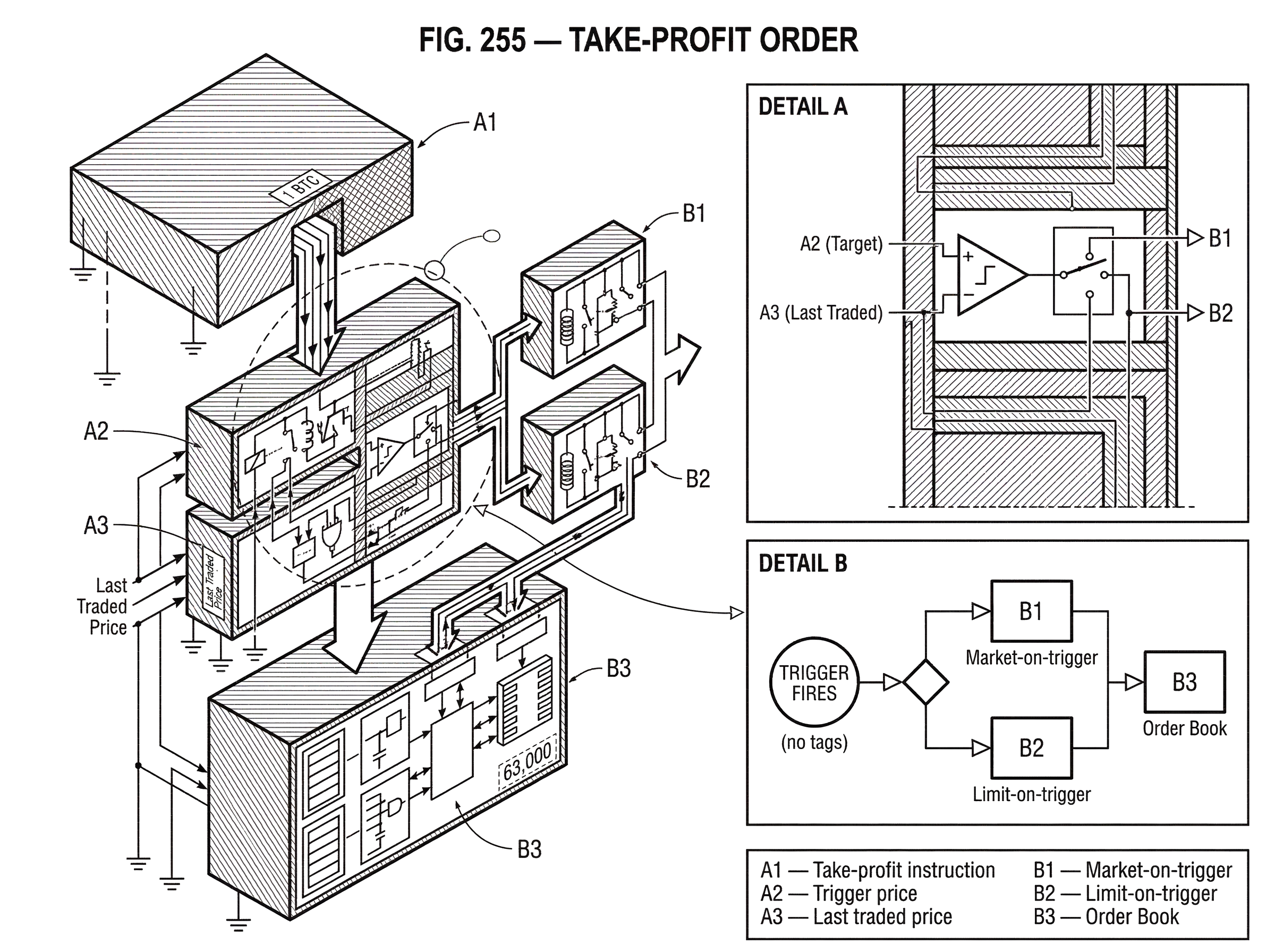
Once the trigger fires, the venue has to convert the instruction into an executable order. This is where take-profit orders divide into two broad mechanisms.
The first mechanism is market-on-trigger. Kraken’s rulebook states that a take-profit order places a market order once the last traded price equals or surpasses the take-profit price, and that when the last traded price touches the profit price, the take-profit order executes immediately as a market order. Binance’s FIX documentation describes TAKE_PROFIT the same way: when the condition is met, it executes a MARKET order.
The second mechanism is limit-on-trigger. Kraken separately supports a take-profit limit order, where a limit order is triggered once the profit price is reached. Coinbase’s exchange API documentation describes take-profit/stop-loss setups in this style: when the stop-style trigger activates, the order executes as a limit order, using a specified stop_limit_price. Coinbase’s international exchange TPSL documentation likewise says the position is closed with a limit order when one of the target prices is reached.
This difference is the heart of the topic.
A market-on-trigger take-profit prioritizes getting out. Once your target is touched, the venue sends a market order into the book. That means you are asking to trade immediately against available liquidity. The benefit is a higher chance of execution. The cost is that the fill price is not guaranteed.
A limit-on-trigger take-profit prioritizes price control. Once the target is touched, the venue submits a limit order at a price you specified. The benefit is that you do not accept a worse fill than your limit. The cost is that the order may not fill at all if the market moves away or gaps through your price.
If you remember only one thing, remember this: a take-profit trigger is not the same thing as a take-profit fill.
Example: same take-profit target, different fills with market vs limit triggers
Imagine you are long 1 BTC at 60,000, and you want to exit with a profit if the market reaches 63,000.
If you place a market-on-trigger take-profit with trigger price 63,000, the system waits until the relevant trigger price is reached. Suppose the last traded price prints 63,000, triggering your instruction. At that moment the venue sends a market sell order for 1 BTC. If the order book is deep, you may fill very close to 63,000. If liquidity is thin or moving quickly, parts of the order may fill at multiple prices lower than 63,000. Kraken’s rulebook is explicit that market orders are not guaranteed to fill at the displayed market price and may fill at a number of different prices depending on size and order book depth.
Now consider a take-profit-limit order with the same trigger price 63,000 and a limit price of 63,000 or perhaps 62,950. The market prints 63,000, so the trigger fires and a sell limit order is submitted. If there are buyers at or above your limit, you fill. But if the market only briefly touched 63,000 and then falls away, your order may sit unfilled. You hit your trigger but did not complete your exit.
Neither behavior is “wrong.” They are solving slightly different problems. The first asks, “when I am in profit, get me out.” The second asks, “when I am in profit, offer to get me out at this price or better.” Those are not the same instruction.
When is a plain limit order a better choice than a take-profit?
A smart reader might ask whether a take-profit order is even necessary. If you want to sell at 63,000, why not simply place a sell limit at 63,000 and wait?
Sometimes that is exactly the right answer. A plain sell limit resting above the market can function as a profit-taking order for a long position. In many retail interfaces, in fact, the practical difference between “take profit” and “sell limit above current price” is more about packaging and attached-order workflows than about deep economic substance.
But there are two reasons the distinction still matters.
The first is that many trading systems use take-profit as part of a paired exit structure. The order is not just “sell if price rises”; it is “if this position opens or fills, attach a profit-taking exit, and perhaps also attach a stop-loss exit.” In that setting, the take-profit order becomes part of a managed relationship among multiple orders rather than a standalone resting quote.
The second is that not every platform implements take-profit as a live visible limit resting on the book. Some treat it as a hidden contingent instruction that only becomes a market or limit order after the trigger condition is met. That changes visibility, time priority, and execution expectations.
So a plain limit order can often imitate the economic goal, but a take-profit order usually refers to the conditional automation layer around that goal.
How do take-profit and stop-loss orders differ and relate?
Take-profit orders and stop orders are mirror images in purpose. A stop order is designed to react when price moves against you past a threshold, usually to cap losses or enter momentum. A take-profit order reacts when price moves in your favor to a target, usually to lock in gains.
Mechanically, they often share the same underlying infrastructure. Coinbase’s exchange API does not present take-profit as a completely separate primitive; instead, it uses stop-style order fields such as stop, stop_price, and stop_limit_price, with different trigger directions for different strategies. This tells you something fundamental: the platform sees both stop-loss and take-profit as members of a broader class of triggered contingent orders.
What changes is not the architecture but the direction of the trigger and the trader’s purpose. For a long position, a stop-loss sell triggers on downward movement; a take-profit sell triggers on upward movement. For a short position, the directions reverse.
That symmetry is useful because traders often want both instructions at once. The profit-taking level answers, “where am I happy to win?” The stop level answers, “where am I no longer willing to keep losing?” Together they define an exit policy, not just a single order.
How do brackets and OCO rules coordinate take-profit and stop-loss exits?
Once you want both a stop-loss and a take-profit around the same position, you need a coordination rule. Otherwise both orders could remain active and accidentally over-close the position. That is where bracket orders, attached TP/SL orders, and OCO-style behavior become important.
Coinbase’s Advanced Trade documentation describes attached TP/SL orders created through attached_order_configuration, and states that as soon as a fill occurs at one of the specified price levels, the other side is automatically disabled. That is classic one-cancels-the-other behavior even if the interface labels it as an attached bracket rather than plain OCO. Coinbase’s international exchange TPSL documentation says the same thing in different words: if one of the orders is triggered, the other order is canceled automatically.
Interactive Brokers’ bracket-order documentation shows the same general pattern from another market stack. A parent order opens the position; one child order is the take-profit limit; the other child is the stop. The orders are linked through parent-child relationships and transmission rules so the bracket behaves as a coordinated whole.
This is not a cosmetic feature. It solves a real mechanical problem. If your take-profit sell fills for the entire size of a long position, your stop-loss sell should no longer exist; otherwise a later downward move could trigger a new sell when you no longer hold the asset. The coordination logic maintains the invariant that these exits are alternative paths to closing the same position, not independent bets.
Where documentation is thinner is partial-fill behavior. Some sources clearly state that attached TP/SL orders inherit the originating order’s size, but do not fully specify every partial-fill adjustment path. That uncertainty is a reminder that “take-profit order” can refer not only to a trigger rule but also to a lifecycle inside a more complex order-management system.
Execution certainty vs price certainty: which take-profit type should I use?
The simplest way to evaluate take-profit design is to ask which uncertainty you are willing to tolerate.
With a market-on-trigger take-profit, you give up control over exact price in order to increase the chance that the position is actually closed. This is attractive when the primary risk is missing the exit during a fast reversal. But it exposes you to slippage. In stressed conditions, the trigger may fire at your target while your actual fills occur materially worse.
With a limit-on-trigger take-profit, you keep control over the worst acceptable price, but you accept fill risk. The market can touch the trigger, activate your order, and then run away before your limit is executed. If the market gaps through the level, your order may simply rest unfilled.
This is not a bug in the order type. It reflects a basic fact about order books. You cannot demand both unconditional execution and a guaranteed minimum sale price unless the market actually provides sufficient liquidity at that price.
Coinbase’s and Kraken’s documentation make this distinction concrete in different ways. Kraken emphasizes that a triggered take-profit becomes a market order, and market orders may fill at multiple prices. Coinbase emphasizes that triggered stop-style profit/loss orders execute as limit orders and are therefore subject to all the constraints of limit orders. Different venues choose different sides of the tradeoff.
What risks and failure modes affect take-profit orders?
There are several ways a take-profit order can behave differently from what a newcomer expects, and most of them come from confusing the trigger condition with the execution environment.
The first is slippage. If your take-profit triggers a market order, the fill can be worse than the trigger price because the order consumes whatever liquidity is available. This is especially important for larger orders and thinner books.
The second is non-execution after trigger. If your take-profit triggers a limit order, you may never exit despite the fact that the market touched your target. The market only has to pass briefly through the trigger condition; it does not owe you resting liquidity at your limit.
The third is market disruption. Official rulebooks usually reserve broad powers during exceptional conditions. Kraken’s market rules note that the venue may suspend trading or prevent traders from completing transactions during disruption or force majeure. In plain terms, if the market itself is impaired, a take-profit instruction may not trigger or execute the way you hoped.
The fourth is fragmented liquidity and extreme volatility. In stressed crypto markets, fragmented venues, rapid liquidations, and thin books can produce very sharp moves. Secondary analysis of market-structure failures during extreme volatility emphasizes how indiscriminate market orders and fragmented collateral can worsen price dislocation. That does not mean take-profit orders are uniquely flawed. It means they depend on the same liquidity conditions as everything else.
The fifth is data-source mismatch. If the trigger is based on last trade price, your chart, quote screen, and the venue’s trigger engine may not line up perfectly in every instant. Coinbase’s documentation notes that trigger logic is tied to the last trade price and warns that not all match messages may be received on public feeds because of dropped messages. A trader watching a public stream can therefore misunderstand why a trigger did or did not happen.
How do different exchanges implement take-profit orders?
| Platform | Trigger source | Post-trigger action | Brackets / OCO | Notes |
|---|---|---|---|---|
| Kraken | last traded price | market (take-profit) or limit (take-profit-limit) | supports attached OTO/brackets | supports relative offsets |
| Binance | last traded price | market (TAKEPROFIT) or limit (TAKEPROFITLIMIT) | OCO / order-list types | supports trailing delta |
| Coinbase | last traded price | trigger posts limit order | attached TP/SL with auto-cancel | TPSL live-limit repricing |
One of the easiest mistakes is to talk about take-profit orders as though every venue means the same thing. The evidence here shows the opposite.
On Kraken, a plain take-profit order is defined as triggering a market order when the last traded price reaches the specified profit price, while a take-profit-limit order triggers a limit order. On Binance, TAKE_PROFIT similarly executes a market order on trigger, while TAKE_PROFIT_LIMIT requires a limit price and time-in-force. On Coinbase Exchange and INTX-style TPSL workflows, triggered profit/loss logic is documented around limit-order execution. On Coinbase Advanced Trade, take-profit often appears as one leg of an attached bracket where one filled side disables the other.
These are not superficial naming differences. They affect what the trader is buying from the system: immediacy, price protection, attachment to a parent order, or coordinated cancellation with a sibling exit.
So the right question is usually not “what is a take-profit order in general?” but “what does this venue do when my profit trigger fires?” The generic concept is stable; the implementation is not.
How do traders use take-profit orders in real strategies?
In practice, traders use take-profit orders to remove discretion from exits. The mechanism matters because human behavior is often the real problem being solved. A profitable trade can turn into a losing one while the trader waits for “just a little more.” A predefined take-profit converts a vague intention into a firm rule.
That rule can serve different styles. A swing trader may place a single target above entry and let the order wait for days. A short-term trader may attach a profit target and stop simultaneously the moment a position opens. An API-driven system may express the same logic through bracket fields, parent-child orders, or a take-profit-limit trigger with a relative offset.
In all of these cases, the take-profit order is valuable not because it predicts the market, but because it enforces a prior decision under uncertainty. It says: if the market gives me this outcome, act without asking me again.
Still, that automation only works well when the trader chooses a mechanism consistent with the real objective. If the goal is to almost certainly exit once in profit, a market-triggered take-profit may fit better. If the goal is to refuse any sale below a strict threshold, a take-profit-limit may fit better. If the goal is to package both upside exit and downside protection around a new trade, an attached bracket or OCO structure is often the natural tool.
What about take-profit orders is fundamental versus platform convention?
The fundamental part of a take-profit order is simple: it is a contingent exit instruction tied to a favorable price move. Everything else is implementation.
The trigger source (often last traded price) is a design choice. Whether the order is visible before activation is a design choice. Whether trigger creates a market order or a limit order is a design choice. Whether it exists as a standalone type or as a configuration of a broader stop/bracket system is a design choice. Whether the opposite exit is canceled automatically is part of the surrounding order-management model.
What does not change is the underlying economic purpose. A trader with an open position wants to say, “if the market reaches this favorable level, close me out according to these rules.” The venue then has to answer two mechanical questions: what counts as “reaches this level,” and what order should I submit when that happens?
If you can answer those two questions for a specific platform, you understand its take-profit order.
Conclusion
A take-profit order is best understood as an automated exit rule, not as a promise of a particular fill. It watches for a trader-defined profit trigger and, once that condition is met, converts that instruction into an executable order; often a market order, sometimes a limit order, and sometimes one leg of a bracket that cancels a paired stop.
The memorable distinction is this: the trigger tells you when the venue will try to act; the execution model tells you what kind of certainty you actually get. If you know whether your venue triggers off last trade, and whether it submits a market order or a limit order after triggering, you know the part of take-profit orders that matters most tomorrow when the market moves fast.
How do you place a take-profit order?
Place a take-profit on Cube by defining a trigger price and choosing how Cube should execute when that trigger fires (market-on-trigger to prioritize execution, or limit-on-trigger to prioritize price). You can create the take-profit as a standalone exit or attach it as the profit leg of a bracket (one-cancels-the-other) when opening a position.
- Fund your Cube account with fiat or a supported crypto transfer.
- Open the order entry for the asset or position you want to exit and choose the "Take-profit" / conditional order option.
- Enter the trigger price and select execution type: choose market-on-trigger to prioritize getting out, or limit-on-trigger and set a limit price/offset (for example, -0.1%) to control worst acceptable fill.
- Set the order size, attach an opposing stop (OCO/bracket) if desired, review fees and execution settings (time-in-force or relative trigger), and submit.
Frequently Asked Questions
Many venues define the trigger using the last traded price rather than current quotes; Kraken and Binance docs (and Coinbase stop-style triggers) explicitly reference last trade, so a single printed trade can fire a take-profit even if the visible book has moved.
A market-on-trigger take-profit converts to a market order on trigger (higher chance of execution but no guaranteed fill price), while a limit-on-trigger take-profit posts a limit order at your specified price (keeps price control but may not fill).
No - a trigger only tells the venue when to act; a market-on-trigger can fill worse than the trigger price because it consumes available liquidity, and a limit-on-trigger can fail to execute even though the market touched the trigger.
They are frequently stored off-book as contingent instructions rather than resting visible limits, but behavior varies by venue; Kraken’s documentation explicitly says stop orders are not posted and the visibility of take-profits is platform-dependent and sometimes unspecified.
Most modern platforms implement one-cancels-the-other logic so an attached take-profit or stop is disabled when the other leg fills, but the exact cancellation sequencing and how attached sizes are adjusted for partial fills is platform-dependent and not fully specified in every provider’s docs.
Yes - exchanges can suspend trading or prevent transactions during outages or force majeure, and data-source issues or dropped public feed messages can delay or prevent triggers from firing as expected.
It depends on your objective: pick market-on-trigger if your priority is to close the position (accept slippage risk), or pick limit-on-trigger if your priority is to avoid selling below a floor (accept the risk it may not fill).
The trigger direction reverses for shorts: a take-profit to close a short is typically a buy that triggers when price falls to or through the target, and several APIs (e.g., Binance) expose explicit direction fields to distinguish upward vs downward triggers.
Related reading