What is dYdX?
Learn what dYdX is, how its chain-based perpetual futures exchange works, and why its order book, staking, and risk controls matter.
Introduction
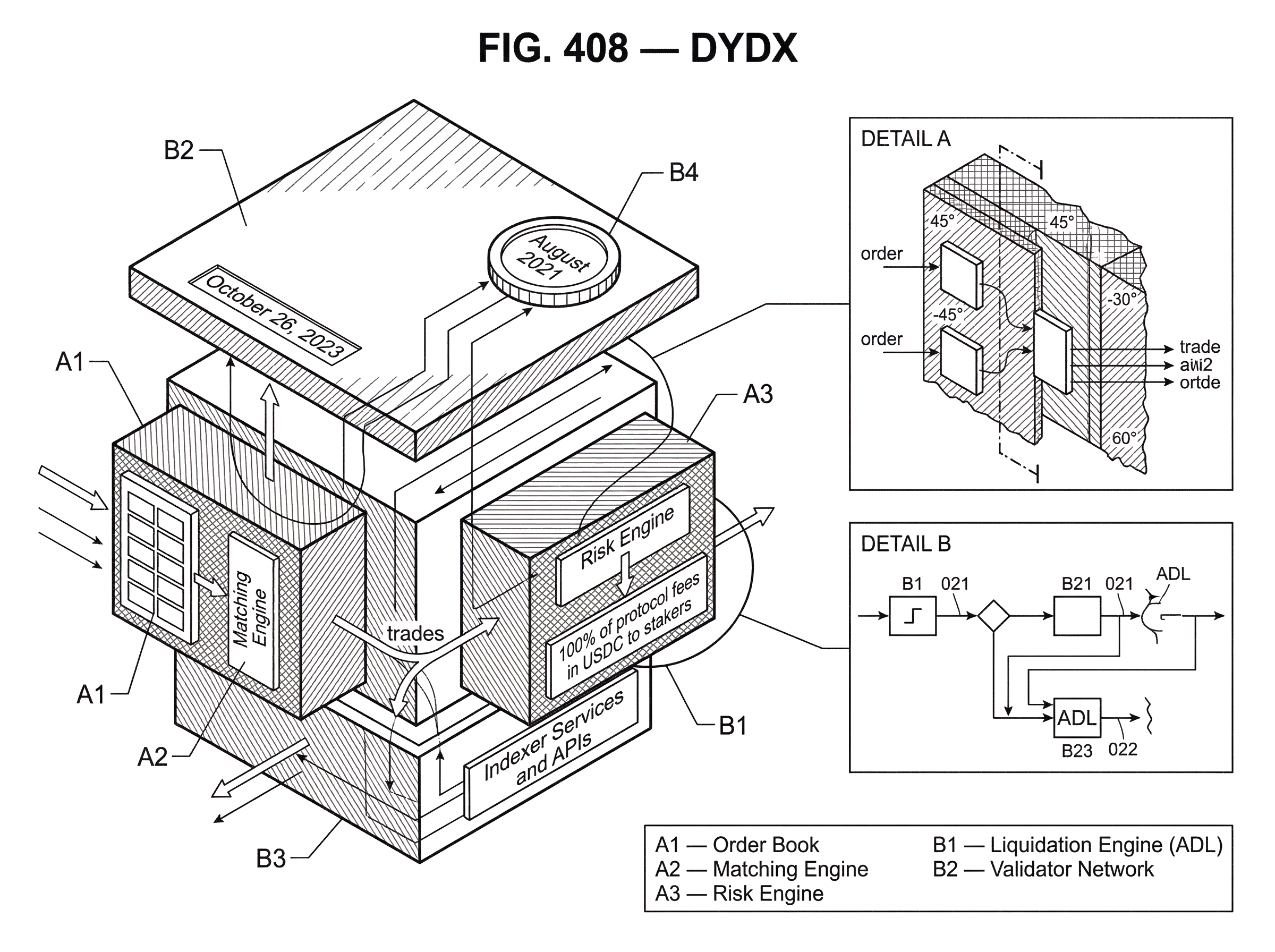
dYdX is a decentralized perpetual futures exchange built around a high-performance order book and matching engine that run on the dYdX Chain, a proof-of-stake blockchain built with the Cosmos SDK and CometBFT for consensus. That combination is the key to understanding why dYdX exists in its current form. Spot-style decentralized exchanges can work well with automated market makers, but perpetual futures trading asks for something else: fast order updates, deep books, precise margining, and risk controls that can respond when markets move violently.
The puzzle dYdX is trying to solve is simple to state and difficult to implement. Traders want the experience of a serious derivatives venue: limit orders, leverage, live books, liquidations, and responsive infrastructure. But they also want a system that is open, auditable, and not wholly dependent on a single company custodying assets and controlling the market. dYdX’s answer is not merely “put exchange functions on a blockchain.” It is to build a blockchain around the exchange itself.
That makes dYdX especially relevant for users who are not just buying and holding crypto, but actively trading perpetuals. If you care about order placement, execution quality, margin management, market structure, or programmatic access through APIs and bots, dYdX is designed with that kind of user in mind.
Why is dYdX built as its own proof-of-stake chain for perpetual trading?
| Option | Control | Performance | Cost/Complexity | Best for |
|---|---|---|---|---|
| dYdX Chain | Validator-run governance | Low-latency, high throughput | Higher infra and operational complexity | Active perp traders and market makers |
| App on other chain | External chain validators | Higher latency, lower throughput | Lower infra overhead, more composability | Simple swaps, broad DeFi integrations |
The most important distinction is this: dYdX is not just an app on top of another chain in its current form; it is its own chain optimized for perpetual trading. The dYdX v4 software, referred to as the dYdX Chain, is described in the project’s codebase as sovereign blockchain software that powers a decentralized perpetual futures exchange with a high-performance order book and matching engine.
Why does that matter? Because perpetual trading creates a constant stream of state changes. Traders place and cancel orders, positions change as prices move, margin requirements need to be checked, and under stress the system must decide who is liquidatable and how losses are absorbed. On a general-purpose chain, that workload can become expensive, slow, or operationally awkward. By building its own proof-of-stake chain, dYdX can shape the execution environment around the exchange’s needs rather than squeezing exchange mechanics into infrastructure designed for broader use.
Here the mechanism is more important than the label. A validator network runs the chain. Consensus comes from CometBFT. The chain software is open source, and the repository also includes associated indexer services. Those indexers matter because raw blockchain data is not a good user interface. The official repository describes them as a read-only layer that indexes on-chain and off-chain data from a node and serves it to users in a more performant and user-friendly way. In practice, that is how a trading interface or analytics app can feel fast enough to use while still grounding the market in chain-based infrastructure.
How do perpetual futures trade on dYdX’s on-chain order book?
| Market model | Execution types | Price formation | Order control | Best for |
|---|---|---|---|---|
| Order-book (dYdX) | Limit & market orders | Matches bids and asks | Fine-grained price control | Limit orders, algos, makers |
| AMM-based perps | Swap-style execution | Curve-derived prices | Coarse price steps, slippage | Passive LPs, simple swaps |
At the user-facing level, dYdX is for trading perpetual markets. A perpetual future is a derivatives contract that tracks an asset’s price without expiring on a fixed date. What matters for the trader is that they can go long or short, use leverage, and manage positions against collateral rather than buying the underlying asset outright.
On dYdX, that trading experience is centered on an order book rather than a liquidity pool. This is a meaningful design choice. In a pool-based system, you trade against a pool and accept the pricing logic that follows from the pool’s inventory curve. In an order-book system, traders and market makers post bids and asks at specific prices, and the market is formed by matching those orders. For active derivatives traders, that structure is often more familiar because it supports limit orders and more explicit control over execution.
A concrete example makes the mechanism clearer. Imagine a trader who expects the price of an asset to rise and wants leveraged exposure through a perpetual market. Instead of swapping tokens in a pool, they post or hit an order in the relevant market on dYdX. The system checks whether they have enough collateral to support the position under current margin rules. If the order executes, they now have a leveraged long position whose profit and loss changes continuously with market price. If the market moves in their favor, their equity rises; if it moves against them far enough, the position can become liquidatable. At every stage, the exchange is not merely recording balances. It is evaluating a risk engine: how much collateral is left, whether further leverage is allowed, and whether the position remains solvent.
That is why dYdX’s design cannot be understood as “just an order book on-chain.” The order book is the visible surface. Underneath it is a margining and liquidation system that determines whether the exchange can function during volatile conditions.
How does dYdX manage liquidations, insurance, and automatic deleveraging during volatile moves?
Perpetual exchanges live or die by their risk controls. When leverage is available, the system needs a disciplined way to handle losses before they become everyone’s problem. dYdX’s architecture reflects that.
The project’s post-mortem on the SUSHI and YFI incidents on dYdX v3 is instructive because it shows what can go wrong in thin or abnormal markets. dYdX described those events as oracle manipulation attacks, with losses absorbed by the v3 insurance fund rather than by customer funds. More important than the incident itself for understanding dYdX today is what the team said changed in response: revised margining in less-liquid markets, improved open-interest monitoring and alerting, and a variable initial margin fraction feature designed for the dYdX Chain.
That feature is worth pausing on. The initial margin fraction affects whether traders can open additional leverage or withdraw collateral against existing positions. dYdX says the chain can automatically raise that requirement when unusually large price movements occur. The idea is not to rewrite a trader’s liquidation price after the fact. It is to prevent a market under stress from becoming a machine that lets traders expand fragile positions or pull out unrealized gains too aggressively.
The dYdX Chain also includes a redesigned liquidation engine and automatic deleveraging, or ADL, as a fallback when liquidations and insurance are not enough. The principle is simple even if the implementation is complex: losses should be contained to the positions involved in the stressed instrument, instead of being socialized across unrelated accounts. For traders who think carefully about exchange risk, this is not a minor implementation detail. It is part of the product.
What role does the DYDX token play in staking, governance, and fee distribution on the dYdX Chain?
Because dYdX now runs on its own proof-of-stake chain, the exchange and the chain’s economics are linked. The DYDX token was adopted by community governance as the Layer 1 token of the dYdX Chain. The Foundation describes Cosmos-native DYDX as having utility for security, staking, and governance, and states that the chain distributes 100% of protocol fees in USDC to stakers.
This matters because staking on a proof-of-stake chain is not an add-on badge of participation. It is part of how the network is secured. Validators participate in consensus, and staking and slashing modules exist to align incentives and penalize certain failures. Governance modules, a community treasury, and distribution mechanisms sit beside that security layer, which means tokenholders are not just speculating on exchange usage; they can also participate in how community-controlled resources are directed over time.
The token story also has a migration component. The original ethDYDX token launched in August 2021 on Ethereum for the earlier dYdX v3 system. After the dYdX Chain launched on October 26, 2023, a one-way bridge design was documented to migrate from Ethereum-based ethDYDX toward DYDX on the new chain. The official docs describe a mechanism in which ethDYDX sent to the bridge is permanently locked, wethDYDX is issued 1:1 on Ethereum, and validators can read bridge events so corresponding DYDX can be distributed on the dYdX Chain. The key operational fact for users is that the bridge was described as one-way and irreversible.
This migration history explains why dYdX today feels like a chain-centered protocol rather than a token appended to an app. Governance chose DYDX as the L1 token, and the chain is where staking, governance, and exchange operation now meet.
Who should use dYdX; which traders and developers benefit most from its design?
| User type | Main benefit | Primary needs | Not ideal if |
|---|---|---|---|
| Active traders | Professional-style execution | Low latency, margin controls, limit orders | Only occasional token swaps |
| Market makers | Order-book depth and tooling | Tight quoting, fast updates, APIs | Pool-based liquidity models |
| Developers | Programmatic access & indexers | APIs, webhooks, on-chain data | No need for perp markets |
| Casual users | Access to perps without custody | Simple UI, low friction | Prefer instant token swaps |
dYdX makes the most sense for users who want decentralized access to perpetual futures with a professional trading structure. That includes discretionary traders who care about order placement and leverage, market makers who need an order-book environment, and developers who want to build bots, analytics tools, or integrations on top of a trading venue.
The developer posture is explicit in the documentation. dYdX provides REST and WebSocket references, market-data and account-data guides, and quick starts for Python, TypeScript, and Rust. The docs distinguish between the Indexer API, which is meant for querying balances, positions, and account information, and authenticated private Node API methods for actions that require signing and execution. That separation reflects the underlying architecture: querying market state and submitting authenticated trading actions are different jobs and are handled differently.
This is also where the trade-off becomes clear. dYdX is not primarily optimized for the simplest possible DeFi experience. It is optimized for a richer and more demanding one. If you only want a quick token swap, dYdX’s design is solving a problem you may not have. If you want live perp markets, order-book execution, algorithmic access, and risk controls that resemble a serious derivatives venue, its complexity starts to look like necessity rather than excess.
As a contrast, some decentralized systems rely on threshold signing and multi-party computation to authorize settlement without ever reconstructing a full private key in one place. Cube Exchange, for example, uses a 2-of-3 threshold signature scheme for decentralized settlement: the user, Cube Exchange, and an independent Guardian Network each hold one key share, no full private key is ever assembled in one place, and any two shares are required to authorize settlement. That is a useful comparison because it shows a different path to decentralization. dYdX’s path is not primarily about threshold-signed settlement over a separate venue; it is about making the exchange itself a chain-governed system.
Key takeaways: what matters about dYdX’s exchange design and trade-offs
dYdX is best understood as a blockchain-built perpetual futures exchange, not just a trading app with a token. Its core idea is that serious derivatives trading needs fast market structure and strict risk management, so the protocol built a proof-of-stake chain around those requirements.
If you remember one thing, remember this: dYdX is trying to decentralize the exchange without giving up the mechanics that active derivatives traders actually need. The order book, the matching engine, the margin system, the liquidation logic, the validator network, and the DYDX-based governance model all follow from that single goal.
How do you trade through a DEX or DeFi market more effectively?
Trade through DEXs and DeFi markets more effectively by checking liquidity, choosing the right execution method, and using Cube Exchange’s funding and order-entry workflow to submit controlled trades. Cube lets you fund your account, open the relevant market or token transfer flow, and place limit or market orders while reviewing estimated fees and slippage before you submit.
- Fund your Cube account with the asset and network you plan to trade (use the same chain as the token to avoid bridge steps).
- Check on-chain liquidity and depth: view 24h volume, order-book depth or pool reserves, and simulate the trade size to estimate price impact.
- Choose execution type: use a limit order (post-only if available) for price control or a market order for immediacy; for large AMM trades, split the amount into smaller swaps to reduce impact.
- Set slippage tolerance and review estimated fees (protocol fees and gas); confirm the estimated fill and submit the order.
Frequently Asked Questions
dYdX runs a purpose-built proof-of-stake blockchain (the dYdX Chain) with CometBFT consensus and a high-performance on‑chain order book and matching engine, and it pairs that with indexer services that provide a fast read-only layer so UIs and analytics feel responsive without moving core matching off-chain.
Losses are managed through multiple layers: margining rules (including a variable initial margin fraction that can rise during stress), an insurance fund (used historically on v3), a redesigned liquidation engine, and automatic deleveraging (ADL) as a fallback so losses are meant to be contained to positions in the stressed instrument rather than socialized across unrelated accounts.
The documented migration from ethDYDX to DYDX on the dYdX Chain is explicitly one-way and irreversible: ethDYDX sent to the bridge is locked and corresponding DYDX is distributed on the dYdX Chain; the docs warn there is no way to reverse the bridge.
The public documentation and repository state that dYdX Trading Inc. does not deploy or run the v4 chain software for public use, but they do not list who currently operates or validates any deployed dYdX Chain network; the operator/validator set composition is therefore not specified in the docs and remains unclear from the available material.
DYDX is the Cosmos‑native Layer‑1 token for the dYdX Chain with utility for staking, governance, and network security, and the Foundation states the chain distributes 100% of protocol fees in USDC to stakers; however, the documentation does not spell out the precise fee‑distribution timing or operational mechanics in detail.
No - according to the project’s Terms of Use and multiple documentation notes, dYdX products and services are not available to persons or entities in the United States or Canada (and may exclude other 'Restricted Persons'), so users in those jurisdictions should not expect access.
For market and account queries you should use the Indexer API (a read‑only, user‑facing layer for balances, positions, and market state); for authenticated, signed trading actions and any operations that change state you must use the private Node API - the docs intentionally separate those roles.
After the SUSHI/YFI v3 incidents dYdX implemented several changes including higher margining in thin markets, improved open‑interest monitoring and alerting, and the variable initial margin fraction to raise initial margin during large moves; these are intended to reduce vulnerability to oracle‑style attacks, though independent verification and ongoing sufficiency are not provided in the public post‑mortem.
Related reading