What is Auto-Deleveraging (ADL)?
Learn what auto-deleveraging (ADL) is, why exchanges use it, how it works mechanically, and how leverage and profits affect ADL risk.
Introduction
Auto-Deleveraging (ADL) is the last-resort mechanism derivatives exchanges use when a losing position cannot be liquidated cleanly and the insurance fund cannot fully absorb the shortfall. That is the uncomfortable fact at the center of the topic: sometimes the market moves so fast, or liquidity gets so thin, that closing the bankrupt trader is not enough. Someone still has to absorb the loss.
In normal conditions, traders tend to think of perpetual futures and futures markets as a clean transfer of profit and loss between longs and shorts. If a long loses, a short wins. If the exchange liquidates the long, the system should remain balanced. The puzzle is what happens when the losing side has run out of collateral, the liquidation cannot be executed at a good enough price, and the reserve fund is also under strain. ADL exists because the accounting must still close.
So ADL is not a normal trading feature and not a strategy. It is a risk backstop. The exchange or protocol forcibly reduces positions on the opposing side (usually traders who are profitable, highly leveraged, or both) so the platform can keep the market solvent. Different venues implement the details differently, but the core idea is the same across centralized and on-chain perpetuals: if liquidation fails to preserve solvency, the system deleverages winners.
That makes ADL one of the least intuitive parts of derivatives trading. Many traders assume their biggest risk is being liquidated when they are wrong. ADL adds a second risk: even when you are right, part of your profitable position can be closed early because the platform needs your exposure to offset someone else’s failed liquidation. Once that clicks, the rest of the mechanism makes sense.
Why do exchanges use auto-deleveraging (ADL)?
A perpetual futures market is not just a collection of separate bets. It is a matching system where the platform has to keep the entire book internally coherent. Long and short exposures must net out, and realized gains must be funded by realized losses plus collateral already posted. In ordinary trading, the market handles this through margin, liquidation, and insurance funds.
Here is the mechanism in plain language. A trader posts margin and opens a leveraged position. If the market moves against that trader, losses eat into the margin. Once the margin buffer becomes too small, the risk engine tries to reduce or liquidate the position. If the liquidation succeeds at prices better than the trader’s bankruptcy price, the system is fine and any excess may even replenish the insurance fund. If the liquidation executes worse than needed, or cannot fully execute because liquidity disappears, the position can become bankrupt: the trader’s collateral is gone, but the losses are not fully closed out.
That is where the insurance fund comes in. Exchanges maintain reserve pools to absorb these shortfalls. Bybit describes its insurance fund as a reserve funded by platform contributions and by excess margin from liquidations closed better than bankruptcy price. OKX describes a similar security-fund role. The design principle is straightforward: many routine liquidations create small surpluses, and those surpluses are saved to cover the rarer cases where liquidations lose money.
But this reserve is finite. In extreme markets, especially when many leveraged accounts fail together, losses can exceed what the fund can absorb. At that point the platform faces a hard constraint, not a preference. If it does nothing, profitable traders may be owed gains that no losing account or reserve fund can pay. The market’s accounting stops balancing. ADL is the mechanism that restores balance by forcibly reducing the opposite-side positions that would otherwise continue to profit from the bankrupt exposure.
This is why official documents consistently describe ADL as a final process or last resort. Bybit says ADL helps control platform risk when the insurance fund cannot cover excessive liquidation losses. OKX calls it the final liquidation process used when the security fund cannot take over more bankrupted positions. Strike Finance, on the on-chain side, frames it similarly: if the insurance fund cannot absorb a bankrupt position, profitable opposing traders are forced to close part of their positions instead.
How is ADL different from normal liquidation?
The cleanest way to understand ADL is to compare it with ordinary liquidation.
In an ordinary liquidation, the exchange tries to hand the failing position to the market. The trader is closed out by available counterparties in the order book, and the insurance fund covers any remaining slippage if necessary. In ADL, that market handoff has broken down. There are not enough willing counterparties at acceptable prices, or the reserve fund has reached its limit. So the platform stops waiting for voluntary matching and begins involuntary matching.
That involuntary matching is what “deleveraging” means here. A trader on the winning side has some or all of their position reduced, not because their own margin is bad, but because their exposure is the mirror image needed to close the failed position on the other side. If a large long collapses and cannot be liquidated cleanly, opposing shorts may be reduced. If a short collapses, opposing longs may be reduced.
The analogy that helps is a crowded lifeboat system. Normally, each boat carries its own passengers and spare capacity handles small shocks. But if one boat springs a leak and the rescue capacity is not enough, the system redistributes people into other boats whether those passengers asked for it or not. That explains why ADL exists: the whole fleet must stay afloat. Where the analogy fails is that financial positions are not people and can be split, repriced, and ranked by risk metrics. ADL is not random redistribution; it is rule-based forced reduction.
That ranking step is crucial. Exchanges do not usually pick counterparty positions arbitrarily. They try to choose the positions whose reduction is most defensible from a system-risk perspective. In practice this tends to mean traders who are both more profitable and more leveraged, because they sit closest to the part of the book where one bad shock can produce the largest compounding effects.
How do exchanges decide which positions get auto-deleveraged?
| Factor | Effect on priority | Why it matters | Trader signal |
|---|---|---|---|
| Unrealized profit | Higher profit increases priority | Offsets bankrupt exposure efficiently | UPnL% indicator |
| Effective leverage | Higher leverage raises priority | Amplifies systemic risk contribution | Leverage setting |
| Position size | Larger positions ranked earlier | Offsets more exposure per cut | Notional size |
| Hedged positions | Hedged portions rank lower | Less net directional risk | Hedge status |
The central design question in ADL is not whether someone will be cut once the backstop is triggered. The question is which opposing positions will be cut first.
Across venues, the organizing principle is similar even when the formulas differ: the system ranks opposing positions by some version of leveraged profitability. A trader with large unrealized gains and high effective leverage is usually nearer the front of the ADL queue than a trader with modest gains and low leverage.
Bybit states that the ADL ranking is determined by the leveraged return of a position. It also adds an important caveat that many summaries miss: opposing positions that are at a loss may still be selected, but positions in profit are given priority. That matters because it shows the ranking is not purely a reward-for-punishment scheme aimed only at winners. The exchange is trying to solve a balance-sheet problem under stress, and if enough profitable counterparties are not available, the selection can extend further.
OKX describes a queue ranked by leverage PnL%. For profitable positions, the metric is the position’s unrealized PnL percentage divided by the account-level maintenance margin ratio. For losing positions, the metric is adjusted differently. The broad intuition is still the same: positions with the highest positive leveraged PnL% are offset first. OKX also exposes this in the interface with an indicator light system, giving traders a rough view of how close they are to the front of the queue.
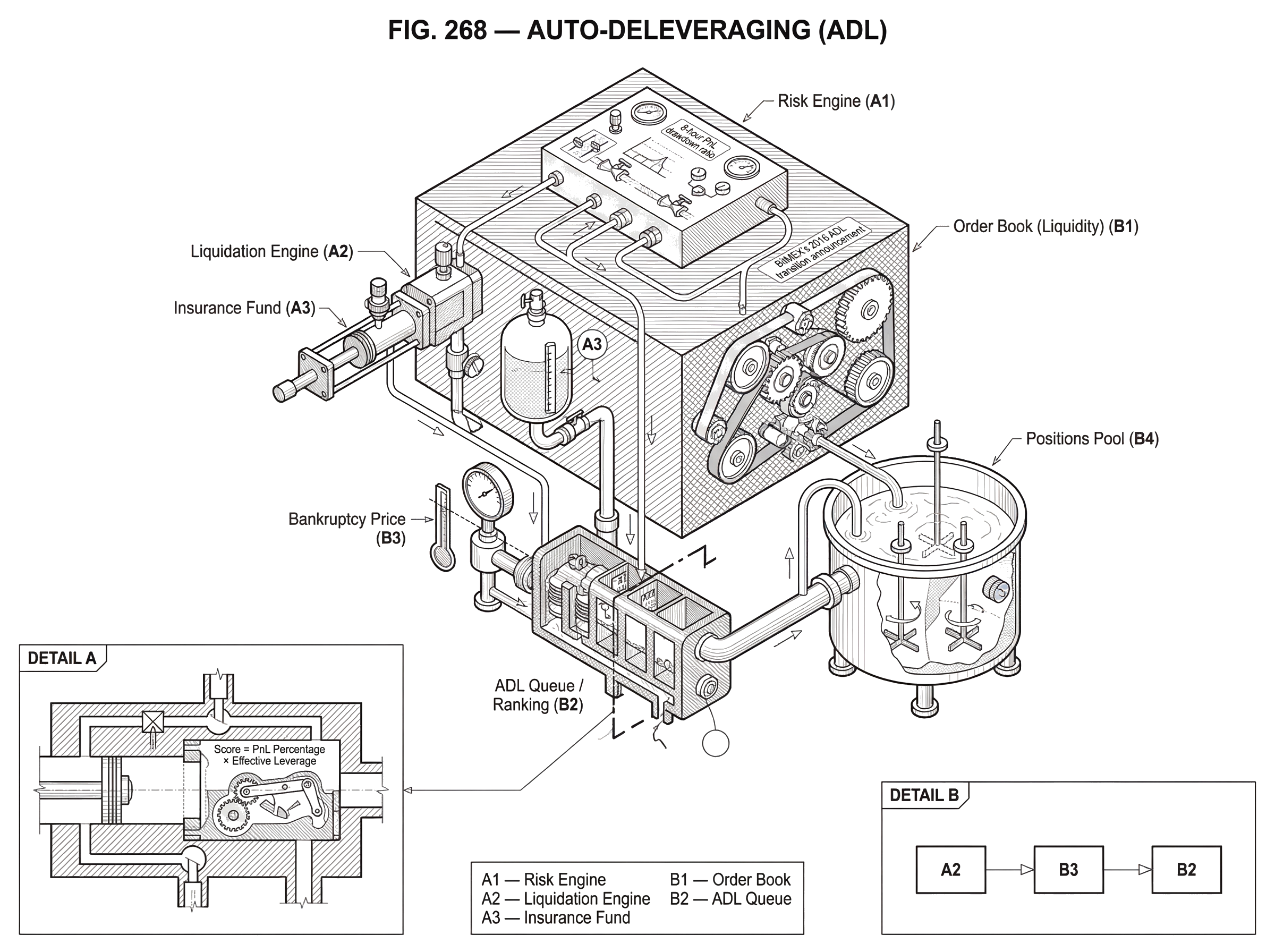
Strike Finance provides one of the clearest public formulas. It ranks candidates with Score = PnL Percentage × Effective Leverage, where PnL Percentage is unrealized PnL divided by notional, and Effective Leverage is notional divided by margin balance. This formula captures the basic idea nicely. If two traders are both profitable, the one whose profit is larger relative to position size and whose position is more leveraged will rank higher. The reason is not moral judgment. It is that reducing this trader’s exposure more efficiently removes risk from the system.
BitMEX’s public materials emphasize the same principle in a less formula-heavy way. Its 2016 ADL transition announcement says the highest-leveraged traders are deleveraged first because they pose the biggest risk to other traders. The exchange also notes that a trader’s place in the queue is viewable in real time, even though the announcement itself points elsewhere for the exact ranking formula.
This ranking has two consequences traders should remember. First, high leverage does not only increase your liquidation risk when you are wrong; it can increase your ADL risk when you are right. Second, reducing leverage can matter immediately. Bybit explicitly says lowering leverage reduces ADL ranking in real time, while partially closing a profitable position may reduce the amount exposed without lowering the ranking itself.
When does auto-deleveraging (ADL) trigger on an exchange?
| Trigger type | Platform signal | Typical threshold | Trader visibility |
|---|---|---|---|
| Insurance fund depleted | Insurance pool balance falls | Fund balance ≤ 0 | API/Web indicators (may lag) |
| 8‑hour PnL drawdown | PnL drawdown vs 8h max balance | Drawdown ≥ trigger line | Exchange ADL tab / alerts |
| Bankruptcy fill failure | Mark price reaches bankruptcy price | Liquidation unfilled at bankruptcy | Orderbook / mark price feeds |
| Combined pool deficit | Multiple pools net to zero or below | Cross‑pool shortfall | Platform-wide alerts |
ADL is often explained as “what happens when the insurance fund is empty.” That is directionally right, but some venues now use earlier warning conditions based on rapid drawdowns, not just a literal zero balance.
Bybit’s documentation is a good example of a more explicit trigger design. One trigger is based on an 8-hour PnL drawdown ratio for a trading pair relative to the insurance fund’s highest balance over that period. ADL begins when the drawdown reaches or exceeds a trigger line and stops when the ratio falls back to or below a stop threshold. The same exchange also documents a second condition in which ADL can trigger when the combined balance of multiple independent insurance pools falls to or below zero, with the system redistributing positive balances by PnL ratio and recalculating bankruptcy prices.
This design tells you something important about modern risk engines. They do not always wait until the reserve is literally exhausted to act. A steep enough drawdown can be treated as a warning that the pool is being consumed too quickly, so the system starts deleveraging before the damage spreads further. That is a policy choice about where to place the solvency buffer.
OKX describes the trigger more qualitatively. ADL can begin when the present value of the applicable security fund falls significantly below a preset threshold. For certain pre-market futures, it can also depend on liquidation-order volume and timing. The exact numbers are not published in the help article, which is a reminder that exchanges often keep some trigger parameters discretionary or operational rather than fully public.
BitMEX’s historical description is simpler and closer to the classic model: deleveraging occurs if a liquidation is not filled by the time the mark price reaches the bankruptcy price. This makes the sequencing especially clear. First the market tries to absorb the liquidation. Then the bankruptcy boundary is reached. If the handoff still has not happened, ADL intervenes.
The common invariant across these versions is simple: ADL begins only after normal liquidation is no longer sufficient to preserve system balance. The exact trigger can be framed as insurance-fund depletion, rapid fund drawdown, inability to absorb a bankrupt position, or failure to fill liquidation by bankruptcy price. But each version describes the same boundary between normal market handling and forced system intervention.
What happens to positions and prices during an ADL event?
| Step | Action taken | Settlement price | User impact |
|---|---|---|---|
| Selection | Rank and pick opposing positions | N/A | Identifies affected traders |
| Reduction | Partial or full position close | Bankruptcy or mark price | Realized profit reduced |
| Pricing | Execute close at settlement price | Bankruptcy or mark price | Can be worse than voluntary exit |
| Operational effects | Cancel orders and notify users | N/A | ADL fills recorded; fee treatment varies |
Once ADL is triggered, the platform needs to do two things at once: select counterparties and determine the price at which the forced reduction occurs.
The selection step is the ranking process just described. The system scans for opposing positions that qualify under the venue’s rules, orders them by ADL priority, and starts reducing them until enough exposure has been offset. Depending on the platform, the reduction can be partial or full. Some systems describe this as a best-effort process; others require a full offset for the relevant emergency mode.
The price step is where traders often feel the event most sharply. Bybit states that positions matched during ADL are closed at a bankruptcy price derived from the loss conditions that triggered ADL. It provides separate long and short formulas in terms of entry price plus or minus an amount based on the maximum loss at trigger divided by total open position size. Strike Finance likewise states that its standard Type 1 ADL executes at the bankrupt trader’s bankruptcy price, not at mark price or oracle price. OKX says deleveraged positions are normally closed at mark price at matching time, but if the security fund is nearly depleted they may instead be closed at bankruptcy price.
The distinction matters because bankruptcy price and mark price are not conceptually the same. Mark price is an estimate used for fair valuation and liquidation logic. Bankruptcy price is the point where the liquidated position’s residual value is approximately exhausted. Settling a winning counterparty at bankruptcy price can be materially worse for that trader than remaining in the market or being closed at a more favorable mark price.
A worked example makes the mechanism easier to see. Imagine a fast crash where a heavily leveraged long position becomes insolvent. The risk engine tries to liquidate it into the market, but bids vanish and the position cannot be fully handed off before the relevant bankruptcy threshold is reached. The insurance fund is already strained, so the platform cannot simply absorb the entire shortfall. It now looks to traders on the short side who are profiting from the crash. Those short positions are ranked; the ones with the highest leveraged profitability are first in line. The platform forcibly closes enough of those shorts against the bankrupt long exposure at the venue’s ADL settlement price. The selected shorts realize profit up to that forced close, but they lose the chance to keep the rest of the position open if the market continues falling.
This is why ADL often feels unfair to affected traders. They were correct about direction, yet the system takes away some of the upside precisely because they were the available profitable counterparties. But from the exchange’s perspective, that is the point. The market cannot let unrealizable profits keep growing against already-bankrupt losses.
Operationally, ADL can also have side effects around orders and notifications. Bybit notes that active orders are canceled for selected traders and that users receive notifications. Exchanges may also apply venue-specific fee treatment. Bybit says maker fees apply to the ADL traders whose positions are reduced and taker fees to the trader whose liquidation triggered ADL, while OKX says trading fees are not charged on deleveraged positions though liquidation fees still apply on liquidated orders. The details vary, but the forced position reduction is the core event.
Why can profitable traders be auto-deleveraged?
At first glance, ADL can seem backward. If someone else blew up, why should a profitable counterparty be closed?
The first-principles answer is that profitable opposite-side traders are the only available source of offsetting exposure inside the market. A bankrupt long can only be neutralized by reducing short exposure somewhere else. The system cannot conjure a new counterparty out of nothing. If the order book will not voluntarily supply that offset and the reserve fund cannot pay for it, the platform has to select existing traders who already hold the opposite position.
This is also why ADL is fundamentally about system solvency, not fairness in the everyday sense. A recent research paper frames the issue as a trilemma: no ADL policy can fully maximize exchange solvency, exchange revenue, and fairness to traders at the same time. Even without endorsing every detail of that model, the intuition is sound. Once losses exceed posted collateral and backup reserves, someone’s interests must be subordinated to keep the venue functioning.
BitMEX’s move from socialized-loss mechanisms to ADL in 2016 reflected exactly this tradeoff. Instead of spreading losses more broadly through withheld profits and rebalances, the exchange shifted to a system that deleverages traders more directly according to risk ranking. Its stated rationale was to reduce moral hazard: the riskiest traders should not be able to create broad losses for everyone else without consequence. ADL concentrates pain rather than diffusing it.
That concentration is also why traders care so much about queue indicators and leverage settings. If ADL were random, there would be little to manage. Because it is ranked, traders can often influence their probability of selection by carrying lower effective leverage, adding margin, choosing more liquid contracts, or running offsetting hedges where the venue’s model recognizes them.
How can traders reduce their chance of being auto-deleveraged?
Since ADL is a queue-based mechanism, reducing risk means moving farther back in the queue or shrinking the position size that could be affected.
The most direct lever is lower leverage. This shows up across venues because the ranking systems all penalize high effective leverage in some way. Bybit explicitly says lowering leverage reduces ADL ranking in real time. OKX similarly recommends adding margin or reducing positions to lower effective leverage and maintenance margin requirements. The mechanism is simple: a position that requires less leverage to generate the same profit is less dangerous to the platform during stress, so it is a worse candidate for forced deleveraging.
Liquidity of the contract also matters. OKX advises prioritizing major coins and more liquid contracts. That advice is not cosmetic. ADL exists because liquidation plus reserve funding failed, and that failure becomes much more likely in thinner markets where order books disappear under stress.
Hedging can matter too, depending on the venue’s treatment. OKX notes that fully hedged portions of positions are ranked lower in the ADL queue. Again, the reason is structural. A hedged trader contributes less net directional risk to the system, so forcing that trader to absorb losses is less necessary.
There is also a subtle point in Bybit’s mitigation guidance: partially closing a profitable position can reduce the number of contracts exposed to ADL risk, but it does not lower the ADL ranking itself. That distinction is easy to miss. Your priority in the queue and your gross amount at risk are related but not identical. A trader might remain high in the queue but have fewer contracts available to be cut.
Finally, traders who need operational visibility can watch whatever the venue exposes. Some exchanges provide interface indicators; others expose API or WebSocket signals. Bybit has an ADL alert endpoint and recommends WebSocket subscription for faster updates, though some data for shared insurance pools can refresh slowly enough to limit intraday usefulness. OKX lists an ADL warning channel and provides queue indicators in the trading interface. Monitoring helps, but it does not eliminate model uncertainty, since some trigger inputs and threshold values remain unpublished.
How does ADL work across centralized exchanges and on-chain protocols?
ADL is not specific to a single exchange architecture. Centralized venues such as Bybit, OKX, and BitMEX all document some version of it, but the same logic appears in on-chain perpetual systems as well.
Strike Finance is a useful example because it makes the mechanism explicit in protocol documentation. Its Type 1 ADL occurs when the insurance fund cannot accept an incoming bankrupt position, and it then ranks profitable opposite-side positions to offset the failure at bankruptcy price. It also defines an emergency Type 2 mode in which the insurance fund reduces its own exposure using the same ranking concept but settles at mark price. The implementation details differ from centralized venues, yet the underlying problem is identical: if ordinary liquidation and fund absorption are not enough, the system must forcibly reduce opposing risk somewhere.
This broader perspective matters because it shows ADL is not an arbitrary exchange quirk. It is a consequence of leveraged derivatives markets that promise continuous trading while maintaining internal solvency. Whether settlement is handled by a centralized risk engine or by on-chain logic, the platform must have a rule for what happens when collateral runs out before exposure does.
That same general principle appears in other parts of market infrastructure too. In decentralized settlement systems, resilience often depends on making sure no single component becomes a fatal point of failure. For example, Cube Exchange uses a 2-of-3 threshold signature scheme for decentralized settlement: the user, Cube Exchange, and an independent Guardian Network each hold one key share, no full private key is ever assembled in one place, and any two shares are required to authorize settlement. That is a different problem from ADL, but it reflects the same design instinct: when the system matters more than any one participant’s convenience, infrastructure is built around controlled fallback rules rather than optimistic assumptions.
What limitations does ADL have during market stress?
ADL is powerful, but it is not magic. It does not make losses disappear. It reallocates them in a way that preserves the venue’s ability to keep operating.
That means ADL has clear limits. If liquidity is extremely thin, even finding enough opposing counterparties to deleverage can be difficult. Some systems describe this as best-effort; others can fail in specific emergency modes if there are not enough qualifying positions. ADL also does not guarantee what a trader would regard as fairness. A profitable trader can be closed before reaching a preferred exit, and the resulting realized profit can be materially smaller than what continued market exposure might have delivered.
There is also a governance limit. Exchanges differ in how transparent they are about trigger thresholds, queue formulas, and real-time status. Bybit publishes substantial detail, including drawdown-based trigger logic and ranking principles, but not every parameter is fully visible. OKX explains ranking and user guidance but not the exact preset thresholds. Binance materials in the evidence here place ADL inside clearing and risk-management frameworks, but the detailed operational rule text is not fully surfaced in the provided extracts. So while the basic mechanism is well understood, the exact implementation remains partly venue-specific and sometimes discretionary.
Recent incident reporting reinforces the practical tradeoff. In major liquidation events, exchanges have used ADL as a targeted intervention to prevent wider failure. BitMEX’s flash-crash writeup describes ADL as a last-resort mechanism protecting users and the exchange by filling bankrupt orders with profitable opposing traders, while noting that the insurance fund still absorbed losses. Secondary analyses of large 2025 events likewise portray ADL as painful for individuals but helpful for preserving market continuity. The pattern is consistent: ADL is costly, but the alternative may be insolvency, frozen markets, or disorderly loss socialization on an even larger scale.
Conclusion
Auto-deleveraging is what a derivatives market does after normal liquidation has already failed. When a bankrupt position cannot be absorbed by the market and the insurance fund is not enough, the platform forcibly reduces opposing positions (usually those with the highest combination of profit and leverage) to restore solvency.
The key idea to remember is simple: ADL is not about punishing winners; it is about closing an accounting gap that cannot be left open. If you trade leveraged derivatives, that means your risk is not only being wrong and getting liquidated. In extreme conditions, being very right and very leveraged can move you to the front of the ADL queue too.
How do you start trading crypto derivatives more carefully?
Trade derivatives more cautiously by sizing smaller positions, choosing margin mode intentionally, and using explicit exit orders while keeping spare margin. On Cube Exchange, fund your account, pick an isolated or cross margin mode that fits your risk tolerance, and use conservative leverage so you sit behind other counterparties in any ADL queue.
- Fund your Cube account with fiat or a supported crypto transfer so you have spare margin available.
- Select margin mode (isolated for single-position risk, cross for account-level collateral) and set lower leverage than you’d normally use. Reducing leverage lowers ADL ranking in real time.
- Open the perp market and use limit orders for entry and reduce-only or limit exit orders plus stop-limit stops for exits to control execution and avoid accidental increases in exposure.
- Calculate your liquidation price, add margin or reduce size to keep a healthy buffer, and enable price/ADL alerts so you can act before forced deleveraging.
Frequently Asked Questions
ADL is triggered when ordinary liquidation plus the insurance fund can no longer close a bankrupt position - described variously as insurance-fund depletion, failure to fill a liquidation by the bankruptcy price, or a rapid drawdown (e.g., Bybit’s 8‑hour PnL drawdown trigger) that pushes the pool past a preset threshold.
Exchanges rank opposing positions by a version of leveraged profitability and deleverage the highest-ranked positions first; examples include Bybit’s leveraged-return approach, OKX’s leverage‑PnL% ranking, and Strike Finance’s Score = PnL% × Effective Leverage formula.
ADL matches are typically settled at a bankruptcy-derived price rather than at mark price, though implementations vary (Bybit and Strike state ADL uses bankruptcy price while OKX usually uses mark price unless the security fund is nearly depleted).
Yes - although profitable positions are prioritized, exchanges’ selection rules can still pick opposing positions that are at a loss if needed to restore balance; selection is about removing exposure, not moral judgment.
ADL reallocates losses to keep the venue solvent but does not eliminate losses; some implementations are best‑effort and can leave unoffset shortfalls (Strike’s Type 1 is best‑effort, Type 2 requires full offset and can fail), and insurance funds or other waterfall steps may still absorb remaining gaps.
Lower effective leverage, adding margin, reducing exposed contract size, hedging recognized exposures, and trading more liquid contracts all reduce ADL queue priority or exposed amount; venues also expose indicators (e.g., OKX’s 1–5 ADL lights, Bybit’s ADL alerts) that help monitor risk but do not remove model uncertainty.
Fee and notification treatment varies by venue: Bybit documents maker fees on the ADL‑reduced trader and taker fees on the liquidation that triggered ADL plus user notifications and order cancellations, while OKX says deleveraged positions normally avoid trading fees though liquidation fees still apply; exact operational treatment differs by platform.
ADL logic is used in both centralized and on-chain perpetual systems because the underlying solvency problem is the same; on‑chain protocols (e.g., Strike Finance) expose explicit ADL modes and formulas, but implementation details differ between architectures.
No - many platforms do not publish all numeric thresholds, trigger values, or full ranking algorithms; some parameters are discretionary or operational, and API/documentation gaps (e.g., missing live PnL fields or T+1 shared‑pool refreshes) mean parts of the system remain opaque to end users.
Related reading