What Is Liquidation?
Learn what liquidation means in derivatives trading, how margin shortfalls trigger forced closeouts, and why exchanges and protocols need it.
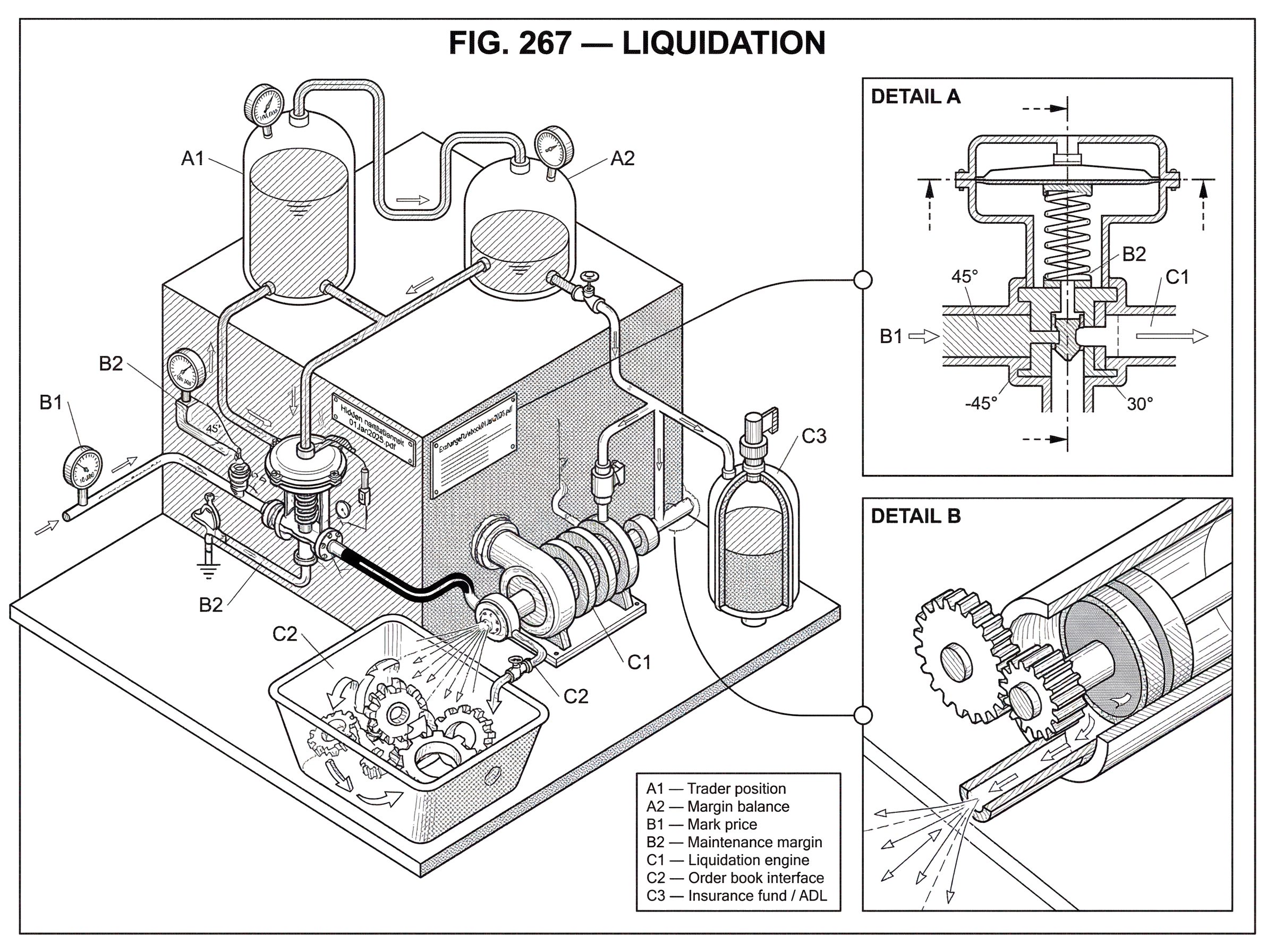
Introduction
Liquidation in derivatives trading is the forced reduction or closure of a position when the collateral supporting it is no longer sufficient. That sounds like a narrow operational detail, but it sits at the center of leveraged markets: without liquidation, traders could lose more than they posted, counterparties would inherit unbounded credit risk, and the market structure itself would become fragile.
The puzzle is that leverage makes markets more capital-efficient and more dangerous at the same time. A small amount of collateral can control a much larger position, which is useful if you want exposure without tying up all your cash. But the same structure means a relatively small adverse price move can wipe out the cushion protecting everyone else. Liquidation exists to resolve that tension. It is the mechanism that stops a losing leveraged position from turning into someone else’s unsecured loss.
If you already know the language of margin, the key idea is simple: liquidation is not mainly a punishment for the trader; it is a solvency mechanism for the market. Everything else (maintenance margin, mark price, liquidation engines, insurance funds, partial close-outs, auctions, and auto-deleveraging) follows from that purpose.
Why do derivatives markets need liquidation mechanisms?
A spot trade can usually be settled immediately: you pay, you receive the asset, and the trade is done. A derivatives position is different. A futures, perpetual, options, or cleared swap position creates an exposure that changes as prices move. That means the market needs a continuing way to ensure each participant can cover losses as they accumulate.
Here is the mechanism. A trader posts collateral, often called margin. The market then allows that trader to hold a position larger than the collateral itself. As long as the trader’s equity remains above the required threshold, the position can stay open. But if losses consume too much of that equity, the market cannot simply wait and hope the trader adds more funds. At that point the position is becoming an unsecured claim on the venue, clearing member, counterparty, or protocol. Liquidation is the point where the system stops waiting and starts closing risk.
This is why liquidation thresholds sit above complete account exhaustion. On many derivatives venues, there is a distinction between the point where the position becomes eligible for forced closure and the deeper point where the account would be effectively bankrupt. BitMEX describes this clearly: the liquidation price is reached when remaining margin has fallen to the maintenance margin level, while the bankruptcy price is the worse price at which the position’s equity is effectively zero. That gap is not arbitrary. It creates room for the liquidation engine to act before losses outrun collateral.
In more traditional cleared derivatives markets, the same principle appears in different legal and operational language. CME Clearing marks positions to market at least daily, and more frequently for exchange-traded derivatives during U.S. hours, collecting and disbursing variation settlement to prevent debt from accumulating unchecked. If a clearing member fails to meet obligations, CME has authority through novation, collateral control, and rulebook powers to hedge, liquidate, auction, or otherwise close out the defaulting portfolio. The structure is different from crypto exchange liquidation, but the invariant is the same: losses must be crystallized and controlled before they become systemic.
How does leverage increase my liquidation risk?
The most important relationship is between position size, collateral, and price movement. If you control a large notional position with a small amount of posted collateral, then your equity buffer is thin relative to the exposure. A 1% move in the underlying may produce a much larger percentage change in your equity. Higher leverage does not just increase potential returns. It narrows the distance between entry and forced exit.
That is why liquidation price moves closer to the entry price as leverage rises. Even without writing out a full formula, the logic is straightforward. Your available buffer is the collateral you can lose before falling below maintenance requirements. Your exposure is the notional value of the position. When exposure is large relative to collateral, only a small adverse move is needed to consume that buffer.
A worked example makes this concrete. Imagine a trader opens a long perpetual futures position worth 100,000 using 10,000 of collateral. If the venue requires some of that collateral to remain as maintenance margin, the trader does not actually have the full 10,000 available to absorb mark-to-market losses. As the mark price falls, unrealized losses reduce account equity. If those losses push equity down to the maintenance threshold, the platform takes over. The trader may think, “I still haven’t lost everything,” but from the venue’s perspective that is exactly the point: it must close risk before everything is lost, because execution itself will take time and may occur in a stressed market.
This is also why volatility matters so much. Liquidation risk is not just about direction; it is about the size and speed of moves relative to your remaining margin buffer. A quiet market can leave an overleveraged position alive longer than seems reasonable. A fast market can liquidate a position even if the trader planned to add collateral moments later.
What triggers liquidation; margin shortfall and mark price?
| Reference price | Used for | Susceptible to | Typical venues | Effect on liquidations |
|---|---|---|---|---|
| Mark price | Margin and P&L | Transient wicks filtered | Deribit, Binance, exchanges | Fewer unnecessary liquidations |
| Last traded price | Official trade value | Thin‑market spikes | Small venues, raw feeds | Can cause spurious liquidations |
| Index / Oracle | Benchmark reference | Oracle delays or manipulation | Indices, DeFi protocols | Delayed or missed triggers |
A common misunderstanding is that liquidation happens because the market traded briefly at a bad tick. In practice, most derivatives venues avoid using the last traded price as the liquidation trigger. They use a mark price, which is an exchange- or protocol-defined estimate of fair contract value designed to avoid unnecessary liquidations caused by temporary wicks, thin prints, or manipulation.
Deribit states directly that it may determine mark-to-market value using the Mark Price “so as to avoid spikes and unnecessary liquidations during periods of high volatility.” Its educational material also notes that account equity is calculated using mark price, not last traded price. Binance’s clearing procedures likewise define mark price as an estimate of contract value used for margin requirements, and liquidation occurs when mark price reaches or crosses the liquidation price.
This design choice is fundamental. If liquidation were tied to the last trade, a single small trade at an off-market price could force close large positions. By using mark price, the venue is saying: we care about the economically relevant value of the contract, not every transient print. The analogy is a thermostat with a smoothing mechanism rather than one that reacts to every gust of warm air. What the analogy explains is why venues filter noise before acting. Where it fails is that liquidation systems are not just smoothing sensors; they are legally and financially binding risk controls.
The actual trigger is usually framed as a comparison between account equity or margin balance and maintenance margin requirement. Deribit says liquidation begins when maintenance margin requirements exceed margin balance. Aave uses a different vocabulary because it is an on-chain lending protocol, but the same structure appears: liquidation occurs when the borrower’s Health Factor falls below 1, meaning collateral value times the weighted liquidation threshold no longer sufficiently covers debt. Different notation, same mechanism.
How do exchanges execute liquidations in practice?
Once the trigger is reached, the position usually passes from trader discretion to a risk engine or liquidation process controlled by the venue. This is where liquidation stops being a price level on the screen and becomes an operational workflow.
On some venues the first goal is not necessarily to close the entire position immediately. Deribit explicitly describes an incremental liquidation system. If maintenance margin reaches the trigger, the system takes control and first tries to liquidate only part of the position. The idea is to reduce risk enough to push the account back below the maintenance threshold. If that succeeds, the remaining position may stay open. This reduces market impact and can preserve some of the trader’s position rather than wiping it entirely.
That partial approach reveals something important about liquidation design. The system is not trying to maximize punishment or fee extraction. It is trying to restore a solvency condition with the least disruption that still works. If a small reduction in exposure re-establishes the required margin relationship, there is no reason to liquidate more than necessary.
Other venues describe the process in staged terms. Binance RCH’s procedures say that when mark price reaches the liquidation price, the clearing house instructs placement of an immediate-or-cancel order on the order book. If that first-stage liquidation succeeds and the post-liquidation account again meets margin requirements, the process ends. If part of the order remains unfilled, the residue can become a bankrupt position, escalating to later loss-management stages involving default funds and potentially ADL.
BitMEX describes a related idea through its Liquidation Engine. When mark price breaches liquidation price, the trader’s maintenance margin is taken over by the engine, which aggregates liquidated positions and attempts to trade them out under several constraints, including reducing positions, obtaining the best possible price, limiting balance use, executing quickly, and limiting market impact. Those goals can conflict in fast markets. Better price usually means slower execution; faster execution usually means more impact. Liquidation engines are attempts to navigate that tradeoff algorithmically.
Can liquidation still leave me owing money, and why?
A forced close does not guarantee that the collateral is enough. It only guarantees that the system acted once the position became too risky to leave open. If the market moves too fast, liquidity disappears, or the liquidation order cannot be fully executed near the intended level, the account can still end up with a negative balance or a residual loss larger than the remaining margin.
That is why many derivatives venues maintain an insurance fund. Deribit states that if an account is bankrupt after the liquidation process, available assets and then the insurance fund are used to bring the account balance back toward zero. Its rulebook defines the insurance fund as the pool of liquidation fees available to cover losses when accounts are bankrupt after liquidation. BitMEX similarly presents its insurance fund as the last line of defense intended to prevent profitable traders from being auto-deleveraged when losing traders cannot fully cover losses.
This is the second important invariant after liquidation itself: leveraged markets need a hierarchy of loss absorption. First, the trader’s own collateral takes the loss. If liquidation recovers enough, the problem ends there. If not, venue-specific backstops absorb the shortfall; insurance funds on exchanges, default waterfalls at clearing houses, protocol reserves or recapitalization mechanisms in DeFi.
CME’s framework makes that hierarchy explicit in institutional form. The clearing house has control over posted collateral, can close out and replace positions, and can draw on guaranty fund resources if the defaulting member’s own assets are insufficient. The details differ from crypto exchanges, but the logic is recognizably the same as an insurance fund plus deeper mutualized resources.
What happens if insurance funds can't cover liquidation; ADL and socialised loss?
| Backstop | When used | Who absorbs | Trader impact | Typical examples |
|---|---|---|---|---|
| Insurance fund | After failed liquidation | Exchange pooled reserve | Protects profitable traders | Deribit, BitMEX funds |
| Auto‑Deleveraging (ADL) | When fund is depleted | Opposing profitable traders | Forced position reductions | Binance, Bybit, OKX |
| Debt recapitalization / socialised loss | When auctions fail or protocol shortfall | Token holders / governance | Dilution or protocol debt | MakerDAO debt auctions |
The most severe cases occur when normal liquidation and the insurance fund are not enough. Then the system has to decide who ultimately absorbs the residual loss.
On some venues, that backstop is auto-deleveraging, or ADL. Binance, Bybit, and OKX all describe forms of ADL in which opposing traders (generally those with profitable and highly leveraged positions) may be selected to have their positions forcibly reduced. The organizing principle is that when a bankrupt position cannot be fully offloaded into the market and the venue’s loss-absorbing resources are insufficient, the market must transfer that position or its losses somewhere. ADL is that transfer.
The ranking logic matters because it determines who is most exposed to this backstop. Binance’s procedures rank positions using a function of unrealized profit relative to position value and effective leverage, tending to prioritize positions that are both more profitable and more leveraged. OKX uses a leverage PnL metric for queue ranking, and Bybit similarly ranks by leveraged return. These formulas vary in detail, but the purpose is consistent: identify the counterparties whose positions can be reduced with the least ambiguity and the greatest capacity to absorb it.
Deribit’s rulebook refers instead to a Socialised Loss Mechanism if the insurance fund or same-currency allocation is depleted. MakerDAO has a different but analogous system-level backstop: if Collateral Auction do not raise enough to cover debt, the shortfall becomes protocol debt, first absorbed by the Maker Buffer and then recapitalized through a debt auction that mints and sells MKR. Aave’s model differs again because liquidators directly repay debt against collateral bonuses, but the same question sits underneath all these systems: if collateral is insufficient, who stands behind the market?
This is where liquidation stops being just a user-risk concept and becomes a market-design concept. It is not enough for a venue to say “positions will be liquidated.” It must also define what happens if liquidation is incomplete.
How do liquidations work in DeFi compared with centralized exchanges?
| Platform type | Trigger metric | Execution actor | Execution style | Backstop |
|---|---|---|---|---|
| Centralized exchange | Mark price vs maintenance | Exchange risk engine | IOC orders, incremental liquidations | Insurance fund, ADL |
| DeFi lending protocol | Health Factor or threshold | Permissionless liquidators / keepers | Seize collateral then auction | Surplus, debt auctions, buffers |
| Clearing house | Variation margin calls | Clearing house / members | Netting, close‑out, auctions | Guaranty fund, member assessments |
The same first principles appear in decentralized protocols, but the mechanics are often more transparent because the rules are encoded in smart contracts.
In Aave, the key state variable is the Health Factor, defined as (Total Collateral Value * Weighted Average Liquidation Threshold) / Total Borrow Value. When that ratio falls below 1, the position becomes eligible for liquidation. A liquidator repays some or all of the borrower’s debt and receives collateral plus a liquidation bonus. This is not an exchange closing a futures position on an order book. It is a protocol allowing permissionless third parties to repair an undercollateralized loan.
MakerDAO solves a related problem through collateral auctions. When a Vault falls below its liquidation ratio, the system seizes the collateral and auctions it to cover the debt plus a liquidation penalty. If the auction does not raise enough Dai, the shortfall becomes protocol debt, eventually recapitalized by a debt auction that mints and sells MKR. Here liquidation is not a market order placed by an exchange engine; it is a governance-parameterized auction mechanism enforced on-chain.
The difference is operational, not conceptual. Centralized venues often rely on internal risk engines, discretionary procedures, insurance funds, and order-book execution. DeFi protocols rely on deterministic thresholds, permissionless liquidators or keepers, and on-chain settlement logic. But both are answers to the same constraint: leveraged or borrowed exposure must be closed before the system becomes undercollateralized as a whole.
Common trader misconceptions about liquidation and margin
The first misunderstanding is treating the displayed estimated liquidation price as a promise. It is usually not. Deribit says plainly that estimated liquidation prices are provided for reference and are not binding. That makes sense because liquidation depends on moving variables: mark price, account equity, fees, other positions, portfolio interactions, and sometimes dynamic margin parameters.
The second misunderstanding is thinking liquidation belongs only to the isolated position being watched. Under cross margin, losses in one position can draw on the whole account. That means the practical liquidation condition belongs to the portfolio, not a single trade. A position that looks safe in isolation can become vulnerable because another position moved against you.
The third misunderstanding is assuming a margin call and liquidation are always distinct stages with meaningful human response time. In some institutional settings there may be a formal call and a short compliance period. CME disciplinary material notes that clearing members may deem even one hour to be a reasonable time for compliance with a performance bond call before closing positions. On many crypto venues, the move from warning to forced action can be nearly automatic.
The fourth misunderstanding is believing stops and liquidation are substitutes. They are not. A stop order is your voluntary attempt to exit risk under your chosen conditions. Liquidation is the system’s involuntary attempt to protect itself once your conditions no longer matter. Deribit’s educational material makes the practical consequence explicit: liquidation orders incur extra fees that feed the insurance fund, so exiting with planned risk controls is often cheaper than letting the venue do it for you.
Which assumptions must hold for liquidation mechanisms to work, and what if they fail?
Liquidation mechanics depend heavily on assumptions about price discovery, liquidity, and legal control.
If the reference price is badly designed, liquidations can trigger too easily or too late. If the market is illiquid, forced execution may occur far from the estimated liquidation level, creating bankrupt positions and drawing down insurance resources. If margin requirements are too loose, the system reaches stress too often; if too tight, capital efficiency suffers and traders are liquidated unnecessarily.
In centralized clearing, legal assumptions matter as much as market ones. CME’s disclosures emphasize novation, settlement finality, first-priority liens on collateral, and the enforceability of close-out rights, especially in bankruptcy. Without those rights, liquidation authority would be uncertain exactly when it is most needed.
In DeFi, the fragile assumptions shift. Oracle quality matters because the protocol can only liquidate based on the prices it knows. Keeper participation matters because someone must actually execute the liquidation. Auction design matters because collateral must be sold quickly enough and fairly enough to cover debt. If any of those assumptions weaken, liquidation still exists in theory but may fail in practice.
Conclusion
Liquidation is the forced closure or reduction of a leveraged position once its collateral buffer is no longer sufficient to protect the market. The durable idea behind it is simple: in leveraged systems, losses must be stopped before they become someone else’s unsecured exposure.
That is why venues use maintenance margin, mark price, liquidation engines, insurance funds, default waterfalls, auctions, and finally ADL or recapitalization mechanisms. The details vary across futures exchanges, crypto derivatives platforms, and on-chain lending protocols. The logic does not. Liquidation is the mechanism that turns leverage from an open-ended credit problem into a bounded risk process.
How do you start trading crypto derivatives more carefully?
Start trading derivatives more carefully by sizing positions, choosing margin mode deliberately, and using order types that limit downside. On Cube Exchange, fund your account, pick your margin mode, and use limit/reduce-only orders plus stop-losses to keep liquidation risk manageable while you trade.
- Deposit fiat or a supported crypto into your Cube account and wait for the required on-chain confirmations or fiat settlement.
- On the contract page, set margin mode to isolated for the position and choose an initial notional so your effective leverage is no higher than 5x (or size the position to use no more than ~25% of your free collateral).
- Place a limit reduce-only entry order where possible; if you need immediate execution, use a market entry but attach a predefined stop-loss (market or limit) sized to close before hitting maintenance margin.
- Maintain a collateral buffer (for example, keep ≥20% free collateral relative to position notional) and set mark-price alerts so you can add collateral or trim exposure before liquidation.
Frequently Asked Questions
Venues use a mark price (an exchange- or protocol-defined estimate of fair value) to avoid liquidations caused by transient wicks, thin prints, or manipulative trades; Deribit and Binance explicitly say account equity and liquidation checks use mark price rather than the last traded price to reduce unnecessary forced closes.
Yes - if the market moves too fast or liquidity is poor, liquidation execution can occur far from the intended level and the recovered proceeds may not fully cover losses, producing a negative account balance that is then covered (if possible) by the venue’s insurance fund or higher-level default resources.
Incremental (partial) liquidation is a process where the system first attempts to reduce only enough exposure to restore the account above maintenance margin; Deribit describes this as a way to lower market impact and preserve part of the trader’s position when a small reduction is sufficient.
Auto-deleveraging (ADL) is a backstop used when liquidation and insurance resources are insufficient: profitable opposing positions (often ranked by profit and effective leverage) can be forcibly reduced to absorb the residual loss, and platforms like Binance, Bybit and OKX describe ADL schemes that select counterparties by leveraged-return metrics.
Exchanges typically rely on insurance funds and rules like ADL to cover shortfalls, while central clearinghouses use a layered guaranty/default waterfall (collateral, guaranty/guarantee funds, novation and other mutualized resources) with legal powers to port or close positions; both designs implement a hierarchy of loss absorption but differ in legal structure and mutualization.
On-chain protocols implement deterministic on‑chain mechanisms: Aave uses a Health Factor that triggers permissionless liquidators when it falls below 1, and MakerDAO seizes collateral and runs collateral auctions, whereas centralized venues use internal risk engines, order‑book liquidations, and discretionary procedures - the aim is the same but the execution layer and actors differ.
No - estimated liquidation prices shown in UIs are reference values and explicitly non-binding because actual liquidation depends on changing variables like mark price, portfolio exposures, fees and margin parameter changes; Deribit warns estimated liquidation prices are provided for reference only.
Yes - under cross margin the whole account’s equity backs all positions, so losses in one trade can erode buffer available to others and cause liquidation at the portfolio level rather than an isolated single position liquidation.
Liquidation systems rely on assumptions about timely, accurate reference prices, sufficient market liquidity, legal enforceability of close-out rights, and participant behaviour (e.g., keeper/liquidator participation); if any of those assumptions weaken (bad oracles, illiquid markets, legal uncertainty) liquidations can be mistimed, fail to recover value, or become systemic.
No - a stop order is a voluntary instruction you place to exit a position under your terms, whereas liquidation is an involuntary, system-enforced action to restore solvency; moreover, liquidations often incur extra fees and can execute under worse market conditions compared with a planned stop.
Related reading