What is Price Impact?
Learn what price impact is, why trades move prices, how it works in order books and AMMs, and how it differs from slippage and MEV-driven costs.
Introduction
Price impact is the change in market price caused by the trade itself. That sounds simple, but it hides an important puzzle: if a market already has a price, why should your own order change it?
The answer is that a market price is never a single, unlimited quote. It is always backed by some finite amount of liquidity at each price level. When you trade a small amount, you can often transact near the current quoted price. When you trade a larger amount, you must consume more of the available liquidity, and the market offers progressively worse terms. In that sense, price impact is not an accident layered on top of trading. It is the mechanical consequence of how markets ration liquidity.
This idea matters across market structures. In a central limit order book, price impact comes from walking through resting bids or offers. In an automated market maker, price impact comes from changing the pool reserves and therefore changing the pool’s quoted exchange rate. The details differ, but the invariant is the same: larger trades relative to available depth move the price more.
That is why price impact sits at the center of execution, liquidity provision, market making, and market design. Traders care because it raises execution cost. Liquidity providers care because it is part of how they earn fees and bear inventory risk. Protocol designers care because the shape of the trading rule determines how costly large trades become. And analysts care because observed execution cost is not just “the market moved”; often, the trade itself was the mechanism that moved it.
Why does my trade move the market? Understanding local price and finite liquidity
The cleanest way to think about price impact is to separate marginal price from average execution price. The marginal price is the price of the next infinitesimal unit. The average execution price is what you actually pay or receive across the whole order.
If liquidity were infinite at the quoted price, these would be the same no matter how large the trade was. Real markets do not work that way. They present a local price backed by limited quantity. Once you consume that quantity, the next available units are less favorable. So price impact is the gap created because execution happens across a curve of available liquidity, not at a single unlimited point.
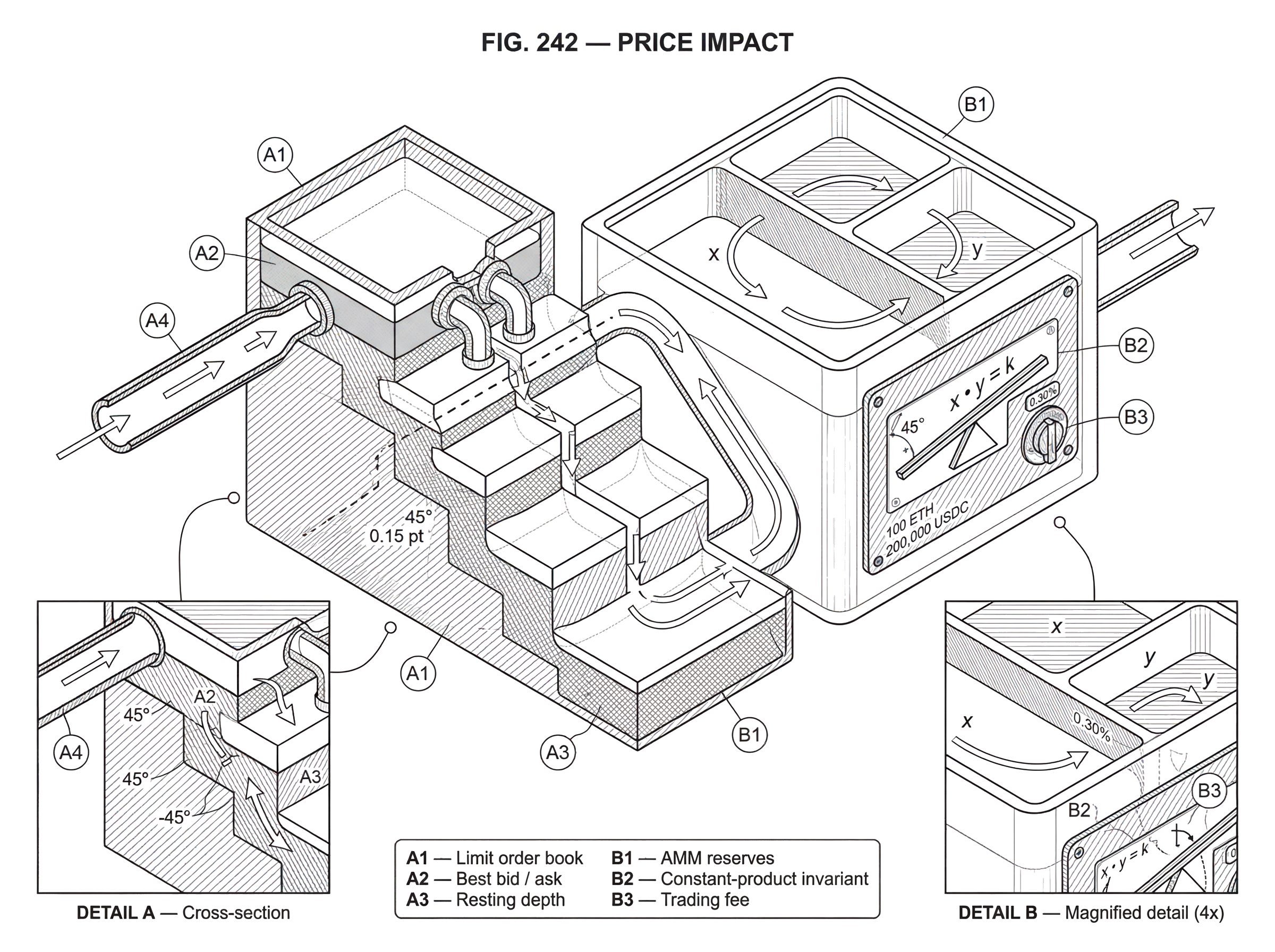
In ordinary language, you can think of the market as a staircase or a ramp, depending on venue design. In an order book, the staircase is visible as discrete levels of bids and asks. In an AMM, the ramp is encoded directly in the pool’s pricing function. The analogy explains why larger orders get worse prices. Where it fails is that real markets are not static objects: arbitrageurs, market makers, and other traders react while the order is being executed, so the available liquidity can change during the trade.
This also explains why price impact is closely related to, but not identical with, slippage. Price impact is the part of execution cost caused by consuming liquidity and moving the market. Slippage is broader: it is the difference between expected and realized execution price, which can also come from latency, adverse selection, reordering, or market movement unrelated to your own order.
How does price impact occur in an order book?
In an order book, the current best ask is only the price of the cheapest unit available for buyers. The current best bid is only the highest price available for sellers. Behind those best quotes sits a ladder of additional liquidity at progressively worse prices.
Suppose a trader wants to buy a modest amount of an asset. If the quantity available at the best ask is enough, the order fills there and price impact is small. But if the order is larger, it consumes the best ask, then part of the next ask level, then perhaps the next. The average price paid rises as the order walks up the book. That worsening is price impact.
The mechanism is straightforward because the market structure is explicit. A market order says, in effect, “fill me now using whatever liquidity is currently available.” The book responds by matching the order against resting liquidity from best price outward. Each matched increment removes depth from the book, and the best available offer after the trade may now be higher than before. The market price has moved because liquidity at the original price was finite and got consumed.
There is a deeper point here. In order-book markets, price impact is not only about visible depth. Some resting liquidity is hidden, some liquidity providers cancel when they detect toxic flow, and some new liquidity arrives in response to the trade. So the impact you observe is shaped by both the static book and the strategic behavior around it. This is one reason microstructure theory distinguishes between the mechanical act of consuming depth and the information conveyed by order flow.
That distinction appears clearly in classic models such as Kyle’s sequential-auction framework. In that setting, market makers infer information from signed order flow, so trades can have a more lasting effect on price when they are interpreted as informative. The important intuition is that some price impact is temporary (a concession required to locate liquidity now) while some can be permanent because the trade changes other participants’ beliefs about value.
How do AMMs create price impact (constant‑product example)?
| AMM type | Liquidity shape | Impact curve | Best for | Main risk |
|---|---|---|---|---|
| Constant-product | Spread across wide range | Steeply nonlinear for large trades | General-purpose swaps | High impact for large trades |
| Concentrated liquidity | Deep near chosen ranges | Flatter inside range, steep outside | Small-to-medium near-market trades | Depth vanishes if price exits range |
| Stable‑asset AMM | Very flat near parity | Very low impact near peg | Stablecoin and pegged assets | Large divergence breaks low slippage |
In an automated market maker, there is no order book to walk. Instead, the pool itself quotes prices according to a trading rule. Your trade changes the reserves, and the changed reserves imply a new price.
For a constant-product AMM such as Uniswap v2, the basic mechanism is especially transparent. If the pool holds reserves x and y, it enforces the invariant that x * y cannot decrease. Ignoring fees for the moment, the pool’s marginal price is given by the reserve ratio. The Uniswap v2 whitepaper states that the marginal price of one asset in terms of the other at time t is the ratio of reserves, p_t = r_a_t / r_b_t.
That one fact makes the whole idea click. Price impact in a constant-product AMM is what happens when your trade changes the reserve ratio. If you buy asset y by adding asset x, the pool ends up with more x and less y. Because the ratio has changed, the next marginal unit of y is more expensive than the previous one.
A worked example makes this concrete. Imagine a pool with 100 ETH and 200,000 USDC. The spot price is about 2,000 USDC per ETH because that is the reserve ratio. Now a trader buys ETH with USDC. The USDC reserve rises and the ETH reserve falls. Even if we ignore fees, the pool cannot give out ETH at a flat 2,000 USDC for the whole order, because doing so would violate the constant-product rule. Instead, each increment of ETH removed leaves the pool scarcer in ETH relative to USDC, so the price rises continuously during execution. The trader’s average execution price ends up worse than the initial spot price, and the post-trade spot price is higher than the pre-trade spot price.
This is why AMM price impact is nonlinear. A trade twice as large does not generally create twice the impact. As the reserves move further along the curve, each additional unit becomes more expensive. Research on constant function market makers generalizes this point: the exchange function for a two-asset swap is concave, so the marginal exchange rate worsens with size. The first-order price from the gradient of the trading function is useful for small trades, but larger trades require the full nonlinear rule.
Fees matter too. Uniswap v2 charges a 0.30% trading fee, paid primarily to liquidity providers, with an optional protocol fee switch that can redirect part of that amount. That fee is not the same thing as price impact, but from the trader’s perspective both appear as execution cost. A large trade on a shallow pool pays both the explicit fee and the implicit cost of moving the pool price.
Which AMM designs reduce price impact and what are the trade‑offs?
Once price impact is understood as a consequence of the trading function, a broader design principle appears: different invariants create different liquidity shapes.
A constant-product AMM spreads liquidity over a very wide price range. That makes it simple and robust, but it also means a lot of capital sits far from the current price, where it does little to reduce impact for near-market trades. Uniswap v3 changes this by allowing concentrated liquidity. Liquidity providers choose a price range rather than supplying uniformly across all prices. Within that active range, the position behaves like a constant-product pool with larger virtual reserves. The practical consequence is more depth near the current price and therefore lower price impact for trades that stay within the active range.
The tradeoff is that this depth is conditional. If the market price moves outside a position’s chosen range, that liquidity becomes inactive. So concentrated liquidity can make execution much better near the current price while also making available depth more fragile and state-dependent. A pool can look very deep until a large move pushes price across ticks and suddenly consumes the active liquidity in one range after another.
This is also why fee tiers and tick spacing matter in concentrated-liquidity systems. Smaller tick spacing allows liquidity to be placed more precisely around the current price, increasing local depth and reducing impact for small trades. But it can also increase gas costs because swaps may cross more initialized ticks. So even the cost of reducing price impact is itself a design tradeoff between capital efficiency and transaction overhead.
A different example comes from stable-asset AMMs such as Curve’s StableSwap design, which was built for assets expected to trade near parity. The design goal is explicit in Curve’s documentation: extremely efficient stablecoin trading. The reason is structural. If two assets are meant to be close in value, the trading function can be made much flatter near that region, creating much lower price impact for ordinary trades around parity than a plain constant-product curve would allow. But that favorable behavior depends on the assumption that the assets really are near-par substitutes. When that assumption fails, the curve no longer protects traders from severe repricing.
So the key question is never just “how much liquidity is in the pool?” It is also “where is that liquidity concentrated, and under what assumptions does it stay active? ” That is the mechanism behind why different AMMs can have very different realized price impact even for similar headline total value locked.
What are instantaneous, temporary, realized, and permanent price impacts?
| Impact type | When measured | What it captures | Typical duration |
|---|---|---|---|
| Instantaneous | Immediately after trade | Quoted/marginal price change | Seconds to minutes |
| Realized | Against execution benchmark | Average execution shortfall | Duration of execution |
| Temporary | Post-trade reversion phase | Transient depth/refill effects | Minutes to hours |
| Permanent | Long-run price shift | Information-driven revaluation | Persistent |
People often talk about price impact as though it were a single number. In practice, there are several closely related quantities.
Instantaneous impact is the immediate change in the quoted or marginal price caused by the trade. In an AMM, this is the movement along the curve caused by changed reserves. In an order book, it is the change in the best bid or ask after liquidity is consumed.
Realized impact is the cost actually paid relative to some benchmark, such as the pre-trade midprice, oracle price, or decision price. This is usually what the trader feels. It includes the fact that different pieces of the order may execute at different prices.
Temporary impact is the part that later reverts. For example, a trade may push through shallow liquidity and then the price partially mean-reverts once market makers refill or arbitrageurs restore the venue to the broader market.
Permanent impact is the part that remains because the trade conveyed information or moved inventory into stronger hands at a new equilibrium price. In traditional microstructure, this is closely tied to adverse selection. In on-chain markets, it can also reflect genuine information arrival, cross-venue repricing, or a large order revealing demand that others treat as informative.
The distinction matters because not all post-trade movement should be blamed on “slippage,” and not all adverse execution is just a fee for liquidity. Some of it is the market learning from the trade.
How does arbitrage affect AMM price impact on-chain?
On-chain AMMs add a feature that is less central in a single isolated order book: cross-venue arbitrage is constantly stitching local prices back toward a broader market price.
If a Uniswap pool moves because of a large trade, that pool price may temporarily diverge from other AMMs or centralized exchanges. Arbitrageurs trade against the discrepancy, earning profit while pushing the pool back toward the external market. From the original trader’s perspective, this means some of the cost of the trade is paid immediately inside the AMM, while some of the post-trade adjustment is completed by arbitrageurs.
This is why AMM price impact and arbitrage are inseparable. The pool does not “know” the external fair price. It only knows its invariant and reserves. Your trade moves the local price mechanically; arbitrage then links that local move to the wider market.
This also explains why AMM oracles often use time-weighted average prices rather than spot prices. Uniswap v2 accumulates prices over time and allows callers to compute a TWAP as the change in the accumulator divided by elapsed time. The point is to reduce sensitivity to a single manipulated or transient reserve state. For understanding price impact, the lesson is that spot execution can be very local and path-dependent, while measurement for downstream applications often needs a smoother benchmark.
How do MEV and transaction ordering increase measured price impact?
In blockchain markets, execution quality depends not only on the pricing rule but also on transaction ordering. That means the price impact a user experiences can be worse than the pool or book would imply in a frictionless, neutral ordering model.
This is where MEV becomes relevant. Research such as Flash Boys 2.0 documents how bots exploit ordering opportunities in DEXes, often by paying for priority and frontrunning user flow. Flashbots describes MEV as a hidden cost on users that inflates fees and degrades user experience. For price impact, the practical point is that an observed execution may reflect both the venue’s mechanical liquidity curve and additional extraction layered on top by strategic ordering.
The clearest example is a sandwich attack. A user submits a trade that will move an AMM price. An attacker buys first, the user then executes at a worse price, and the attacker sells after, capturing the difference. The user’s realized cost is now larger than the “pure” impact implied by the original pool state. Mechanically, the AMM still follows its invariant. But the path through state space has been manipulated by reordering.
So whenever people report price impact on-chain, an immediate question should be: impact relative to what execution path? Neutral simulation from the pre-trade state? Actual realized transaction sequence? A benchmark price on another venue? These are not equivalent.
This is also why transaction-protection tools exist. Private relays, protected RPC endpoints, auction-based orderflow, and other execution designs aim to reduce avoidable extraction. They do not repeal price impact (finite liquidity still exists) but they can reduce the part of realized cost caused by adversarial ordering rather than by the market’s underlying depth.
How is price impact measured in practice?
There is no single universal definition because the right benchmark depends on the question being asked.
If the question is about market design, a natural measure is the change in marginal price produced by a trade of size q. In AMMs, that can often be computed directly from the pool’s trading function. In order books, it can be approximated from the depth consumed across levels.
If the question is about trader cost, the more relevant measure is the difference between the order’s average execution price and a benchmark such as the pre-trade midprice. That captures the economic burden of liquidity consumption. Execution systems often go further and ask what would have happened under an alternative routing strategy, venue split, or time schedule.
For empirical work, analysts increasingly rely on indexed on-chain datasets and curated trade tables. Tools such as The Graph provide blockchain indexing and query infrastructure, while Dune offers standardized DEX trade datasets across many chains and explicitly frames them as useful for studying liquidity dynamics, price impact, and market manipulation. These datasets make measurement possible, but they do not remove the conceptual choice of benchmark. A “price impact” metric is only as clear as the definition behind it.
In off-chain order-book settings, market data providers such as Kaiko package top-of-book, depth, and slippage-related fields. Again, these are inputs to analysis, not substitutes for defining what kind of impact you mean: instantaneous quote movement, average execution shortfall, or a cost-to-trade curve for a given notional size.
How can traders reduce price impact?
| Tactic | How it reduces impact | Main tradeoff |
|---|---|---|
| Trade deeper venues | More available local depth | May require venue access |
| Split across venues | Avoids concentrating consumption | Routing complexity increases |
| Time-sliced execution (TWAP) | Lets depth replenish between slices | Slower execution risk |
| RFQ / OTC | Keeps large blocks off public book | Counterparty/selection risk |
| Choose correct AMM pool/tier | Pick pool with active local liquidity | Might pay higher fees |
The mechanism now makes the common mitigations unsurprising. You reduce price impact by avoiding the need to consume too much liquidity at once from any single state.
That can mean trading where there is more depth. It can mean splitting an order across venues so no single book or pool is pushed too far. It can mean spreading execution over time, as with TWAP-style execution, so that replenishment and arbitrage can refill depth between slices. It can mean using RFQ or OTC workflows for large blocks so the order never publicly walks a visible book. And in concentrated-liquidity AMMs, it can mean routing through the fee tier and range structure with the deepest active liquidity near the current price.
Each tactic is just a way of changing the ratio between trade size and available local liquidity. That ratio is the quantity that really governs impact.
When do simple rules about price impact fail?
The biggest misunderstanding is to assume that price impact is just “big order, big move.” The truth is more conditional.
A trade can be large in dollar terms and still have modest impact if the venue is deep and replenishes quickly. A much smaller trade can have severe impact in a thin or fragmented market. In concentrated-liquidity AMMs, the relevant depth may disappear abruptly when price leaves a range. In stable-asset pools, impact can be tiny near parity and then rise sharply once the pool is stressed away from that region.
Another common mistake is to treat price impact as purely mechanical and therefore entirely predictable from the visible state. That is often approximately true for a single AMM swap in isolation. It is much less true for real execution across multiple venues, where routing, latency, hidden liquidity, arbitrage, and MEV all matter.
And finally, there is a conceptual mistake in treating impact as a bug. Price impact is not a flaw added to markets after the fact. It is how scarce liquidity expresses itself. If markets offered unlimited size at the best quoted price, liquidity providers would be giving away an infinite free option. The existence of price impact is part of what makes market making economically possible at all.
Conclusion
Price impact is the market’s way of charging for immediacy when liquidity is finite. In an order book, you pay it by consuming depth across price levels. In an AMM, you pay it by moving the pool along its trading curve. The exact shape depends on market design, active liquidity, fees, and strategic behavior around execution, but the core mechanism is always the same: the larger your trade relative to available local depth, the more your own trade moves the price against you.
How do you improve your spot trade execution?
Improve spot trade execution by prioritizing liquidity reading, order-type choice, and explicit slippage control. On Cube Exchange you can fund your account, inspect the market’s depth and spread, and use limit or post-only orders or time-sliced execution to lower the immediate price impact of large trades.
- Fund your Cube account with fiat or a supported crypto transfer.
- Open the market order book for the pair and read top-of-book and cumulative depth vs. your notional to judge how much of the book you would walk.
- Choose an order type: use a limit order or post-only limit to control fill price and avoid taker slippage; for very large sizes, slice the order (TWAP-style) across multiple fills.
- Review fees, quoted spread, and estimated fills, then submit; if execution must be immediate, accept a smaller fill or reduce size to limit impact.
Frequently Asked Questions
In an order book you ‘walk the book’ - a market order consumes resting bids or asks so the best quote steps through discrete depth levels; in an AMM you change the pool’s reserves and therefore its marginal price because the trading function (e.g., xy=k) maps reserve changes to price. The observable consequence is the same (larger relative trades worsen average execution), but the mechanical cause and the natural way to compute impact differ across the two architectures.
Constant-product AMMs enforce an invariant (xy=k) so the marginal price equals the reserve ratio; removing or adding assets changes that ratio and the marginal price continuously. Because the trading function is nonlinear, doubling a trade typically produces more-than-proportional worsening of the marginal rate, so impact is concave and cannot be treated as simply linear with size.
Temporary impact is the portion of the price move that later reverts as liquidity providers or arbitrageurs refill the venue, while permanent impact is the portion that persists because the trade conveyed information or shifted equilibrium inventories. Distinguishing them matters because temporary impact is a short‑term liquidity cost, whereas permanent impact reflects information/adverse selection and changes the trader’s benchmark for realized cost.
Concentrated liquidity (Uniswap v3) lets LPs supply capital in tight price ranges, creating much larger virtual depth near the current price and therefore lower impact for trades that stay inside those ranges. The tradeoff is fragility: when price exits an LP’s chosen range that depth becomes inactive, so a pool can look deep until a large move crosses ticks and suddenly removes the locally available liquidity; tick spacing and gas costs also shape this capital-efficiency vs. execution‑overhead tradeoff.
No - trading fees are an explicit, per‑trade charge (for example, Uniswap v2’s 0.30% fee) paid to LPs, while price impact is the implicit cost from consuming finite liquidity and moving the marginal price. From a trader’s perspective both reduce execution quality, but they arise from different mechanisms and are conceptually separable.
On‑chain ordering risk and MEV increase realized price impact by allowing adversaries to exploit or reorder your transaction (e.g., sandwich attacks): attackers transact before and after your swap to capture the price movement, making your effective cost larger than the AMM’s mechanical slippage. The literature and practitioner tools (Flash Boys 2.0, Flashbots) document these extraction channels and the mitigation designs (private relays, protected RPCs, builder systems) that aim to reduce them.
There is no single canonical metric - choose the benchmark that matches your question: use marginal price change from the trading function (or depth consumed) for market‑design comparisons, and use the difference between your order’s average execution price and a pre‑trade benchmark (pre-trade midprice or decision price) to measure trader cost. Indexed on‑chain datasets and providers (The Graph, Dune, Kaiko) supply the raw trades and depth needed for these computations, but the numerical value you report depends entirely on the chosen reference and measurement window.
Reduce the ratio of trade size to available local liquidity: execute where there is more depth, split the order across venues or over time (TWAP-style slicing), use RFQ/OTC for large blocks, or route through fee tiers/ranges with the deepest active liquidity in concentrated‑liquidity AMMs. Each approach lowers immediate consumption of depth but can introduce other costs or risks (latency, opportunity cost, or execution complexity).
Related reading