What is Sui?
Learn what Sui is, how its object-centric blockchain works, why it uses Move, and how its fast path and consensus design differ from traditional networks.
Introduction
For the token explainer, see SUI.
Sui is a permissionless smart contract network designed around a specific bet: most blockchain activity is not really about mutating one giant shared state, but about moving or updating discrete assets that have clear owners. If that bet is right, a blockchain does not need to run every transaction through the same heavy coordination path. It can let many transactions proceed independently and reserve full consensus for the cases that genuinely involve shared state.
That is the idea that makes Sui click. The important question is not just what chain is Sui, but what problem its architecture is trying to solve. Traditional smart contract systems often make unrelated transactions contend with one another because they are all interpreted as changes to a common global state. Sui starts from a different premise: if an asset can be modeled as an object with an owner and a version, then the network can often validate and finalize operations on that object without first imposing a total order on everything else.
This design is closely tied to Move, the programming language Sui uses for smart contracts. In Sui’s model, assets are not an afterthought layered on top of accounts. They are first-class objects. That affects how developers write applications, how validators check safety, how full nodes verify history, and why Sui is often described as an object-centric blockchain.
Sui also matters because it is not only a programming model. It is a full network with validators, full nodes, fee markets, APIs, operator tooling, and a production consensus stack. Its documentation includes developer guides, Move references, operator guides for validators and full nodes, cryptography and standards material, and SDKs such as the Sui API, Sui Framework, Rust SDK, and Sui dApp Kit. In other words, Sui is both a protocol design and an ecosystem for building and operating applications on that design.
Why does Sui model state as objects instead of one global ledger?
| Object type | Coordination needed | Global ordering? | Typical use-cases | Fast path? |
|---|---|---|---|---|
| Uniquely owned | Local checks and lock-once | No | NFT transfers; coin spends | Yes (Byzantine broadcast) |
| Shared mutable | Full Byzantine agreement | Yes | Shared order books; communal state | No |
| Shared immutable | Simple validation only | No | Static metadata; published artifacts | Yes |
The cleanest way to understand Sui is to contrast it with the mental model many readers bring from earlier chains. In an account-based system, state often feels like a large shared database. An account has balances, storage slots, and code; contracts read and write pieces of that global state; and the network must be careful about the order in which transactions touch it. Even when two transactions seem unrelated, the system often treats them as participants in the same ordering problem.
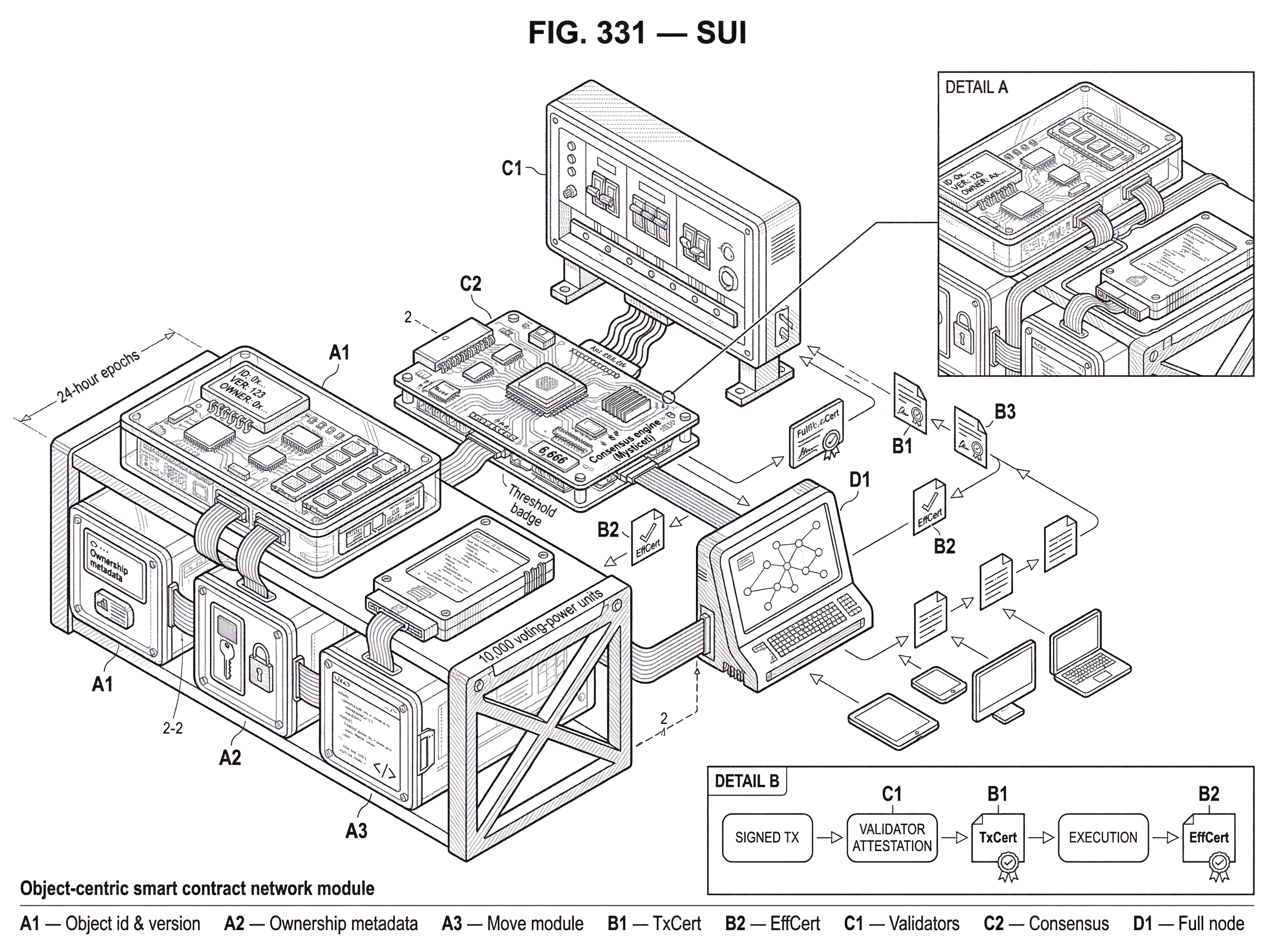
Sui changes the unit of state. Instead of centering the system on accounts with arbitrary storage, it centers the system on objects. According to the Sui whitepaper, each object has a globally unique identifier, ownership metadata, contents, and a version that increments whenever the object is mutated. Ownership matters because it tells the network what kind of coordination is needed. Some objects are owned by a single address or by another object. Some are shared and mutable. Some are shared but immutable.
That ownership field is not a cosmetic detail. It is the mechanism that lets Sui separate easy transactions from hard ones. If Alice owns an object and wants to transfer or modify it in a way that touches only objects she exclusively controls, then validators do not need to debate where that transaction belongs in a universal sequence of all transactions. They need to check that Alice is allowed to act on the current version of that object and that no conflicting use of that same object has already been accepted.
This is why Sui is often described as optimized for asset-oriented workloads. Many economically meaningful actions on blockchains are exactly of this form: transfer an NFT, update a position object, spend a coin object, mint or merge assets under clear ownership rules. When those actions can be expressed as operations on owned objects, the network can avoid dragging them through the most expensive coordination path.
The analogy that helps here is a warehouse. In a conventional global-state model, it is as if every worker must wait for the foreman to approve a master sequence for all tasks, even when they are handling items on different shelves. In Sui’s model, each item carries its own identity and custody rules. If two workers are handling different items, they can proceed independently. The analogy explains why parallelism becomes easier. It fails in one important way, though: a blockchain still needs cryptographic proof, quorum signatures, and protection against Byzantine failures. Sui is not removing coordination entirely; it is narrowing it to where the underlying state structure actually demands it.
How does Sui track object ownership, versions, and mutations?
In the whitepaper’s formal description, an object can be thought of as a tuple containing its contents, object ID, ownership, and version. You do not need the notation to grasp the invariant. The invariant is simple: an object is a durable, typed piece of state with a stable identity and an explicit ownership mode, and every mutation moves it to a new version.
That version number is doing real work. It prevents validators from accidentally accepting two incompatible futures for the same owned object. If a transaction consumes version v of an object and creates version v+1, then any other transaction trying to act on version v conflicts with it. This is how Sui turns ownership into concurrency without giving up safety: unrelated objects can move independently, but the same object cannot be spent or mutated twice at the same version.
Transactions in Sui are explicit about the objects they operate on. A transaction includes the target package, module, and function, along with arguments and object inputs. This matters because the network does not want to discover the touched state only after speculative execution against a giant mutable store. It wants the transaction to declare its footprint up front. That footprint tells validators which objects must be checked, locked, or ordered.
Move strengthens this model. The whitepaper emphasizes that Move’s type system is built for resource safety. In ordinary programming languages, it is easy to accidentally copy or discard a value in a way that would be disastrous for digital assets. Move was designed so that resource-like values cannot be duplicated or destroyed arbitrarily. On Sui, that means assets represented as Move objects inherit language-level protections against common mistakes such as accidental duplication or invalid disposal.
A simple example makes this concrete. Imagine a game item represented as an object owned by a player. The item has an ID, some fields such as durability or rarity, and a current version. The player sends a transaction calling a Move function that upgrades the item by consuming an upgrade material object they also own. Because both inputs are owned objects, the transaction can name them directly. Validators check that the signer controls them, that the referenced versions are current, and that the Move code is valid. If execution succeeds, the old versions are consumed, updated objects are created, and each mutated object receives a new version. Nothing about that flow requires global ordering against every swap, vote, or mint elsewhere on the network.
Which Sui transactions use the fast path and which require full consensus?
The deepest architectural distinction in Sui is between operations on owned or read-only objects and operations on shared mutable objects. That is the line between transactions that can use a lower-latency path and transactions that need full Byzantine agreement.
For common operations on owned assets, Sui uses a protocol based on Byzantine consistent broadcast rather than full consensus. In plain language, validators individually check the transaction, sign it if it is valid, and the client gathers enough signatures from a quorum to form a transaction certificate, or TxCert. Later, processing the transaction and obtaining a quorum on the resulting effects yields finality. Because the transaction affects only owned objects, the key safety problem is not “what is the global order of all transactions?” but “has a quorum attested to this exact transaction against these exact object versions, and has any conflicting use been prevented?”
The crucial safety mechanism is object locking. The whitepaper explains that authorities lock owned input objects to the first transaction or certificate they accept for them within an epoch. The phrase sounds narrow, but it is the heart of safety. If validators could sign conflicting transactions for the same owned object version, the low-latency path would collapse into double-spend risk. The lock-once behavior ensures that the first accepted use of an owned object version excludes competing uses.
Shared mutable objects are different because ownership no longer isolates contention. If many users can mutate the same object, then there really is a sequencing problem. Two transactions might both be valid in isolation but produce different outcomes depending on order. Here Sui cannot rely on the lighter path. It must use full Byzantine agreement to impose an order that all honest validators accept.
This is where Sui’s consensus layer matters. Research and implementation materials tie Sui’s consensus engine to Mysticeti, a DAG-based Byzantine consensus protocol. The Sui codebase’s consensus directory describes itself as the implementation of Sui Consensus based on the Mysticeti protocol. The Mysticeti research paper argues that this design reaches a three-message-round lower bound for commit latency in the consensus path and reports substantial latency improvements when integrated into Sui.
The practical takeaway is more important than the branding. Sui is not claiming that consensus disappears. It is claiming that only the transactions that genuinely require shared ordering should pay the full cost of consensus. That is a meaningful difference from systems where every transaction inherits that cost by default.
How does finality work on Sui (TxCert and EffCert explained)?
| Certificate | What it proves | Signed by | Primary use | Client benefit |
|---|---|---|---|---|
| TxCert | Quorum accepted the submitted transaction | 2f+1 validators | Portable proof of acceptance | Initial finality evidence |
| EffCert | Quorum attested execution effects | 2f+1 validators | Proof of transaction outcome | Light-client verification |
| Checkpoint | Sequence of committed state transitions | Validator set quorum | Long-term state anchor | Bootstrap and sync full nodes |
Because Sui splits transaction handling into different coordination paths, readers sometimes wonder whether finality is somehow less real for the “fast path.” It is not. The finality proof simply takes a different shape.
A client sends a signed transaction to Sui validators. Each validator checks validity: the sender’s authorization, object ownership and version references, gas information, and whether the transaction obeys the rules of the called Move code and package. If valid, the validator signs. The client collects signatures from a quorum and forms a TxCert. That certificate is portable evidence that a quorum accepted the transaction.
Execution produces effects, and a quorum can also sign those effects, producing an effects certificate, or EffCert. The whitepaper describes these certificates as transferable proofs of the transaction and its outcome. This is useful for more than just validators. Full nodes can use quorum-certified data to re-execute and validate state transitions. Light Client can authenticate reads without storing the full chain. Bridges and other interoperability systems can use checkpoints and certificates as evidence about Sui state.
This certificate-based design is one reason Sui full nodes are described as read-only views of the network state that still validate integrity. Official full-node documentation explains that full nodes cannot sign transactions, but they can verify chain integrity by re-executing transactions that a quorum of validators has already committed. To stay in sync correctly, a full node must follow at least 2f+1 validators, where up to f may be Byzantine. The same quorum threshold also appears in the documentation’s explanation of transaction certificates.
There is a nice first-principles point here. Finality in Sui is not “trust the server that answered your API request.” It is “check the cryptographic and quorum-backed evidence that enough validators recognized the transition.” That distinction matters for wallets, indexers, explorers, and cross-chain systems.
How do Mysticeti and networking improvements affect Sui’s consensus and reliability?
Sui’s architecture is easiest to understand as a layered system. The object model decides when transactions can avoid total ordering. The fast path handles owned-object transactions. The consensus path orders shared-object transactions. But underneath consensus there is another problem: how validators disseminate blocks and recover missing data efficiently under real network conditions.
That is why Sui’s research trail includes not only the original object-model whitepaper and Mysticeti, but also work like Beluga, which studies block synchronization in Byzantine settings. Beluga’s paper identifies a “pull induction” attack in which an adversary can exploit naïve push-pull dissemination to trigger redundant block fetches, wasting bandwidth and harming liveness. The paper describes a design that combines optimistic push with a more disciplined pull mechanism and reports that it has been integrated into Mysticeti and deployed in Sui mainnet.
This layer can sound abstract, but it has concrete consequences. A blockchain is not only a state machine; it is also a distributed system moving authenticated data over imperfect networks. If validators cannot exchange blocks efficiently under stress, then a theoretically strong consensus protocol may still suffer in practice. Sui’s evolution here shows that the team is not treating consensus as a solved box. They are iterating on the block dissemination and recovery machinery around it.
The same pattern appears in release engineering. Recent release notes mention consensus fixes such as improved direct finalization and a correction for cases where validators might disagree on transactions that should be rejected. For users, the lesson is straightforward: Sui’s design has strong core ideas, but production reliability still depends on implementation quality, networking behavior, and ongoing protocol maintenance.
What kinds of dApps are best suited to Sui’s object model?
An architecture matters only if it changes what developers can express and what users can feel. Sui’s object model pushes applications toward explicit assets and stateful components with clear ownership relationships. That naturally fits wallets, collectibles, games, onchain positions, escrow-like objects, and systems where users manipulate distinct pieces of state more often than they coordinate on one giant shared pool.
This does not mean Sui can only do NFTs or simple transfers. Shared objects allow genuinely multi-user state, so applications such as exchanges, shared liquidity systems, order books, governance mechanisms, or game worlds with common mutable state are still possible. The difference is that when developers choose shared mutable objects, they are also choosing the stronger coordination costs that come with them. Sui makes that tradeoff more explicit than many platforms do.
That explicitness can be healthy. It forces a design question early: is this state really shared, or have we modeled it that way out of habit? In some applications, breaking a system into owned objects lets many user actions proceed independently while reserving shared objects for the smaller surface where coordination is actually needed. In others, the application is intrinsically shared, and Sui will not magically remove that cost.
The official docs reflect this developer orientation. The documentation hub highlights getting-started materials, Sui developer basics, Move concepts, APIs, framework references, and SDKs. That breadth matters because Sui is not just asking developers to learn another chain’s RPC endpoints. It is asking them to think in terms of packages, Move modules, explicit object inputs, and ownership-aware state design.
What is SUI used for, and how do fees and validators work on Sui?
Sui has a native token, SUI, used for gas and delegated stake. The whitepaper describes an EIP-1559-style fee model with a protocol-defined base fee adjusted at epoch boundaries and an optional user tip. That means fees are not purely first-price bids for every unit of demand; part of fee pricing is algorithmically adjusted at the epoch level.
Validators are central to both execution and network governance. Operator documentation describes validator nodes as specialized nodes that do more than full nodes, including roles in staking, gas-price reference, and tallying rules. Validators need substantially more infrastructure than a casual user: official guidance suggests high-core-count machines, large RAM, fast NVMe storage, and specific network port configurations and Linux tuning.
Sui also uses epochs as administrative boundaries. The validator documentation states that Sui uses 24-hour epochs, which is relevant because some locking behavior, validator-set changes, and staking-related transitions are epoch-scoped. This is one of those details that feels operational until it affects protocol reasoning: if locks are per epoch, then epoch changes become part of the safety and liveness story.
Validator admission rules are also evolving. A governance proposal, SIP-39, argues that requiring a fixed minimum amount of SUI to join the validator set creates an unnecessarily high barrier to entry. It proposes switching to minimum voting-power thresholds instead. The proposal explains that Sui normalizes total stake to 10,000 voting-power units and that finality requires signatures from validators with combined voting power above 6,666. This is a more structural way to think about validator influence than an absolute token threshold, though the effective SUI needed for a given amount of voting power still changes with total stake.
How do validators and full nodes differ, and how should operators run Sui nodes?
| Node type | Signs transactions? | Recommended hardware | Primary responsibilities | API support |
|---|---|---|---|---|
| Validator | Yes | 24 cores; 128 GB RAM; 4 TB NVMe | Certification, execution, consensus | Validator RPCs; staking endpoints |
| Full node | No (read-only) | 8 cores; 128 GB RAM; 4 TB NVMe | Verify commits; serve queries; index | gRPC preferred; JSON‑RPC deprecated |
It helps to separate two kinds of network participation. Validators participate in transaction certification, execution, and consensus. Full nodes do not sign, but they verify and serve data.
The official full-node guide says Sui full nodes validate blockchain activity, store state and history, and answer queries. They are meant for reading and verifying the chain rather than participating in consensus. The same guide warns operators not to sync from genesis because it is too slow and resource intensive; instead they should start from a recent snapshot. That is a practical reminder that modern high-throughput chains are operational systems as much as theoretical protocols.
Sui’s data-access surface is also changing. The full-node documentation says JSON-RPC is deprecated and that operators who want to serve the gRPC API must enable gRPC indexing. That indexing step can initially consume enough resources that the node may struggle to serve other traffic. This tells you something broader about Sui’s maturity: its state and API model are still being refined, and operators need to track those changes closely.
For external observers, Sui exposes public operational surfaces as well. The Sui status page reports recent uptime windows for mainnet validators and public RPC nodes, while the Sui Explorer includes validator-oriented views such as distribution, stake snapshots, and operational metrics. Those tools do not define the protocol, but they matter because a network is only useful if users and operators can observe its health.
When does Sui’s object-centric design improve performance; and when does it not?
Sui’s strongest idea is also its main boundary. If your workload can be decomposed into operations on independently owned objects, Sui can often avoid global sequencing and achieve lower latency and more parallelism. If your workload revolves around truly shared mutable state, then Sui must fall back to the same fundamental reality every blockchain faces: someone has to agree on order.
That means the right comparison is not “Sui eliminated consensus” but “Sui narrowed the domain where consensus is unavoidable.” This is a meaningful contribution, but it is not magic. A decentralized exchange with a heavily shared order book, a global game-state object, or any application with hot shared contention will still live on the slower and more coordination-heavy path.
A second assumption is that developers can model their applications well in object terms. Sometimes that is natural. Sometimes it is awkward. An object-centric architecture can clarify ownership and reduce accidental coupling, but it can also force a redesign for developers used to account-style storage and unconstrained shared state.
A third boundary is implementation complexity. Sui’s split execution model, certificate machinery, validator locking, consensus engine, and block synchronization layers create a system that is elegant in principle but nontrivial in practice. The presence of ongoing research, release-note fixes, and operator guidance on tuning is not a flaw by itself; it is what one should expect from a high-performance distributed system. But it does mean readers should distinguish the architectural promise from the day-to-day work of operating that architecture robustly.
Conclusion
Sui is a smart contract network built on a simple but powerful observation: not every transaction needs the whole network to agree on a global order first. By representing assets as versioned objects with explicit ownership, Sui lets many ordinary transactions proceed through a lighter path, while reserving full consensus for genuinely shared mutable state.
That object-centric design is the part to remember tomorrow. Sui is not just another chain with a different throughput claim. It is an attempt to restructure blockchain execution around the shape of the state itself; and most of the network’s mechanics, from Move programming to certificates, validators, and consensus, follow from that choice.
How do you buy SUI?
Buying SUI on Cube is straightforward: trade the SUI/USDC market to acquire SUI and settle the purchase in your Cube account. Open the SUI/USDC market at /trade/SUIUSDC to compare execution options and place your order.
- Deposit USDC into your Cube account using the fiat on-ramp or a direct crypto transfer.
- Open the SUI/USDC market via /trade/SUIUSDC.
- Choose an order type: use a market order for immediate execution or a limit order to control price and reduce slippage.
- Enter the SUI amount or USDC spend, review estimated fill, fees, and slippage, then submit the order.
Frequently Asked Questions
Sui models state as versioned objects with explicit ownership and treats many operations on exclusively owned or read-only objects as independent, so those operations can be validated and finalized without first imposing a global order on all transactions.
For transactions that touch only owned or read-only objects, Sui uses a lower-latency path based on validators individually checking and signing the transaction to produce a quorum-backed transaction certificate (TxCert) and later an effects certificate (EffCert); only transactions on shared mutable objects are sent through full Byzantine consensus ordering.
An object’s version increments on each mutation and validators lock owned input object versions to the first transaction or certificate they accept in an epoch, so any later attempt to act on the same version conflicts and is rejected - this lock-once policy is the core mechanism preventing double-spends on the fast path.
Shared mutable objects require full agreement because multiple actors can legitimately mutate the same object and outcomes depend on a single global ordering; Sui routes those operations through its Byzantine consensus layer (research/implementations reference Mysticeti) rather than the fast certificate path.
Move’s type system is designed for resource safety so values representing assets cannot be copied or destroyed arbitrarily; on Sui this means assets encoded as Move objects inherit language-level protections that reduce common asset-management mistakes.
Finality on Sui is quorum-backed: clients collect validator signatures into TxCerts and EffCerts that act as portable cryptographic evidence a quorum accepted a transaction and its effects, and full nodes can re-execute quorum-certified transactions to verify state without signing themselves.
Gas uses an EIP-1559-style model with a protocol base fee adjusted at epoch boundaries plus an optional user tip, and fees are charged even for aborted executions; detailed token-economics distributions are deferred to a dedicated paper.
Run validators to participate in signing, execution, and staking and expect operator guidance that recommends high-core-count machines, lots of RAM and fast NVMe; full nodes are read-only verifiers that should start from snapshots (not genesis), and JSON-RPC is deprecated in favor of gRPC indexing which can be resource-intensive to build initially.
Sui’s design helps when workloads can be decomposed into independently owned objects, but it does not eliminate the coordination cost for intrinsically shared workloads - developers must decide early whether state needs to be shared or can be modeled as owned objects because choosing shared objects implies paying the consensus cost.
Light clients and external systems can authenticate Sui state using quorum certificates (TxCerts/EffCerts) without storing full history, because these certificates are portable proofs that a quorum of validators attested to a transaction and its effects.
Related reading