What Is Cross-Chain Interoperability?
Learn what cross-chain interoperability is, how bridges and messaging protocols work, and why verification and trust assumptions define their security.
Introduction
Cross-chain interoperability is the problem of getting separate blockchains to work together without treating them as a single chain. That sounds simple until you ask the question that actually matters: who is allowed to believe what happened on another chain? A blockchain is useful precisely because it reaches its own consensus about its own state. The moment assets, messages, or control move across chains, you need some mechanism for carrying not just data, but trust.
This is why cross-chain interoperability is both necessary and difficult. Users want to move tokens, trigger contract logic across networks, manage accounts from another chain, and build applications that are not trapped inside one ecosystem. Protocols like IBC, XCM, CCIP, LayerZero, and Wormhole all exist because isolated chains create friction. But they solve different parts of the same underlying problem, and they make different choices about verification, delivery, and trust.
The key idea is this: cross-chain interoperability is not mainly about transport; it is about authenticated state transition across separate consensus systems. If Chain A says, “a token was locked,” or “this packet was sent,” Chain B needs a way to verify that claim strongly enough to act on it. Everything else (relayers, guardians, oracle networks, message formats, lock-and-mint flows, burn-and-mint flows) follows from that requirement.
Why do blockchains need interoperability?
A single blockchain can only natively reason about its own history. Ethereum validators do not automatically validate Solana blocks. A Cosmos chain does not natively know whether a message on another chain was finalized. A Polkadot parachain may share security within its own architecture, but that does not make an external chain legible by default. So even if two chains both support smart contracts, tokens, and accounts, they are still separated by a verification gap.
That gap creates practical constraints. Liquidity becomes fragmented. Applications must choose where to live, even when their users and assets live elsewhere. A lending protocol might want collateral on one chain, settlement on another, and messaging from a third. A game might want cheap in-game actions on one network but access to assets or users on another. Institutions may want asset movement across private and public chains. In every case, the same obstacle appears: one chain needs some justified belief about another chain’s state.
This is why interoperability exists at all. It is not a luxury feature layered on top of mature systems. It is a response to the fact that the blockchain ecosystem expanded into many execution environments, fee markets, consensus models, and trust domains. Once that happened, the choice became either isolation or some machinery for moving value and intent across boundaries.
How can one blockchain verify events from another chain?
| Model | How verification works | Trust anchor | Integration cost | Best for |
|---|---|---|---|---|
| Light client | On-chain light-client verifies proofs | Source chain consensus | High implementation effort | Security-sensitive links |
| External attestation | Validator/oracle signs attestations | External verifier set | Low integration effort | Heterogeneous chain connectivity |
| Shared ecosystem | Common hub or relay enforces checks | Shared infrastructure security | Medium, ecosystem-specific | Parachains and system hubs |
The cleanest way to understand cross-chain interoperability is to separate two questions that are often blurred together.
The first question is what happened on the source chain? Did a user really lock 10 tokens? Was a message actually emitted by a particular application? Did a governance action really pass? The second question is how does the destination chain learn that fact? These are related, but they are not the same. Many systems can transport a claim. The hard part is making the claim believable enough for the destination chain to execute against it.
This is where most bridge designs differ. Some systems try to minimize new trust assumptions by having each chain verify the other through a light client. Cosmos IBC is the clearest example: chains maintain light clients of counterparties and use them to verify packets and proofs. Cosmos documentation describes IBC as a protocol that lets blockchains share arbitrary byte-encoded data, with security coming from on-chain verification and off-chain relayers that move packets. Relayers are important, but they are not the source of truth; they are couriers.
Other systems shift verification to an external verifier set. Wormhole does this through its Guardian network and Verified Action Approvals, or VAAs. Guardians observe messages, and once a two-thirds supermajority agrees a message is valid, they sign the message hash. The destination chain verifies the VAA rather than directly verifying the source chain’s consensus. CCIP similarly relies on Chainlink decentralized oracle networks for cross-chain execution. In these systems, the destination chain is not directly checking the source chain’s full consensus rules. It is trusting an intermediate attestation mechanism.
A third family separates message format from message transport. Polkadot’s XCM is explicit about this distinction: XCM is a messaging format and language for communication between consensus systems, not the transport itself. Delivery may happen through XCMP or related transport mechanisms. This distinction matters because interoperability has multiple layers. A system can standardize message meaning without standardizing every delivery path.
The compression point is that cross-chain interoperability always answers the same question (how can Chain B safely act on a claim about Chain A?) but different designs place the burden of proof in different places.
Why think of cross‑chain messages as 'mail, not telepathy'?
It helps to think of chains as countries with separate courts, not computers on the same motherboard. If a court in one country issues a judgment, another country does not act on it merely because the paper arrived. It acts because there is a recognized process for authentication, recognition, and enforcement. The message alone is not enough. The institution that validates the message is what matters.
That analogy explains why bridges and interoperability protocols have so much machinery around proofs, signatures, validators, relayers, and finality. A raw message saying “release funds” is worthless unless the destination system has a rule for accepting it. Some systems accept direct cryptographic proof rooted in the source chain’s own consensus. Some accept signatures from a designated federation or validator set. Some rely on oracle-style networks. Some work best inside architectures that already share security assumptions.
The analogy also has limits. Blockchains can often verify evidence much more mechanically than courts can, and they can encode those rules on-chain. But the core point holds: interoperability is institutional compatibility expressed in protocol form.
How do cross‑chain transfers and messages work step‑by‑step?
| Transfer type | Source action | Proof produced | Delivery | Destination action |
|---|---|---|---|---|
| Lock-and-mint | Lock tokens in escrow | Inclusion proof or attestation | Relayer or VAA submission | Mint wrapped representation |
| Burn-and-mint | Burn tokens on source | Burn receipt or attestation | Relayer or oracle | Mint equivalent token |
| Atomic swap | Hash-time-lock on both sides | Preimage reveal proof | Coordinated on-chain settlement | Claim funds or refund |
| Message-passing | Emit application packet | Merkle proof or VAA | Packet relayer / XCM / XCMP | Execute handler or update state |
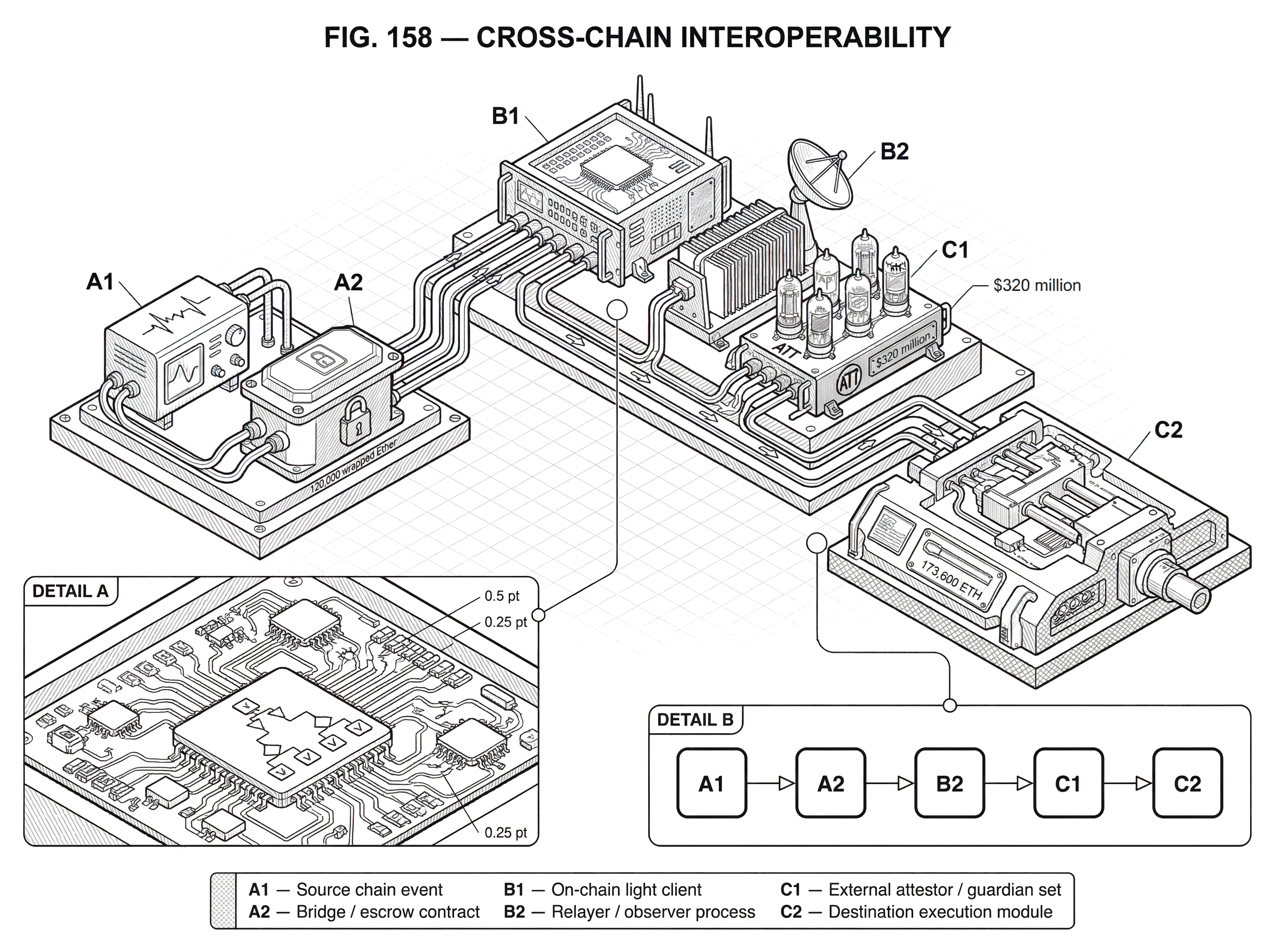
Mechanically, most cross-chain systems have four moving parts: a source-chain event, a proof or attestation that the event happened, a delivery mechanism, and destination-chain execution. The details differ, but the invariant is the same.
Imagine a user wants to move a token from Chain A to Chain B. On Chain A, something observable happens first. In a lock-and-mint bridge, the original token is locked in a contract. In a burn-and-mint system, the source-chain representation is destroyed. In a generalized message-passing protocol, an application emits a packet containing instructions or data. Ethereum.org’s bridge explainer captures the three main asset-transfer mechanisms well: lock-and-mint, burn-and-mint, and atomic swaps. Those are not arbitrary categories; they reflect where the asset’s continuity is maintained.
Next, some proof is produced. In a light-client design, that proof may be a Merkle proof against state the destination chain can verify using a light client of the source chain. Solana’s payment and state verification proposal shows the general shape of such thinking: a light client can verify a minimal receipt that a transaction was included in a block and confirmed by the relevant validator set, without running a full validator itself. IBC uses this broad pattern: the receiving chain verifies proofs against its on-chain light client of the sending chain.
In an externally verified bridge, the proof is usually an attestation by an external set. Wormhole’s VAA structure makes this concrete. The body is deterministically derived from an on-chain message, hashed, and signed by Guardians once a two-thirds supermajority agrees it is valid. The destination chain verifies those signatures and then decides whether to execute the message. Here the cryptography is strong, but the trust anchor is different: it is the Guardian set rather than native source-chain verification.
Then comes delivery. In IBC, off-chain relayers watch for packets and submit them to the other chain. The relayer does not need to be trusted to tell the truth because the destination chain checks proofs itself. In Wormhole, relayers may retrieve and submit VAAs. In XCM, the format of the message is separate from the transport mechanism that carries it. In every case, an off-chain actor often moves information around, because blockchains do not poll one another directly.
Finally, the destination chain executes. If the message is valid under its rules, it may mint a representation of a locked asset, unlock escrowed funds, update account control, invoke an application handler, or process a contract call. At this point, interoperability stops being abstract. It becomes visible as token balances, contract state changes, or account authority updates.
What role do relayers play and why shouldn't you trust them?
A common misunderstanding is that a bridge is “the relayer.” That is almost never the right abstraction. The relayer is often just the messenger. The real question is what happens if the messenger lies, disappears, or races another messenger.
IBC makes this especially clear. Cosmos documentation describes relayers as off-chain processes that scan state, construct datagrams, and submit them to counterpart chains. Multiple relayers can serve a channel. This works because the chain verifies the packet using a light client of the counterparty chain. If a relayer submits false data, verification fails. If a relayer goes offline, liveness suffers, but correctness need not fail.
That separation (untrusted delivery, trusted verification) is one of the cleanest design goals in cross-chain systems. It reduces the power of operational intermediaries. But not every system achieves it to the same degree. If the destination chain depends on a specific external verifier set, then the relaying and attestation architecture together become part of the trust model. In practice, many real systems sit somewhere between pure light-client verification and fully trusted federation.
Message passing vs. asset bridging: what's the difference?
| Approach | Data complexity | Latency | Security model | Best use |
|---|---|---|---|---|
| Asset bridging (liquidity) | Low (value only) | Low / fast | Liquidity or custodial assumptions | Fast token swaps and transfers |
| Generalized message-passing | High (arbitrary bytes) | Higher; more engineering | Light-client or validator attestations | Cross-chain contracts and control |
| Oracle / attestation network | Medium (structured attestations) | Medium; configurable | Trusted oracle or guardian set | Heterogeneous chain connectivity |
People often speak about “bridges” as if moving tokens were the whole story. But token transfer is just one application of cross-chain interoperability. The more general capability is authenticated message passing.
This is why protocols emphasize bytes, packets, and message semantics. Cosmos describes IBC as allowing chains to share any type of data encoded as bytes. That enables token transfers, but also atomic swaps, multi-chain smart contracts, and cross-chain account control. XCM similarly focuses on expressing intended state changes between consensus systems. It is not itself a transaction, and by default it is asymmetric or “fire and forget.” That matters because not every interoperable action is a payment. Some are instructions, account authorizations, or application-specific state transitions.
This distinction explains a lot of architectural divergence. A liquidity network optimized for fast swaps may be excellent for moving value but poor at carrying rich application logic. A generalized message-passing system can support more complex cross-chain applications, but it often pays for that flexibility in latency, engineering complexity, or connectivity constraints. Ethereum.org’s bridge overview notes this trade-off directly: generalized message-passing bridges are better at passing complex data, while liquidity networks tend to optimize for speed and connectivity.
So when asking whether a system is “good at interoperability,” the right follow-up is: interoperability of what? Assets, arbitrary messages, governance, account control, or shared application logic are not the same design problem.
How does a token transfer across chains work (lock‑and‑mint example)?
Consider a user moving tokens from one chain to another through a lock-and-mint design. On the source chain, the user sends tokens into a bridge or application contract. Those tokens are no longer freely spendable by the user; that is the economic anchor that prevents duplication. The contract emits a message stating, in effect, that a particular amount of a particular asset has been locked for a specified destination.
Now a relay or observer network notices that event. If the system is light-client-based, the relay gathers a proof that the lock event is included in finalized source-chain state and submits that proof to the destination chain. If the system is externally verified, an oracle, guardian, or validator network attests that the event occurred and signs a standardized payload. In Wormhole terms, that would become a VAA. In IBC terms, a relayer would carry the packet and proof to a counterparty chain that verifies it using an on-chain light client.
The destination chain then checks whether its acceptance conditions are satisfied. If yes, it mints or releases the corresponding representation. The user now holds something spendable on the destination chain. Notice what did not happen: the original asset did not literally travel. What traveled was a verified claim that justified creating or releasing a corresponding state on the other side.
That detail is the source of both the power and the fragility of bridging. The power comes from making isolated systems composable. The fragility comes from the fact that if the verification step is wrong, you can create assets that are not actually backed, or execute messages that were never legitimately authorized.
What are the main security risks in cross‑chain interoperability?
Cross-chain systems concentrate risk because they sit at the boundary between trust domains. If a single-chain application fails, the damage is often local to that chain and contract. If a bridge fails, the failure can propagate through wrapped assets, collateral systems, liquidity pools, and dependent applications on multiple chains at once.
This is not theoretical. Ethereum.org notes that bridges have been a major source of severe DeFi hacks. A recent systematization-of-knowledge on bridge security argues that bridges remain immature, identifies 12 potential attack vectors, and groups observed attacks into 10 vulnerability types. The pattern behind these incidents is straightforward: interoperability systems must reason across more components, more assumptions, and more failure modes than ordinary single-chain applications.
The Wormhole exploit is a vivid example of what breaks when verification fails. Chainalysis describes how the attacker minted 120,000 wrapped Ether on Solana without the necessary Ethereum collateral, creating roughly $320 million in stolen value. The underlying economic model depended on a simple invariant: every wrapped asset on one side should correspond to real locked collateral on the other. Once that invariant failed, downstream protocols accepting the wrapped asset as collateral faced systemic risk.
The Ronin bridge compromise illustrates a different failure mode. According to Ronin’s postmortem, attackers gained control of five of nine validator keys and used that threshold to forge withdrawals, draining 173,600 ETH and 25.5 million USDC. Here the cryptography did not “break” in the abstract. The system behaved according to its rules; the problem was that the trusted validator threshold was operationally compromised. This is the right way to think about many bridge failures: they are not failures of interoperability as a concept, but failures of a specific trust model under real operational pressure.
Nomad’s exploit, widely analyzed through public incident datasets, exposed yet another aspect of bridge fragility: once a verification or initialization flaw makes fraudulent claims easy to replicate, attacks can become socially contagious because copying the exploit path is cheap. Different bridge architectures fail differently, but they all revolve around the same core risk: the destination chain accepts a claim it should not have accepted.
Trade‑offs: trust assumptions versus connectivity in interoperability designs
There is no universal best interoperability design because the goal is not just correctness. Systems also need acceptable cost, latency, coverage, developer ergonomics, and operational liveness.
Light-client-based interoperability minimizes additional trust assumptions by verifying source-chain state more directly. This is why IBC is often treated as a high-trust-minimization model. But such systems usually require meaningful implementation work on both chains, compatible proof systems, and support for maintaining light clients. They can be elegant and powerful where they fit, but they do not automatically connect every chain to every other chain.
Externally verified systems usually expand connectivity and simplify integration. Oracle networks, guardian sets, and validator federations can connect heterogeneous chains that would struggle to verify one another natively. CCIP’s pitch of moving data and value across many public and private chains reflects this practical advantage. LayerZero’s description of “lightweight message passing” and “configurable trustlessness” points to the same design space: change the verification architecture to make connectivity easier, then expose security choices as configuration. The trade-off is that these systems introduce new trust surfaces. The question stops being only “do I trust the source chain?” and becomes “do I also trust this verifier network, oracle system, or configuration?”
Shared-ecosystem systems can sometimes do better because they inherit common infrastructure. XCM works inside an environment designed for communication between consensus systems in the Polkadot ecosystem, and it explicitly separates message semantics from transport. That allows richer coordination than generic ad hoc bridging, but it also means the design is deeply shaped by the surrounding architecture.
So the real organizing principle is not a list of bridge “types.” It is this: every interoperability system chooses where verification happens, who bears the cost of proving source-chain truth, and how much new trust is introduced to make that possible.
Common mistakes when evaluating cross‑chain interoperability
The first common mistake is to think interoperability means “sending tokens between chains.” In reality, token transfer is a special case of authenticated cross-chain state change.
The second is to confuse message delivery with message validity. A message arriving on Chain B does not mean Chain B should act on it. XCM’s own documentation is useful here because it explicitly says the format is not the transport. More generally, transport answers “did the message get here?” Verification answers “should I believe it?” Those are different layers.
The third is to assume “trustless” means “risk-free.” Even systems designed to avoid new trust assumptions can suffer from implementation bugs, incorrect proof verification, client-update failures, relayer liveness issues, or mismatches in finality assumptions. The Solana light-client proposal, for example, shows how subtle proof construction and validator-set verification can be in practice. Trust minimization helps, but it does not repeal engineering complexity.
The fourth is to collapse all bridge security into smart contract audits. Audits matter, but incidents like Ronin show that validator operations, key management, monitoring, allowlists, and organizational controls can be just as important as on-chain code. Cross-chain security is socio-technical by nature.
When does cross‑chain interoperability fail or become unsafe?
Cross-chain interoperability depends on assumptions that are sometimes hidden during normal operation. If the source chain reorgs more deeply than expected, a message believed final may no longer correspond to canonical history. Wormhole’s documentation makes this concrete through consistency_level: lower consistency can speed VAA production but increases reorg risk. If validator sets change and a light client is not updated correctly, proofs may become unverifiable or insecure. If an oracle or guardian network is corrupted or censored, the system may halt or mis-execute. If wrapped assets become dominant in downstream protocols, a bridge failure can become a market-wide solvency problem rather than a local bug.
There is also a deeper conceptual limit. Interoperability cannot make independent chains fully native to one another. It can only create controlled ways for one chain to act on evidence about another. That means every cross-chain action has a boundary where assumptions are imported. You can move that boundary, harden it, and make it more explicit. You cannot make it disappear.
Conclusion
Cross-chain interoperability is the machinery that lets one blockchain safely do something because of what happened on another blockchain. The central problem is not transmission but verification: how the destination chain gains enough justified confidence in a source-chain event to act on it.
Once that clicks, the landscape becomes easier to reason about. IBC leans toward on-chain verification with light clients and untrusted relayers. XCM standardizes message meaning separately from transport. Systems like Wormhole, CCIP, and LayerZero use various external attestation or messaging architectures to widen connectivity and usability. The trade-offs are always about the same thing: where trust lives, how proof is produced, and what happens when that machinery fails.
If you remember one sentence tomorrow, make it this: cross-chain interoperability is the art of moving trust across chains without pretending the chains were ever the same system.
How do you move crypto safely between accounts or networks?
Moving crypto safely between accounts or networks starts with verifying the exact asset, chain, and destination before you send anything. Use your Cube Exchange account to fund the asset, open the transfer/withdraw flow, and submit the on-chain transfer or withdrawal while following chain-specific confirmation rules.
- Fund your Cube account with the asset you plan to move (or deposit fiat and convert to a supported on-chain token).
- In Cube’s transfer/withdraw flow, select the correct network and token contract/identifier. Copy and paste the destination address and any required memo or tag; verify the address checksum and contract address on a block explorer.
- Send a small test amount first (for example, 0.01–0.1 of the asset or a few dollars’ worth) and confirm it arrives on the destination chain.
- After the test clears, set the full amount, review on-chain fee estimates and the chain’s recommended confirmation threshold (e.g., ~12 confirmations for many EVM chains; finality rules differ for Solana/Cosmos), then submit the full transfer.
- Monitor the transfer on the destination chain explorer and retain TXIDs and timestamps until the receiving account shows the expected balance.
Frequently Asked Questions
Because each chain reaches its own consensus about its history, the hard problem is not moving bytes but giving Chain B a justified reason to believe a claim about Chain A; simply delivering a message does not make it valid under the destination chain’s rules.
A light client lets the destination chain verify source-chain state on‑chain using cryptographic proofs, so relayers act only as couriers and need not be trusted; by contrast, guardian/oracle designs (e.g., Wormhole’s Guardians or Chainlink DONs) replace native verification with an external attestation layer, which is easier to connect heterogenous chains to but adds a new trust anchor.
They are three distinct continuity patterns: lock‑and‑mint holds real tokens in escrow on the source chain while minting a representation on the destination, burn‑and‑mint destroys the source representation before minting on the other side, and atomic swaps exchange assets across chains without intermediate wrapped supply; each preserves continuity differently and has different operational and security implications.
If relayers stop relaying, delivery and liveness suffer (transactions and transfers don’t reach the destination), but correctness can still hold when the destination performs on‑chain verification (as in IBC); however, systems that rely on external attestations combine relayer/attestor availability with the trust model, so outages can both halt and, in some designs, enable unsafe outcomes.
Major bridge failures fall into a few patterns: verification or logic flaws that allow minting without collateral (Wormhole’s VAA exploit), operational compromise of validator/guardian keys that meet the bridge’s signing threshold (Ronin), and initialization or protocol bugs that make fraudulent proofs easy to produce (Nomad); each illustrates a different trust or implementation failure mode.
No - interoperability cannot erase the fact that chains are independent consensus systems; it only creates explicit, controllable ways for one chain to act on evidence about another, so the boundary and imported assumptions remain even if you harden or move them.
Light‑client approaches minimize added trust by relying on verifiable proofs and on‑chain verification but require compatible proof formats and effort to run clients; externally‑attested approaches (e.g., CCIP, LayerZero) lower integration friction and broaden reach at the cost of adding oracle/guardian trust surfaces and configuration choices about who you trust.
A chain reorganization can turn a previously accepted claim into a non‑canonical history point, so systems must choose a consistency/finality model (Wormhole’s documented consistency_level is an example) - weaker consistency speeds attestation but raises reorg risk, while stronger finality delays messages but reduces that risk.
Delivery only answers whether the bytes arrived; validity answers whether the destination should act on them - protocols like XCM and IBC separate format/transport from verification for this reason, so developers must design on‑chain acceptance rules and not assume delivery implies authorization.
Related reading