What is Maker?
Learn what Maker is, how Maker Vaults generate DAI, how liquidations and governance work, and who this DeFi lending protocol is built for.
Introduction
Maker is a lending protocol built to solve a specific problem: how do you create a digital dollar-like asset without trusting a bank, an issuer, or a custodian to hold the dollars? Its answer is not to promise redeemability from an institution, but to build a system where users lock collateral on-chain and borrow a stable asset against it. That stable asset is DAI, and the smart-contract system behind it is the Maker Protocol.
This makes Maker different from a typical lending market. In a protocol like Aave, the main product is a pool where some users supply assets and others borrow them. In Maker, the central product is the stablecoin itself. Lending is the mechanism that creates it. You do not go to Maker mainly to earn interest from a pool of lenders; you go there to turn held collateral into usable liquidity while keeping your underlying exposure.
That design has made Maker one of the defining models in DeFi. It introduced the now-familiar pattern of overcollateralized borrowing through what were once called CDPs and are now called Vaults. The product is useful for people who hold crypto assets and want cash-like liquidity without selling, for traders and protocols that need a decentralized stable asset, and for applications that want a neutral on-chain unit of account.
How does borrowing create DAI in the Maker Protocol?
The simplest way to understand Maker is to start from the accounting identity at its center. DAI is created when someone borrows against collateral. It is not pre-issued by a company treasury. A user deposits approved collateral into a Vault, and the protocol lets that user generate DAI up to a limit determined by the collateral’s risk settings.
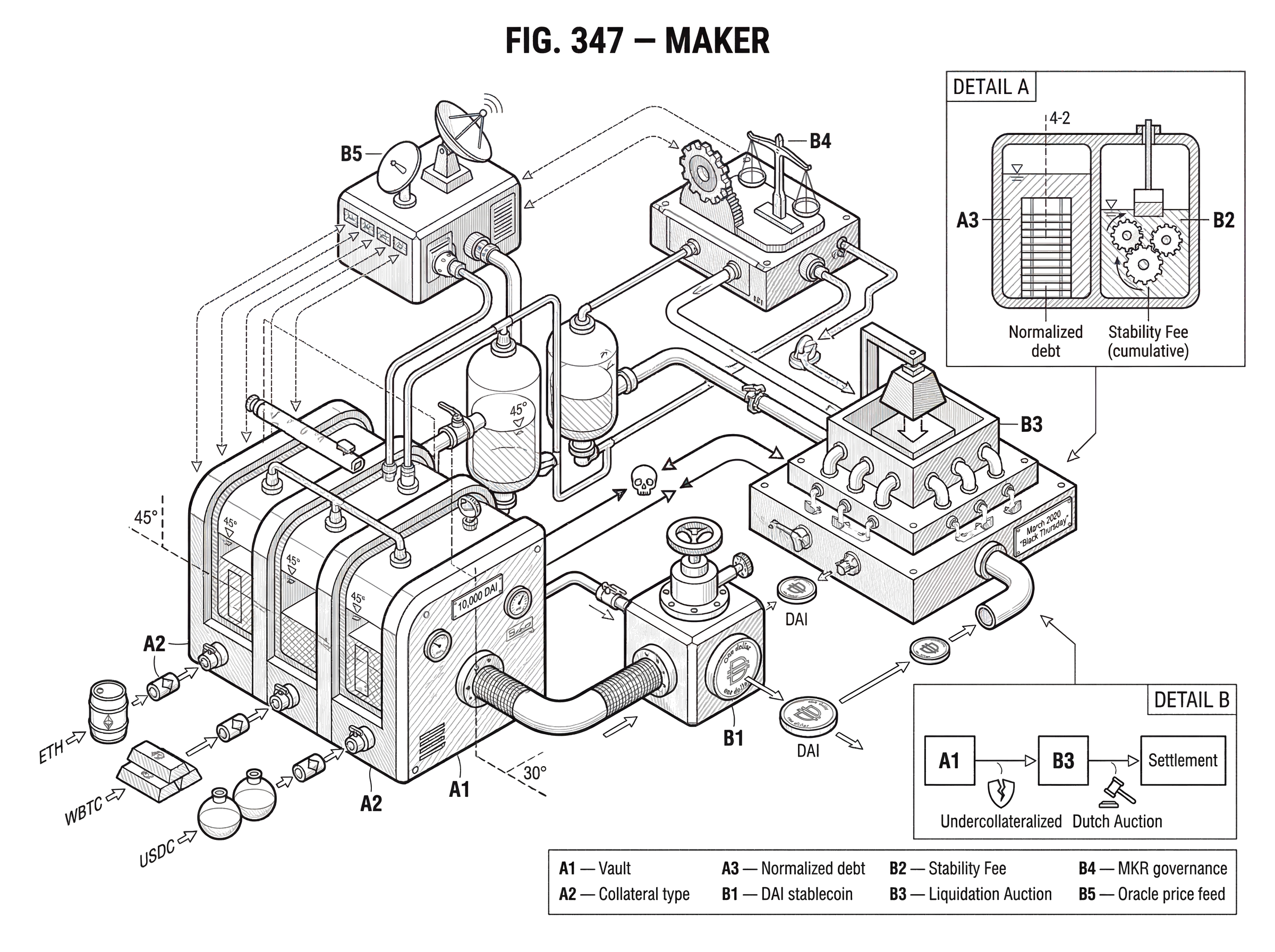
That means every unit of DAI begins as someone’s debt. If you lock collateral and generate 10,000 DAI, the protocol now has two linked facts on-chain: your collateral is escrowed in a Vault, and your Vault owes 10,000 DAI plus an ongoing borrowing cost called the Stability Fee. To get the collateral back, you must repay the debt. The stablecoin exists because the debt exists.
This is the idea that makes Maker click. DAI is not stable because a company says it is worth one dollar. It is stable because the system is designed so that borrowers have to maintain valuable collateral against their debt, and because governance can tune the economic incentives around borrowing, saving, and liquidation to keep the system solvent and keep DAI trading near its target.
The stability target is a soft peg to the US dollar, not a magical guarantee that market price can never move. Maker’s own whitepapers are careful on this point. The protocol aims to keep DAI near one dollar through collateral, interest-rate-like policy tools, and arbitrage-friendly mechanisms, but market conditions can still push it above or below target.
How do Maker Vaults work to generate DAI and manage collateral?
| Profile | Typical draw | Liquidation buffer | Best use case |
|---|---|---|---|
| Conservative | Small DAI relative to collateral | High buffer, low risk | Long-term holders |
| Balanced | Partial liquidity, retain upside | Moderate buffer, manageable risk | Active DeFi deployment |
| Aggressive | Maximizes DAI from collateral | Low buffer, high liquidation risk | Short-term leverage or trading |
At the user level, Maker feels like a collateralized credit line. You choose an approved collateral asset, deposit it into a Vault, and generate DAI. The amount you can safely generate depends on the asset’s required collateralization ratio and other risk parameters set by governance.
Suppose you hold ETH and do not want to sell it, but you want dollars to deploy elsewhere in DeFi, cover expenses, or reduce directional exposure temporarily. You deposit ETH into a Maker Vault. The protocol values that ETH using its oracle system and allows you to generate some smaller amount of DAI against it. If ETH’s price stays healthy relative to your debt, your position remains safe. If ETH falls enough, your Vault becomes too risky and can be liquidated.
That last point is the trade-off that defines Maker. You keep upside exposure to the collateral because you still own the position economically, but you accept liquidation risk in exchange for liquidity. Maker is therefore best suited to users who understand collateral management. It is not just “borrow dollars from crypto.” It is “borrow conservatively enough that volatility does not force a sale at the worst time.”
The borrowing cost is the Stability Fee, which accrues continuously over time. In the modern system, that fee is paid in DAI, and Maker’s rates module tracks the growth efficiently using cumulative accounting rather than updating each Vault one by one. Technically, each Vault stores a normalized debt amount, and a collateral-specific cumulative rate converts that normalized amount into current debt. The user-facing consequence is straightforward: the longer you keep the loan open, the more DAI you owe.
Why does Maker require overcollateralization to protect DAI?
Maker only works if the system’s assets remain worth more than its liabilities. That is why overcollateralization is fundamental rather than optional. Because the collateral can fall in price, the protocol requires users to borrow less than the current value of what they lock.
This is not a cosmetic safety margin. It is the mechanism that protects DAI holders. If Vaults were allowed to mint DAI right up to the full value of their collateral, even a small market drop could make the system underbacked. By forcing borrowers to keep a buffer, Maker gives itself room to liquidate risky positions before losses spill onto the stablecoin.
Different collateral types can carry different risk settings. Governance approves collateral and sets parameters such as debt ceilings, liquidation thresholds, and stability fees. That means Maker is not claiming all collateral is equally good. It explicitly treats collateral onboarding as a risk-management decision. The protocol became much more flexible with Multi-Collateral Dai, which expanded the system beyond its original single-collateral design.
The benefit of that flexibility is broader backing and broader demand. The cost is that governance has more judgment to exercise. A system backed by many asset types can be more diversified, but only if those assets are onboarded and parameterized carefully.
What happens if a Maker Vault becomes undercollateralized?
| Outcome | On-chain mechanics | Who pays | Next steps |
|---|---|---|---|
| Auction covers debt | Collateral sold, debt cleared | Collateral buyers; owner recovers surplus | Vault closed; surplus returned |
| Auction shortfall (bad debt) | Debt not fully covered | Protocol bears deficit; MKR recapitalizes | Debt auctions mint/sell MKR |
| Global Settlement | System halted and unwound | Participants settle pro rata claims | Orderly unwind; claim collateral |
If collateral value falls too far relative to debt, the protocol liquidates the Vault. This is where Maker stops being a simple borrowing app and reveals itself as a risk engine.
In the current design, undercollateralized Vaults are sold through on-chain liquidation auctions. Maker’s Liquidation 2.0 architecture uses Dutch auctions, where the asking price starts high and moves down over time until a buyer takes the deal. The auction settles instantly, which makes participation more capital-efficient and allows more composable strategies, including flash-loan-assisted bidding.
Here is the mechanism. When a Vault crosses its liquidation threshold, the protocol seizes the collateral and transfers the debt burden to the liquidation system. The auction then attempts to sell enough collateral for DAI to cover the Vault’s debt plus penalties. If the auction raises enough, the system remains whole and any surplus handling proceeds according to protocol accounting. If it does not raise enough, the shortfall becomes protocol debt.
That is where MKR enters the picture economically, not just politically. Maker’s governance token is used to govern the system, but it also acts as a backstop. If the protocol accumulates bad debt, debt auctions can mint and sell MKR for DAI to recapitalize the system. In the opposite direction, when the system collects surplus, surplus auctions can remove MKR. The underlying logic is simple: governance should bear the consequences of bad risk management, so the token that controls risk parameters is tied to the system’s financial outcome.
How does Maker try to keep DAI close to $1?
| Tool | Primary action | Peg effect | Trade-off |
|---|---|---|---|
| Stability Fee | Adjust borrowing cost | Alters incentive to mint DAI | Lag; borrower stress |
| Dai Savings Rate | Adjust deposit yield | Raises DAI demand | Requires protocol funding |
| Peg Stability Module | Swap approved stablecoins | Direct market peg support | Adds centralized exposure |
| Liquidations / Auctions | Sell collateral for DAI | Remove unsafe supply | Market stress can cause losses |
A common misunderstanding is that Maker stabilizes DAI only by overcollateralization. That is necessary, but not sufficient. Solvency and peg stability are related, not identical.
A solvent system can still have a stablecoin that trades above or below target if supply and demand drift. Maker addresses this with several levers. The first is the Stability Fee: changing the cost of borrowing changes the incentive to create new DAI. The second is the Dai Savings Rate, or DSR, which lets DAI holders deposit DAI into a protocol module to earn a savings yield. Raising the DSR can increase the attractiveness of holding DAI; changing borrowing costs can restrain or encourage supply.
The protocol’s rates infrastructure is designed to apply these changes efficiently. Instead of looping through every Vault or every DSR depositor, Maker maintains cumulative rate variables that can be updated in constant time. That sounds like a technical detail, but it matters because it makes the monetary side of the system scalable on-chain.
Maker also introduced the Peg Stability Module, or PSM, to make the peg tighter in practice. The PSM lets users swap certain approved stable assets against DAI at near-par terms, with fees. Conceptually, this gives the market a simpler arbitrage route when DAI drifts from target. The trade-off is equally important: it improves short-term peg behavior by accepting more direct exposure to centralized stable assets used in the module. So the protocol gains tighter market stability, but potentially at the cost of some purity in decentralization.
Why are oracles and governance core to Maker's risk model?
Maker cannot decide whether a Vault is safe unless it knows what collateral is worth. That makes oracles a core dependency. The protocol uses decentralized oracle feeds and an Oracle Security Module that delays price updates, giving governance and emergency actors time to react if a feed appears compromised. That delay is a protection against sudden oracle corruption, but it also means the protocol is always balancing responsiveness against safety.
Governance matters because Maker is not an immutable machine with one fixed risk model. MKR holders use governance polling and executive voting to set collateral types, risk parameters, and system modules such as the DSR. In other words, Maker’s decentralization does not mean “no one makes decisions.” It means the decisions are made through on-chain governance rather than by a centralized management team.
For users, this has practical consequences. Maker can adapt to changing markets, onboard new collateral, and revise liquidation designs. But it also means the protocol reflects governance quality. Good parameter choices can strengthen resilience; poor choices can increase systemic risk.
When has Maker been tested and what vulnerabilities appeared?
Maker is old by DeFi standards, and that matters because it has been tested in real market stress. It has also shown that decentralized credit systems do not fail only at the level of smart-contract logic. They can fail at the boundaries: oracle design, auction participation, network congestion, and governance response.
The clearest historical example is the March 2020 “Black Thursday” crisis, when extreme market volatility and Ethereum network congestion disrupted liquidation auctions and contributed to severe losses, including zero-bid outcomes in some auctions. That episode helped motivate later improvements, including newer liquidation architecture. The lesson is not that Maker’s model is invalid. The lesson is that a collateralized stablecoin is a whole system, and its reliability depends on every part of that system working under stress.
That is also why Maker includes an emergency shutdown or Global Settlement mechanism as a last resort. In severe failure scenarios, the system can be halted and unwound so that claims on collateral can be settled in an orderly way. This is not a normal operating mode; it is the protocol’s emergency brake.
Who is Maker for and when should you use it?
Maker is most useful for people and applications that want on-chain dollar liquidity without selling collateral. For a long-term ETH holder, it can function like a conservative line of credit. For a DeFi protocol, DAI can serve as a decentralized settlement asset or accounting unit. For a user holding DAI rather than borrowing it, the protocol offers a stable asset whose supply is tied to transparent on-chain collateral and risk rules rather than a conventional issuer balance sheet.
But the product is not designed for everyone equally. If you want the simplest possible borrowing experience, Maker may feel unforgiving because you must manage collateral ratio and liquidation risk. If you want a stablecoin with the fewest moving parts, Maker may feel more governance-heavy than alternatives. And if you care deeply about decentralization at every layer, some of the peg-management tools that improve stability in practice can look like compromises.
Those trade-offs are not accidental. They come from the protocol’s core job: to keep a decentralized stablecoin usable while remaining solvent through volatile markets.
Conclusion
Maker is best understood as a machine for turning overcollateralized crypto debt into a dollar-like asset. Users lock approved collateral in Vaults, generate DAI, pay a stability fee over time, and face liquidation if their buffer disappears. Around that simple borrowing loop, Maker has built a larger system of auctions, rate mechanisms, oracles, governance, and emergency controls to keep DAI usable and the protocol solvent.
The short version to remember is this: Maker lets you borrow the stablecoin it creates, and every part of the protocol exists to make that creation process survive volatility.
How do you evaluate a DeFi lending or collateral market before using it or buying related tokens?
Use a short checklist to evaluate lending and collateral markets before interacting with a protocol or buying related tokens. Focus on collateral quality, liquidation mechanics, oracle and governance risk, and what token exposure actually means for you. If you decide to take market exposure, Cube Exchange lets you trade MKR, DAI, or collateral tokens directly from your funded account.
- Open the protocol’s collateral list and note each asset’s debt ceiling, liquidation ratio, and the oracle feeds used to price it.
- Calculate liquidation risk for a sample position: pick a collateral amount, compute current collateralization, and find the % price drop that would trigger liquidation.
- Check the protocol’s liquidation design and history: confirm whether auctions are Dutch or English, review past auction outcomes, and note any zero-bid or delayed-settlement incidents.
- Review governance and oracle centralization: read recent governance votes, timelocks, and the Oracle Security Module delays to judge how fast parameters or prices can change.
- If you decide to trade tokens for exposure, fund your Cube Exchange account, open the MKR/DAI or collateral-token market, place a limit order for price control (or a market order for immediate fill), review estimated fees and slippage, and submit.
Frequently Asked Questions
DAI is minted when a user locks approved collateral in an on-chain Vault and generates DAI against it; that Vault then records a debt equal to the DAI minted plus an accruing Stability Fee, and the borrower must repay that debt to reclaim their collateral.
If a Vault becomes undercollateralized the protocol seizes the collateral and sells it in on-chain liquidation auctions (Liquidations 2.0 uses Dutch auctions that start high and move down) to raise enough DAI to cover the debt and penalties; if auctions fail to cover the shortfall it becomes protocol debt.
MKR acts as an economic backstop: when the protocol accumulates bad debt it can mint and sell MKR in debt auctions to recapitalize the system, while surplus auctions can remove MKR when the system runs a surplus.
Maker uses levers like the Stability Fee (to influence DAI supply), the Dai Savings Rate (to influence demand for holding DAI), and the Peg Stability Module (PSM) which allows near-par swaps with fees to tighten the peg, but these tools cannot guarantee a perfect 1:1 peg and the PSM trades off some decentralization for tighter short-term peg behavior.
Maker relies on decentralized price feeds and an Oracle Security Module that delays price updates so governance and emergency actors can react to suspicious or compromised feeds, balancing responsiveness against protection from oracle attacks.
Risk parameters such as minimum collateralization ratios, debt ceilings, and stability fees are set by governance on a per-collateral basis rather than being fixed in the protocol, and the article and supporting documentation do not list live numerical values - users must consult current governance portals and parameter dashboards for up-to-date settings.
Adding many collateral types increases diversification and broadens demand for DAI, but it also requires governance to exercise careful judgment because onboarding weaker or mis-parameterized assets raises systemic risk and increases the chance of bad debt.
Maker includes an emergency shutdown (Global Settlement) as a last-resort mechanism to halt the system and unwind claims on collateral in an orderly way, but it is intended only for severe failure scenarios and is not normal operation.
Related reading