What is Curve Finance?
What is Curve Finance? Learn how Curve’s StableSwap AMM enables low-slippage swaps for stablecoins and correlated assets, and how veCRV governance works.
Introduction
Curve Finance is a decentralized exchange designed to make swaps between similar-value assets unusually efficient. That sounds narrow, but it solves a real problem: if you want to trade USDC for USDT, or one wrapped version of an asset for another, you usually do not need a market that discovers a new price from scratch. You need a market that assumes the assets should be close in value and therefore should not charge you much, in slippage or fees, just to move between them.
That is the core idea behind Curve. Where a general-purpose AMM like Uniswap must work for almost any token pair, Curve specializes. Its exchange pools are built for stablecoins and other correlated assets, and that specialization lets it price trades more efficiently when the pool is near balance. For users, the visible result is simple: lower slippage on the kinds of trades Curve is built for. For liquidity providers, the protocol is designed to turn that steady trading flow into fee income, and in some cases additional yield through integrations.
At a high level, Curve is both a DEX and a liquidity venue. Users can swap assets and provide liquidity on the Curve DEX, while token holders can also participate in governance through CRV and veCRV, Curve’s vote-escrowed governance system. The protocol has grown into a broader ecosystem, but the exchange remains easiest to understand if you start from the problem it was created to solve.
Why use Curve Finance for stablecoin and parity swaps?
| Platform | Typical slippage | Liquidity required | Best for | Main trade-off |
|---|---|---|---|---|
| Curve | Very low for par assets | Lower for parity trades | Large stablecoin swaps | Specialized, less universal |
| General AMM | Higher on large trades | Needs more liquidity | Any token pair | Flexible but higher slippage |
| Centralized exchange | Low for liquid markets | Depends on order book | High-volume instant trades | Custodial counterparty risk |
Most AMMs face a trade-off. If they are built to handle any possible price ratio, they must keep enough curvature in their pricing function to stay solvent even when a pool becomes heavily imbalanced. That flexibility is useful for volatile assets, but it also means traders swapping near-equal assets often pay more slippage than seems economically necessary.
Curve’s answer is to use a different market-making rule for assets that are expected to stay near parity. Stablecoins are the obvious example. If DAI, USDC, and USDT are all meant to be worth about one dollar, then a pool trading among them can behave more aggressively near that shared price. It can offer exchange rates that stay closer to 1:1 without requiring the enormous liquidity that a generic constant-product AMM would need to do the same.
This is the product’s compression point: Curve is useful because it does not try to be a universal exchange first. It tries to be extremely good at the narrower case of correlated assets. That design choice explains almost everything else; its pricing model, its user base, its governance incentives, and its trade-offs.
How does Curve’s StableSwap AMM reduce slippage?
| A level | Behaves like | Slippage near parity | Robustness when skewed | Liquidity efficiency |
|---|---|---|---|---|
| High A | Close to constant-sum | Very low slippage | Less defensive when skewed | High efficiency near parity |
| Medium A | Blend of both | Moderate slippage | Balanced defense | Moderate efficiency |
| Low A | Closer to constant-product | Higher slippage | More robust when skewed | Lower efficiency near parity |
Curve’s core AMM design is called StableSwap. The intuition begins with two simpler models.
A constant-sum market, in plain terms, acts like the pool will happily trade 1 unit for 1 unit as long as it has inventory. That gives excellent pricing and almost no slippage near parity, but it breaks down when the pool is pushed too far to one side. A constant-product market, by contrast, protects liquidity even when the pool becomes imbalanced, but the price moves more sharply and traders feel more slippage.
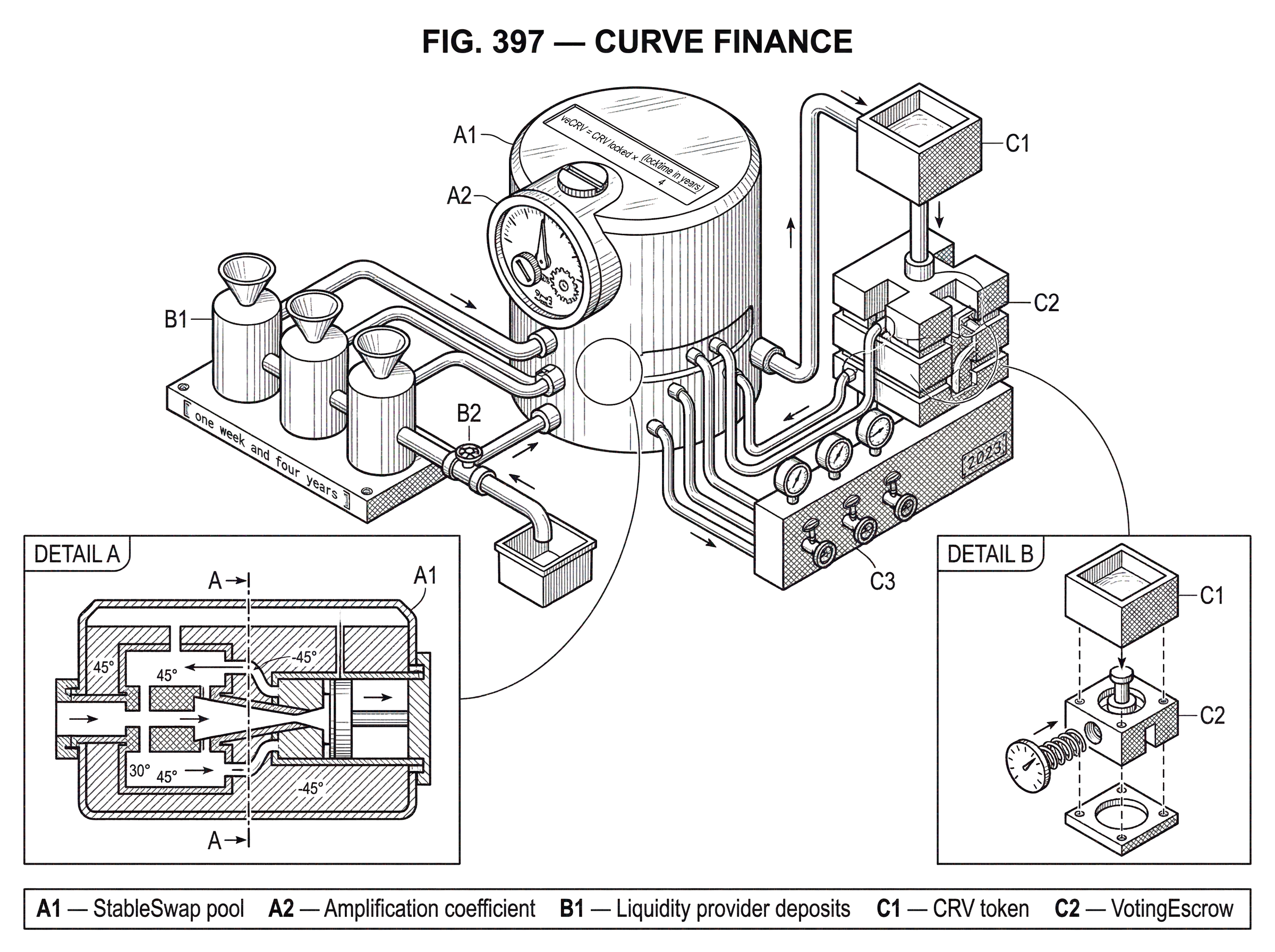
StableSwap combines the strengths of both. Curve’s whitepaper describes an amplification coefficient, written as A, that controls how much the pool behaves like constant-sum near balance and how much it falls back toward constant-product behavior as it moves out of balance. When the pool is well balanced, trades can clear with very low slippage. As the pool becomes more skewed, the pricing curve stiffens and behaves more defensively.
That mechanism is why Curve works so well for assets that should stay close together. It does not eliminate market risk or peg risk. Instead, it says: when the pool is near the state it was designed for, pricing can be much more efficient. The whitepaper explicitly positions StableSwap as a low-slippage automated market maker for stablecoins, with reported slippage much smaller than constant-product designs under its assumptions.
A concrete example makes this easier to see. Imagine a trader who wants to swap a large amount of USDC for USDT. On a general AMM, that trade can move the pool price noticeably because the system must remain robust even if the tokens stop tracking each other. On Curve, the pool starts from the stronger assumption that these assets are meant to trade close to 1:1. So long as reserves are reasonably balanced, the trader gets a rate much closer to parity. The trade still changes the pool composition (there is now more USDC and less USDT in the pool) but the penalty for making that swap is smaller because the AMM was designed around that exact situation.
The same logic extends beyond plain stablecoins. Curve’s contracts and pool designs have been used for other correlated cryptocurrencies, including wrapped or yield-bearing versions of related assets. But this is also where the model’s limits become clear: if the assets are not actually close substitutes, Curve’s advantage weakens. Its efficiency comes from assuming local stability, not from discovering wide, volatile price moves better than general-purpose AMMs.
How to trade and provide liquidity on Curve Finance
For traders, Curve is straightforward. You connect a wallet, choose a supported pool, and swap one asset for another. The product is especially attractive when you care about execution quality on large stable-value trades, because that is where low slippage matters most.
For liquidity providers, the mechanism is different. Instead of trading against the pool, they deposit assets into it so that traders can use that liquidity. In return, LPs earn a share of trading fees. Curve’s contract repository describes this as low-risk, supplemental fee income for liquidity providers, particularly in the stablecoin context. Historically, some Curve pools have also integrated with lending protocols so that pooled assets could generate additional income on top of swap fees, though the exact setup depends on the pool design.
This helps explain who Curve is really for, without needing a separate category. If you are swapping volatile memecoins, Curve is not the natural first stop. If you are moving size between stablecoins, wrapped assets, or other tightly related tokens, Curve is much closer to its ideal use case. Likewise, if you are an LP seeking broad market exposure, other AMMs may fit better; if you want fee income from heavily used stable-asset routing, Curve’s design is more directly aimed at you.
How does veCRV governance affect Curve’s incentive distribution?
| Action | Commitment | Voting power | Impact on emissions | Best for |
|---|---|---|---|---|
| Lock CRV (veCRV) | 1 week to 4 years | Scales with amount and lock time | Enables directing CRV emissions | Long-term influence seekers |
| Vote on gauges | Requires veCRV | Uses locked voting weight | Allocates weekly CRV rewards to pools | Projects and large LPs |
| Do nothing | No lock required | No on-chain voting power | No direct control of emissions | Retail traders or passive holders |
Curve is not just an AMM with passive pools. It is also a governance system built around CRV and veCRV. CRV is the protocol token used for governance and value accrual, while veCRV comes from locking CRV in the VotingEscrow contract.
The basic rule is simple and unusually consequential: users lock CRV for a period between one week and four years, and in return receive voting power that scales with both the amount locked and the remaining lock time. The technical docs summarize the relationship as veCRV = CRV locked × (locktime in years) / 4. Because the lock decays over time, voting power also decays unless the user extends the lock.
This is not just cosmetic governance. Curve uses veCRV in the machinery that directs incentives across liquidity gauges. The GaugeController contract manages how CRV emissions are allocated among gauges, and veCRV holders can vote on those weights. In effect, governance does not only decide abstract policy; it helps steer where liquidity incentives go.
That matters because Curve’s exchange depends on attracting and retaining liquidity in the right pools. Gauge votes are the bridge between token governance and market depth. If a pool is strategically important, veCRV voters can direct more weight toward it, which affects CRV emissions to the associated gauge. The docs note that gauge weights are updated on a weekly schedule, and voting power is time-locked rather than fully fluid.
This model also reveals who participates deeply in Curve beyond simple swapping. Projects integrating with Curve, large LPs, and users who want influence over incentive flows are the natural veCRV participants. Curve’s docs explicitly provide technical resources for developers and protocols looking to integrate with its smart contracts and APIs, which fits the fact that Curve often functions as infrastructure as much as as a consumer app.
What are Curve’s implementation risks and protocol trade-offs?
Curve’s smart contracts are written in Vyper, and its repositories publish both exchange-pool contracts and DAO governance contracts. New pools are built from templates, and the protocol maintains testing, audits, and a bug bounty program. Official documentation lists multiple third-party audits across major Curve components and describes a bug bounty focused on substantial fund-loss, liveness, or irreversible-loss issues.
Still, specialization does not remove risk. Curve’s history makes that plain. The protocol and its ecosystem have undergone repeated security review, but it has also been affected by real-world vulnerabilities, including the 2023 exploits tied to a Vyper compiler bug in certain versions. That incident is a useful reminder of something easy to miss in DeFi: even if an AMM design is economically elegant, implementation risk remains. Smart contract security, compiler behavior, governance design, and integration complexity all matter.
There are also product-level trade-offs. Curve’s low-slippage advantage is strongest when assets are genuinely correlated and the pool is not badly imbalanced. If a stablecoin depegs or a wrapped asset stops tracking its reference asset, the assumptions behind the pool weaken precisely when traders most want certainty. Curve does not make those risks disappear; it prices around them until the market moves far enough that the pool shifts into more defensive behavior.
Governance has its own constraints as well. Locking CRV for veCRV is not reversible until the lock ends, veCRV is non-transferable, and users cannot maintain multiple independent locks with different expiries at one address. Those are not incidental details. They are part of how Curve turns short-term tokens into longer-term governance commitment.
When should you use Curve versus general AMMs?
The cleanest way to place Curve is by contrast. A general AMM is built to support almost any pair, which makes it flexible but less optimized for parity trades. Curve gives up that universality to become especially efficient at a narrower class of markets.
That is why Curve has become important infrastructure in DeFi. It is not merely another place to swap tokens. It is a venue optimized for the parts of the market where execution quality on near-equal assets matters, and where deep stable-asset liquidity becomes a foundation other protocols can build on.
Conclusion
Curve Finance is a specialized decentralized exchange for low-slippage swaps between similar-value assets. Its key innovation is the StableSwap AMM, which uses an amplification parameter to behave gently near balance and more defensively when a pool becomes skewed.
Everything else follows from that design. Traders use Curve when they want efficient stable-asset execution. Liquidity providers use it to earn fees from that flow. Governance participants lock CRV into veCRV to influence where incentives go. The memorable idea is simple: Curve works by narrowing the problem. Instead of optimizing for every market, it optimizes deeply for the markets where assets should already be close in price.
How do you trade through a DEX or DeFi market more effectively?
Trade through a DEX more effectively by prioritizing execution quality: pick deep, stablecoin-focused liquidity for parity swaps, fund your account, and choose an order method that matches your slippage tolerance. On Cube Exchange, you can fund your account and execute swaps while comparing execution options and fee estimates before submitting.
- Deposit the asset you’ll trade (fiat via on-ramp or a supported stablecoin like USDC) into your Cube Exchange account.
- Check on-chain liquidity and recent volume for the target pool or venue; prefer stablecoin-focused pools (e.g., Curve-style pools) for large parity trades and note the estimated slippage for your trade size.
- Choose an execution method: use a limit order for price control or split a large market trade into several smaller tranches (3–5 fills) to reduce immediate slippage.
- Review estimated fees, network and token details, set a max-slippage tolerance, then submit the swap and monitor confirmations.
Frequently Asked Questions
The amplification coefficient A makes the pool behave more like a constant-sum AMM when the reserves are near balance (giving very low slippage) and gradually shifts the curve back toward constant-product behavior as the pool becomes imbalanced; it therefore reduces slippage near parity but does not remove risk once the pool moves far from balance.
Specialization lowers execution slippage for correlated assets but does not eliminate implementation, peg, or market risk: Curve’s docs note past vulnerabilities (including 2023 exploits tied to a Vyper compiler bug) and emphasize that smart-contract, compiler, and integration risks remain.
No - locking CRV into veCRV is irreversible until the chosen lock expires, veCRV is non-transferable, and locks are for discrete durations (the docs specify one week up to four years), so you cannot withdraw or transfer veCRV early.
veCRV holders vote via the GaugeController to set gauge weights that determine how new CRV emissions are distributed, and those weights are updated on a weekly schedule; in short, locked voting power directly steers where incentive emissions flow.
Adding a gauge is an admin action that the documentation treats as irreversible, though a gauge can be 'killed' to set its emissions to zero; you therefore cannot fully remove a gauge once added but you can disable its emissions.
If a stablecoin in a pool depegs or correlated assets stop tracking each other, Curve’s low-slippage advantage weakens and the pool’s pricing curve stiffens to behave more defensively, but the protocol does not eliminate peg or market risk for users.
The original StableSwap paper reports simulation-derived LP returns but also warns that those results depend on strong, specific assumptions (three coins, six-month period, $30k liquidity, restricted trade triggers) and the brief paper omits the full StableSwap invariant, so mapping those simulated APRs to real markets is uncertain.
Curve publishes contract repositories and deployment data, but the repo READMEs do not consistently list authoritative on-chain addresses and the deployment JSON snapshots can be archived or incomplete, so canonical deployed addresses should be verified via the official Curve docs or on-chain sources rather than relying only on a single GitHub README.
Curve has experienced large incidents referenced in postmortems and analyst reports (Chainalysis documents an initial ~ $70M loss figure) but those tallies note white-hat and MEV recoveries that can lower net losses, and public writeups tie some incidents to a Vyper compiler bug that affected certain compiled contracts.
Related reading