What Is SPL Token?
Learn what SPL Token is on Solana, how mint and token accounts work, why ATAs exist, and how Token-2022 extends the original token program.
Introduction
SPL Token is the standard token system on Solana, and it matters because nearly every fungible token, many non-fungible assets, and much of the wallet experience on Solana are built on top of it. If you come from Ethereum, the first surprise is that an SPL token is usually not a separate smart contract deployed for each asset. Instead, Solana puts the token logic into a shared on-chain program, and individual tokens are created by initializing accounts that the program understands.
That design choice explains most of what feels unusual about SPL Token. Why does a wallet need a separate token account for each asset? Why is there a special “Associated Token Account” convention? Why do you pay SOL just to be able to hold a token? Why are there now two token programs, the original one and Token-2022? These are not random quirks. They all follow from the same underlying model: the token program defines the rules, while Solana accounts hold the token state.
Once that clicks, the rest becomes much easier to reason about. A token is identified by its mint. Supply lives on the mint. Individual balances live in token accounts. Authorities control who may mint, freeze, or otherwise administer a token. And newer features are not bolted onto the old program forever; they live in a newer superset program, Token-2022, that preserves the old mechanics and adds opt-in extensions.
Why does Solana need SPL Token and what problem does it solve?
A blockchain needs a common way to represent assets. At minimum, that system has to answer a few questions reliably: what asset is this, how many units exist, who owns which units, and who is allowed to create or destroy more? If every project answered those questions differently, wallets, exchanges, and applications would have to integrate each token from scratch.
SPL Token solves that coordination problem for Solana. It provides a common on-chain implementation for fungible and non-fungible tokens, so the ecosystem can agree on one set of instructions for minting, transferring, burning, and administering assets. This is why wallets can display balances from many different tokens without every token team negotiating a custom integration path.
The important point is that SPL Token is both a standard and a program. On some chains, “token standard” mostly means an interface that many contracts separately implement. On Solana, the standard is embodied much more directly in a shared program that token creators and wallets call into. That makes behavior more uniform. It also changes the developer mental model: instead of deploying a fresh token contract, you usually create a new mint account under the token program.
This is the first major contrast with ERC-20. ERC-20 gives a common interface, but each token is typically its own contract with its own storage and code. SPL Token centralizes the core code path into the token program, and then stores per-token and per-holder state in accounts. The comparison helps explain the architecture, but it is not perfect: Solana’s account model and rent mechanics create constraints and conventions that do not map cleanly onto Ethereum.
How does SPL Token's 'one program, many mints' model work?
The cleanest way to think about SPL Token is to separate global token state from individual holder state.
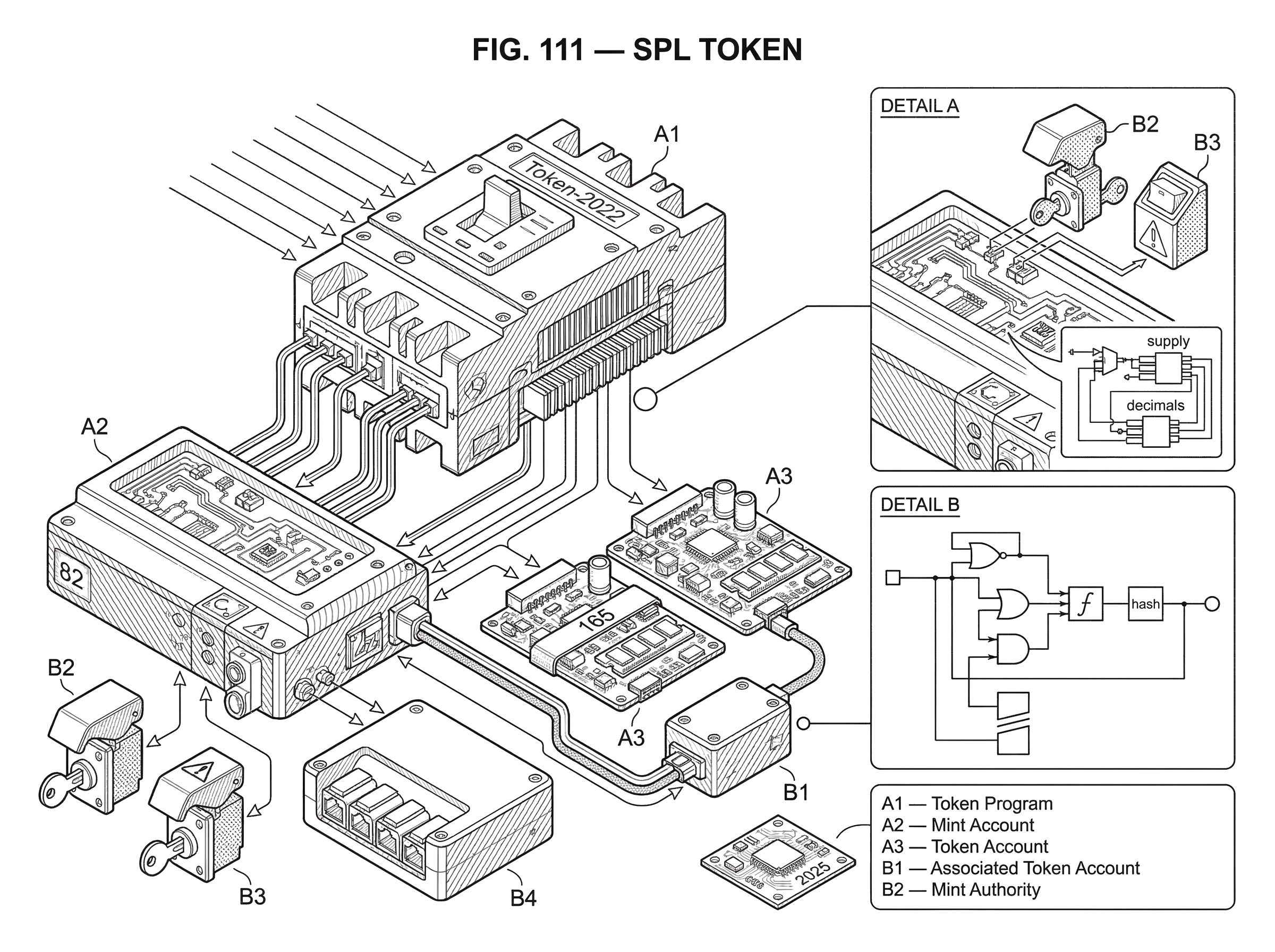
The global state for a token lives in its mint account. This account uniquely identifies the token and stores facts that are true for the token as a whole, such as total supply, decimal precision, mint authority, and freeze authority. If you want to know what token everyone is talking about when they say “this USDC mint” or “this memecoin mint,” they mean the address of that mint account.
The holder-specific state lives in token accounts. A token account does not represent a token type; it represents a balance of one particular mint owned by one authority. It stores, among other fields, the mint it belongs to, the owner authorized to move the balance, and the amount held there. This is why a wallet on Solana does not have a single universal “token balance table” built into its main address. Instead, it usually controls many token accounts, one per mint it wants to hold.
That sounds cumbersome until you see the mechanism clearly. The token program is not guessing who owns what. It reads explicit account state. The mint says, in effect, “I am token X; my supply is Y; these are my authorities.” Each token account says, “I hold amount Z of mint X, and owner A controls transfers.” The blockchain does not infer balances from event history. It stores them directly in accounts the program can verify.
This also explains why SPL Token operations often involve more than one account. A transfer needs a source token account, a destination token account, the authority allowed to move the source balance, and the token program itself. The mechanics are explicit because the state is explicit.
How are SPL token mints created and what do mint accounts store?
A token begins when someone creates and initializes a mint account. Initializing a mint creates a new token type. The mint then acts as the canonical object for that asset. It is where the token program records supply and the policy knobs that govern issuance and control.
Two fields matter especially for understanding token behavior: decimals and mint authority. Decimals determine how applications should display units. A mint with 6 decimals means the smallest on-chain unit is one-millionth of the displayed whole token. This is a display and denomination choice, not a statement about value. A token with 0 decimals can still be fungible; it simply cannot be subdivided below whole units.
The mint authority controls whether new units can be created with MintTo. As long as a valid mint authority exists, supply is elastic: more tokens can be issued. If that authority is set to None using SetAuthority, minting becomes impossible and the supply is fixed from that point forward. That detail matters because people often speak loosely about “fixed supply tokens” as if that were an inherent token category. Under SPL Token, fixed supply is not magic; it is the consequence of irreversibly removing mint authority.
There may also be a freeze authority, which can freeze token accounts for that mint. Whether that is useful or objectionable depends on the use case. For a regulated stablecoin, account controls may be part of the product design. For a censorship-resistant community token, they may be seen as a liability. The mechanism is the same in both cases; the disagreement is about governance and trust assumptions, not token plumbing.
Burning tokens works in the opposite direction from minting. A Burn instruction destroys tokens from a token account and reduces the mint’s recorded supply. Again, the key invariant is simple: the mint tracks total supply, and token-account balances must remain consistent with that supply.
Why do SPL token balances live in separate token accounts?
A common beginner misunderstanding is to think a wallet address directly “holds” SPL tokens in the way an address holds native SOL. For SPL Token, that is not quite right. The wallet usually controls token accounts, and those token accounts hold balances.
A concrete example makes this easier to see. Imagine Alice creates a new fungible token for an in-game currency. She initializes a mint account with 2 decimals and keeps mint authority for now. She then creates a token account for herself for that mint and mints 100000 base units into it, which a wallet would display as 1000.00 tokens. At this moment, the mint says the total supply is 100000, while Alice’s token account says it holds 100000 units of that mint.
Now Alice wants to send Bob 25.50 tokens. Bob cannot receive them into his main wallet address directly. He needs a token account for that same mint. Once Bob has one, the transfer reduces Alice’s token-account balance by 2550 base units and increases Bob’s token-account balance by the same amount. The mint’s total supply does not change, because a transfer moves ownership; it does not create or destroy units.
This account-based representation has practical consequences. If you want to hold ten different SPL tokens, you generally need ten token accounts. If an application wants to send you a token you have never held before, someone must first create the corresponding token account. That creation costs SOL because Solana accounts must be funded to be rent-exempt, and transactions also incur fees.
This is one of the least intuitive parts of Solana for newcomers, but it follows directly from the data model. A token balance is not free-floating metadata attached to your wallet. It is state stored in a dedicated on-chain account.
What is an Associated Token Account (ATA) and how does it simplify transfers?
If users can have multiple token accounts for the same mint, how does a sender know where to send funds? In principle, they could ask the recipient. In practice, that would make wallets and dApps awkward and error-prone. Solana’s answer is the Associated Token Account, usually shortened to ATA.
An ATA is not a different kind of balance object. It is just a token account whose address is deterministically derived from two inputs: the owner’s wallet address and the mint address. Because the address is derived rather than arbitrarily chosen, anyone can compute the “default” token account for a given wallet-and-mint pair.
That convention solves a discovery problem. If Alice wants to send Bob a token, she can derive Bob’s ATA for that mint and either use it if it exists or help create it if it does not. Wallets and applications can converge on the same expected destination without back-and-forth coordination. This is why ATAs are so central to everyday Solana UX even though, mechanically, they are still ordinary token accounts.
There is still a cost, though. Creating the ATA requires SOL for the new account’s rent-exempt balance and for transaction fees. Official guidance for wallet integration reflects this: before a wallet confidently tells a user they can receive a token, the relevant associated token account should exist on-chain.
There is a subtle edge case in the token program docs worth knowing because it teaches caution: a transfer where source and destination are the same account will succeed. So a successful transfer instruction is not, by itself, proof that value changed hands in the way an application intended. Integrators need to validate the accounts they are using, not merely check for transaction success.
Who controls SPL tokens? Authorities, multisig, and trust implications
| Authority | Control model | Failure risk | Operational cost | Best for |
|---|---|---|---|---|
| Single key | One signer controls actions | Single point of compromise | Low overhead | Small teams; fast changes |
| M-of-N multisig | Requires multiple signers | Risk if threshold colludes or keys lost | Higher coordination cost | Treasury and custodial control |
| Program / PDA authority | Controlled by on‑chain logic | Bugs or upgradeability risk | Requires program maintenance | Enforceable on‑chain policies |
SPL Token is not just about balances. It is also about who has control over sensitive actions. The important authorities include the mint authority, the freeze authority, and the owners or delegates of token accounts. The presence or absence of these authorities determines much of a token’s trust model.
This matters because two tokens can look similar in a wallet and still have very different governance assumptions underneath. A token with an active mint authority can be inflated later. A token with a freeze authority can be subject to account-level intervention. A token whose authorities are held by a single key depends on that key’s security and discretion. A token whose authorities are assigned to a multisignature account spreads control across multiple signers.
SPL Token supports M-of-N multisignatures for mint authorities, account owners, and delegates. In plain language, that means an action can require, for example, 2 of 3 signers or 3 of 5 signers instead of one key. The program’s multisig implementation supports signer sets up to 11 keys. This is not merely an operational convenience. It is a way of converting “trust this one operator” into a more distributed decision rule, which is often essential for treasury control, custodial systems, or DAO-managed assets.
Even here, Solana’s mechanics show through. Multisig state is itself stored in an on-chain account that must be initialized and funded. The theme repeats: important token state lives in explicit accounts, and the token program enforces rules by reading and updating them.
Why do SPL tokens require SOL for account creation and rent?
On some chains, token explanations can stay abstract for a long time. On Solana, the physicality of accounts matters early. Mint accounts, token accounts, and multisig accounts are all on-chain accounts, and the docs are explicit that they must hold enough SOL to be rent-exempt for validity and consistency.
This is not a side detail. It affects product design, onboarding, and economics. If a wallet wants to create a token account for a user, someone pays the SOL. If an airdrop targets many fresh wallets, account-creation costs become part of the campaign. If an app assumes users can receive any token at any time without preparation, it will run into friction.
The operational flow also explains a quirk in initialization instructions. InitializeMint, InitializeAccount, and InitializeMultisig do not require the just-created Solana account itself to sign, so they are meant to be paired atomically with the system instruction that allocates the account in the same transaction. In other words, account creation and token-state initialization belong together as one coherent action. That keeps partially created state from hanging around in an unusable form.
What is wrapped SOL and how does it differ from native SOL?
| Asset | Representation | SPL-compatible | Mint supply reported | Primary purpose |
|---|---|---|---|---|
| Native SOL | Lamports in system account | No | N/A | Native balance and fees |
| Wrapped SOL (Native Mint) | SOL held inside an SPL token account | Yes | Native Mint reports 0 | Interoperability with SPL programs |
SPL Token also reaches into a case that often confuses users: wrapped SOL. The token program defines a special Native Mint for representing SOL inside the token-account model. Wrapped SOL is useful because many programs expect SPL token accounts, and native SOL does not naturally appear in that format.
Here the token abstraction is deliberately imperfect. For wrapped SOL accounts, the token balance reflects the SOL held in the account, transfers move SOL as well as token balance, burning wrapped SOL is not supported, and the Native Mint’s reported supply remains 0 regardless of how much SOL is wrapped. That last point is especially important: wrapped SOL behaves like an SPL token for interoperability, but not every invariant you expect from ordinary mints applies in the same way.
The lesson is broader than SOL itself. “Uses the SPL Token program” does not always mean “behaves exactly like a plain fungible mint.” Sometimes the system preserves compatibility by introducing special-case semantics.
Original Token Program vs Token‑2022: what's the difference?
| Program | Extensibility | Compatibility | Opt-in model | Best for |
|---|---|---|---|---|
| Original Token Program | Stable; no new features | Very wide ecosystem support | No extensions | Max compatibility |
| Token-2022 (Token Extension) | Extensible via mint/account extensions | Base fields byte-for-byte compatible | Mints opt into extensions | Advanced token policies |
For many years, the original Token Program has been the default SPL token engine on Solana. It is widely used and considered functionally complete. Official docs say there are no plans to add new functionality to it beyond important fixes. That stability is valuable because it gives wallets, exchanges, and protocols a predictable base target.
But stable interfaces create a tension: ecosystems still want new token features. Solana’s answer is Token-2022, also called the Token Extension Program. Token-2022 is a strict superset of the original Token Program. It supports the same instruction layouts byte-for-byte for the original instruction set and adds new instructions after the old range. In many cases, software can target Token-2022 by changing the program_id while keeping familiar instruction data formats for the base operations.
The crucial design idea is the extension model. Rather than changing the base mint and account layouts in incompatible ways, Token-2022 keeps the original representation at the front and appends extra extension data after it. The first 82 bytes of a mint and the first 165 bytes of an account match the original layouts; extension data comes after that. This preserves compatibility for software that knows how to read the base fields, while allowing newer mints and accounts to opt into added capabilities.
That opt-in matters. Not every Token-2022 mint uses every extension, and original Token mints cannot retroactively pretend to have Token-2022 extension state. Applications therefore need to know which token program a mint belongs to and whether specific extensions are present.
What new features does Token‑2022 add and why would issuers use them?
The easiest way to understand Token-2022 is to ask what the original program could not express cleanly. The answer is not “basic tokens,” because the original program already handles minting, transferring, freezing, burning, delegation, and multisig. The missing layer is specialized token behavior that some issuers want and others do not.
Token-2022 introduces mint and account extensions for features such as transfer fees, interest-bearing tokens, non-transferable tokens, permanent delegates, transfer hooks, metadata, pausable behavior, confidential transfers, memo requirements, and immutable ownership. The organizing principle is not that these features are all similar in user experience. It is that they are all policy or capability extensions layered on top of the same core token machinery.
This architecture has consequences. It lets advanced token issuers get richer behavior without forcing the entire ecosystem to accept extra complexity for every token. But it also means wallets, dApps, and on-chain programs must become more careful. With the original Token Program, “token transfer” had a narrower meaning. With Token-2022, a transfer may involve fees, hooks, or other extension-specific checks. Compatibility becomes a matter of understanding not just “is this an SPL token?” but “which program and which extensions does this mint use?”
The associated token account story remains pleasantly simple: there is still a single ATA program that can create token accounts for either the original Token Program or Token-2022. That continuity reduces user-facing fragmentation even as the underlying feature set expands.
Where does token metadata live on Solana and how does it relate to SPL Token?
If SPL Token tells you supply, balances, and authorities, where do token names, symbols, images, and creator data live? Not in the original token standard itself. On Solana, metadata has historically been handled by the Metaplex Token Metadata program, which attaches a separate metadata account to a mint via a PDA.
That separation is easy to underestimate. It means “the token exists” and “the token has human-friendly metadata” are related but distinct facts. Wallets and marketplaces often rely heavily on metadata accounts for display and discovery, but the token program itself is primarily about asset state and transfer rules.
Today there are two main approaches. Metaplex Token Metadata works with both the original Token Program and Token-2022 and is widely supported. Token-2022 metadata extensions let metadata be stored on the mint itself, but only for mints created under Token-2022. Official Solana docs are explicit about the constraint: if a token was created with the original Token Program, it cannot use Token-2022 mint metadata extensions and must use something like Metaplex metadata instead.
This is a good example of what is fundamental versus conventional. The existence of a mint account, token accounts, and supply accounting is fundamental to SPL Token. The exact metadata layer is more of an ecosystem convention. In practice, though, conventions become important because wallets and marketplaces need common expectations.
What are the security risks and maturity limits of SPL Token and Token‑2022?
The original SPL Token program is designed to be stable, and Token-2022 has undergone multiple audits with public reports and audit listings. That gives some confidence in the maturity of the ecosystem’s token infrastructure. But “audited” does not mean “incapable of failure,” especially once extensions, bridge wrappers, and surrounding systems are involved.
A recent example comes from Token-2022 confidential transfers. Official Solana materials describe confidential transfers as hiding transfer amounts and balances while keeping token account addresses public. Mechanically, the feature relies on additional Token-2022 instructions plus a ZK ElGamal proof system. In 2025, Solana disclosed a vulnerability in the on-chain ZK ElGamal proof program: a missing component in a Fiat-Shamir transcript hash could have allowed forged proofs. The mitigation was to disable confidential transfers and feature-gate the affected proof program while audits and fixes proceeded.
That incident is instructive because it shows where complexity changes risk. Basic token transfers are one thing. Privacy-preserving encrypted balances with zero-knowledge proofs are another. Token-2022 makes richer behavior possible, but each added mechanism introduces new assumptions, implementation risks, and operational responsibilities.
A different kind of risk appears with bridged assets. Wrapped tokens on Solana are often implemented as SPL tokens, but their economic validity depends on collateral and control outside the token program itself. The Wormhole exploit is the clearest example: an attacker was able to mint large amounts of wrapped ETH on Solana without matching collateral on Ethereum. The resulting asset was still an SPL token mechanically, but it was temporarily unbacked economically. This highlights an essential distinction: SPL Token can enforce on-chain token rules, but it cannot guarantee off-chain or cross-chain backing claims.
So when evaluating an SPL token, the right question is rarely just “is it an SPL token?” More useful questions are: Who controls the mint authority? Is there a freeze authority? Is the token using the original Token Program or Token-2022? Are there extensions that change transfer semantics? If the token is wrapped or bridged, what secures the backing?
Conclusion
SPL Token is best understood as Solana’s shared asset engine: a common program that defines token behavior, with state split between mint accounts and token accounts. That one idea explains why token balances live in dedicated accounts, why associated token accounts exist, why SOL is needed to create token-holding accounts, and why token authorities matter so much.
From there, the rest follows naturally. The original Token Program gives the stable base for minting, transferring, burning, and administering assets. Token-2022 extends that base with opt-in features for issuers who need richer behavior. Metadata lives alongside this core system rather than inside it by default. And the real risks often sit not in the basic mechanics, but in the added layers: admin control, complex extensions, and external backing assumptions.
If you remember one thing tomorrow, make it this: an SPL token is not primarily a contract you deploy, but a set of accounts interpreted by a token program. Once you see that structure, Solana’s token design stops looking idiosyncratic and starts looking internally consistent.
How do you evaluate a token before buying it?
Evaluate the token’s on‑chain rules, metadata, and control before you buy, and use Cube to both inspect those facts and execute the purchase if you decide to proceed. Start by preparing your account (you will need SOL for fees and possible ATA creation), then use Cube’s token details and market pages to check mint authorities, program type, and provenance.
- Fund your Cube account with enough SOL via the fiat on‑ramp or a direct SOL transfer to cover transaction fees and any associated token account (ATA) rent.
- Paste the token’s mint address into Cube’s search and open the token details. Check the token’s program_id (original Token Program vs Token‑2022), mint authority (is it set to None?), freeze authority, decimals, and total supply.
- Inspect metadata and provenance: confirm whether metadata is from Metaplex or a Token‑2022 on‑mint extension, review creator/issuer info, and check whether the token is a bridged asset and which bridge or reserves back it.
- If you will receive tokens, ensure an ATA exists for your wallet (create the ATA and fund it with SOL if needed). Then open the token market on Cube, choose limit orders for price control or a market order for immediate fills, enter the size, review estimated fees and slippage, and submit.
Frequently Asked Questions
Because SPL token balances are stored as separate on‑chain token account objects, a wallet needs one token account per mint it wants to hold; each token account explicitly records the mint, the owner, and the amount, so there isn’t a single implicit balance tied to the wallet address itself.
An Associated Token Account (ATA) is a convention: a token account whose address is deterministically derived from the wallet owner and the mint so anyone can compute a recipient’s “default” token account; this makes discovery and UX practical while the underlying object remains an ordinary token account that still costs SOL to create.
Because token accounts are real Solana accounts that must hold enough SOL to be rent‑exempt and pay transaction fees, creating the token (or ATA) requires someone to fund that account with SOL before it can hold tokens.
A mint’s mint authority is the key that can call MintTo to increase supply; setting the mint authority to None (using SetAuthority) is the documented way to make minting impossible and thus produce a fixed supply - this is not automatic but the consequence of irrevocably removing the authority.
Token‑2022 is a backward‑compatible superset of the original Token Program that appends opt‑in extensions by adding extra data after the original mint/account layouts, so programs and wallets must check which program_id and which extensions a mint uses because extensions can change transfer semantics and behavior.
No - mints created under the original Token Program cannot use Token‑2022 on‑mint metadata extensions; they must continue to use metadata systems like Metaplex, while Token‑2022 mints can optionally put metadata on the mint itself.
Wrapped SOL is represented as an SPL token (using the Native Mint) so it can live in token accounts, but it has special semantics: the token account actually holds SOL, burning wrapped SOL is not supported, and the Native Mint’s reported supply always remains 0, so some usual mint invariants do not apply.
Extensions add new capabilities (fees, hooks, confidential transfers, interest bearing behavior, etc.) but each adds implementation and operational risk; a concrete example: confidential transfers relied on an on‑chain ZK ElGamal program that was disabled after a disclosed vulnerability, showing that richer features can introduce new, nontrivial attack surfaces and operational coordination needs.
SPL Token supports M‑of‑N multisignatures for authorities by storing multisig state in on‑chain accounts; the built‑in multisig implementation supports signer sets up to 11 keys, and those multisig accounts must themselves be created and funded like other accounts.
A Transfer instruction that succeeds is not by itself proof that value moved to a different party, because a transfer where the source and destination are the same token account will succeed; integrators must validate the accounts used rather than assuming transaction success implies the intended value change.
Related reading