What is Tether?
Learn what Tether is, how USDT works, what backs it, and why traders and crypto platforms use it despite issuer and reserve trade-offs.
Introduction
Tether is a stablecoin issuer whose main product, USD₮ or USDT, is designed to keep a token worth about one U.S. dollar while moving across blockchains like any other crypto asset. That sounds almost trivial until you notice what problem it solves: banks move dollars through account networks, business hours, jurisdictional controls, and intermediaries, while crypto moves tokens continuously across public ledgers. Tether sits between those two worlds. It issues tokens that are meant to represent fiat-denominated claims, then lets those tokens circulate on-chain where exchanges, traders, wallets, and payment systems can use them as a common unit of value.
That bridge is why Tether became so important, and it is also where the real questions live. The token itself is easy to transfer. The harder part is trusting that an on-chain token issued by a private company really remains redeemable and credibly backed off-chain. To understand Tether, you need both halves at once: the blockchain token and the issuer balance sheet behind it.
Who buys USDT and what is Tether selling?
At the user-facing level, Tether is not mainly selling yield, governance, or a new monetary policy. It is selling transferable dollar exposure in a crypto-native form. If a trader wants to exit a volatile asset without wiring back to a bank, or an exchange wants a quote currency that works across many chains, a token like USDT is useful because it behaves more like cash inventory than like a speculative asset. You can hold it, move it, post it as collateral, settle trades with it, and route it through crypto infrastructure at blockchain speed.
Tether’s official description is that each fiat-denominated Tether token is backed by assets it calls Reserves and, subject to its terms, may be redeemed for the underlying fiat currency. The core idea is simple: users treat the token as worth one dollar because the issuer says it will issue against incoming fiat and redeem against outgoing fiat, while managing a reserve pool large enough to meet those obligations. In its terms, Tether says each token in circulation is 100% backed by reserves equal to the token’s stated value, and those reserves can include cash, cash equivalents, and other assets.
That design tells you who Tether is really for. It is most directly built for institutions, exchanges, market makers, and other large actors that need a liquid dollar proxy inside crypto markets. Retail users benefit from that liquidity in the secondary market, but the mechanism itself is centered on wholesale issuance and redemption rather than small direct consumer cash-ins and cash-outs.
How does Tether create, redeem, and circulate USDT?
| Layer | Actor | Access | Process | Peg role |
|---|---|---|---|---|
| Issuer-side | Tether (issuer) | KYC verified customers | Mint on fiat receipt; burn on redemption | Links supply to reserves |
| Market-side | Exchanges & traders | Open secondary markets | Trade USDT on-chain | Price discovery via arbitrage |
The essential mechanism has two layers. The first layer is issuer-side creation and redemption. The second is market-side circulation.
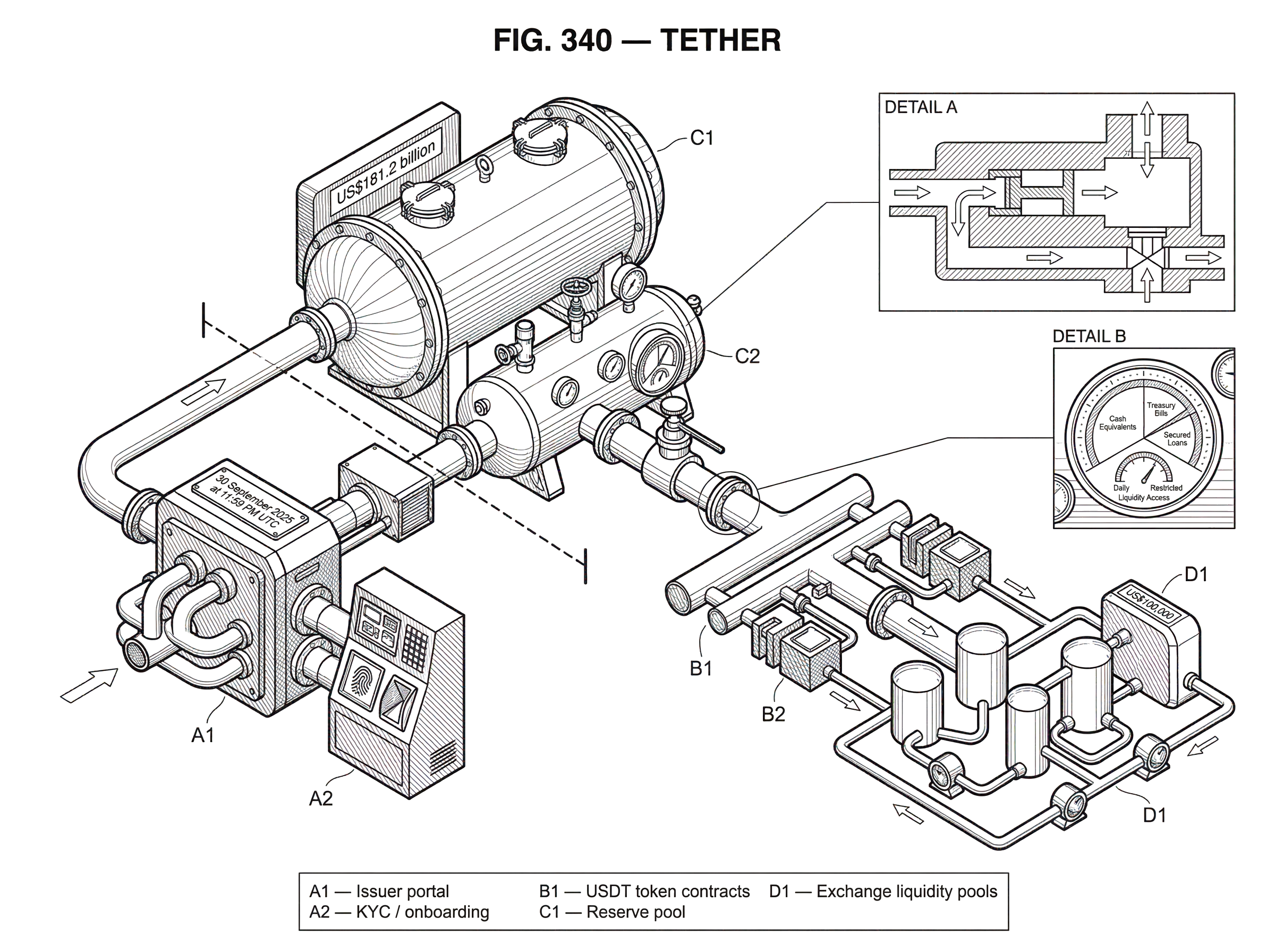
On the issuer side, Tether says KYC-verified customers can purchase and redeem tokens through its website. The current primary-market minimum disclosed in its regulatory filing is US$100,000, with fees of 0.1%, and redemption fees set at the greater of US$1,000 or 0.1%. That threshold matters because it shows that direct access is not designed as a retail convenience product. Tether’s own filing is explicit that its obligations exist with respect to users and transactions in this Primary Market.
Here is the mechanism in plain language. Suppose a large trading firm sends dollars to Tether and has completed onboarding. Tether receives the fiat, records a liability to that customer in the form of newly issued USDT, and mints the tokens on a supported blockchain. Those tokens can then be withdrawn to the customer and moved freely on-chain. Later, if that same kind of customer wants to redeem, it returns USDT to Tether, Tether burns the tokens, and sends out fiat currency, assuming the transaction fits its terms and operational requirements. The peg is not maintained by magic inside a smart contract. It is maintained because issuance and redemption are meant to connect token supply to off-chain reserves.
On the market side, most people do not interact with Tether directly. They buy and sell USDT on exchanges, receive it from other users, or use it inside apps and payment flows. This distinction matters. A token can trade very close to one dollar in secondary markets because traders believe enough large actors can arbitrage deviations through the primary market or through exchange inventories, even if ordinary users never redeem with the issuer themselves.
Why is USDT issued on multiple blockchains?
Tether’s usefulness increases when it is available where liquidity already is. That is why Tether issues tokens on multiple networks rather than tying itself to a single chain. Its supported-protocol documentation says Tether tokens exist on multiple blockchains and should be treated as interchangeable: 1 Tether token on one supported chain is intended to equal 1 Tether token on another.
This multi-chain model solves a practical problem. Different exchanges, wallets, and trading communities prefer different networks because of fees, speed, local liquidity, or technical history. By issuing the same dollar-linked token across Ethereum, Tron, Solana, TON, Avalanche, Aptos, Tezos, Polkadot Asset Hub, Liquid, and others, Tether gives users a shared unit of account that can travel through many crypto environments. The token is not valuable because any one blockchain guarantees the peg. It is valuable because the issuer tries to make chain-specific wrappers of the same liability usable wherever market demand exists.
That said, multi-chain issuance introduces operational complexity. Tether has also said it no longer issues or is obligated to redeem tokens on some older chains, including Omni, Bitcoin Cash SLP, Kusama, EOS, Algorand, and certain others retained only for historical reference. So while Tether presents chain versions as interchangeable, support is still a policy choice by the issuer, not a permanent law of nature.
What assets back USDT and how liquid are they?
| Reserve asset | Reported size | Liquidity | Price sensitivity | Main reserve role |
|---|---|---|---|---|
| Cash & equivalents | US$140B | High | Low | Primary liquidity buffer |
| Secured loans | US$14.6B | Moderate | Counterparty risk | Yield support |
| Precious metals | US$12.9B | Low to moderate | Market volatility | Store of value |
| Bitcoin | US$9.86B | Moderate | High volatility | Noncash diversification |
| Other investments | US$3.87B | Low | Variable | Residual allocations |
The key economic question is not whether a USDT token transfers correctly on-chain. It is whether the issuer’s assets are enough, liquid enough, and reliable enough to meet redemptions.
Tether’s reserve reporting describes reserves as the assets backing fiat-denominated Tether tokens in circulation. In the independent reasonable-assurance report dated as of 30 September 2025, BDO Italia opined that Tether International’s issuer-prepared Financial Figures & Reserves Report was fairly presented, in all material respects, according to the report criteria. At that reporting date, Tether International reported total reserves of about US$181.2 billion, total liabilities of about US$174.4 billion, of which about US$174.36 billion related to digital tokens issued, leaving an excess of roughly US$6.78 billion.
The reserve mix matters because not all backing assets behave the same under stress. In that same point-in-time disclosure, the largest category was cash, cash equivalents, and other short-term deposits, totaling roughly US$140.0 billion. Other reported categories included secured loans, precious metals, bitcoin, other investments, and a small corporate bond position. Management’s policies in the report say financial investments, precious metals, and digital assets are valued at fair value, while secured loans are measured at amortized cost with expected-credit-loss considerations, and the tokens themselves are classified as refund liabilities repayable on demand.
The right way to read this is not “backed” versus “not backed,” as if reserve quality were binary. The more precise question is how much of the reserve pool is immediately cash-like, how much depends on market valuation, how much depends on counterparties, and how the issuer would perform if many holders tried to exit at once. Tether’s disclosures provide a high-level category view, but they do not fully disclose all specific custodians, counterparties, or detailed schedules for every exposure on the face of the assured report.
What issuer and operational risks do USDT holders accept?
| Asset held | Primary risk | Redemption access | Settlement speed | Best for |
|---|---|---|---|---|
| Cash | Sovereign risk | Direct bank withdrawal | Instant (physical) | Everyday payments |
| Bank deposit | Bank & payment risk | Bank withdrawals | Hours to days | Savings & regulated accounts |
| USDT | Issuer & counterparty risk | KYC redemptions (≥US$100k) | Blockchain transfers (minutes) | Trading and cross‑venue liquidity |
A useful mental model is that holding USDT means taking issuer risk in exchange for network convenience. If you hold physical cash, your main concern is the sovereign currency. If you hold bank deposits, you add bank and payment-system risk. If you hold USDT, you add the risk that a private issuer can and will manage reserves, operations, compliance, and redemptions in a way that preserves the peg.
Tether tries to support that trust with transparency reports and independent assurance. Its transparency page says information about tokens in circulation is typically published daily, while reserve reports are published quarterly and accompanied by independent auditors’ reports. But the assurance scope matters. The 2025 BDO report is a point-in-time opinion: it applies to 30 September 2025 at 11:59 PM UTC, not to every day before or after, and the report notes that its procedures do not provide assurance for other dates. That is meaningful assurance, but it is not the same thing as a continuous live audit.
Tether’s history also matters here. U.S. regulators have previously taken enforcement action over older reserve-related representations. In 2021, the CFTC announced a US$41 million penalty and cease-and-desist order over misleading statements about reserves during earlier periods, and the New York Attorney General announced a settlement with Tether and Bitfinex that imposed penalties, barred certain New York activity, and required additional disclosures. Those actions were tied to historical conduct, not proof of the firm’s condition today, but they are part of why reserve credibility remains the central question around Tether.
Why do traders and exchanges use USDT despite issuer trade-offs?
Tether remains widely used because it is solving an operational problem that markets care about every day. Traders need a dollar-like asset that settles continuously. Exchanges need a common quote asset across jurisdictions and banking frictions. Market makers need inventory they can shift between venues and chains quickly. Wallet users and payment flows often need something more stable than volatile crypto assets but easier to move than bank wires.
This is why Tether can be simultaneously controversial and deeply embedded. Its value proposition is not that it eliminates trust. It is that it concentrates trust into one issuer so the token can move through relatively trust-minimized blockchain rails afterward. That is a compromise many users accept because the alternative (repeated entry and exit through the banking system) is slower, more expensive, or less available.
The same mechanism also explains who should be cautious. Users who want direct legal clarity, broad retail redemption rights, or a fully on-chain collateral model may find Tether’s issuer-centered design less appealing. Tether’s terms also give it significant discretion over supported users, jurisdictions, wallet access, and compliance actions, and direct redemptions are limited to verified customers under its terms. So USDT behaves like a portable digital dollar for many users in practice, but it is not the same thing as holding dollars in a bank account, and it is not a decentralized stablecoin.
Conclusion
Tether is best understood as a private issuer that turns off-chain reserves into on-chain dollar tokens. Its success comes from making dollar-like liquidity available wherever crypto markets operate, across many blockchains and trading venues. The important thing to remember is simple: USDT is useful because it is easy to move, but it is trusted only to the extent that the issuer’s reserves, redemption process, and disclosures remain credible.
How do you trade Tether-related assets?
To trade Tether-related assets, fund your Cube Exchange account and trade USDT pairs on spot markets where liquidity sits (for example USDT/USD, USDT/USDC, or USDT/BTC). Cube lets you place limit orders for price control or market orders for immediate execution and shows fees and estimated fills before you submit. Follow the steps below to move from funding to a filled trade quickly.
- Deposit fiat or supported crypto (e.g., USDC) into your Cube account using the fiat on-ramp or a direct crypto transfer.
- Open the relevant USDT spot market (USDT/USD, USDT/USDC, or a cross asset pair) and select the order type you want.
- Enter the amount, choose limit for precise pricing or market for immediate execution, and review the estimated fill, fees, and any minimum order size.
- Submit the order and monitor the trade; if you need low slippage between stablecoins, prefer the USDT/USDC pair or a limit order with a tight price band.
Frequently Asked Questions
Tether maintains the peg mainly through issuer-side creation and redemption for KYC‑verified customers (the disclosed primary‑market minimum is US$100,000 with associated fees) and through market‑side arbitrage and exchange inventories; the peg is not enforced by an on‑chain smart contract but by the issuer linking token supply to off‑chain reserves and by traders arbitraging price deviations in secondary markets.
At the 30 September 2025 reporting date Tether reported about US$181.2 billion in total reserves, of which roughly US$140.0 billion were classified as cash, cash equivalents and short‑term deposits; the remainder included secured loans, precious metals, bitcoin and other investments, so backing is not exclusively cash and includes assets with varying liquidity and valuation characteristics.
No - direct redemptions are limited to KYC‑verified customers in the Primary Market, with a disclosed minimum of US$100,000 and redemption fees (greater of US$1,000 or 0.1%), so ordinary retail holders typically rely on secondary markets rather than redeeming directly with the issuer.
USDT is not a decentralized or on‑chain collateralized stablecoin; it is an issuer‑centered liability that exposes holders to Tether’s operational, compliance and reserve management risk rather than the sovereign risk of holding bank deposits or cash.
Tether issues tokens on many blockchains so liquidity can exist where users and exchanges operate, and Tether intends supported tokens on different chains to be interchangeable; however, chain support is an issuer policy choice and Tether has already ceased issuance/obligation on older chains (e.g., Omni, EOS, Kusama, Algorand), so continued interoperability depends on Tether’s ongoing support.
Tether publishes circulation data frequently and provides quarterly reserve reports accompanied by independent assurance, but the available assurance (for example, BDO Italia’s opinion) is point‑in‑time (30 September 2025) and its procedures do not provide continuous or perpetual audit coverage; several detailed schedules and specific custodial counterparties were outside the auditor’s assurance scope.
In a stress scenario the key risks are reserve composition and liquidity: some reserve categories (secured loans, investments, precious metals, cryptocurrencies) are less cash‑like and are valued under normal market assumptions, the auditor noted no expected‑credit‑loss provision at the report date, and the reports do not disclose full line‑item custodial/counterparty details - all of which create uncertainty about how quickly and at what price assets could be converted if many holders tried to exit simultaneously.
Tether has faced past regulatory enforcement related to prior reserve representations (notably a 2021 CFTC order and a New York Attorney General settlement), which were about historical conduct and resulted in penalties and disclosure requirements; those actions are part of the company’s history but do not by themselves prove the firm’s current condition, which relies on more recent disclosures and assurance reports.
Related reading