What Is Chainlink?
Learn what Chainlink is, how its oracle networks and data feeds work, and why developers use it for DeFi, randomness, automation, and CCIP.
Introduction
Chainlink is an oracle network: infrastructure that lets smart contracts use information and services that do not live on the blockchain itself. That sounds simple, but it solves one of the most important constraints in crypto. A smart contract can enforce rules exactly, yet by default it only sees its own chain. If an application needs the ETH/USD price, a proof that reserves exist, a random number for a game, or a message from another blockchain, something has to bring that input in. The central question is not whether data can be imported, but who is trusted to import it, and how much damage they can do if they are wrong.
That is the reason Chainlink exists. Instead of treating the oracle as a single server that posts answers onchain, Chainlink treats oracle delivery as a network problem. Multiple independent node operators gather data, combine or attest to it, and deliver a result that smart contracts can read. In practice, that design has made Chainlink one of the most widely used pieces of infrastructure in DeFi, and the company positions it more broadly as an oracle platform for tokenized assets, institutional workflows, and cross-chain applications.
Why do smart contracts need Chainlink?
Blockchains are intentionally closed systems. They are good at verifying things already available onchain, but they do not natively know what happened on a website, an exchange, a bank network, or another blockchain. An application that lends against collateral still needs a market price. A stablecoin issuer may need reserve data. A Prediction Markets may need a final score. A cross-chain app may need trustworthy confirmation that a message was sent elsewhere. Without an oracle, the contract cannot tell whether any of these statements are true.
The naive solution is to let one party write the answer onchain. That works mechanically, but it reintroduces a familiar weakness: the application becomes only as trustworthy as that one operator. If the source is manipulated, delayed, censored, or simply misconfigured, the smart contract still executes whatever it was told. This is why oracle design matters so much in DeFi. If a lending market uses a bad price, liquidations can happen at the wrong time or not happen when they should. If a protocol uses a manipulable onchain spot price from a single DEX pair, attackers can distort it for one block and profit from the contract’s mistake.
Chainlink’s core idea is that oracle security should come from a combination of decentralization, aggregation, and operational controls. The product is not “a price API on a blockchain.” The product is a way to make external inputs usable by contracts without collapsing back to a single trusted intermediary.
How does Chainlink's oracle network work?
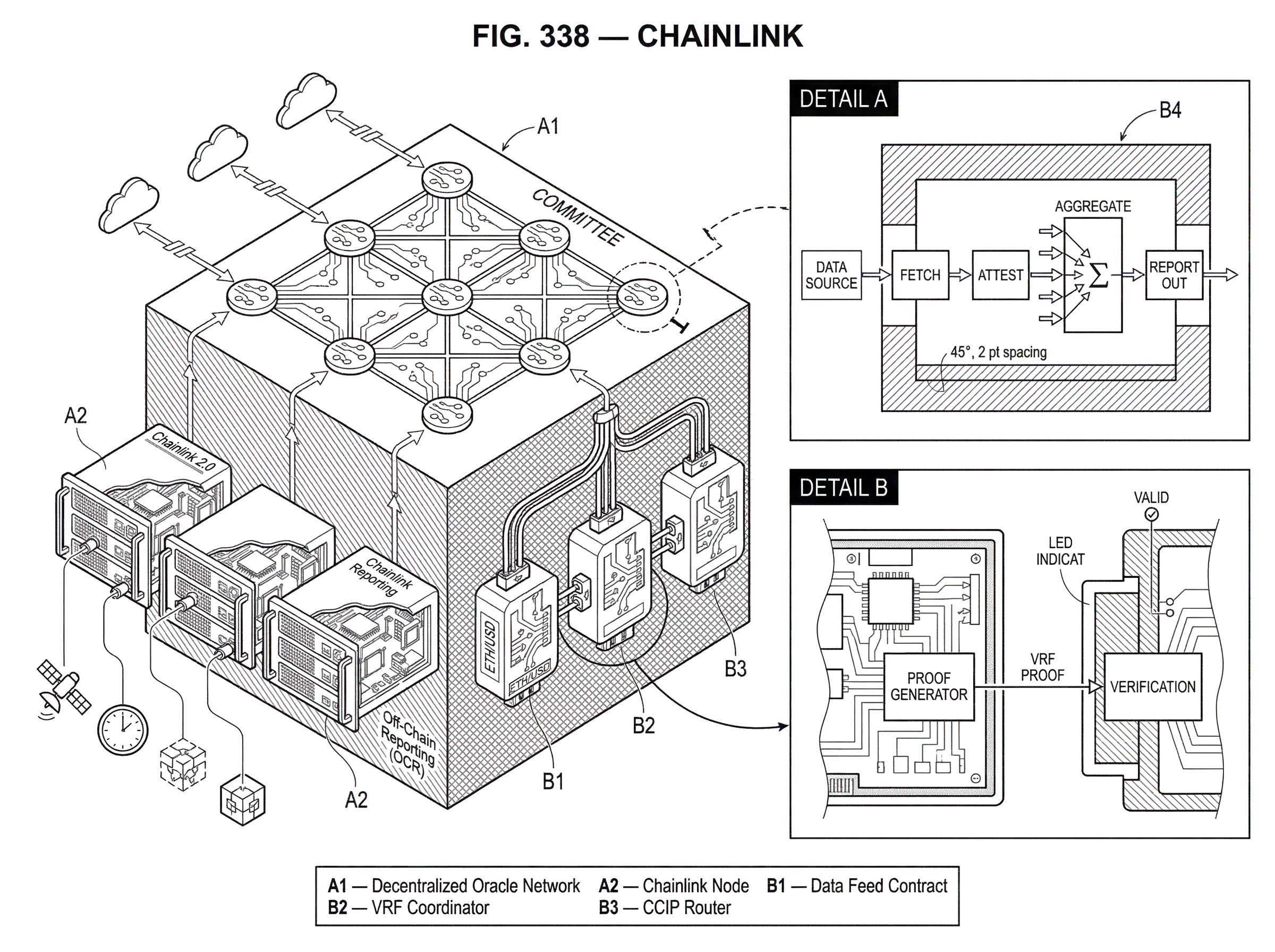
The simplest way to think about Chainlink is as a set of decentralized oracle networks, often shortened to DONs. In Chainlink’s whitepaper, a DON is a committee of Chainlink nodes maintained by independent operators. That committee performs some oracle function: fetching data, aggregating observations, generating randomness, relaying cross-chain messages, or running offchain compute. The common pattern is that the work happens across multiple operators rather than one.
A Chainlink node is software run by a node operator. The core node software and contracts are published by Chainlink, and nodes can be extended with external adapters, which are integrations that let the node call custom APIs or run specialized computations over a REST interface. This matters because real-world data is messy. Different applications need different sources, formats, and logic. Chainlink’s design is useful partly because it is not locked to one fixed data source or one narrow oracle job.
At the user-facing level, most developers never operate the node network themselves. They integrate an existing Chainlink service. On a blockchain like Ethereum or another supported chain, they point their contract at a known feed address, CCIP router, VRF coordinator, or other product endpoint. In other words, Chainlink is usually consumed as shared infrastructure rather than deployed from scratch by each application.
What are Chainlink Data Feeds and how do they work?
| Feed type | Update model | Freshness | On-chain cost | Best for |
|---|---|---|---|---|
| Price Feeds | Push (heartbeat/deviation) | Periodic updates | Higher with frequent updates | Lending and core DeFi |
| Data Streams | Pull-based on demand | Very fresh | Lower per-request | Low-latency apps |
| Calculated / single-source | Calculated or single-source | Varies by source | Typically lower | Specialized values |
For many users, Chainlink primarily means Data Feed, especially price feeds. These are onchain data products that Chainlink says are aggregated from many data sources by a decentralized set of independent node operators. The mechanism matters more than the label. Instead of a lending protocol asking “what is the ETH price?” from one exchange or one publisher, it reads from a contract that has been updated by a network designed to produce a market-representative answer.
Chainlink’s materials describe Data Feeds as a push-based system. That means updates are proactively published onchain, rather than requested fresh by every consuming contract. The feed update cadence is controlled by conditions such as heartbeat and deviation triggers. A heartbeat is a maximum interval between updates even if the market is quiet. A deviation trigger causes an update when the underlying value changes enough. The trade-off is straightforward: more frequent updates improve freshness, but they also increase onchain cost.
There is an important subtlety here. Chainlink’s docs explicitly note that not every feed is equally decentralized in the same way. Some feeds may depend on a single source, and some values may be calculated rather than aggregated from many raw sources. That is not a small footnote. It means developers should not treat the word feed as a blanket guarantee of identical trust assumptions. The security question is always feed-specific: where does the data come from, how many operators report it, and what exactly is being aggregated?
A concrete example makes the mechanism clearer. Imagine a lending protocol that accepts wrapped bitcoin as collateral and needs a BTC/USD reference price. If it relied on the reserves of a single DEX pair, an attacker could move that pool’s price long enough to influence liquidations or borrowing limits. With a Chainlink feed, the protocol instead reads from an onchain contract representing a broader oracle process: multiple operators source data, aggregate it, and publish a canonical answer for contracts to consume. That does not make the system magical or infallible, but it changes the attacker’s job from manipulating one thin market to corrupting a broader reporting pipeline.
Offchain coordination is the scaling trick
| Approach | On-chain writes | Latency | Cost | Scalability | Trust |
|---|---|---|---|---|---|
| Per-node on-chain posting | Many writes | Lowest finality | Very high | Poor | Per-node trust |
| OCR (Chainlink off-chain reporting) | Single aggregated write | Moderate | Low | High | Multi-operator attested |
| Trusted relayer | Single write | Fast | Low | Moderate | Single operator |
A common misunderstanding is to imagine every oracle node posting every observation directly onchain. That would work, but it would be expensive and slow. Chainlink’s architecture instead uses Off-Chain Reporting, or OCR, as an aggregation mechanism. In the Chainlink 2.0 whitepaper, OCR is described as a protocol used by price feeds in which oracle report aggregation happens offchain and the network produces an attested report whose median value is constrained by honest node reports.
The compression point is this: the expensive part is blockchain settlement, not observation itself. So Chainlink tries to do coordination offchain and only commit the result onchain. That preserves the blockchain as the final place of verification and consumption while avoiding the cost of having every node fully settle each intermediate step on the base layer.
This is why Chainlink could evolve from “oracle nodes posting prices” into a broader oracle-computation network. In the whitepaper framing, DONs provide networking, storage, and computation, and expose functionality through executables and adapters. The terminology is more general than what many users need, but the intuition is simple: Chainlink is trying to turn oracle work into programmable networked services, not just a single data-posting primitive.
Which Chainlink products should developers use (Feeds, VRF, Automation, CCIP)?
| Product | Purpose | Delivery | Latency | Best for |
|---|---|---|---|---|
| Data Feeds | Market reference prices | Push-based | Moderate | Lending, derivatives |
| Data Streams | High-frequency asset streams | Pull-based | Low-latency | Exchanges, arbitrage |
| Functions | Custom API calls & compute | On-demand | Task-dependent | Custom integrations |
| Automation | Scheduled/recurring execution | On-chain triggers | Recurring | Upkeep, periodic jobs |
| VRF | Verifiable randomness | Off-chain proof | Moderate | Games, NFT assignment |
| CCIP | Cross-chain messages & tokens | Router + DONs | Variable | Token transfers, bridging |
The easiest way to understand Chainlink’s product suite is by the kind of external dependency a smart contract has.
If the contract needs widely consumed reference data, developers use Data Feeds. If they need lower-latency, on-demand delivery, Chainlink offers Data Streams, which Chainlink describes as a pull-based product. If they need arbitrary API access and custom offchain compute, they can use Functions, which Chainlink documents as a serverless platform that fetches data from any API and runs custom compute. If they need recurring execution, they can use Automation. If they need tamper-resistant randomness, they can use VRF, where the random value is generated offchain with a cryptographic proof verified onchain.
If the application spans multiple chains, the relevant product is CCIP, the Cross-Chain Interoperability Protocol. Chainlink describes CCIP as a protocol for transferring tokens, messages, or both across chains. Here again, the useful idea is not the brand name but the mechanism: cross-chain systems fail when they depend on weak verification or brittle relayers. Chainlink positions CCIP as reusing its oracle-network approach, with multiple DONs and defense-in-depth controls such as rate limits and timelocked, role-based upgrades for security-critical changes.
This broad portfolio explains who Chainlink is really for. It is primarily for developers and protocols that want smart contracts to depend on the outside world without building their own oracle infrastructure. In DeFi, that usually means lending markets, derivatives platforms, stablecoins, and liquid staking protocols. In newer institutional settings, it can mean tokenized asset workflows, compliance-aware data delivery, or cross-chain settlement orchestration. The more valuable the contract’s decisions are, the more its builders care about oracle design.
Why has Chainlink become an industry‑standard oracle?
Chainlink’s strongest advantage is not just that it offers oracle services, but that it became a shared standard. Its homepage describes it as the industry-standard oracle platform and highlights usage across major DeFi protocols and financial institutions. That standardization matters because oracle integration has a coordination problem. Developers want feeds that others already trust, auditors want familiar components, and users prefer systems whose dependencies are well understood.
There is also a feedback loop in oracle networks. The more applications depend on a given network, the more pressure there is to maintain operational maturity, broad chain coverage, and integration tooling. Chainlink’s docs reflect this by offering feed addresses, API references, guides across EVM and non-EVM ecosystems, and product-specific tooling such as CCIP SDKs and explorers. For a developer, reliability is often less about elegant theory than about whether the service already exists on the target chain with known addresses and support resources.
What are the security and integration trade‑offs of using Chainlink?
Chainlink reduces oracle trust, but it does not remove trust entirely. The main trade-off is that oracle security is always a system property, not a slogan. You still have to ask which operators are in the network, which data sources they use, what update thresholds are configured, what governance can change those parameters, and how quickly errors can be corrected. Some of those details are surfaced clearly in docs; others require deeper inspection and are not always fully specified on overview pages.
And even when the oracle network is functioning as designed, integration mistakes can still be costly. A protocol can compose feeds incorrectly, use the wrong unit conversion, or place governance controls around oracle changes that are too slow for emergencies. Postmortems in the ecosystem show that oracle failures are often not “the oracle lied” in a simple sense. They can come from stale thresholds, bad assumptions, or misconfiguration at the application layer. Chainlink helps solve the external-data problem, but developers still need to integrate it carefully.
Conclusion
Chainlink is best understood as shared infrastructure that lets blockchains securely depend on things outside themselves. Its original and still most important role is delivering onchain data through decentralized oracle networks, especially via Data Feeds. But the deeper pattern is broader: Chainlink uses committees of nodes, offchain coordination, and onchain verification to make external data, computation, randomness, automation, and cross-chain messaging usable by smart contracts.
That is why Chainlink is widely used. Smart contracts are powerful precisely because they are strict, but that strictness becomes useful only when they can consume trustworthy inputs. Chainlink’s job is to make those inputs available without forcing every application to trust a single operator. In one sentence: Chainlink is the middleware that helps smart contracts see and act on the rest of the world.
How do you buy Chainlink?
Buy Chainlink (LINK) directly on Cube Exchange by using the LINK/USDC or LINK/USD spot markets. Fund your Cube account with fiat or a supported crypto, then place a market order for immediate execution or a limit order to target a price.
- Deposit USDC or fiat into your Cube account via the fiat on‑ramp or transfer LINK/USDC from an external wallet.
- Open the LINK/USDC or LINK/USD spot market on Cube Exchange.
- Choose an order type: select Market for immediate fill or Limit to set the exact price; enter the LINK amount or the USD/USDC you want to spend.
- Review estimated fill, fees, and price impact, then submit the order.
Frequently Asked Questions
Chainlink uses committees of independent node operators that fetch and attest to data, plus aggregation and operational controls, so the oracle result is produced by a decentralized network rather than a single server; this raises the attacker’s cost from corrupting one source to compromising a broader reporting pipeline.
OCR (Off‑Chain Reporting) is an aggregation protocol where nodes coordinate and compress their observations offchain and only a single attested report is committed onchain, reducing the number of expensive onchain transactions while preserving an onchain canonical result.
No - Chainlink explicitly warns that not every feed is equally decentralized: some feeds may rely on a single source or use calculated values, so trust assumptions are feed‑specific and consumers should check the feed’s sources and operator set.
Data Feeds are push‑based and publish updates when a deviation trigger or a heartbeat condition is met; increasing update frequency improves freshness but raises onchain transaction costs, while sparser updates save fees at the expense of timeliness.
Most developers do not run their own node networks; they point their contracts at existing Chainlink endpoints (feed addresses, VRF/Automation/CCIP coordinators, etc.) and consume Chainlink as shared infrastructure rather than deploying an entire oracle stack themselves.
CCIP (Cross‑Chain Interoperability Protocol) is Chainlink’s cross‑chain messaging/token transfer product that applies the same DON/committee and defense‑in‑depth approach to relaying messages, but Chainlink and its docs emphasize that cross‑chain interoperability carries inherent risks and CCIP mitigates rather than eliminates them.
No - Chainlink reduces reliance on single parties by using decentralization, aggregation, and tooling, but oracle security remains a system property: consumers must still examine operator membership, data sources, thresholds, governance controls, and integration correctness because misconfiguration or slow governance can still cause failures.
Related reading