What is Arbitrum?
Learn what Arbitrum is, how Nitro and optimistic rollups work, why transactions are cheaper, and where the protocol’s security assumptions matter.
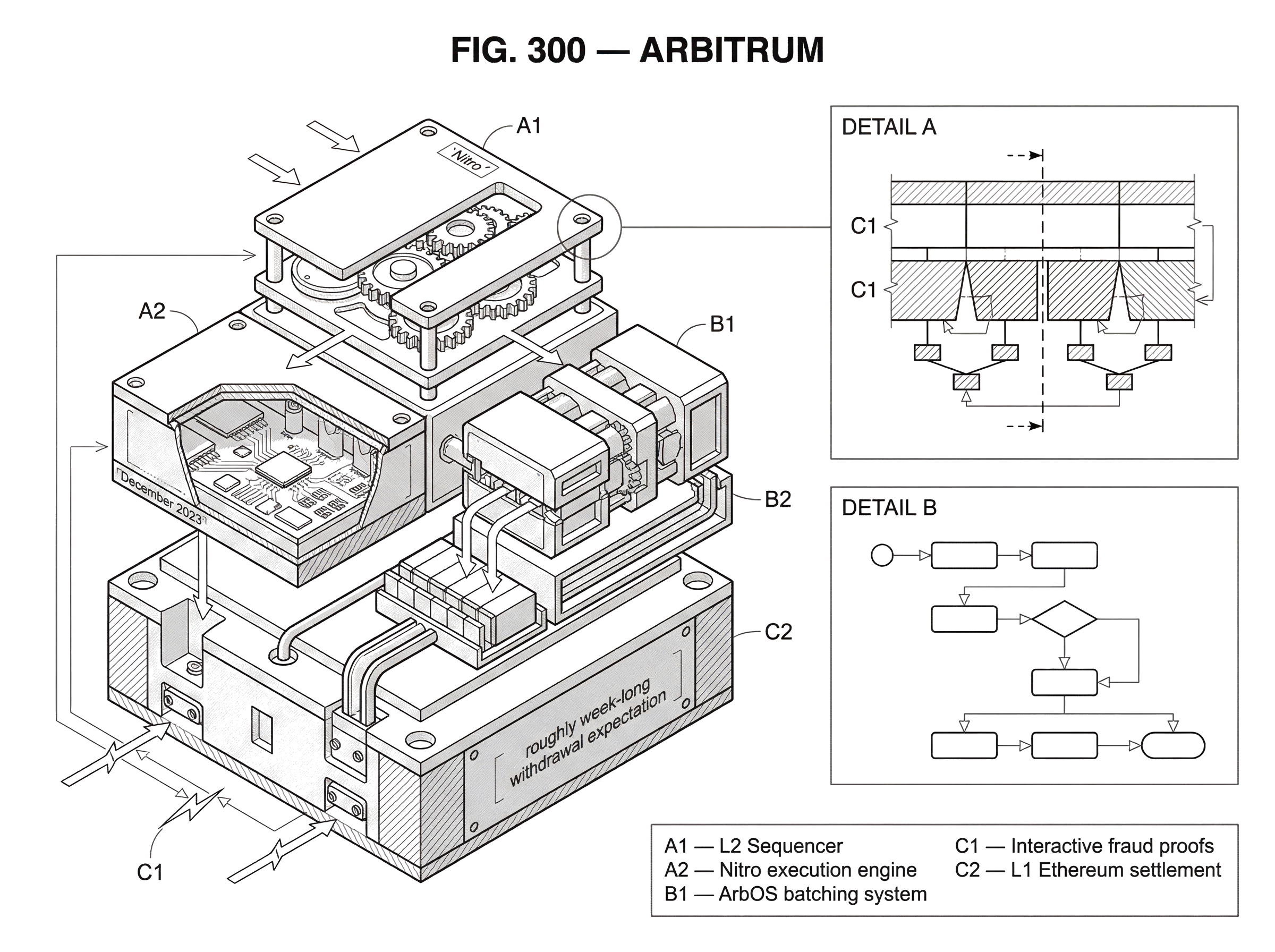
Introduction
Arbitrum is a family of Ethereum scaling protocols and chains designed to make transactions faster and cheaper without leaving Ethereum’s security orbit entirely. The puzzle it tries to solve is simple to state and hard to implement: if Ethereum is expensive because every node must process every transaction, how can you get much more throughput without asking users to trust a completely separate system?
Arbitrum’s answer is to move most execution away from Ethereum while still using Ethereum as the place where transaction data is anchored and disputed results are enforced. That makes it a form of optimistic rollup in its main design, with a related AnyTrust variant for different tradeoffs. The most widely used implementations are Arbitrum One, which uses the rollup model, and Arbitrum Nova, which uses AnyTrust. The current Arbitrum software stack is called Nitro.
If you keep one idea in mind, the rest of Arbitrum becomes easier to understand: Arbitrum is not trying to make Ethereum nodes do less by weakening correctness; it is trying to make them do less most of the time, while preserving a path to force correctness when needed. That is the mechanism. Transactions are ordered and executed away from L1, their data is batched and compressed, and Ethereum only has to intervene when someone claims the offchain result is wrong.
Why does Ethereum need Arbitrum?
Ethereum’s base layer is expensive for a structural reason, not because engineers forgot an optimization. A blockchain where many independent nodes all verify the same state transition is secure partly because verification is duplicated. That duplication is useful for trust minimization, but it is also what limits throughput.
So there are only a few basic levers. You can make the base layer itself bigger, which pressures decentralization because stronger hardware and bandwidth become necessary. You can move activity to separate chains, which improves capacity but usually weakens the tie to Ethereum’s security. Or you can keep Ethereum as the settlement layer while pushing routine execution elsewhere. Arbitrum belongs to that third category.
What this means in practice is that users submit transactions to Arbitrum, not directly to Ethereum, and Arbitrum handles the immediate work of ordering and execution. Then it periodically commits the relevant data back to Ethereum in compressed batches. If everyone behaves honestly, Ethereum does very little beyond storing commitments and honoring the protocol’s rules. If someone behaves dishonestly, the protocol falls back to a dispute process on Ethereum.
That trade is why Arbitrum can be cheaper. Ethereum is no longer being asked to execute every individual application step in real time. It is being asked to act as the final court.
How does the 'fast clerk, slow court' analogy explain Arbitrum?
A useful analogy is this: imagine a busy commercial market with a fast clerk and a slow but authoritative court. The clerk records trades all day and gives participants quick feedback. The court does not inspect every trade as it happens, because that would be too expensive. Instead, it assumes the clerk is doing the job correctly unless someone files a challenge. If a challenge happens, the court has the authority to inspect the disputed record and enforce the correct outcome.
That is roughly how Arbitrum works. The sequencer plays the role of the fast clerk by accepting transactions, ordering them, and giving users a responsive experience. Ethereum plays the role of the court by acting as the final source of truth for posted data, dispute resolution, and asset settlement.
The analogy explains responsiveness and security, but it has limits. A real clerk might have subjective judgment; Arbitrum does not. The state transition rules are deterministic. For a given starting state and transaction sequence, there is only one correct result. That determinism is what makes an optimistic system workable: a dispute is not a matter of opinion but a matter of computation.
How are transactions processed on Arbitrum?
In normal use, a transaction reaches Arbitrum’s sequencer first. The sequencer orders transactions and provides users and applications with fast feedback, which is why interacting with Arbitrum usually feels much quicker than waiting for Ethereum finality. But this fast path is only part of the story. For Arbitrum to remain tied to Ethereum, transaction ordering and state commitments must eventually be represented on L1.
Nitro, the current implementation, is a full integrated Layer 2 system that includes the sequencer, fraud proofs, token bridges, and calldata compression. Its architecture matters because it explains both why Arbitrum is EVM-compatible and why it can still support disputes. Nitro integrates the core of Geth, the mainstream Ethereum client, into Arbitrum’s stack, replacing an older custom EVM emulator. That design choice pushes Arbitrum closer to Ethereum’s practical execution standard rather than asking developers to live with a niche virtual machine implementation.
Around that execution engine sits ArbOS, a slimmer runtime component responsible for chain-specific functions such as cross-chain communication and the batching and compression system that minimizes L1 costs. The result is a split between ordinary high-speed execution and a verifiable fallback path. In normal operation, Nitro nodes and validators run the engine compiled to native code for performance. When a fraud proof is needed, the same logic can be used through a WASM-based proving path.
That design is important. It means Arbitrum does not force every honest participant to pay the cost of the dispute machinery on every transaction. Most of the time, the system runs in the cheap, fast mode. Only the exceptional case uses the slower, more formal proving mode.
What does 'optimistic' mean in optimistic rollups?
| Layer type | Upfront proof? | Dispute mechanism | Withdrawal delay | Compatibility |
|---|---|---|---|---|
| Optimistic rollup | No upfront proof | Interactive fraud proofs | Long (days) | High (Geth-compatible) |
| ZK rollup | Validity proofs upfront | Validity proofs on L1 | Short (minutes–hours) | Tooling varies |
An optimistic rollup works by accepting a claim first and checking it only if challenged. In Arbitrum, the claim is effectively that a posted sequence of transactions leads to a particular state transition. The system is called optimistic because it does not require proof of correctness up front for every batch. It assumes correctness unless someone disputes it during the challenge period.
This sounds risky at first, but the safety argument is stronger than it appears. Because execution is deterministic, there is only one correct post-state for a given pre-state and ordered transaction list. If an invalid claim is posted, an honest validator can challenge it. As long as the protocol gives at least one honest challenger a realistic path to participate, a bad claim should not survive.
The real burden therefore shifts from “prove every step immediately” to “make challenges feasible, credible, and enforceable.” That is the heart of Arbitrum’s security model. Security does not come from assuming the sequencer is honest forever. It comes from making dishonesty punishable and detectable on Ethereum.
How do interactive fraud proofs limit on‑chain replay in Arbitrum?
The obvious but expensive dispute design would be to replay a whole disputed execution on Ethereum. Arbitrum instead uses interactive fraud proofs, which are meant to narrow a dispute down rather than dump the entire computation onto L1 at once.
The principle is straightforward. If two parties disagree about a long computation, they can repeatedly divide the disputed region until they isolate the exact step where their views diverge. Only that minimal disputed step needs to be checked directly in the most expensive environment. Arbitrum’s Nitro stack does this over WASM, which is one reason the proving path can be separated cleanly from the fast native execution path.
This is one of Arbitrum’s most important design choices. The protocol is not merely saying, “If there is fraud, we will check it later.” It is saying, “If there is fraud, we will reduce the checking problem until Ethereum only needs to verify the smallest decisive piece.” That is why the design can scale better than naïvely re-executing everything on L1.
Historically, this also distinguishes Arbitrum from optimistic systems that use different fault-proof structures. The difference is not just branding. It affects challenge latency, implementation complexity, and how expensive worst-case disputes become.
What happens when you submit a swap on Arbitrum One?
Suppose a user opens a decentralized exchange on Arbitrum One and submits a swap. The application behaves almost like an Ethereum app because, under Nitro, Arbitrum is using Geth-derived execution semantics. The transaction goes to the sequencer, which places it in order alongside many other transactions and returns a near-immediate result to the user interface.
At that moment, the user experience is fast, but the transaction is not yet in the same position as an L1 Ethereum transaction with full settlement finality. The sequencer’s ordering must still be published in batched form to Ethereum. ArbOS helps package many such transactions together and compress the data so that the L1 posting cost can be shared across the batch rather than paid individually.
Now imagine nothing goes wrong. No validator disputes the resulting state claim, the challenge window passes, and the batch becomes final from the rollup’s perspective. The reason this is cheap is that Ethereum did not execute every swap instruction itself. It only had to host the posted data and serve as the settlement anchor.
Now imagine the exceptional case instead. A malicious actor tries to assert a state transition that gives an incorrect balance after the swap. An honest participant compares the posted claim with the deterministic result they compute locally and sees the mismatch. They challenge. The dispute process then narrows the disagreement through Arbitrum’s interactive mechanism until the precise faulty step is exposed and resolved on Ethereum’s terms. The dishonest assertion loses because there is only one correct execution trace.
That story captures Arbitrum’s whole logic: fast offchain execution, cheap batched data posting, and expensive onchain intervention only when necessary.
What does the sequencer do and what risks does it create?
The sequencer is central to Arbitrum’s user experience because it gives the chain low-latency ordering. Without a sequencer, users would have to wait for slower coordination paths much more often, and many applications would feel noticeably worse. The sequencer also reduces harmful auction dynamics around transaction ordering compared with a fully open immediate-posting model.
But the same component creates a concentration point. Arbitrum’s sequencer has been operated as a centralized component by Offchain Labs, and that matters for both liveness and censorship risk. A centralized sequencer can fail operationally, and it can in principle choose not to include transactions promptly.
Arbitrum’s design does not pretend this problem disappears. Instead, it builds an escape hatch. The protocol includes a Delayed Inbox or force-inclusion path that allows transactions to be submitted via Ethereum if the normal sequencing path is unavailable or censoring. This is slower and worse for user experience, but it matters because it limits how absolute sequencer power really is. The sequencer improves convenience and speed; it is not supposed to be the ultimate source of safety.
That distinction became concrete during real operational stress. Arbitrum One experienced a major sequencer, batch-poster, and feed outage in December 2023. Status reporting attributed the trigger to a sustained surge of inscriptions, and third-party analysis tied the issue to severe pressure on the L1 batch-posting path under unusually high calldata load. This does not mean the core rollup security model failed. It means the system’s liveness and operational path had a bottleneck, which is different but still important for users.
The deeper lesson is that rollups have two different kinds of trust surface. One is safety: can invalid state be prevented or challenged? The other is liveness: can the system keep accepting and posting transactions smoothly? Arbitrum’s design is strongest on the first when honest challengers exist, but the second still depends on engineering, infrastructure, and in today’s architecture a sequencer operator.
Why are withdrawals from Arbitrum slower than deposits?
| Bridge type | Delay | Trust model | Cost | When to use |
|---|---|---|---|---|
| Canonical optimistic bridge | 1 week (challenge window) | Trust-minimized | Lower fees | Trustless withdrawal to L1 |
| Fast bridge (third-party) | Minutes–hours | Trusted liquidity provider | Higher fees | Immediate liquidity, lower trust |
Arbitrum is also a bridge system, because assets move between Ethereum and the L2. Deposits from Ethereum to Arbitrum are comparatively straightforward: Ethereum can lock or escrow assets under the bridge logic and make them available on Arbitrum. The hard direction is withdrawal back to Ethereum.
The reason is mechanical. If Arbitrum is optimistic, Ethereum must allow time for someone to dispute an invalid state claim before honoring withdrawals based on that claim. Otherwise a malicious actor could withdraw funds from an incorrect L2 state before a challenge is raised. So withdrawal delay is not arbitrary inconvenience. It is the price of giving honest challengers time to act.
This is why users often encounter the familiar roughly week-long withdrawal expectation from optimistic rollups. The exact timing can depend on configuration and layering assumptions. In discussion of Orbit L3s built on optimistic layers, default assumptions can compound these delays, and challenge bisection plus censorship considerations can make exits longer in worst cases. That is a direct consequence of stacked optimistic security assumptions, not an incidental UI issue.
Fast bridges can reduce the waiting time for users, but they do so by changing the trust and liquidity structure. Usually a third party advances funds early and later settles through the canonical bridge. That can be useful, but it is not the same mechanism as the trust-minimized base withdrawal path.
Why does Nitro matter for Arbitrum's compatibility and costs?
Nitro is not just a version name. It reflects a design reset around a more realistic engineering principle: use standard tooling where possible, and reserve custom machinery for the parts that are genuinely special.
That is why integrating Geth matters. Ethereum compatibility is not just about supporting opcodes in theory. In practice, developers want chains that behave like Ethereum under the software assumptions their tools already make. Reusing the execution engine that effectively defines Ethereum behavior reduces divergence risk.
That is also why the WASM proving route matters. It lets Arbitrum keep a formal dispute path without requiring the whole chain to run in a strange bespoke environment all the time. And ArbOS’s role in batching, compression, and cross-chain messaging matters because the cost structure of a rollup is dominated not only by execution but by what must still be posted to L1.
So Nitro improves three things at once: execution compatibility, proving architecture, and L1 data efficiency. Those are exactly the three pressure points a serious Ethereum rollup has to manage.
How do Arbitrum One and Arbitrum Nova differ in security and cost?
| Chain | Data availability | Security assumption | Typical cost | Best use-case |
|---|---|---|---|---|
| Arbitrum One | Onchain calldata | Ethereum-anchored rollup | Moderate | General dApps, high security |
| Arbitrum Nova | Committee-backed data | AnyTrust committee model | Lower | Throughput-focused, low-cost apps |
It is easy to talk about “Arbitrum” as if it were one chain, but the name covers more than one security and data-availability model. Arbitrum One is the flagship rollup. Arbitrum Nova implements AnyTrust, which makes a different trade around data availability in exchange for lower cost.
This matters because “faster and cheaper” can be achieved in more than one way. In a rollup, transaction data is posted to Ethereum so the chain can be reconstructed and disputed from L1. In an AnyTrust design, the system can rely more heavily on a data availability committee, with Ethereum holding less of the raw data burden. That can lower cost further, but it changes assumptions.
So when someone says they are “using Arbitrum,” the next question should be: which Arbitrum, under which assumptions? The brand is shared, but the security model is not identical across all implementations.
How does Arbitrum governance affect decentralization?
Arbitrum is not just code; it is also a governed protocol. The Arbitrum DAO, using the ARB governance token, has authority over Arbitrum One, Arbitrum Nova, and future authorized chains, while a Security Council exists for emergency and security-sensitive actions. ArbOS upgrades that change a chain’s ability to produce valid Arbitrum blocks require formal governance approval on DAO-governed chains.
This is worth mentioning because “decentralization” in Arbitrum has more than one layer. There is the decentralization of validation and dispute rights. There is the operational centralization of today’s sequencer. And there is the governance distribution of upgrade authority. These are related, but they are not the same thing.
Arbitrum’s own governance materials describe this as progressive decentralization, which is a useful phrase if taken literally rather than ceremonially. It means some powers have been broadened beyond the original builder, but not every critical function is already maximally decentralized. That is neither a scandal nor a non-issue; it is just the actual state of the system.
A more recent part of this story is BoLD, the Bounded Liquidity Delay protocol, which Offchain Labs describes as a dispute system for permissionless validation of Arbitrum chains. BoLD is intended to provide an efficient all-vs-all challenge protocol with a fixed upper bound on challenge confirmations. The important implication is that Arbitrum’s fraud-proof and validator model is still evolving toward broader permissionless participation, not frozen in its earliest form.
What Arbitrum is actually good at
Arbitrum exists because many Ethereum applications need lower fees and faster interaction more than they need every state transition to happen directly on L1. That is especially true for frequent trading, gaming, social activity, and other transaction-heavy workloads. The ecosystem around Arbitrum reflects this: applications that would be painful or uneconomic on Ethereum mainnet often become viable when execution is moved to the L2 and costs are amortized through batching.
But the reason those applications can exist on Arbitrum is not merely lower fees. It is the combination of lower fees with enough Ethereum compatibility that developers can bring familiar contracts, tooling, and assumptions with them. A cheap chain with poor compatibility forces rewrites. A compatible chain with no credible settlement anchor inherits less of Ethereum’s trust value. Arbitrum’s appeal comes from sitting in the middle of that trade space.
What are the limits and failure modes of Arbitrum's model?
Arbitrum’s model depends on assumptions, and the cleanest way to understand it is to name them directly.
First, optimistic security depends on at least one honest and capable party being able to challenge invalid assertions in time. If no honest challenger participates, the dispute system is irrelevant. The protocol can guarantee that an honest challenger should win; it cannot guarantee that one appears by magic.
Second, low fees are still constrained by Ethereum’s data costs. Compression helps, batching helps, and Ethereum improvements such as blob-based data availability help, but a rollup never becomes independent of L1 economics. When demand for posting data to Ethereum rises sharply, pressure can reappear in Arbitrum’s cost and liveness profile.
Third, the user experience still depends heavily on the sequencer path. The escape hatch through L1 exists, which is important, but users generally do not want to live on the escape hatch. So operational resilience remains a first-class concern, not an implementation detail.
Fourth, withdrawal delays are not bugs to be optimized away without tradeoffs. They are part of the mechanism that makes optimistic settlement defensible. You can shorten the delay only by changing assumptions, changing proof architecture, or adding trusted liquidity intermediaries.
Conclusion
Arbitrum is best understood as Ethereum with most of the routine work moved elsewhere, but with Ethereum retained as the place that can overrule mistakes. Its core trick is not mysterious: execute fast offchain, post compressed data to L1, and rely on an optimistic challenge system so that full onchain verification is only needed when something is disputed.
That design makes Arbitrum useful because it changes Ethereum’s cost structure without severing the connection to Ethereum settlement. It also leaves Arbitrum with visible fault lines: sequencer centralization, challenge-window delays, and dependence on honest disputers and L1 data economics. If you remember one sentence tomorrow, it should be this: Arbitrum is a system for buying scale by making correctness lazy in the common case and enforceable in the exceptional case.
How do I get exposure to Arbitrum?
You can get exposure to Arbitrum by buying the ARB token or trading spot markets that track Arbitrum-related assets on Cube Exchange. Cube’s workflow keeps the whole trade on the exchange: fund your account, open the ARB market, and submit an order to acquire exposure.
- Deposit fiat via Cube’s on‑ramp or transfer USDC from an external wallet into your Cube account.
- Open the ARB/USDC market on Cube (search “ARB” if it’s not immediately visible).
- Choose an order type: place a limit order to control your entry price or a market order for immediate execution; enter the ARB amount and review estimated fees.
- Submit the order and, if desired, add a stop‑loss or take‑profit order to manage risk.
Frequently Asked Questions
Withdrawals are slower because Ethereum must keep a challenge window open so honest parties can dispute any invalid L2 state before funds are honored on L1; that delay is an intentional security cost of optimistic rollups and is commonly on the order of about a week unless users rely on trusted fast-bridge services.
Interactive fraud proofs let two parties bisect a disputed execution until they isolate a single offending step, so Ethereum only needs to verify that small step rather than replaying the whole computation onchain.
The sequencer orders transactions and gives fast feedback, but users can bypass it via a Delayed Inbox or force-inclusion path that submits transactions through Ethereum when the sequencer is unavailable or censoring, at the cost of slower UX.
Arbitrum One is a standard optimistic rollup that posts transaction data to Ethereum, while Arbitrum Nova uses an AnyTrust model that relies more on a data-availability committee to reduce costs - so they share branding but make different data-availability and trust tradeoffs.
Sequencer centralization mainly threatens liveness (transaction ordering and censorship risk) rather than the rollup’s core safety, because safety relies on the ability to challenge wrong state on L1; however, real outages (e.g., the December 2023 sequencer/batch-poster/feed outage) show operational centralization can materially affect usability and posting liveness.
Nitro’s source is released under a Business Source License with an Additional Use Grant that restricts some deployment scenarios: deploying Nitro to settle to a non‑Arbitrum L2 typically requires participation in the Arbitrum Expansion Program and a revenue contribution, so permissionless redeployment is constrained.
Arbitrum’s optimistic security depends on at least one honest and capable challenger appearing in time, on L1 data‑availability and calldata economics remaining manageable, and on operational resilience of the sequencer - if those assumptions fail the system can suffer censorship, higher costs, or unchallenged invalid claims.
ArbOS packages and compresses transaction data into batched postings to L1 so many transactions can share the L1 cost, and Ethereum improvements (e.g., blob/blob-like data-availability features) and compression both help reduce per-transaction L1 fees.
BoLD is described as a protocol for permissionless, bounded-delay dispute validation intended to enable efficient all‑vs‑all challenges and broaden who can validate Arbitrum chains, signaling ongoing evolution toward more permissionless validation even as implementation details continue to be developed.
Related reading