What is Spot Trading?
Learn what spot trading is, how spot markets work, how prices are formed, and how spot differs from futures, margin, OTC, and on-chain swaps.
Introduction
Spot trading is the direct purchase or sale of an asset for immediate exchange at the current market price. That sounds almost too simple to deserve its own term, but the simplicity is the point: in spot markets, you are not mainly trading a contract about an asset, and you are not mainly borrowing money to amplify exposure. You are exchanging value now for the asset now.
That basic structure solves a very old problem in markets. If two people want to trade, they need a clear answer to a few practical questions: What price applies? When does the exchange happen? Who ends up owning what? Spot trading gives the most straightforward answer possible. The agreed price is the current market price, settlement happens immediately or under the venue’s standard short settlement convention, and ownership transfers directly. In crypto, that may mean your dollars or stablecoins are exchanged for bitcoin, ether, or another token. In traditional markets, it may mean cash for foreign currency, a stock, or a commodity.
The important thing to understand is that spot trading is not defined by short-term speculation. People often associate it with buying low and selling high, and that is certainly one use. But mechanically, spot trading is broader than that. It is the market form you use whenever you want actual exposure to the asset itself. That is why long-term investors, treasury managers, arbitrageurs, payment firms, and ordinary users all rely on spot markets even when their goals differ.
The idea becomes clearer by contrast. In a futures market, you may trade an agreement tied to an asset’s future price without taking present ownership of the asset. In margin trading, you increase your position with borrowed funds, which changes both potential return and failure mode. Spot trading strips those layers away. You pay with your own capital, receive the asset, and bear the gains and losses that come with owning it.
How does spot trading create immediate ownership?
The heart of spot trading is immediate exchange. A buyer gives up cash, stablecoins, or another accepted asset, and the seller gives up the asset being traded. After the trade, the buyer owns the purchased asset and the seller owns the payment asset. Profit and loss then come from later price changes in the asset actually held.
That is the compression point for the whole topic: spot trading creates exposure by transferring ownership, not by creating a side contract. Once that clicks, many differences between spot and other trading forms become much easier to reason about. There is no funding rate because there is no perpetual contract that needs to be anchored to spot. There is no liquidation mechanism tied to borrowed collateral because the position is not financed with margin. There is no expiry date because the trade is not a futures agreement that matures later.
This also explains why spot trading feels more intuitive to beginners. If you buy 1 BTC in a spot market, you own 1 BTC. If the price rises, the value of what you own rises. If the price falls, the value falls. The mechanics are close to ordinary ownership in everyday life. That does not make spot trading safe in any broad sense (price risk is still real) but it does make the source of risk easier to see.
There is one subtlety worth keeping in view. “Immediate” does not always mean literal instant final settlement in every market. In practice, venues have operating conventions. Some traditional financial markets settle on a standard timetable rather than with literal atomic exchange at the moment of trade. Crypto trading venues often make the result appear immediate within the platform, while the final movement to self-custody or another venue depends on withdrawal and blockchain confirmation. The core idea remains the same: the trade is for present delivery, not future delivery.
What determines the spot price across exchanges and AMMs?
The spot price is the price at which the asset can be bought or sold for immediate delivery. That definition matters because it ties price to an actual executable exchange, not just to an estimate or model.
Why does a spot price exist at all? Because markets are constantly trying to clear disagreement. Some participants are willing to sell at certain prices; others are willing to buy at certain prices. The current spot price is the market’s best available answer to the question, At what price can ownership change hands right now?
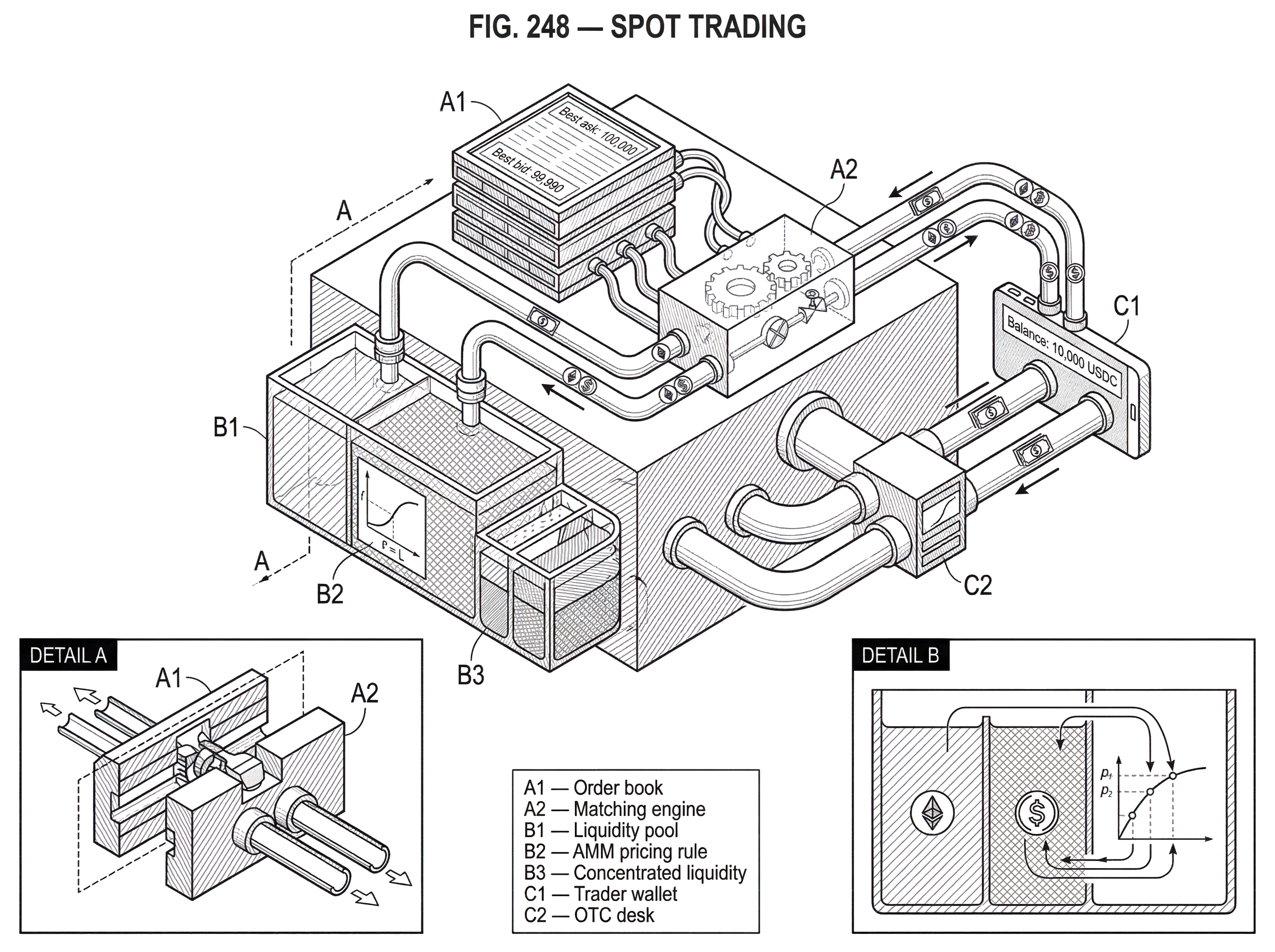
In an exchange order book, that answer emerges from standing buy and sell orders. If the best available seller is offering bitcoin at 100,000 and the best available buyer is bidding 99,990, then the market is telling you something precise: immediate purchase is available at the ask, immediate sale is available at the bid, and trades occur when someone accepts one of those terms or posts an order that crosses the spread. The spread itself is the cost of urgency and a signal of liquidity.
In an automated market maker, the same economic question is answered differently. There may be no central list of bids and offers from many traders. Instead, a smart contract quotes a price implied by pool balances and the pool’s pricing rule. Uniswap v3, for example, uses concentrated liquidity so that liquidity is active only within chosen price ranges, which changes how much trading depth exists near the current price. Curve’s StableSwap uses a different invariant so that trades between similarly priced assets can happen with low slippage near balance. In both cases, the venue still answers the same spot question: What exchange rate can you get right now for immediate settlement on-chain?
So while people often speak of “the spot price” as if it were a single universal number, that is slightly idealized. In reality there are many local executable prices across venues, and arbitrage keeps them from drifting too far apart for long. The spot price is best understood as a market-wide tendency produced by many trading venues, not always a single identical quote everywhere.
Example: How does a spot trade execute on an exchange or AMM?
Imagine a trader with 10,000 USDC who believes ETH is undervalued and decides to buy ETH on a centralized exchange. At that moment, the exchange’s order book shows offers from sellers at nearby prices. If the trader submits a market order, the matching engine will consume the best available asks until the order is filled. Perhaps part of the order fills at one price and the rest at slightly higher prices if available liquidity at the best ask is limited. The trader now holds ETH and no longer holds that 10,000 USDC, aside from any remainder not spent and any fees charged.
Notice what created the exposure. It was not a prediction market, not borrowed capital, and not a derivative contract. The trader simply exchanged one asset for another. From then on, if ETH rises, the trader’s account value rises because the owned asset is worth more in USDC terms. If ETH falls, the account value falls for the same reason. The unrealized gain is just a mark on paper until the trader sells, but the economic exposure exists immediately because ownership has changed.
Now imagine the same trade on an AMM. The trader sends USDC into a pool and receives ETH out of the pool. There is no central matching engine pairing buyer and seller order by order. Instead, the pool’s rule determines how much ETH comes out for the USDC going in, and the trade itself moves the pool price. If the pool is deep near the current price, the execution is close to the quoted price; if it is thin, the trader experiences more slippage. But the result is still a spot trade: the trader parts with USDC now and receives ETH now.
This example shows a useful invariant across very different architectures. **Spot trading is about present exchange and present ownership; the venue decides how price discovery and execution happen. ** Order books and AMMs are different market structures, but both can host spot trades.
How is a spot trade executed on order books, OTC desks, and AMMs?
| Venue | Execution model | Price discovery | Liquidity shape | Best for |
|---|---|---|---|---|
| Order book | Central matching engine | Visible bids and asks | Discrete depth by price level | Price-sensitive orders |
| AMM | Smart-contract pool pricing | Pool invariant quotes price | Continuous pool-based depth | On-chain swaps and retail trades |
| OTC | Bilateral brokered quotes | Dealer negotiation or quote | Hidden block-sized liquidity | Large block trades |
Most spot trading happens in one of two market structures: order-book venues and direct or pooled liquidity venues.
On order-book exchanges, buyers and sellers express willingness to trade at specified prices. A limit order says, in effect, “I will buy up to this price” or “I will sell down to this price.” A market order says, “Fill me now against the best available liquidity.” This structure separates price discovery from execution urgency. If you care most about price, you post a limit order and wait. If you care most about getting done immediately, you send a market order and accept the prevailing offers. Research on order books models these venues as flows of limit orders, market orders, and cancellations because that is the mechanism that shapes short-term price movement and fill probability.
On over-the-counter, or OTC, desks, execution works differently. The buyer and seller trade directly, usually with an intermediary arranging the quote. This is especially useful for large trades because a visible large order on an exchange can move the market before it fully executes. OTC trading reduces that information leakage. The trade is still spot if the parties exchange the assets for present delivery; the difference is not the economic nature of the trade but the execution channel.
On-chain AMMs replace the order book with a pricing function and liquidity pool. This changes what “liquidity” means. In an order book, liquidity is resting interest from traders at discrete price levels. In an AMM, liquidity is capital deposited into a pool under a rule that maps inventory balances to prices. Uniswap v3’s concentrated liquidity lets providers choose the price ranges where their capital is active, which improves capital efficiency but also means liquidity can disappear from the current trading range if price moves outside those bounds. Curve’s StableSwap shifts the design toward very low slippage when assets should trade near parity, which is why it is useful for stablecoin swaps.
These are not cosmetic differences. They affect slippage, transparency, execution certainty, and failure modes. But they do not change the underlying fact that the user is engaging in spot trading when present ownership is exchanged for present payment.
When should you use spot markets instead of derivatives or leverage?
People use spot markets because sometimes the simplest exposure is the right exposure.
If you want to accumulate an asset over time, spot is the cleanest mechanism. This is why recurring buys and dollar-cost averaging naturally map onto spot trading. Each purchase increases actual holdings rather than creating a leveraged claim that must later be rolled, margined, or settled. The position can be held indefinitely, transferred, withdrawn, or used elsewhere because it is an owned asset, not just a contract entry.
If you want transparent pricing, spot also has an advantage. The execution price is tied directly to available supply and demand on the venue, or to the AMM’s current state. By contrast, derivative prices can reflect additional forces such as expiry effects, funding, basis, and liquidation pressures. Those instruments can be useful, but their prices answer a more complicated question than simple present exchange.
Spot trading also matters far beyond speculative investing. A business converting revenues from one currency into another is using a spot market. A protocol treasury rebalancing into stable assets is using a spot market. An arbitrageur aligning prices between venues is often doing spot trades on both sides. Even many derivative markets depend on spot markets because spot prices anchor settlement, hedging, and price discovery.
This is part of why spot markets sit near the center of financial market structure. Other instruments often derive from them, hedge against them, or converge to them.
Spot vs futures vs margin: what mechanically differs?
| Instrument | Ownership | Leverage | Expiry | Main risk | Typical use |
|---|---|---|---|---|---|
| Spot | Immediate asset ownership | No leverage | No expiry | Market price risk | Buy-and-hold, simple hedging |
| Futures | Contract claim on asset | Easily levered | Has expiry | Basis and funding risk | Shorting, hedging, speculation |
| Margin | Owned asset with borrowed funds | Borrowed leverage | No expiry | Liquidation risk | Amplified spot positions |
The most useful comparison is not historical but mechanical.
A futures trade is an agreement whose value is linked to an asset, but the agreement itself is what you trade. You may gain or lose as the underlying price moves without ever taking present ownership of the asset. That makes futures powerful for hedging and speculation, especially when you want short exposure or leverage. But it also introduces features that do not belong to spot: expiry, rollover, basis, or in perpetuals, funding transfers between longs and shorts.
A margin trade changes a different variable: financing. You may still be trading the underlying asset, but part of the position is funded with borrowed capital rather than only your own. That raises potential return on your own capital if the trade goes well, but it also creates a threshold at which collateral is insufficient. That is where margin calls and liquidations enter. Spot trading, by contrast, uses your own capital and therefore does not have the same forced-liquidation structure from borrowed exposure. Your asset can still lose value, of course, but the venue is not closing you out because a loan covenant was breached.
This distinction explains a common beginner confusion. People say spot trading is “less risky,” but that is only partly true. Spot avoids leverage-specific risks such as liquidation and funding costs. It does not avoid market risk. If you buy a volatile token in spot and it falls 80%, the absence of leverage does not rescue the trade. What it changes is the shape of the loss process and the absence of debt amplification.
What are the main risks of spot trading?
| Risk | How it appears | Primary effect | Mitigation |
|---|---|---|---|
| Price risk | Asset declines after purchase | Portfolio value falls | Diversify and size positions |
| Liquidity risk | Thin books or shallow pools | Large slippage on exit | Use OTC or stagger trades |
| Execution risk | Market orders or mempool delays | Poor average fills | Use limits and slippage caps |
| Custody risk | Assets held on exchange | Loss on platform failure | Self-custody or vetted exchanges |
| MEV / ordering risk | On-chain frontrunning and reordering | Worse execution and gas loss | Private relays, Flashbots Protect |
Because spot trading is simple, its risks are easy to underestimate.
The most obvious risk is price risk. If you buy an asset and its market price falls, your position loses value. This remains true whether you trade on a large centralized exchange, a small altcoin venue, or a DEX. Simplicity of instrument does not imply simplicity of market behavior.
Then comes liquidity risk. A quoted price is only useful if meaningful size can trade near it. In thinner markets, especially for smaller tokens, liquidity can dry up. That means the price you see may not be the price you can actually exit at in size. On order-book venues this appears as a sparse book and wide spreads. On AMMs it appears as slippage that becomes severe as your trade consumes the pool’s available depth.
There is also execution risk. A market order guarantees urgency, not price. If the book is thin or the pool is shallow, the average fill can be materially worse than the best displayed price. Limit orders improve price control but introduce non-execution risk: your desired trade may simply not happen. On-chain, execution risk includes transaction inclusion and ordering. The trade you signed is not necessarily the trade environment you get when it lands on-chain.
That leads to a risk specific to decentralized execution: MEV and transaction reordering. Research on decentralized exchanges has shown that bots can bid for priority ordering, seeking to frontrun or otherwise exploit user trades. This is not a side detail. It means that in some on-chain environments, execution depends not only on price and liquidity but also on who gets ordered first in the block and under what information conditions. Infrastructure such as Flashbots Protect and related systems exists precisely because public transaction exposure can harm ordinary traders.
Finally, there is custody and counterparty risk on centralized venues. In pure economic theory, spot trading is just exchange and ownership transfer. In practice, if your asset remains on an exchange, your effective control depends on that platform’s solvency, governance, and internal controls. The collapse of FTX is the clearest recent reminder that the market risk of an asset and the institutional risk of the venue are different risks. A trader may correctly understand spot exposure and still be harmed by exchange failure, misuse of customer funds, or preferential treatment of related parties.
So the clean statement is this: spot trading removes some layers of complexity, but it does not remove the need to think about liquidity, execution, and custody.
How do centralized exchanges and decentralized venues change spot trading?
A useful way to organize the landscape is by asking which function the venue performs for you.
A centralized exchange usually performs three functions together: custody, matching, and internal settlement. It holds user assets, runs an order book and matching engine, and updates balances on its own ledger when trades occur. That design can make execution fast and convenient, and it supports familiar order types such as market and limit orders. But it also concentrates trust.
A decentralized spot venue usually unbundles those functions. Custody stays with the user’s wallet until the trade executes through smart contracts. Matching may be replaced by an AMM or handled by different routing mechanisms. Settlement happens on-chain. This reduces some forms of intermediary dependence, but it introduces new frictions: gas costs, transaction visibility, latency tied to block inclusion, and exposure to MEV.
Neither design is simply “better” in all respects. Centralized venues often offer deeper liquidity and smoother execution for many assets. Decentralized venues offer composability and direct on-chain settlement. The crucial point is that both are still spot markets when the trade exchanges assets for immediate ownership rather than future claims.
Common misconceptions about spot trading
The first misunderstanding is to equate spot trading with day trading. Many spot traders do trade actively, but spot says nothing about time horizon. You can hold for minutes or for years. The defining property is present exchange and ownership.
The second is to assume that because spot uses no leverage, losses are somehow small. They are limited to invested capital in the sense that there is no borrowed notional creating debt beyond the position, but the invested capital itself can still decline dramatically.
The third is to think that “owning the asset” means all operational questions disappear. In crypto especially, ownership raises further questions: do you hold on an exchange or withdraw to self-custody? Can you move the asset when needed? Are there chain-specific settlement delays or smart-contract risks? Spot trading answers the exposure question, not every operational one.
The fourth is to treat all spot venues as if they share the same execution mechanics. They do not. A market order in a deep exchange order book, a large OTC block, and a swap through a concentrated-liquidity AMM are all spot trades, but they behave differently under size, volatility, and stress.
Conclusion
Spot trading is the direct exchange of value for an asset at the current market price for immediate delivery. Its importance comes from a simple mechanism: it creates exposure by transferring ownership now, not by layering on future obligations or borrowed financing.
If you remember one thing tomorrow, remember this: spot is the market form for actually getting the asset. Everything else (order books, OTC desk, AMMs, slippage, custody, and comparisons with futures or margin) follows from that fact and from the practical question of how markets make that immediate exchange possible.
How do you start spot trading?
How do you start spot trading on Cube? Start by funding your Cube account, then place a spot order on the market you want to trade. Cube’s trading flow supports both immediate market fills and limit orders for price control so you can choose execution that fits your goal.
- Deposit funds into your Cube account via the fiat on‑ramp or by sending a supported crypto (e.g., USDC) to your Cube deposit address.
- Open the relevant spot market (for example ETH/USDC). Choose a market order for immediate execution or a limit order; use post‑only for a limit if you want to avoid maker fees and prioritize price.
- Enter your size, review the estimated fill, slippage, and fee summary on Cube, then submit the order.
- After the trade, optionally set a limit sell, stop‑loss, or withdraw the asset on‑chain from Cube to your wallet if you need external custody or on‑chain use.
Frequently Asked Questions
Mechanically, spot trading exchanges one asset for another for immediate ownership, whereas futures trade the contract (a claim on a future price) and margin trading uses borrowed capital to amplify exposure; spot therefore has no expiry, funding rates, or lender-driven liquidations that come with futures or leveraged margin positions.
No - spot removes leverage-specific features but not market and operational risks: you still face price risk, liquidity risk, execution risk (including slippage and partial fills), on-chain MEV/ordering risk, and custody or counterparty risk if your asset sits on an exchange.
Execution depends on the venue: order-book venues match limit and market orders and show discrete depth and spreads; AMMs price by pool balances so depth and slippage are a function of pool size and the pricing invariant; OTC desks trade privately to hide large size and reduce market impact; these differences change slippage, transparency, and the chance of adverse fills.
“Immediate” in spot means present delivery under the venue’s settlement convention, not always literal atomic finality: traditional markets often use short standard settlement windows, centralized exchanges may update internal ledgers instantly while external withdrawals wait for settlement, and on-chain trades appear immediate within a platform but finality depends on blockchain confirmations.
Custody changes your effective risk: keeping assets on a centralized exchange makes custody, matching, and internal settlement convenient but concentrates counterparty and operational risk (e.g., exchange insolvency), while self‑custody reduces intermediary trust but introduces on‑chain frictions like gas, latency, and MEV exposure.
There is no single universal spot quote - each venue offers a local executable price determined by its order book or pricing function, and arbitrageurs and liquidity providers tend to keep those venue prices from diverging far for long.
Concentrated‑liquidity AMMs (Uniswap v3) make capital more efficient by activating liquidity only inside chosen price ranges but can leave liquidity absent if price moves outside those ranges, while Curve’s StableSwap uses a different invariant to give much lower slippage for near‑par swaps; both designs change execution depth and slippage compared with constant‑product pools.
On‑chain MEV and transaction reordering can let bots frontrun or extract value from user spot trades by changing execution ordering or bidding for priority, and mitigations such as private‑relay/priority‑protection services (e.g., Flashbots Protect/MEV mitigations) exist although their quantitative impact on user harm varies and remains an area of ongoing study.
Related reading