What is an OTC Desk?
Learn what an OTC desk is, why institutions use it, how bilateral execution works, and how documentation, clearing, collateral, and reporting fit together.
Introduction
An OTC desk is the part of a financial institution that arranges, prices, executes, and manages over-the-counter trades; transactions negotiated directly between counterparties rather than matched on a public exchange. The basic puzzle it solves is simple: if markets are supposed to be efficient, why do large institutions still call a dealer, negotiate terms bilaterally, and rely on a specialized desk instead of just trading on-screen? The answer is that many real trades are not just requests for a price. They are requests for size, customization, discretion, credit intermediation, and operational certainty all at once.
That combination is what makes the OTC desk a piece of market infrastructure, not merely a sales channel. It sits between clients who need to transact and the fragmented set of liquidity sources, legal agreements, collateral arrangements, clearing choices, and reporting systems required to make the trade real. In derivatives, this often means a dealer desk documenting trades under an ISDA Master Agreement and managing collateral through a Credit Support Annex. In cash and digital-asset markets, the same underlying logic appears even when the instruments differ: the desk is still the entity that intermediates bilateral execution and then absorbs the operational burden that exchange trading pushes into the venue.
The core idea to keep in mind is this: an exchange standardizes the trade before execution; an OTC desk standardizes the relationship around the trade. That is why OTC desks continue to exist even in highly electronic markets.
Why do institutions use OTC desks instead of exchanges?
To see why an OTC desk exists, start with what an exchange is good at. An exchange works best when the product is standardized, the order size is not so large that it overwhelms the market, and the buyer and seller can remain largely anonymous because the venue and clearinghouse handle the trust problem. If those conditions hold, an order book is efficient: prices are visible, matching is fast, and post-trade processing is routine.
An OTC transaction begins where those conditions weaken. A corporate treasurer may want a hedge that matches a very specific currency exposure or interest-rate profile. A fund may need to move a block position large enough that displaying it to the market would move price against itself. A client may want a trade that combines features not available in listed form. Or the issue may be less about product design than about relationship-based trading: the client wants a dealer that can extend credit, commit capital, coordinate settlement, and remain accountable if something in the trade lifecycle breaks.
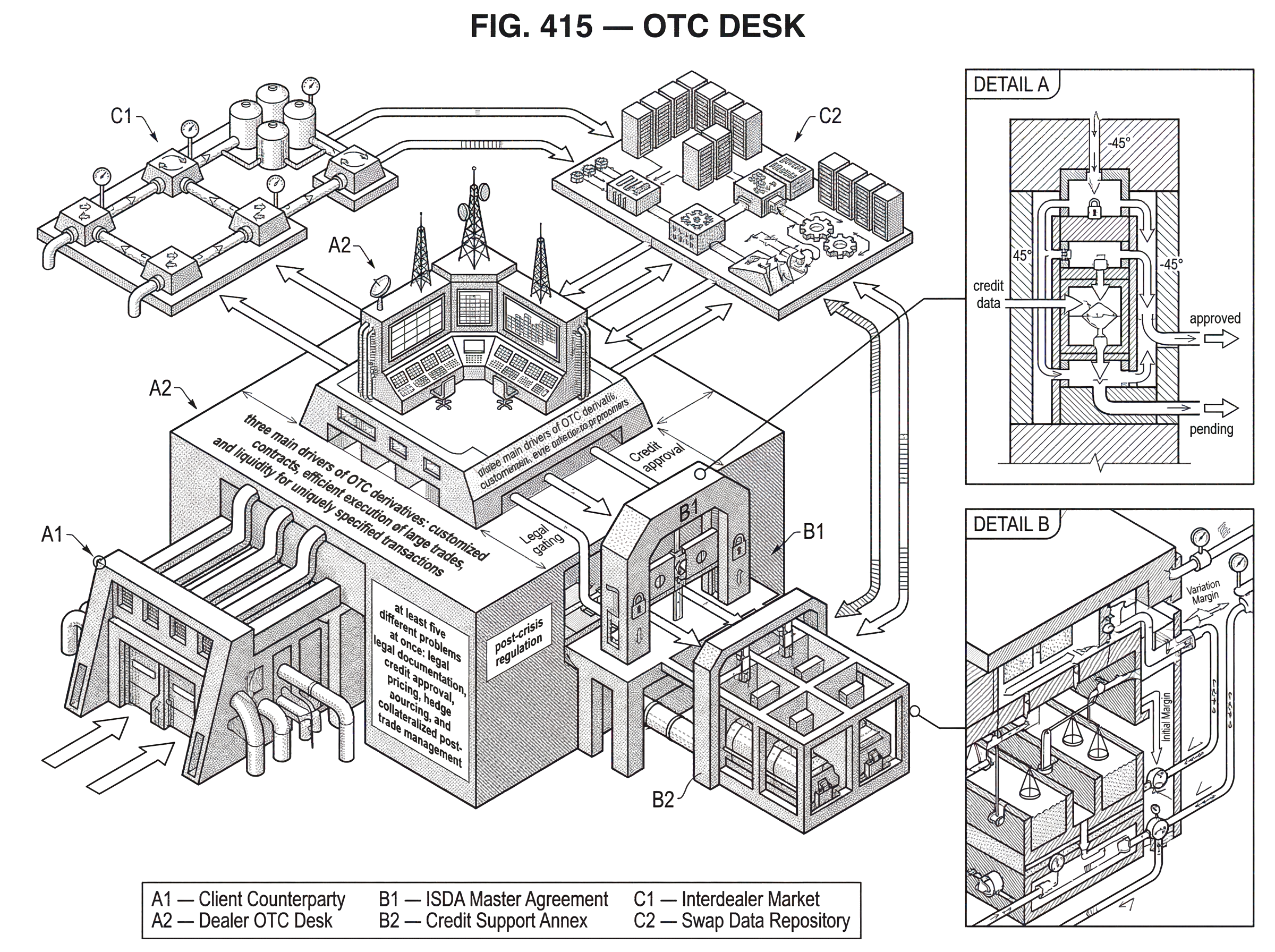
The Chicago Fed’s overview of OTC derivatives describes three main drivers of OTC markets: customized contracts, efficient execution of large trades, and liquidity for uniquely specified transactions. Those three are enough to explain the desk. The desk exists because someone has to turn a client’s non-standard need into an executable trade, and then into a settled position whose risks are measured, margined, reported, and, if necessary, hedged elsewhere.
This is also why OTC markets naturally split into two connected segments. There is a customer market, where end users trade with dealers, and an interdealer market, where dealers offset, warehouse, or rebalance the risks they acquired from customers. The OTC desk is the institutional surface that faces the customer, but it cannot be understood without the dealer’s ability to recycle risk behind the scenes.
How does an OTC desk turn a client request into an executable trade?
People often picture an OTC desk as a group of traders answering chat messages and quoting prices. That is part of the story, but it misses the mechanism. The desk does not merely name a number; it makes a bilateral transaction possible by combining pricing, principal risk, documentation, credit assessment, collateral terms, execution logistics, and post-trade operations.
Suppose a pension fund wants a large interest-rate swap tailored to its liabilities. The fund does not send a generic order into a book and wait to be matched. Instead, it approaches one or more dealer desks. The desk first has to determine whether it is willing to face that client at all, because OTC trading creates counterparty exposure, not just market exposure. If the relationship is already in place, the legal framework may sit under an existing ISDA Master Agreement. If not, the trade may not be executable until legal and credit teams define the relationship.
Once the relationship exists, the desk quotes a price. That quote reflects more than the market’s expected path of rates. It also reflects the desk’s estimate of hedging cost, balance-sheet usage, capital consumption, funding cost, collateral terms, and the difficulty of unloading or offsetting the risk in the interdealer market or through a clearinghouse. What looks to the client like a single price is, from the desk’s perspective, a compression of many constraints into one executable number.
After execution, the desk’s job is still not finished. The trade must be confirmed, booked, margined if applicable, potentially cleared, and reported to the appropriate infrastructure. If the trade is uncleared, variation margin and, for in-scope counterparties, initial margin may have to move under standardized collateral documents. If the trade is clearable and mandated or elected for central clearing, the desk must route it into that process. The trade then generates a continuing stream of lifecycle events: valuation changes, collateral calls, amendments, novations, terminations, and regulatory reporting updates.
That is why the better way to think about an OTC desk is as a relationship engine with market-making capabilities, not just a trading screen with a salesperson attached.
Which legal agreements govern OTC trades and why do they matter?
| Document | Primary purpose | Risk effect | Typical products | Operational impact |
|---|---|---|---|---|
| ISDA Master Agreement | Standardize default & netting | Enables cross‑trade netting | Swaps and derivatives | Simplifies exposure calculation |
| Credit Support Annex (CSA) | Define margin mechanics | Reduces variation exposure | Uncleared derivatives | Drives margin flows |
| GMRA (global repo) | Standardize repo terms | Creates financing & close‑out rules | Repo / SFTs | Structures settlement & reuse |
| Custody / collateral agreement | Control asset custody | Affects collateral control & loss risk | Collateralized trades, digital assets | Determines withdrawal & delisting handling |
In exchange markets, much of the legal structure is embedded in the venue rulebook and the clearing system. In OTC markets, the legal structure has to be built more explicitly into the counterparty relationship. For derivatives, the central instrument is usually the ISDA Master Agreement, which standardizes how the parties define events of default, termination, netting, and other core terms across many individual transactions.
The importance of this framework is not formality for its own sake. It is the mechanism that turns many separate trades into a single netted relationship. Without netting, a firm might owe its counterparty on some trades and be owed on others, with each gross exposure standing on its own. With netting under the master agreement, the parties can calculate a single bilateral exposure. That changes credit risk, collateral needs, close-out mechanics, and ultimately the economics of whether the desk is willing to trade at all.
The same logic appears in adjacent OTC markets outside classic swaps. Repo markets rely on the GMRA, another master agreement designed to make a bilateral financing relationship legally and operationally robust. The family resemblance matters. Across OTC markets, the desk is not just pricing isolated transactions; it is operating inside a documentation framework that makes repeated bilateral trading workable.
Collateral arrangements sit on top of that framework. A Credit Support Annex, or CSA, defines how margin is posted, what collateral is eligible, how it is valued, and how disputes are handled. For non-centrally cleared derivatives, post-crisis regulation pushed more of this margining discipline into the bilateral market, including phased requirements around variation margin and initial margin. That changed the economics of OTC desks materially. An uncleared bespoke trade is not only harder to hedge than a standardized one; it may also be more expensive because the bilateral margin regime consumes liquidity, operations, and legal setup.
Here the key distinction is between what is fundamental and what is contingent. The fundamental fact is that bilateral OTC trading creates counterparty risk that must be governed contractually. The contingent part is the exact documentation set, legal jurisdiction, and margin method chosen. Those vary by product, counterparty type, and geography.
How do OTC executions differ from exchange trading in practice?
| Execution mode | Standardization | Clearing likelihood | Speed | Best for |
|---|---|---|---|---|
| Exchange order book | High | Likely (CCP) | Fast | Standard, small trades |
| SEF / electronic platform | Medium‑high | Possible | Fast–moderate | Partially standardized swaps |
| Dealer‑led OTC (voice/bilateral) | Low | Unlikely (bilateral) | Slower, negotiated | Large bespoke trades |
Execution in OTC markets historically relied heavily on voice trading and direct negotiation. That made sense because many trades were too bespoke to fit a common electronic workflow, and because human negotiation is useful when a trade involves size, customization, or delicate information. Over time, more electronic platforms emerged, and regulatory reforms after the financial crisis pushed some standardized swaps onto swap execution facilities, or SEFs.
This does not mean OTC desks disappeared when electronic execution arrived. It means the desk’s role shifted. In a fully bespoke trade, the desk may still negotiate directly with the client and then decide how to hedge the resulting exposure. In a more standardized product that trades on a SEF, the desk may use the platform for price discovery or execution while still managing the client relationship, balance-sheet commitment, and post-trade workflow. The desk remains the coordinating intelligence around the trade even when one execution step becomes more exchange-like.
The right mental model is that OTC execution lies on a spectrum. At one end, you have something close to exchange trading: standardized terms, electronic order interaction, likely central clearing. At the other end, you have deeply customized bilateral risk transfer with manual negotiation and bilateral collateral. An OTC desk operates across that spectrum, and much of its skill lies in recognizing which parts of the trade can be standardized and which cannot.
That distinction also explains why clients care about dealer quality. Two desks can quote the same headline product but differ materially in responsiveness, certainty of execution, access to liquidity, documentation readiness, and operational reliability. In block trading or stressed markets, those differences matter as much as a small price improvement.
Example: what steps does a desk take when a client requests a tailored swap?
Imagine a corporate treasurer with future euro revenues and dollar costs. The company wants to reduce the risk that currency moves will damage margins, but the exposure does not line up neatly with listed futures expiries or standard contract sizes. The treasurer approaches a bank’s OTC desk for a tailored hedge.
The desk does not begin by asking only where euro-dollar is trading. It begins by checking whether the bank can face the company under existing documentation and credit limits. If an ISDA relationship and collateral terms already exist, the desk can move quickly; if not, the trade may be economically obvious but operationally impossible today. That is a defining feature of OTC markets: the trade is a function of the relationship as much as of the market view.
Next, the desk structures the hedge. Perhaps the company wants a forward-like exposure for irregular dates and cash-flow amounts. The desk translates that commercial need into tradable terms and prices it. The price embeds the market level, but also the dealer’s expected cost of hedging the position, funding it, carrying the counterparty exposure, and managing any residual basis risk that cannot be perfectly offset.
Once the client accepts, the trade is executed bilaterally. Confirmation follows. If the contract is uncleared, valuation changes may lead to variation margin calls under the CSA, and if the counterparties are subject to regulatory initial margin rules for uncleared swaps, segregated IM arrangements may also be required. If the trade later becomes uneconomic for the dealer to warehouse, the desk may hedge pieces of it in the interdealer market or use more standardized instruments to neutralize most of the risk.
Notice what happened. The client experienced a single service: “the bank helped us hedge currency risk.” But under the surface, the desk had to solve at least five different problems at once: legal documentation, credit approval, pricing, hedge sourcing, and collateralized post-trade management. That bundle of functions is what makes it a desk rather than just a quote provider.
What post-trade systems must an OTC desk manage?
A common misunderstanding is that OTC trading ends at agreement on price and size. In reality, that is often the start of the operationally difficult part. Because OTC contracts are bilateral and often long-lived, the trade must be maintained through its full lifecycle.
This is where repositories, custodians, collateral systems, confirmation platforms, and settlement facilities come in. In U.S. swaps markets, the post-crisis framework requires reporting to swap data repositories, or SDRs. The CFTC describes SDRs as central facilities for swap data reporting and recordkeeping, and all swaps, whether cleared or uncleared, must be reported to registered repositories. For security-based swaps, parallel repository structures exist under SEC rules. The point is not simply compliance theater. Centralized reporting exists because bilateral OTC markets are otherwise relatively opaque; regulators wanted better visibility into positions, pricing, and concentrations of risk.
An OTC desk therefore has to produce clean trade data, maintain identifiers, update lifecycle events, and ensure the record in the repository reflects the economic reality of the trade as it evolves. That requires disciplined booking and operations. A trade that is economically correct but operationally misreported can create regulatory and reconciliation problems that are expensive in their own right.
Clearing decisions also live here. Some OTC derivatives are centrally cleared through a central counterparty, or CCP, especially when the products are sufficiently standardized and accepted by the clearinghouse. Others remain bilaterally cleared. Standardization increases the likelihood of central clearing, but it does not make clearing automatic; the CCP still decides what it will accept. For the desk, that means execution is inseparable from infrastructure choice. The same economic exposure can carry different funding, credit, and operational consequences depending on whether it clears.
How do crypto OTC desks differ from traditional desks and what risks change?
The basic institutional logic of an OTC desk also appears in digital assets. A crypto OTC desk intermediates buyers and sellers who do not want, or cannot easily use, an open exchange for a large transfer. The reasons are familiar: trade size, discretion, access to liquidity, and sometimes the desire for a single counterparty to manage settlement.
Here too, the desk is more than a matching service. It may source inventory from liquidity providers, quote principal prices, arrange fiat and asset settlement, and provide a layer of execution privacy relative to visible public order books. In this respect, the resemblance to traditional OTC dealing is strong.
But digital-asset OTC desks also expose where assumptions from traditional markets can break. Settlement may happen on-chain, off-chain within internal books, or through custodial transfers. Asset support can change if a custodian delists a token or faces a regulatory event. Operational control over pledged collateral may depend on specific custody and account-control arrangements rather than the more mature infrastructure of a traditional CCP or securities depository. That does not make the desk less real as infrastructure; it means more of the infrastructure is still being assembled.
The privacy and flexibility that make OTC channels attractive for legitimate large trades can also create abuse risk. That is particularly visible in law-enforcement guidance on crypto OTC desks, which emphasizes opacity, intermediary behavior, and the possibility that off-exchange activity is harder to monitor in real time. The general lesson travels beyond crypto: where trading becomes more bilateral and less visible, the desk’s control environment matters more.
What factors do OTC desks optimize besides price?
| Constraint | Client impact | Price effect | Desk action |
|---|---|---|---|
| Inventory & risk appetite | Access to immediate fills | Spread adjusted for warehousing | Warehouse or hedge in interdealer market |
| Credit capacity | Trade without pre‑funding | Higher price to consume credit | Set limits or require collateral |
| Funding & collateral | Margin call liquidity needs | Adds funding premium | Request collateral or clear centrally |
| Market impact & hedgeability | Execution cost to lay off risk | Hidden slippage costs | Block trades or stagger hedges |
| Operational & documentation | Speed depends on docs | Delays can change cost | Pre‑approve docs; streamline ops |
From the client side, the natural question is often: why not just ask several desks for quotes and take the best price? In practice, institutions do compare quotes, but they know the best execution problem is broader than a single spread. OTC desks are optimizing across a constrained system.
The first constraint is inventory and risk appetite. A desk willing to warehouse a position can quote differently from a desk that must immediately hedge every component. The second is credit capacity. If the trade consumes bilateral exposure or balance sheet, the quote must pay for that usage. The third is funding and collateral friction. A trade that generates frequent margin calls or requires segregated initial margin is more expensive to carry. The fourth is market impact and hedgeability. A client block may be cheap in theory but costly in practice if the desk will move the market while laying off risk.
This is why OTC prices are often better understood as relationship prices rather than pure market-clearing prices. They emerge from the specific pairing of product terms, client characteristics, legal setup, and market conditions. Two clients can ask for economically similar exposure and receive different quotes because the surrounding bilateral relationship is different.
This is not arbitrary. It is the consequence of the desk solving a richer problem than exchange matching solves. The exchange asks, “At what price do anonymous standardized orders cross?” The OTC desk asks, “Under what complete set of terms is this bilateral transaction worth doing?”
When is an OTC desk not the best execution venue?
The OTC desk is powerful precisely because it can absorb complexity. But that flexibility has limits.
If a product becomes standardized enough, liquid enough, and easy enough to clear, much of the desk’s traditional advantage shrinks. At that point, electronic venues and CCPs can handle more of the value chain. The desk may still matter for client service and block risk, but not in the same way as for highly bespoke trading.
The model also becomes fragile when legal and operational foundations are weak. A brilliant price is not useful if documentation is incomplete, collateral terms are disputed, or lifecycle events cannot be processed accurately. In bilateral markets, small operational defects can become large economic defects because there is no venue rulebook absorbing the inconsistency for everyone.
And the desk can create opacity as well as efficiency. Bilateral negotiation can reduce market impact for a legitimate large trade, but it can also reduce public visibility. That is one reason reforms after 2008 pushed toward greater clearing, electronic execution where appropriate, and trade reporting to repositories. Those reforms did not eliminate OTC desks because the underlying client need did not disappear. They did, however, change the boundaries within which desks operate.
So the right conclusion is not that OTC desks are relics, nor that they are superior to exchanges. It is that they are specialized institutions for a different optimization problem. They are best where trading requires customization, size handling, bilateral credit, and operational coordination. They are less essential where standardization can safely push those functions into market-wide infrastructure.
Conclusion
An OTC desk exists because some trades are not just orders; they are bilateral problems involving price, size, trust, documentation, collateral, and settlement all at once. The desk’s job is to make those trades possible by wrapping market-making inside a durable counterparty relationship.
If you remember one thing, remember this: an exchange standardizes the product and the process; an OTC desk standardizes the relationship that allows a non-standard trade to happen. That is why OTC desks remain central to institutional market infrastructure even in an increasingly electronic world.
What should an institutional trader evaluate before executing in this market?
Assess legal, credit, settlement, and execution-readiness before committing capital; these factors determine whether the trade should route to an OTC desk or an on-book market. On Cube Exchange, prepare by funding the account, confirming documentation and settlement terms with the counterparty, then choose the execution path that matches your size and customization needs.
- Verify legal and credit readiness: confirm ISDA/CSA status or equivalent bilateral docs and that counterparty credit limits permit the planned notional.
- Fund your Cube account via fiat on-ramp or a supported crypto transfer; confirm token support and allow the chain-specific confirmation count before settlement.
- Choose the execution path: select OTC execution for large or bespoke blocks, or open the on-book market for standardized, clearable sizes.
- Pick an order type and enter details: use a limit order for price control or a market order for immediacy; for OTC, specify settlement instructions (custodial vs on-chain) and required delivery windows.
- Review fees, counterparty limits, and settlement mechanics, then submit the trade and monitor confirmations until settlement completes.
Frequently Asked Questions
Institutions use OTC desks when trades need size, bespoke contract terms, discretion, bilateral credit, or operational certainty that an exchange order book cannot provide; the desk bundles documentation, credit intermediation, hedging and settlement so non‑standard needs become executable trades.
A desk’s quote reflects the market level plus the dealer’s expected hedging cost, balance‑sheet and capital usage, funding cost, collateral terms, and the difficulty of offloading or hedging the position - all compressed into a single executable price for the client.
OTC trades are typically governed by master documentation such as the ISDA Master Agreement (for derivatives) and a Credit Support Annex for margining, with analogous templates like the GMRA for repos; these frameworks enable netting, define close‑out and margin mechanics, and materially change the counterparty economics of a trade.
Central clearing can change a trade’s funding, collateral and operational profile: if a product is cleared through a CCP it alters margining, novation and counterparty exposure compared with an uncleared bilateral trade, and post‑crisis margin reforms for non‑centrally cleared derivatives have raised the cost of uncleared trades.
OTC desks must feed clean trade data into post‑trade infrastructure - confirmations, booking, margin movements, and regulatory reporting to swap data repositories or SDRs - and maintain lifecycle messages so repositories and regulators have an accurate record of valuation and collateral events.
Crypto OTC desks perform the same relationship, liquidity‑sourcing and principal‑pricing functions as traditional desks but face different failure modes: settlement can be on‑chain or custodial, custody delistings or regulatory actions can disrupt asset support, and the bilateral opacity heightens compliance and law‑enforcement risks.
The desk model becomes less essential when a product is standardized, liquid and easily cleared - in that case electronic venues and CCPs can take over much of the value chain - but desks remain important for blocks, bespoke terms and client servicing.
Yes; bilateral negotiation can reduce public visibility and create monitoring gaps, which is why reforms after 2008 increased clearing, electronic execution where appropriate, and trade reporting, and why authorities have flagged crypto OTC desks as potential opacity and illicit‑flow risks.
Related reading