What is Morpho?
Learn what Morpho is, how its lending protocol works, why Morpho Blue matters, and how users and developers use its markets and vaults.
Introduction
Morpho is a decentralized lending protocol built to make onchain lending more capital-efficient without taking custody of user funds. The core problem it addresses is simple: in many lending systems, suppliers earn one rate, borrowers pay a higher rate, and the spread between the two is the cost of using a pooled market. Morpho’s design is an attempt to narrow that gap while preserving what users value most in lending markets: liquidity, predictable mechanics, and composability.
That basic idea explains why Morpho has attracted both everyday DeFi users and developers. If you are lending stablecoins or borrowing against collateral, better rates matter directly. If you are building DeFi products, a lending protocol that is permissionless, flexible, and governance-minimized is useful as infrastructure. Morpho now spans both of those roles: it started by improving existing pool-based protocols through peer-to-peer matching, and its newer architecture, Morpho Blue, provides a simpler base layer for creating lending markets and vault strategies.
What lending inefficiency does Morpho solve and why does it matter?
| Model | Lender yield | Borrower cost | Liquidity source | Fallback | Best for |
|---|---|---|---|---|---|
| Pooled market | Lower (pool APY) | Higher (pool APR) | Shared liquidity pool | None (native) | Maximum immediate liquidity |
| P2P match | Higher than pool | Lower than pool | Matched counterparties | No native fallback | Direct financing, max efficiency |
| Morpho hybrid | Between pool and P2P | Between pool and P2P | P2P + underlying pools | Reverts to underlying pool | Better rates with pool safety |
To see why Morpho exists, start with the usual pooled lending model used by protocols such as Aave or Compound. Many suppliers deposit assets into a shared pool, and borrowers draw from that pool against collateral. This model is robust and liquid because everyone interacts with a common pot of capital. But it naturally creates a spread: the protocol pays suppliers a lower APY than it charges borrowers.
That spread is not arbitrary. It comes from how pool utilization, reserve mechanics, and risk buffers are structured. Still, from a first-principles point of view, it means two users who could in effect finance each other are routed through a shared pricing mechanism that leaves value on the table. A supplier might earn 3%, while a borrower pays 5%, even though the system is really matching supply and demand for the same asset.
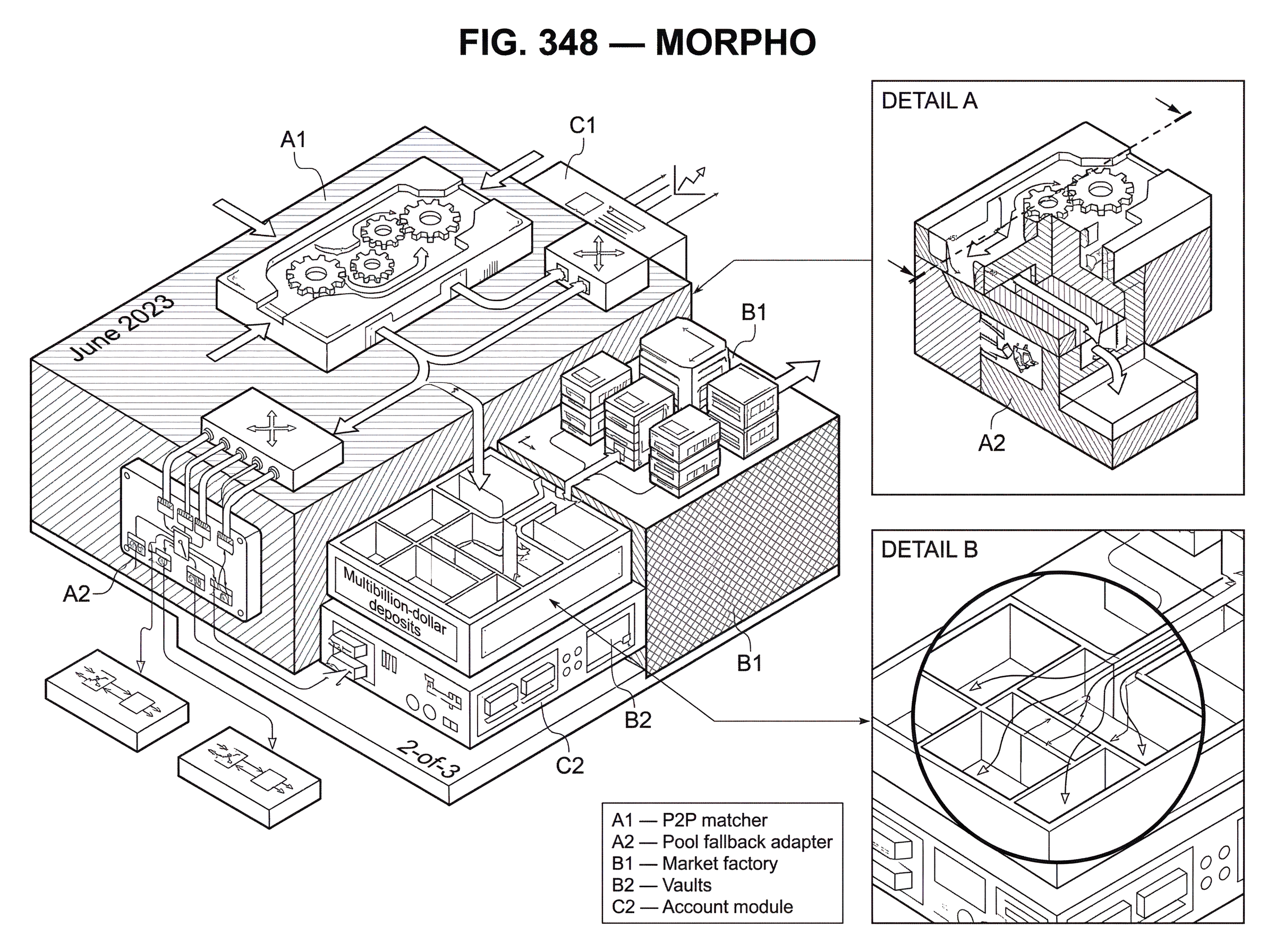
Morpho’s original insight was that you can keep the pool as a fallback source of liquidity and liquidation infrastructure, while matching compatible lenders and borrowers more directly when possible. If that match happens, the rate can sit between the pool supply APY and the pool borrow APY. Morpho called this the P2P APY. In practical terms, that means the lender earns more than they would in the pool, and the borrower pays less than they would in the pool.
How did Morpho’s original peer-to-peer optimizer match lenders and borrowers?
The useful mental model is this: Morpho was not originally trying to replace pooled lenders. It was trying to sit on top of them as a smarter coordination layer.
In that design, Morpho connected to existing liquidity pools and attempted to match suppliers and borrowers peer-to-peer. When a match existed, both sides received the improved P2P rate. When a match did not exist, or when a matched credit line broke, the user position fell back to the underlying pool. That fallback is the key to why the design was attractive: users could get better rates when matching was available, but they still relied on the underlying protocol’s liquidity and liquidation guarantees when it was not.
A concrete example makes this clearer. Imagine Alice wants to supply USDC and Bob wants to borrow USDC against collateral. In a standard pooled market, Alice would deposit into the pool and earn the supply rate, while Bob would borrow from the pool and pay the borrow rate. In Morpho’s optimizer-style model, if Alice and Bob could be matched, Morpho would place them into a peer-to-peer relationship at a rate between those two pool rates. Alice earns more than the pool would have paid her. Bob pays less than the pool would have charged him. If Bob repays or Alice withdraws and the match can no longer be maintained, the exposure reverts to the underlying pool mechanics rather than failing altogether.
This explains both Morpho’s appeal and its constraint. The appeal was improved capital efficiency with familiar market structure. The constraint was that the system still inherited important properties of the underlying protocols it integrated with. Morpho’s own materials were explicit that it aimed to preserve the same market risks and the same liquidity as the underlying interest-rate protocols, while improving rates. That is a strong value proposition, but it also means the design was partly downstream of Aave- or Compound-style infrastructure rather than fully independent.
What changed in Morpho Blue compared with the original optimizer?
| Variant | Market creation | Risk management | Oracle model | Developer features |
|---|---|---|---|---|
| Optimizer (original) | Uses existing liquidity pools | Inherits underlying pool risk | Relies on underlying oracles | Optimizer UX and integrations |
| Morpho Blue | Permissionless market creation | Permissionless risk configs | Oracle-agnostic pricing | SDKs, callbacks, flash loans |
Morpho has since expanded beyond that original optimizer model. The newer architecture, Morpho Blue, is best understood as a lending primitive rather than just an overlay.
Morpho Blue is a noncustodial lending protocol for the EVM designed as a simple, immutable, and governance-minimized base layer. The important change is not just branding. It reflects a different philosophy: instead of optimizing someone else’s market design, Morpho Blue makes market creation itself more flexible and permissionless.
According to the protocol’s documentation and repository, Morpho Blue supports permissionless market creation, permissionless risk management, and oracle-agnostic pricing. Those three properties matter together. Permissionless market creation means users and teams do not need a central gatekeeper to launch a lending market. Permissionless risk management means the risk configuration is part of the open design space rather than something only a protocol committee can set. Oracle-agnostic pricing means Morpho Blue does not hard-code a single pricing source model into the protocol, which makes it easier to adapt markets to different assets and risk assumptions.
The result is a more modular system. Rather than offering one globally curated set of lending markets, Morpho Blue acts like a minimal settlement layer for isolated lending pairs and strategies. Developers can then build additional layers on top, including interfaces, vaults, curation systems, and automation.
How do Morpho vaults work and when should you use one?
If markets are the raw lending primitive, vaults are the way Morpho makes that primitive easier to use at scale.
A market is direct and specific: a given collateral asset, a loan asset, a pricing setup, and risk parameters. That is powerful, but it pushes decision-making onto the user. Many users do not want to manually compare markets and rebalance capital. They want an abstraction that allocates funds where the risk-adjusted opportunity is attractive.
That is where Morpho Vaults come in. Morpho’s documentation presents Vaults and Markets as the primary primitives for builders, and it describes a curation layer focused on optimizing vault performance and balancing stakeholder needs. The underlying mechanism is straightforward: markets provide the places capital can go, and vaults provide a managed allocation layer on top of them.
This is part of who Morpho is for. A technically confident user may want to interact with markets directly, choosing exact lending exposures. A less hands-on lender may prefer a vault that packages those choices into a strategy. A developer may care less about the front-end distinction and more about the fact that these are composable building blocks accessible through SDKs and APIs.
How do users and developers interact with Morpho in practice?
From a user-facing perspective, Morpho is mostly about two actions: supplying assets to earn yield and borrowing assets against collateral. That sounds like every lending protocol, but the reason users choose Morpho is more specific. They are usually looking for either better rates, more flexible market design, or a cleaner route into curated vault strategies.
For developers, the attraction is that Morpho offers an infrastructure layer rather than just an app. The docs explicitly position Morpho as something you can build on using SDKs, APIs, Vaults, and Markets. Morpho Blue also includes developer-oriented features such as a singleton implementation, callbacks, free flash loans, and account-management features. Those are not cosmetic additions. They reduce integration friction and make it easier to compose Morpho into trading systems, leverage products, automated strategies, and portfolio managers.
This same pattern appears across crypto infrastructure more broadly. A protocol becomes more useful when it separates a minimal base layer from higher-level orchestration. In custody and settlement systems, for example, threshold signing separates the core authorization primitive from the products built on top of it. Cube Exchange uses a 2-of-3 threshold signature scheme for decentralized settlement: the user, Cube Exchange, and an independent Guardian Network each hold one key share, no full private key is ever assembled in one place, and any two shares are required to authorize a settlement. Morpho is solving a different problem, but the architectural lesson is similar: keep the base primitive simple and secure, then let richer coordination layers sit above it.
What are Morpho’s main security and integration risks and past incidents?
| Risk type | What it is | Notable example | Mitigation status | Practical impact |
|---|---|---|---|---|
| Integration risk | Dependence on external pools | Aave V3 optimizer incident | Patched and audited | Large-capital exploit potential |
| Implementation bug | Contract logic or math errors | Cached index bug (June 2023) | Fix deployed and retested | Funds drain or precision loss |
| Governance risk | Elevated admin privileges | Single-step transferOwnership (retest) | Partially unresolved | Accidental or malicious takeover |
| Operational/data risk | Data-structure or approval issues | Heap spam; infinite approvals | Flagged by audits; mixed fixes | Higher gas costs or drainage |
The most important thing to understand about Morpho’s risk is that its design choices have changed over time. The earlier optimizer products depended more directly on underlying protocols such as Aave, and that dependence introduced integration risk in addition to Morpho’s own contract risk.
A good example is the June 2023 vulnerability affecting the Aave V3 ETH Optimizer. Morpho disclosed that the issue arose from cached underlying pool indexes being reused within a block. In combination with Aave V3 flashloan-fee mechanics, that created a way to manipulate indexes and potentially drain some user funds. The fix was conceptually simple: Morpho removed the caching logic and recomputed indexes at each user interaction. That episode is useful because it shows a real trade-off. A gas optimization that seems harmless can become dangerous when it interacts with an external system in an unexpected way.
Audits and formal verification have been a visible part of Morpho’s development process. The Morpho Blue repository links to a whitepaper and audit materials, and earlier systems were reviewed by firms including Trail of Bits, Runtime Verification, and ChainSecurity. Those reviews found both resolved and unresolved issues in various versions of the protocol. The right conclusion is not that Morpho is uniquely risky, nor that audits make a protocol safe by default. The better conclusion is that lending infrastructure is security-sensitive, and Morpho should be understood as serious infrastructure that still requires careful evaluation at the contract, market, and integration level.
Why has Morpho attracted users and significant TVL?
Morpho’s growth makes sense if you view it as a protocol that improved a simple but important equation. Lenders want more yield for a given risk. Borrowers want lower cost for a given collateral position. Developers want open lending rails they can compose without negotiating access. Morpho’s product evolution addresses all three.
The protocol’s own network dashboard reports multibillion-dollar deposits, active loans, and TVL, which suggests that the market has found this design useful in practice, not just in theory. That scale also helps explain why Morpho now describes itself as a universal lending network. The phrase is aspirational, but the underlying idea is concrete: make lending markets and liquidity accessible through open infrastructure rather than through a single closed product surface.
Conclusion
Morpho is best understood as a lending protocol built around a single economic insight: pool-based lending is useful, but often leaves a spread that better market design can reduce. It began by improving rates on top of protocols like Aave and Compound through peer-to-peer matching with pool fallback. It has evolved into Morpho Blue, a simpler and more permissionless lending base layer that supports custom markets, vaults, and third-party applications.
If you remember one thing, remember this: Morpho tries to separate the core lending primitive from the strategy and coordination layers above it. That separation is what makes it useful both to users chasing better lending terms and to developers building the next layer of DeFi on top.
How do you evaluate a DeFi lending or collateral market before using it or buying related tokens?
Before using a lending market or buying related tokens, verify contract-level and market-level risks, liquidation parameters, and token exposure so you know what failure modes matter. Use Cube Exchange to run that research and, if you take a position, to fund your account and trade the token on an exchange market.
- Open the protocol docs or on-chain contracts and record asset-specific parameters: max LTV, liquidation threshold, close factor, and reserve factor.
- Read recent audits, security advisories, and incident postmortems; check whether fixes addressed issues like cached-index or oracle-manipulation bugs.
- Check on-chain liquidity and dependency risk: compare TVL, market depth, and whether the market relies on external pools (e.g., Aave) or third-party oracles.
- Inspect admin controls and tokenomics: find multisig owners, timelock lengths, token distribution, and whether market creation or risk config is permissionless.
- If you decide to take exposure, deposit fiat or crypto into Cube Exchange, open the token market, choose a limit order for price control or a market order for immediate fill, and set a price alert or stop-loss.
Frequently Asked Questions
Morpho attempts to match compatible suppliers and borrowers directly and applies a peer-to-peer (P2P) APY that sits between the underlying pool’s supply and borrow rates; if a P2P match can’t be maintained the position falls back to the underlying pool’s mechanics and rates.
No - Morpho is noncustodial: it coordinates matching and markets but does not take custody of user funds, relying on underlying pools for liquidity and liquidation guarantees when matches aren’t available.
Originally Morpho acted as an optimizer sitting on top of existing pools (matching P2P with a pool fallback); Morpho Blue is a re‑architected, noncustodial base layer that enables permissionless market creation, permissionless risk management, and oracle‑agnostic pricing rather than only optimizing other protocols’ markets.
Vaults are managed allocation layers built on top of markets: they automate allocation and rebalancing across Morpho markets so less technical users can access curated, risk‑adjusted lending strategies rather than choosing and managing individual markets themselves.
Morpho disclosed a June 2023 vulnerability where cached underlying pool indexes were reused within a block and - combined with Aave V3 flashloan‑fee mechanics - could be manipulated; the team patched it by removing caching and recomputing indexes on each interaction, and the exploit scenario required very large capital and multi‑block execution according to the disclosure.
Morpho has been audited by firms such as Trail of Bits, Runtime Verification, and ChainSecurity, but audits are time‑boxed and not comprehensive; they reduce risk but do not guarantee safety, so contract‑level, market‑level, and integration risks still require independent evaluation.
No - Morpho’s design does not eliminate the fundamental risks of the underlying pool model: the project states it preserves the same market risks and liquidity while trying to improve rates, and the original optimizer introduced additional integration risk by depending on external protocols’ mechanics.
The docs publish contract addresses and multi‑chain deployments, but the resources do not, on the same page, list controller ownership, multisig addresses, or timelock details; users should verify on‑chain ownership and admin controls before interacting with deployed contracts.
Morpho Blue advertises permissionless market creation and permissionless risk management and supports oracle‑agnostic pricing, but the public get‑started materials and repos do not include detailed governance/tokenomics timelines or a full decentralization roadmap, so some governance specifics remain unspecified.
Related reading