What is GMX?
Learn what GMX is, how its decentralized perpetual exchange works, and why its pool-and-oracle design appeals to onchain traders.
Introduction
GMX is a decentralized perpetual exchange. Its significance is not just that it lets people trade onchain, but that it approaches leveraged trading with a different structure from a classic order-book exchange: instead of matching buyers and sellers directly, it routes trading through protocol liquidity and oracle-based pricing. That difference is the key to understanding why some traders prefer it, why liquidity providers matter so much to it, and why its risks do not look exactly like those of a centralized exchange or an AMM for spot swaps.
At a high level, GMX sits in the part of crypto markets where users want more than a simple token swap. They want to go long or short, often with leverage, without handing custody to a centralized platform. The protocol is presented by GMX itself as a “Decentralized Perpetual Exchange,” and secondary security materials describe it as supporting both spot swaps and perpetual trading, with low fees and zero price impact trades as a core product claim. The practical meaning of that phrase is important: GMX is trying to give users a way to trade leveraged directional exposure without relying on the visible slippage mechanics that traders associate with a conventional AMM.
Why does GMX separate price discovery (oracles) from trade settlement (liquidity)?
| Model | Price source | Liquidity source | On‑chain cost | Price impact | Custody |
|---|---|---|---|---|---|
| Order‑book | Exchange order book | Counterparty orders | High | Visible slippage | Centralized custody |
| AMM‑style perp | Pool formula pricing | AMM liquidity pools | Variable | Worse with large trades | Noncustodial onchain |
| GMX (pool+oracle) | Oracle‑fed prices | Shared protocol pool (GLP) | Low on L2s | Minimal visible impact | Noncustodial (protocol) |
Perpetual futures are useful because they let a trader express a view on price direction without buying the asset outright. A trader can go long if they think an asset will rise, or short if they think it will fall. On a centralized exchange, this is usually handled by a matching engine, an order book, and an internal liquidation system. That setup can be fast and capital-efficient, but it asks users to trust the venue with custody, execution, and often opaque internal risk management.
Putting the same product fully onchain is harder than it first appears. An order book is expensive to maintain onchain, and AMM-style pricing can become awkward for leveraged products because large trades move the price against the trader. GMX’s answer is to separate two jobs that many traders assume must happen together. The first job is price discovery. The second is trade settlement against liquidity. GMX leans on oracle prices for the first job and a shared liquidity pool for the second.
That is the compression point: GMX is useful because it treats leveraged trading as an interaction with protocol liquidity at externally referenced prices, rather than as direct onchain matching between traders. Once that idea clicks, most of the product starts to make sense.
How do you open and manage leveraged positions on GMX?
When a user opens a position on GMX, they are not primarily looking for another trader on the other side in the way they would on an order-book venue. Instead, they are interacting with the protocol’s liquidity system. The protocol uses oracle-based prices to determine the value of the position, and liquidity providers supply the assets that make the market functional.
This is why GMX has often been described as using a multi-asset liquidity pool. In secondary security material, that pool is described as the thing that supports trading and earns fees from market making, swaps, and leverage trading for liquidity providers. The crucial consequence is that the user experience can feel simpler than trading against an order book. A trader chooses a market, sets collateral and leverage, and the protocol handles the position against shared liquidity rather than waiting for another user’s limit order to fill.
The phrase zero price impact trades should be understood carefully. It does not mean trading is free of all cost or all risk. It means the execution model is not driven by an AMM curve that visibly worsens the quoted price as trade size grows. Users still face fees, borrowing costs, liquidation risk, and dependence on oracle and protocol design. The benefit is that the protocol can offer a more stable execution model for perp traders than a simple constant-product AMM would.
A concrete way to picture this is to imagine a trader who wants to short ETH on Arbitrum. On a spot DEX, they would need to borrow or synthesize that exposure indirectly, and a large trade could move the pool price against them. On GMX, the trader instead posts collateral and opens a short position using the protocol’s market structure. The price reference comes from oracles rather than from the immediate imbalance of a local swap pool. The trade therefore behaves less like “swap token A for token B” and more like “enter a marked-to-market contract against protocol liquidity.” That is the mechanism that makes GMX appealing to users who care more about directional trading than about token exchange routing.
Who funds GMX’s pool and what risks do liquidity providers bear?
Because traders are not mainly matched peer to peer, someone has to bear the economic exposure of serving as the counterparty base. In GMX’s design, that role is taken by the protocol liquidity side. This is what makes liquidity providers more than a background feature. They are part of the engine.
The result is a different relationship between traders and liquidity providers than on a spot AMM. In a spot pool, liquidity providers mostly earn from swap flow while taking inventory risk. In GMX, the pool also underpins leveraged trading. That means fees from swaps and leveraged activity matter directly to the economics of supplying liquidity. It also means protocol health depends on whether that liquidity system is robust under volatile conditions.
This design tends to attract two kinds of users for different reasons. Active traders come for onchain perpetual exposure without centralized custody. Liquidity-oriented users come because the protocol channels trading-related fees to the liquidity side. But those users are not doing the same thing, and they are not taking the same risks. A trader is expressing a market view with leverage. A liquidity provider is underwriting part of the venue’s trading system.
Which chains host GMX and how does chain choice affect trading?
| Network | Typical cost | Confirmation time | Bridging notes | GMX suitability |
|---|---|---|---|---|
| Arbitrum | Low gas | Fast confirmations | Stargate bridge available | Preferred L2 for GMX |
| Avalanche | Moderate gas | Fast confirmations | Stargate bridge available | Supported; good L2 usability |
| Ethereum mainnet | High gas | Slower confirmations | Arbitrum → ETH 7‑day wait | Less practical for active perps |
GMX is associated primarily with Arbitrum and also with Avalanche. That detail is not incidental. Onchain perpetual trading only becomes practical if transaction costs and confirmation times are low enough for frequent position management, liquidations, and updates. A design like GMX’s would be far less usable on a slower, more expensive base layer.
The token docs also note that GMX can be bridged between Arbitrum and Avalanche using Stargate, and that bridging from Arbitrum to Ethereum involves a seven-day waiting period. The deeper point is that the product is designed to be used where the trading loop is cheap enough to function. In practice, that means users generally experience GMX as an L2-centric trading venue rather than a mainnet-first protocol.
How does the GMX token capture fees and grant governance rights?
| Option | Purpose | Earnings | Governance power | Current status |
|---|---|---|---|---|
| Hold GMX | Store governance token | Price appreciation only | Grants governance rights | Standard holding |
| Stake GMX | Access fee buyback share | Share of buybacks (27%) | Receives staked token receipt | Rewards distribution suspended |
| esGMX | Escrowed reward token | Used for vesting/referrals | Counts toward staked balance | Historically used as incentive |
The GMX token is the platform’s utility and governance token. According to the official token documentation, staking GMX earns exposure to a share of protocol fee buybacks, and the token also grants governance power. The docs state that 27% of protocol fees from leverage trading, liquidations, borrowing fees, and swaps are used to buy back GMX on the open market through a DAO-approved mechanism.
That creates a fairly clear economic story. GMX is not just a badge for governance participation. It is also meant to connect protocol activity to tokenholder economics through buybacks. But the exact current flow matters. The same docs say that staking rewards are currently suspended, and bought-back GMX is accumulating in the treasury to be distributed later if GMX reaches a stated threshold of $90. So a reader should distinguish between the long-run mechanism and the present operating state. The mechanism exists; the live reward distribution is currently paused.
The token system also includes esGMX, or escrowed GMX, which the docs say has historically been used as a staking and referral incentive. After staking, users receive a Staked GMX receipt token whose balance reflects their total staked amount, including esGMX. This matters mostly for users who are not just trading but participating in the protocol’s economic layer; people who want fee exposure, governance rights, or longer-term alignment with the platform.
On supply, the docs give a forecasted maximum of 13.25 million GMX, with any minting beyond that requiring governance approval by GMX tokenholders. That does not remove governance risk, but it does tell users where the default supply boundary sits and who has authority to change it.
How does GMX governance shape security, incident response, and treasury decisions?
For GMX, governance is not decorative. The public governance forum shows ongoing proposals around treasury use, committees, token emissions, integrations, and broader economic policy. That matters because a protocol like GMX depends on live choices about incentives, treasury management, and operational response.
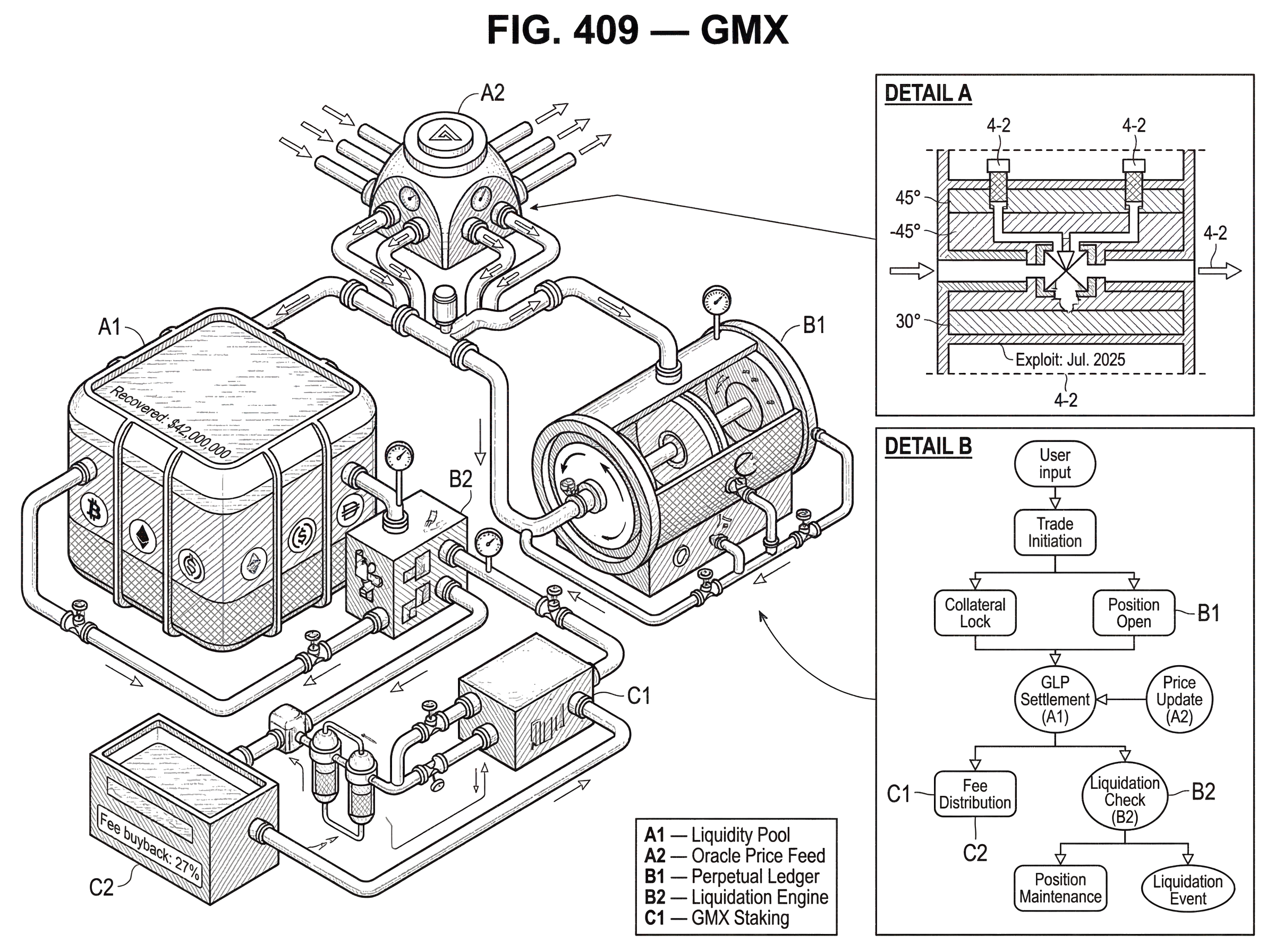
This became especially visible during the July 2025 GMX V1 Arbitrum exploit, discussed publicly in GMX governance channels. Official forum discussion says a live vulnerability in GMX V1 on Arbitrum allowed roughly $42 million of GLP value to be withdrawn, that the funds were later returned, and that the DAO then had to decide how to distribute recovered funds to affected users. GMX V1 on Arbitrum and Avalanche was paused, while GMX V2 was described as unaffected.
For a user trying to understand GMX, the lesson is broader than the incident itself. Decentralized exchanges do not eliminate operational decision-making; they expose it more openly. When something breaks, governance, security committees, bug bounty processes, and treasury policy become part of the user experience. GMX’s bug bounty on Immunefi also reflects that posture: the protocol maintains a formal reward program for vulnerabilities, with critical smart-contract rewards described as up to 10% of directly affected funds, capped at $5 million.
Who should use GMX versus a spot DEX or a centralized derivatives platform?
GMX makes the most sense for users who already understand what a perpetual is and want onchain access to directional trading. If someone only wants the cheapest route to swap one token for another, GMX is not the most natural starting point. Its design is built around exposure management, collateral, and leverage.
It also suits users who care about self-custody and onchain transparency but still want a trading experience closer to a dedicated derivatives venue than to a generic DEX aggregator. That said, “decentralized” should not be confused with “simple.” Users still need to understand collateral management, liquidation, chain selection, and protocol-specific risk. The fact that pricing is oracle-based and liquidity is pooled changes the shape of those risks; it does not make them disappear.
For longer-term participants, GMX can also appeal as a governance and fee-exposure asset through staking. But that audience should pay attention to the current state of rewards rather than assuming the tokenomics are operating exactly as they did historically.
Conclusion
GMX is best understood as an onchain perpetual exchange built around a simple but powerful idea: use shared protocol liquidity and oracle prices to make leveraged trading work without a traditional order book. That design is what gives it its appeal to self-custodied traders, and it is also what makes liquidity, governance, and risk management so central to the protocol.
If you remember one thing tomorrow, remember this: **GMX is not just a place to swap tokens onchain. It is a venue for trading exposure, and everything about the protocol (its pools, token, governance, and risks) follows from that fact. **
How do you trade through a DEX or DeFi market more effectively?
Trade through DEX and DeFi markets more effectively by prioritizing on-chain liquidity, execution options, and settlement costs. Cube Exchange lets you fund an account or deposit crypto, pick an execution path, and place orders while you monitor on-chain confirmations and fees.
- Fund your Cube account with fiat using the on-ramp or deposit a supported token (for example USDC) from your wallet.
- Open the market for the asset you want and review on-chain liquidity cues: quoted spread, recent 24h volume, and available depth at the top-of-book.
- Choose an execution method: use a limit order to control execution price or a market order for speed; for large fills split the size into several limit orders to reduce slippage.
- Check network and gas settings, set an appropriate slippage tolerance, verify the destination chain, and submit the order.
- After settlement, monitor on-chain confirmations and, if needed, adjust the position or withdraw funds.
Frequently Asked Questions
GMX separates price discovery (via external oracles) from trade settlement (against a shared liquidity pool), so execution isn’t routed through a constant‑product AMM curve that visibly worsens the quoted price as size grows. That “zero price impact” claim therefore means trades don’t move an on‑chain AMM quote, but users still pay fees, funding/borrowing costs, face liquidation risk, and remain dependent on oracle and protocol design.
Positions are ultimately underwritten by the protocol’s multi‑asset liquidity pool - liquidity providers (LPs) act as the counterparty base and therefore absorb market exposure and liquidation risk. This differs from a spot AMM where LPs mainly earn swap fees and manage inventory risk, because on GMX the pool also supports leveraged positions and associated liquidation flows.
Onchain perpetual trading is practical only where transactions are cheap and fast, so GMX runs primarily on L2/fast chains (notably Arbitrum and Avalanche). The protocol supports bridging (Arbitrum↔Avalanche via Stargate) and the docs note a seven‑day wait to bridge from Arbitrum to Ethereum, so chain choice affects usability, costs, and how quickly you can manage positions.
No - staking rewards are currently suspended. Bought‑back GMX is being accumulated in the treasury and will only be distributed to stakers once GMX reaches a stated threshold of $90 per token, per the token docs.
The protocol’s documentation forecasts a maximum supply of 13.25 million GMX, but it also states that any minting beyond that cap requires governance approval by tokenholders. The exact vote thresholds and precise conditions for additional minting are not specified in the available docs.
A vulnerability in GMX V1 on Arbitrum allowed roughly $42M of GLP value to be withdrawn in July 2025; the funds were later returned, V1 deployments were paused, and GMX V2 was described as unaffected. The incident illustrates that governance, security committees, bug bounties, and treasury decisions are central to how the protocol responds to incidents and protects users.
Because GMX uses oracle prices for marks and execution, its liquidation and valuation mechanics depend on the integrity and design of those feeds - so oracle failures or manipulation are a primary risk vector that looks different from an order‑book venue. The project’s security materials and bounty program also explicitly treat certain price‑feed/admin‑key scenarios differently, underscoring that oracle governance and admin privileges create special risk considerations.
GMX is best for users who already understand perpetual futures and want onchain, self‑custodied directional exposure with optional leverage; it is not primarily designed as the cheapest route for simple token swaps. It also fits liquidity providers seeking fee exposure and participants who are comfortable with active governance and protocol‑level risk decisions.
Related reading