What is Algorand?
Learn what Algorand is, how its Pure Proof-of-Stake consensus works, why it aims for fast finality, and what tradeoffs shape the network.
Introduction
For the token explainer, see ALGO.
Algorand is a blockchain network designed to answer a stubborn question in public-ledger design: *can a system be open to everyone, avoid the waste of proof-of-work, and still give users fast, reliable finality? * That question matters because many blockchains force a visible tradeoff. Some are open but slow to settle. Some settle quickly but rely on narrower validator sets. Some are robust but expensive in computation and energy. Algorand’s design is an attempt to change the mechanism rather than merely tune the parameters.
At a high level, Algorand presents itself as an efficient way to implement a public ledger; a tamper-resistant sequence of records that anyone can read and append to. The whitepaper frames it as a “money platform,” but the architectural ideas matter more broadly: who gets to propose the next block, how the network agrees on it, and how that agreement becomes hard to reverse. The central promise is not just speed. It is speed with finality: once a block is accepted, the protocol aims to avoid the familiar pattern where competing chains temporarily coexist and one later gets discarded.
The key idea that makes Algorand click is simple to state even if the engineering underneath is subtle: instead of having everyone race to win block production, the protocol secretly and randomly selects a very small set of participants, weighted by stake, to propose and certify each block. Those participants are chosen anew again and again, and the selection is designed to be unpredictable until the moment they speak. That changes both the cost structure and the attack surface.
To see why that matters, it helps to start with the problem any blockchain faces.
Why does a blockchain need agreement rather than just producing blocks?
| Mechanism | Finality | Latency | Resource cost | Fork risk | Best for |
|---|---|---|---|---|---|
| Proof-of-Work | Probabilistic finality | Minutes to hours | High energy cost | Reorgs possible | Permissionless censorship resistance |
| Algorand (PPoS) | Fast probabilistic finality | Seconds | Low computation | Vanishing probability of forks | Quick settlement, low cost |
A public ledger has two jobs that are easy to confuse. It must store transactions, but before it can store them, it must first solve agreement under mistrust. If Alice says a payment happened, Bob disputes it, and some network participants are offline or malicious, the system still needs one shared answer to the question: what is the next valid block?
In proof-of-work systems, the usual answer is a contest. Anyone may try to extend the chain by spending computation. The network treats the heaviest or longest valid chain as canonical. That mechanism works, but it creates a consequence that users feel directly: confirmation is not the same thing as finality. A block may look accepted, yet a competing branch can still appear. Waiting for more confirmations is really waiting for the probability of reversal to fall.
Algorand aims at a different target. Its academic specification says the protocol requires a negligible amount of computation compared with proof-of-work systems and produces a transaction history that will not fork with overwhelmingly high probability. That wording matters. The claim is not metaphysical certainty. It is a very strong probabilistic guarantee, grounded in the behavior of the consensus protocol.
So the practical goal is not “make blocks fast” in isolation. The goal is make agreement fast enough that the chain does not need to live with routine ambiguity. If the network can agree directly on a block instead of letting rival branches compete in public, then users and applications get a cleaner notion of settlement.
What is Algorand’s Pure Proof-of-Stake (PPoS)?
Algorand’s consensus model is known as Pure Proof-of-Stake, usually shortened to PPoS. The phrase can sound like branding, so it is worth reducing it to first principles.
“Proof-of-stake” means influence in consensus is tied to stake rather than to expended computation. In broad terms, if you hold more of the network’s native asset, you have a larger chance of being selected to help advance the chain. What makes Algorand’s version “pure” is the way it tries to preserve open participation while using stake to drive security. Rather than maintaining a small, fixed validator club, Algorand uses cryptographic selection to sample participants from the wider set of online stake.
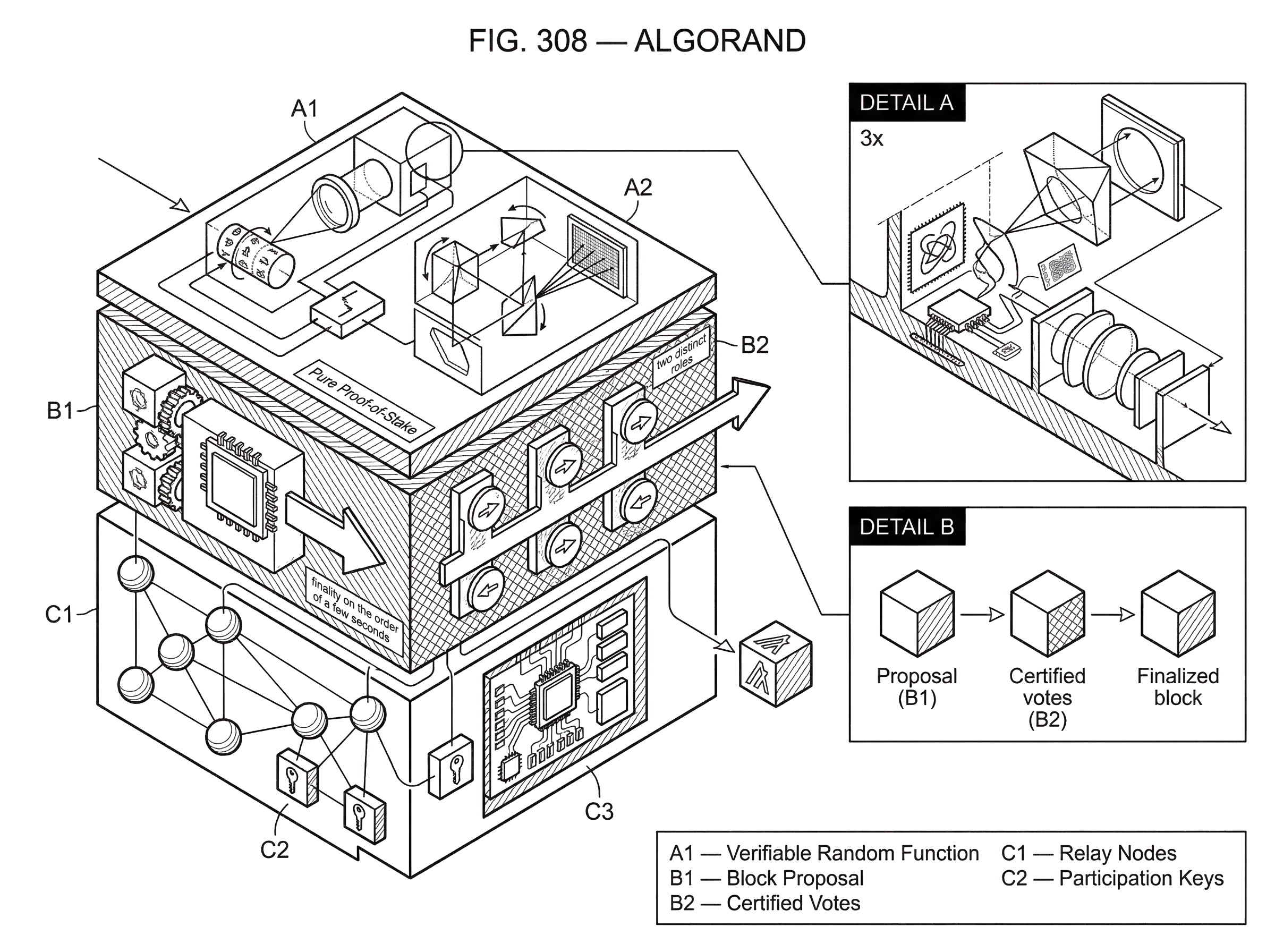
That selection uses verifiable random functions, or VRFs, together with cryptographic sortition. The intuition is this: every eligible participant can privately check, using cryptography, whether it has been chosen for a role in the next step of consensus. If it has, it can prove that fact to others when it broadcasts its message. If it has not, it stays silent. The rest of the network can verify the proof without having trusted the sender in advance.
This private-first selection is not a cosmetic detail. It is the mechanism that reduces attackability. In many systems, the next block producer or voting committee is known ahead of time, which gives adversaries a target. In Algorand, the protocol tries to keep the selected parties effectively hidden until they reveal themselves by acting. By then, the time available for an attacker to disrupt that specific round is much shorter.
That is the conceptual heart of Algorand: stake determines selection probability, randomness keeps selection unpredictable, and cryptographic proof makes the randomness publicly checkable.
How does Algorand reach consensus on a block?
Algorand’s whitepaper describes the protocol as based on a super-fast message-passing Byzantine agreement. That phrase comes from distributed systems. “Byzantine” means some participants may behave arbitrarily; lying, equivocating, or refusing to cooperate. “Agreement” means honest participants should still converge on the same result.
The easiest way to understand the process is as a repeated conversation with two distinct roles. First, the network needs a candidate block. Second, it needs a way to certify that candidate so everyone can move on.
Imagine a new round begins. Many transactions are waiting. Online participants use the protocol’s randomness mechanism to learn whether they have been selected. A very small selected party may get the right to propose a block. Separately, selected committees vote on whether a proposed block is the valid choice for that round. Because these committees are sampled from stake and are chosen freshly and unpredictably, the protocol does not need every account to send every consensus message. Most participants do nothing in most rounds. Security comes from the statistical properties of repeated random sampling, not from universal activity.
Now consider what happens when messages begin to flow. A proposer sends a candidate block together with the proof that it was legitimately selected. Committee members verify the proposal, evaluate validity, and send certified votes if appropriate. Other nodes check those proofs and tally the outcome according to the Byzantine agreement rules. If the selected committees contain enough honest stake (which is the assumption the protocol relies on) the network converges on one block and finalizes it.
The important contrast with Nakamoto-style longest-chain consensus is that fork resolution is not deferred to later chain growth. Agreement happens around the block itself. That is why Algorand emphasizes that accepted history should not fork except with overwhelmingly small probability.
A useful analogy is a series of randomly staffed juries. For each case, a new jury is quietly assembled from the population, chosen with odds proportional to stake. Only those selected know they are on that jury until they appear in court with cryptographic credentials. If most jurors are honest, they can reach a decision quickly. The analogy explains the role of small random committees and why advance targeting is harder. It fails, however, in one important respect: a human jury is slow, deliberative, and identity-based, whereas Algorand’s committees are ephemeral, algorithmically selected, and verified by proof rather than by institutional identity.
Why is Algorand’s consensus more efficient than proof-of-work?
The protocol’s efficiency follows from a simple mechanism: only a small fraction of participants need to communicate in each consensus step. In proof-of-work, security comes from aggregate computational expenditure. In Algorand, security is meant to come from honest stake being statistically well represented in selected committees. That changes what the network spends.
Instead of devoting large amounts of hardware and electricity to leader election, Algorand reduces leader election to cryptographic checks. Instead of having all nodes actively compete to produce the next block, it has nodes locally determine whether they were selected. The difference is structural. The network is not solving a puzzle whose difficulty must remain high. It is sampling from a stake distribution and then running agreement among those sampled parties.
This does not mean the protocol is “free.” Consensus still requires network communication, signature verification, online nodes, and enough connectivity for messages to propagate in time. But the dominant resource is no longer brute-force computation. That is why Algorand’s foundational materials stress negligible computation relative to proof-of-work.
The consequence for users is straightforward: if consensus is not bottlenecked by mining races, the protocol can aim for quick confirmation and more predictable settlement. Official material around participation and staking describes finality on the order of a few seconds, with rewards distributed as blocks finalize. The exact performance users observe depends on software, network conditions, and current protocol parameters, but the underlying design goal is clear: reach agreement directly, then move on.
How do you participate in Algorand consensus (nodes, keys, roles)?
| Node type | Primary role | Full ledger? | Consensus role | Connectivity | Risk if combined |
|---|---|---|---|---|---|
| Relay node | Route and propagate blocks | Yes (archival) | Usually not | High bandwidth, many peers | Can centralize routing |
| Non-relay participation node | Host participation keys | No (default) | Yes | Moderate bandwidth | Safer key isolation |
| Archival node | Store full history | Yes | Optional | High disk usage | High storage cost |
A common misunderstanding about proof-of-stake systems is that “holders” and “validators” are always cleanly separated. On Algorand, the reality is more operational. Consensus participation depends on accounts being online through nodes that hold participation keys. The developer documentation distinguishes ordinary network roles from consensus roles.
At the node level, Algorand has relay nodes and non-relay nodes. Relay nodes are primarily for routing communication. They accept incoming connections, talk to other relays, and distribute blocks onward. Non-relay nodes connect to relays and can participate in consensus. A participation node is not a wholly separate software type; it is a node currently hosting participation keys for one or more online accounts.
That distinction matters because many readers casually equate relays with validators. On Algorand, that is not the right mental model. The docs explicitly say relay nodes are communication infrastructure, while consensus participation comes from nodes with participation keys, and the project recommends that only non-relay nodes participate in consensus. In other words, message routing and block agreement are related but not identical jobs.
A concrete example makes this clearer. Suppose an institution wants to participate in consensus and also build an application that needs historical data. It might run a non-relay participation node to keep its participation keys online for consensus. It might separately run an archival node, which stores the full ledger history rather than only recent blocks. If it also wants to serve the wider network as a high-connectivity router, it could operate a relay; but the documentation warns against mixing relay operation with participation, because exposing a heavily connected routing node to consensus-key duties increases operational and security risk.
This is one place where Algorand becomes more nuanced than the slogan “everyone participates.” In principle, the protocol is designed for broad stake-based participation. In practice, online participation requires node operation, key management, and reliable connectivity. More recent staking materials also introduce reward eligibility thresholds for direct staking rewards, which affect who can profitably participate on their own versus through pooled or delegated arrangements.
Can Algorand run smart contracts and native assets?
| Contract type | State | Typical use | Resource limits | When to choose |
|---|---|---|---|---|
| LogicSig | Stateless | Smart-signature spending | Small opcode budget | Simple auth or multisig |
| Application | Stateful | On-chain apps and assets | Larger budget, state limits | Complex dApps and assets |
The original paper described Algorand as a money platform for concreteness, but the live network is not limited to simple transfers. Algorand supports smart contracts through the Algorand Virtual Machine, or AVM, and its low-level language TEAL.
The AVM is a bytecode-based stack interpreter. That sounds technical, but the important idea is simple: transactions can carry or invoke small programs that run inside the protocol’s execution environment. A program approves an action by finishing with a nonzero value on the stack. Algorand distinguishes LogicSig programs, which are stateless and behave like smart signatures, from Application programs, which are stateful smart contracts.
This matters because it changes what the chain can be used for. Instead of just recording balances, the network can enforce custom spending conditions, manage application state, and support more complex on-chain behavior. That is how a chain originally framed as a money platform grows into a broader application platform.
But here the design choice is visible again: the AVM is not an unconstrained general-purpose computer. Programs operate under resource limits, opcode budgets, and explicit rules about which blockchain resources they may access. Those constraints are not incidental. They exist because deterministic execution inside consensus must remain bounded and predictable. The consequence is a more tightly controlled execution model than some developers expect coming from other smart-contract ecosystems.
How does Algorand’s network topology affect performance and decentralization?
Consensus protocols are often discussed as if they float above networking. They do not. A fast agreement protocol still depends on message delivery. Algorand’s node architecture reflects that reality.
Official docs describe relay-based bootstrapping and peer management. In the relay network path, nodes can discover relays through DNS service records and connect through a phonebook-like mechanism. Relay nodes are archival and require substantially more compute and bandwidth than ordinary non-relay nodes. Operational guides also note that configuring a node as a relay means making it listen for incoming connections and, in broader deployments, advertising it so others can find it.
This architecture helps propagation, but it introduces a familiar systems tradeoff. High-connectivity routing hubs can improve performance by reducing the number of network hops between ordinary nodes. At the same time, hub-like structures can make a network less decentralized at the network-topology level. Research on relay-heavy blockchain networks, though not specific to Algorand alone, finds exactly this tension: relay infrastructure can improve propagation speed while reducing some measures of decentralization.
That does not prove Algorand is “centralized” in any simplistic sense. It means decentralization is multi-layered. There is stake distribution, consensus selection, software control, governance, and also network topology. A system can be open in one dimension and more concentrated in another. For Algorand, readers should keep both truths in view: relay infrastructure can be useful for performance, and concentrated routing infrastructure can still be a meaningful dependency.
How do governance and rewards work on Algorand?
No blockchain design is only technical. Once a network is live, incentives and change processes shape how it evolves.
Algorand has an official governance platform and an ARC process (Algorand Requests for Comments) for proposing standards and changes. The ARC repository explicitly distinguishes mature proposals from drafts and points readers to the public ARC site for status. That tells you something important about the ecosystem: protocol evolution is not just code shipped by a single team; it is also a process of proposal, review, and adoption.
The economic side has also evolved. Official staking material describes rewards for accounts that actively contribute to consensus by bringing stake online. The same material says Algorand’s staking does not use slashing in the way many proof-of-stake networks do. Instead, ineffective nodes can be removed from consensus eligibility and miss rewards rather than lose principal. It also says staked tokens remain in the user’s wallet rather than being locked up in the conventional sense.
Those choices affect participant behavior. No slashing lowers one class of downside risk, which may make participation operationally simpler for some users. But it also means the system relies more heavily on selection design, liveness assumptions, and reward incentives rather than on punitive confiscation to discipline validators. Whether that is preferable depends on what failure mode you care most about.
What assumptions must hold for Algorand’s security guarantees?
The strongest way to understand Algorand is not to ask what it promises, but what must be true for those promises to hold.
First, the protocol assumes an honest majority in the relevant stake sense. Random committee selection only helps if the sampled committees are, with high probability, dominated by honest participants rather than adversarial ones. If stake becomes too concentrated in hostile hands, the security story changes.
Second, the protocol depends on network conditions good enough for Byzantine agreement to complete. Fast finality does not emerge from cryptography alone. Messages still need to reach the selected parties and be relayed across the network quickly enough for the round structure to work as intended.
Third, the practical accessibility of participation is not the same as theoretical openness. If running reliable participation infrastructure is too operationally demanding, then many users will rely on intermediaries, and effective influence may concentrate even if the protocol itself is formally open. Reward thresholds and node requirements matter here.
Fourth, non-forking is a probabilistic property, not an absolute law of nature. The whitepaper’s phrasing (“overwhelmingly high probability”) is exactly the right kind of caution. It means the protocol aims to make forks so unlikely that users can treat finality as immediate for practical purposes, while still being honest that all real distributed systems live inside models and assumptions.
Why was Algorand created and what problem does it solve?
Algorand exists because earlier public-ledger designs left an uncomfortable gap. They showed that decentralized digital ledgers were possible, but they often made users choose between open participation, low resource consumption, and quick finality. Algorand’s answer is to redesign consensus around private random selection plus Byzantine agreement.
That design leads to the network’s defining character. Blocks are not supposed to emerge from open-ended races. They are supposed to emerge from small, stake-weighted committees that are chosen unpredictably, prove their legitimacy cryptographically, and converge on a result quickly. From that mechanism flow the network’s main promises: low computation compared with proof-of-work, short settlement times, and a history that should not fork except with vanishing probability.
The lasting way to remember Algorand is this: it is a blockchain built on the idea that randomness can be used not just for fairness, but for defense. By hiding who matters until the moment they act, the protocol tries to make agreement both cheaper and harder to disrupt. Everything else (finality, efficiency, participation, and the tradeoffs around infrastructure) follows from that core choice.
How do you buy Algorand?
To buy Algorand (ALGO) on Cube Exchange, fund your Cube account with fiat or a supported stablecoin, then open the ALGO spot market and place an order. Use a market order for immediate execution or a limit order to control price and reduce slippage; Cube supports common ALGO spot pairs such as ALGO/USDC or ALGO/USD.
- Deposit USD via the fiat on-ramp or transfer USDC/USDT to your Cube account.
- Open the ALGO/USDC or ALGO/USD spot market on Cube Exchange.
- Choose an order type: market for immediate fill or limit to set the execution price and avoid slippage.
- Enter the ALGO amount (or USD to spend), review the estimated fill and fees, and submit the order.
Frequently Asked Questions
Algorand uses private, stake-weighted selection via verifiable random functions (VRFs) and cryptographic sortition so only the selected participants learn they were chosen until they broadcast a proof; that unpredictability makes it much harder for attackers to target proposers or committee members before they act.
Finality in Algorand is probabilistic: the protocol aims for a transaction history that will not fork except with overwhelmingly high probability, so users can treat confirmed blocks as final in practice but not as absolute mathematical certainties; these guarantees also depend on honest-stake assumptions and timely message delivery.
The security claims rely on several assumptions: a sufficient fraction of honest stake so sampled committees are honest-majority with high probability, network conditions good enough for the Byzantine agreement rounds to complete, and practical accessibility of participation infrastructure so stake is actually online; non-forking is therefore probabilistic and model-dependent.
Relay nodes are meant for routing and high-connectivity propagation, while consensus requires nodes hosting participation keys; the documentation warns that combining relay duties with participation (relay+participation) is insecure and strongly discouraged because it increases operational and security risk.
Unlike proof-of-work, which secures the chain via extensive external computation, Algorand’s Pure Proof-of-Stake reduces computational cost by privately sampling small, stake-weighted committees and running a message-passing Byzantine agreement among them, so the dominant resource is online availability and message propagation rather than brute-force hashing.
Algorand’s staking design does not use slashing in the typical PoS sense: ineffective nodes can be removed from eligibility and miss rewards rather than lose principal, staked tokens remain in the user’s wallet rather than being conventionally locked, and the network has community-set eligibility thresholds (for example, a 30,000 ALGO minimum for direct reward eligibility was set by governance).
To participate you need accounts with participation keys hosted on online participation nodes, reliable connectivity so messages can be received and relayed in round time limits, and operational practices that typically separate archival, relay, and participation duties; reward eligibility also depends on bringing stake online and meeting any governance thresholds.
Using relays or other high-connectivity routing infrastructure improves block and message propagation but can concentrate network-topology roles, so while relays boost performance they introduce a trade-off by creating a meaningful dependency that can reduce decentralization at the networking layer even if stake-based participation remains distributed.
Related reading