What is SushiSwap?
Learn what SushiSwap is, how its decentralized exchange works, and why its multi-chain routing and cross-chain tools matter for crypto users.
Introduction
SushiSwap is a decentralized exchange, or DEX, built for people who want to trade crypto assets directly from their wallets rather than through a centralized platform. The reason it matters is not just that it lets users Swap tokens. It is that Sushi has grown into a broader onchain trading system: a user-facing swap interface, routing logic that looks for usable liquidity, and cross-chain tooling that tries to reduce the friction of moving between networks.
That combination solves a specific problem. Crypto liquidity is fragmented. A trader may hold assets on one chain, want a token on another, and face a maze of pools, bridges, approvals, and wallet network changes. Sushi’s product direction is to compress that complexity into a single interface. You still interact with blockchains and smart contracts, but the product tries to make the path from “I have this asset” to “I want that asset” shorter and more legible.
Sushi is also a useful example of how DeFi products evolve. It began as a fork of Uniswap with added token incentives for liquidity providers, then expanded into a multi-chain exchange experience with routing infrastructure and cross-chain swapping. If you understand Sushi, you understand a large part of what modern DEXs are trying to become.
How does a DEX let me swap tokens without a centralized intermediary?
| Model | Custody | Liquidity access | Fees & speed | Best for |
|---|---|---|---|---|
| Decentralized exchange (DEX) | User keeps private keys | Access to onchain pools | Onchain fees; variable speed | Wallet-native traders, long‑tail tokens |
| Centralized exchange (CEX) | Custody held by platform | Aggregated offchain liquidity | Platform fees; faster execution | Casual traders, fiat on/off ramps |
At the user level, Sushi feels simple: connect a wallet, choose the token you want to sell, choose the token you want to buy, review the route, and confirm an onchain transaction. But the simplicity hides the real mechanism. There is no central order book operator matching buyers and sellers behind the scenes in the way a traditional exchange does. Instead, Sushi routes your trade through smart contracts and available liquidity pools.
The core promise of a DEX is self-custody during trading. Your assets stay in your wallet until you approve a transaction. The trade settles onchain, and the network you are using enforces the result. For users who care about holding their own assets, accessing long-tail tokens, or trading across many blockchain ecosystems, this is the feature that matters most.
That also explains who Sushi is for. It is designed for crypto users who are comfortable with wallets and onchain transactions: traders moving between tokens, liquidity providers looking to put idle assets to work, and developers integrating swap functionality into apps. The official Sushi docs are not just a consumer help center; they also point directly to developer tools, an npm package installable with npm install sushi, GitHub repositories, and code examples. That tells you Sushi is meant to be both a product and a piece of infrastructure.
How does SushiSwap route and execute a token swap in practice?
| Route type | Liquidity source | Typical slippage | Complexity | When used |
|---|---|---|---|---|
| Direct pool | Single pool between pair | Low when deep | Simple | Common token pairs |
| Multi‑hop | Intermediate pools via asset | Moderate | Medium | Pairs lacking direct liquidity |
| Aggregated route | Multiple liquidity sources | Lower via optimization | Higher | Optimize price across pools |
| Cross‑chain (SushiXSwap) | Bridges and providers | Variable; extra fees | Highest | Move assets across chains |
The easiest way to understand Sushi is to follow a trade from the user’s point of view. Suppose you are on Ethereum and want to swap one token for another. You open Sushi’s swap interface, which has chain-specific routes such as its Ethereum swap page, connect your wallet, and enter the asset pair. Before anything executes, the interface has to determine whether there is enough liquidity, what route is available, and what output estimate is plausible.
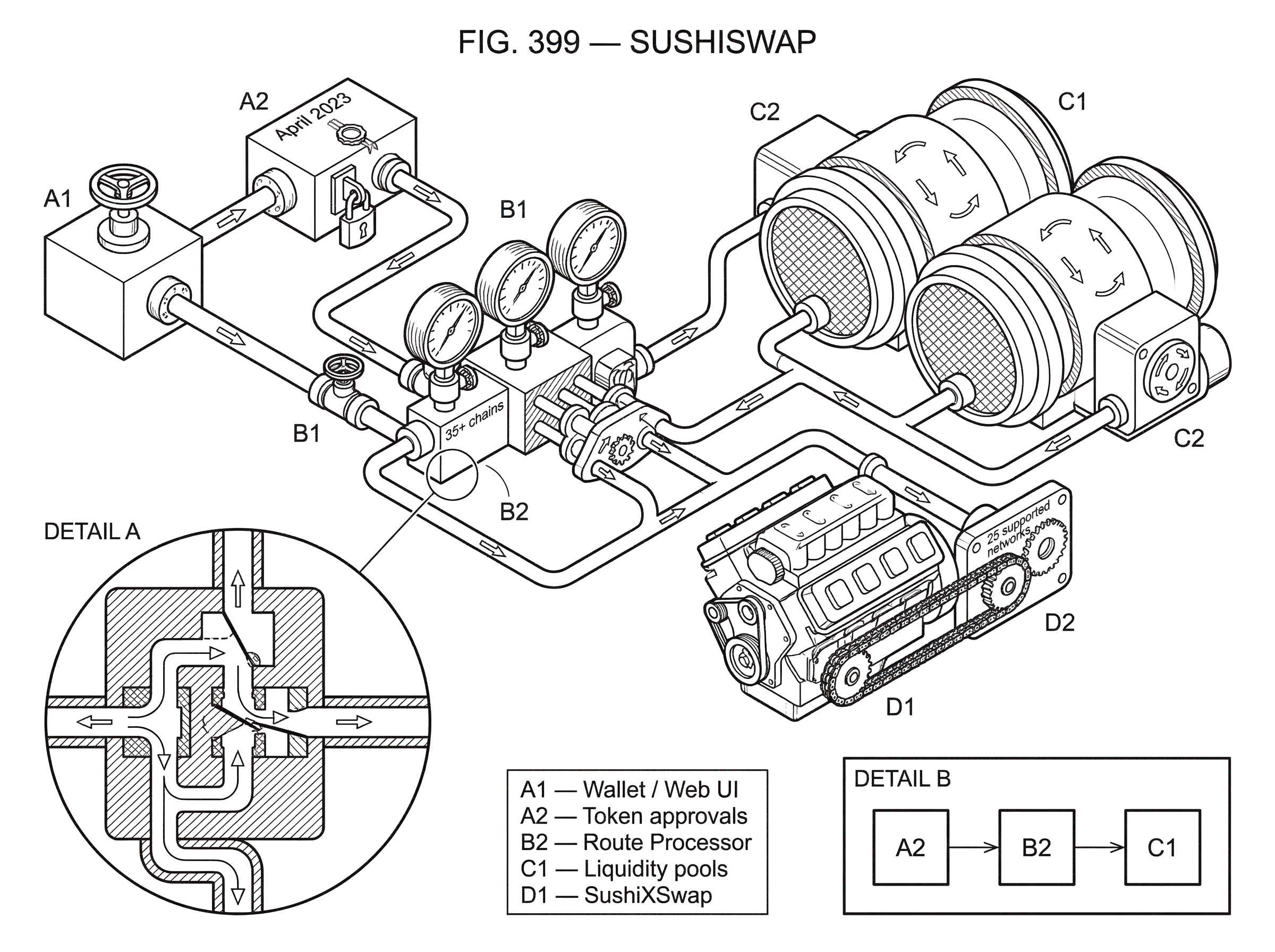
This routing step is where a modern DEX becomes more than “just a pool.” In principle, the best path from token A to token B may not be a direct pool. It might go through an intermediate asset, or rely on different liquidity sources assembled into a route. Sushi’s product materials refer to a Route Processor, which it positions as part of how users access strong asset inventory and pricing across many chains. The exact routing logic is implementation-specific, but the user-facing point is clear: the interface is trying to find a practical path through fragmented liquidity rather than forcing the user to discover that path manually.
Once the route is selected, the blockchain still needs permission to move the input token from your wallet. That usually means first granting an approval and then submitting the swap transaction itself. This is one of the least intuitive parts of DEX use, because approvals are not the trade; they are permission for a contract to spend a token on your behalf up to some limit. The mechanism is powerful because it enables smart-contract-based trading. It is also risky if approvals are granted too broadly or to flawed contracts.
That risk is not abstract for Sushi. In April 2023, reporting around an exploit involving the RouterProcessor2 contract described an approval-related bug and a significant loss. The most important lesson for users is not the incident timeline itself, but the underlying structure: DEX convenience often depends on token approvals, and approvals create a standing permission surface. That is why experienced users pay attention not only to price impact and slippage, but also to what contract they are approving and whether they later revoke stale permissions.
Why did SushiSwap expand to multiple chains and what does that change?
| Approach | Scope | User friction | Dependencies | Best for |
|---|---|---|---|---|
| Single‑chain DEX | One blockchain only | Lower | Fewer external providers | Chain‑specific traders |
| Multi‑chain DEX (UI) | Many chains in one interface | Moderate | Network RPCs and indexing | Users switching networks often |
| Cross‑chain swap (SushiXSwap) | End‑to‑end across chains | Lowest operationally | Bridges, aggregators, providers | Users wanting chain completion |
A DEX on one chain is useful. A DEX spread across many chains is solving a different class of problem. Liquidity, users, and assets are no longer concentrated in one place, so a product that wants to remain useful has to meet them where they are. Sushi’s own product announcements describe a Network Selector designed to make swapping across 35+ chains easier, with quick switching and chain search built into the interface.
This matters because network choice is not cosmetic. Each chain has its own assets, gas costs, execution environment, and local liquidity conditions. A trader who moves between Ethereum, Arbitrum, Base, Polygon, or other networks is not just changing screens; they are entering distinct markets. Sushi’s chain-aware interface is meant to reduce the operational friction of doing that repeatedly.
There is a second layer beyond multi-chain swapping: cross-chain swapping. Sushi’s SushiXSwap product is aimed at users who do not merely want to trade on a chosen chain, but want to end up on a different chain entirely without manually bridging first. Sushi says SushiXSwap launched to remove the need for separate bridging or wrapping flows, and more recently expanded to 25 supported networks while leveraging LiFi’s aggregation stack for route selection.
Here the trade-off becomes especially clear. The product is more convenient because the user no longer has to think in separate stages; bridge, wait, switch networks, then swap. But the mechanism is necessarily more layered. cross-chain execution depends on external bridges or providers, route optimization choices such as Fastest Route versus Best Return, and additional fees on top of ordinary onchain costs. Sushi explicitly says SushiXSwap transactions include a standardized UI fee. So the convenience is real, but it is not free, and it adds dependence on third-party systems.
How did liquidity incentives and Sushi’s early history shape the protocol?
Sushi is easier to understand if you know why it became prominent in the first place. Historically, Sushi launched as a fork of Uniswap and differentiated itself by adding token incentives for liquidity providers. The basic economic idea was straightforward: if a DEX needs liquidity to be useful, then it can attract liquidity by rewarding the people who deposit assets into its pools.
That incentive layer helped Sushi grow quickly, especially during its early “vampire attack” period, when it used unusually strong rewards to draw liquidity away from Uniswap and planned to migrate that liquidity into Sushi’s own system. The tactic worked in the sense that it attracted attention and capital. But it also revealed an important truth about DeFi: liquidity can be highly mobile when incentives change.
Sushi’s early history also exposed governance and trust risks. The controversy around founder Chef Nomi, token sales, and the emergency transfer of control became one of the defining episodes of early DeFi. That history matters because it shows the difference between the idea of decentralization and the process of achieving it. A protocol can market itself as decentralized while still depending heavily on privileged actors, upgrade controls, and community trust during its early stages.
That does not make Sushi unique; it makes Sushi representative. Many DeFi systems are best understood as moving targets: progressively decentralized, increasingly multi-signature-controlled, and always balancing speed of development against operational safety.
How can developers integrate SushiSwap and what risks should they consider?
Sushi is not only for end users clicking through a web app. Its official docs and repositories make clear that the team also treats it as a developer platform. There is an installable package, public source code, examples, a TypeScript-heavy monorepo for the main interface, and separate repositories for components like subgraphs and MasterChef contracts.
For developers, this changes what Sushi is. It is not merely “a website where swaps happen.” It is a stack of contracts, routing logic, indexing systems, and interface code that can be queried, extended, or integrated. The subgraphs repository, for example, covers indexing for multiple Sushi components across many chains, which is what makes analytics, historical data, and app integrations practical. Without indexing, onchain data is available but awkward; with indexing, it becomes usable.
At the same time, the repositories make the usual DeFi caveat impossible to ignore. The code is provided as is, and parts of the ecosystem carry explicit warnings or risk disclaimers. Even when interfaces are polished, the underlying reality is still open financial software interacting with volatile markets and adversarial environments. Developers and power users are expected to bring their own judgment.
When should you use SushiSwap instead of a centralized exchange?
The most helpful way to think about Sushi is this: it is a system for turning fragmented onchain liquidity into a usable trading experience. If you are a casual crypto holder who only wants a few large, highly liquid assets and prefers customer support, a centralized exchange may feel simpler. But if you want wallet-native trading, access to many chains, onchain execution, and in some cases cross-chain completion from one interface, Sushi is built for that world.
Its usefulness comes from reducing coordination work. The user does not need to discover every pool, calculate every route, or manually stitch together every chain hop. Sushi tries to do that orchestration in the interface and routing layer. The price of that convenience is that users still bear the underlying realities of DeFi: wallet security, gas fees, slippage, approval management, smart contract risk, bridge or provider dependence in cross-chain flows, and the possibility that the best route is not the cheapest-looking route at first glance.
Conclusion
SushiSwap is best understood not as a single exchange contract, but as a multi-chain trading and routing system built around self-custodied crypto trading. It started as an incentive-driven Uniswap fork, then expanded into a broader product for onchain swaps, route optimization, and cross-chain asset movement.
If you remember one thing, remember this: Sushi’s job is to make fragmented liquidity feel like one market, even though under the surface it is spread across pools, contracts, and chains. That is what makes it useful; and that is also where most of its complexity comes from.
How do you trade through a DEX or DeFi market more effectively?
Trade through a DEX effectively by checking liquidity, choosing the right execution type, and sequencing approvals and confirmations. Cube Exchange combines funding and market access so you can execute swaps with explicit order controls and slippage settings in a single workflow.
- Fund your Cube account with fiat via the on-ramp or transfer a supported crypto (for example, deposit USDC to avoid extra wrapping).
- Open the Cube market or swap flow for the token pair and select the correct network; if the pair requires multiple hops, confirm the shown route and estimated output.
- Choose an execution mode: use a limit order for price control on thin or multi-hop pairs, or a market order for immediacy; set slippage tolerance (e.g., 0.5–1% for liquid pairs, higher for low‑liquidity tokens) and an execution deadline.
- Submit the trade and monitor the on‑chain confirmation; if you granted token approvals for the trade, revoke any broad allowances after completion using your wallet.
Frequently Asked Questions
Sushi’s Route Processor searches across available liquidity pools and intermediate assets to assemble a practical path from your input token to your desired output, so a swap may go through one or more hops rather than a single direct pool; the article notes the exact routing logic is implementation‑specific rather than a single disclosed formula.
Multi‑chain swapping refers to Sushi providing swap interfaces and liquidity access on many individual networks (you pick or switch the network), whereas cross-chain swapping (SushiXSwap) aims to complete a trade that starts on one chain and finishes on another in a single flow without you manually bridging first.
Token approvals let a contract move your tokens on your behalf and thus create a standing permission surface; the April 2023 RouterProcessor2 incident exploited an approval‑related bug leading to a large loss, which illustrates why users should check what contracts they approve and consider revoking stale approvals.
SushiXSwap now leverages LiFi’s aggregation stack and multiple third‑party bridges/providers to pick cross‑chain routes and offers options like “Fastest Route” versus “Best Return,” but that convenience comes with additional provider fees and dependence on external systems rather than purely on‑chain execution.
Sushi has moved from a founder‑led project toward more distributed controls over time, but its early episode with Chef Nomi and emergency interventions shows protocols can depend on privileged actors during transition, so full decentralization is a process rather than an immediate, absolute state.
Sushi publishes developer tools, packages, and repositories to enable integrations, but several repos include explicit warnings that code is provided “as is” and may not be a drop‑in production artifact, so developers should treat the public code and examples as starting points and perform their own audits and testing.
Sushi advertises support across “35+ chains” and a network selector to make switching easier, but the public announcements and docs do not list every supported chain or fully explain how one‑click network switching interacts with all wallets, so the exact chain roster and wallet UX behavior are not enumerated in the cited sources.
After the April 2023 exploit Sushi publicly promised to reimburse affected users, but contemporaneous reviews and reporting indicated reimbursement was not yet completed as of the cited dates, so whether and when users are made whole remains uncertain in those sources.
Related reading