What is Social Recovery?
Learn what social recovery is, how guardian-based and threshold wallet recovery work, why smart accounts enable it, and where the security tradeoffs lie.
Introduction
Social recovery is a way to regain control of a wallet without relying on a single backup secret such as a seed phrase. The idea sounds almost contradictory at first: crypto wallets are built around strict control of keys, so how can you recover access without weakening ownership? The answer is that social recovery does not remove security rules. It replaces one brittle rule (one secret controls everything) with a programmable recovery policy that can require approval from several trusted parties, devices, or verification methods.
That shift matters because self-custody has a basic tension at its core. If only you can control the wallet, then losing your key can mean irreversible loss. But if someone else can reset the wallet too easily, then ownership was never really under your control. Social recovery exists to sit in the narrow space between those two failures. It tries to make loss recoverable without making theft easy.
In practice, social recovery is most often implemented in smart-contract wallets or smart accounts, because an ordinary externally owned account cannot change its own authorization rules. A simple account controlled by one private key has no native place to encode ideas like “if 3 of 5 guardians approve after a 7-day delay, replace the signer.” A programmable account does.
That is the core click: social recovery is not a backup file; it is a recovery rule. Once that distinction is clear, the rest of the design starts to make sense.
Why is a single seed phrase risky for self‑custody?
A seed phrase is simple in one important sense: it concentrates control into a single object. Whoever has the phrase can usually restore the wallet. That simplicity is powerful, but it is also fragile. The system gives you full sovereignty only by making you fully responsible for storing one piece of information correctly, privately, and durably.
This creates a harsh symmetry. A seed phrase is excellent at preventing ambiguity, because there is no committee deciding who the real owner is. But the same design makes accidental loss catastrophic. Fire, device failure, forgotten backups, phishing, or simple disorganization can all turn “self-custody” into “permanent inaccessibility.” Social recovery starts from the observation that this is not just a user-interface inconvenience. It is a structural problem in how control is represented.
Instead of asking the user to preserve one irreplaceable secret forever, social recovery spreads recovery authority across multiple factors. Those factors might be friends acting as guardians, hardware devices, secondary wallets, passkeys, email-based verifiers, or threshold key shares. The point is not that any single factor is especially strong. The point is that the wallet can require a meaningful combination of them.
This changes the failure model. With a seed phrase, losing the phrase ends the story. With social recovery, losing one device or forgetting one credential does not have to be fatal, because the recovery policy can still be satisfied another way. But the design also changes the attack model. An attacker no longer needs the original key if they can satisfy the recovery policy instead. So the security of the wallet becomes the security of the entire recovery process, not just the secrecy of one key.
How does social recovery let a wallet change its signer?
A social-recovery wallet usually works by separating two questions that a simple wallet treats as the same thing. The first question is, who can spend right now? The second is, who can change who spends right now if the main controller is lost? In a basic single-key wallet, the answer to both is the same private key. In a social-recovery wallet, those can be different powers with different conditions.
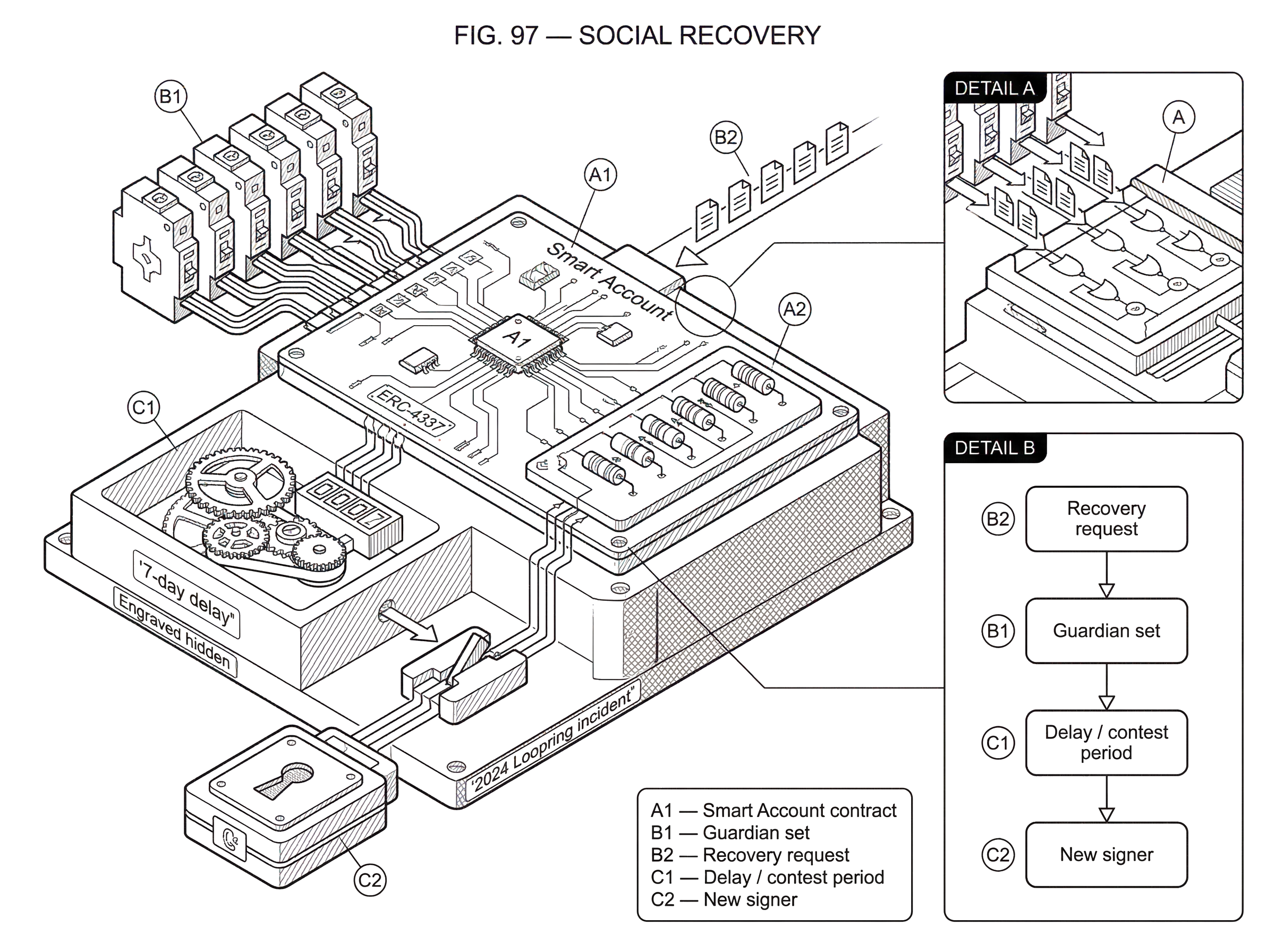
Imagine a smart account whose normal signer is your phone. Day to day, that phone authorizes payments. But the account also stores a recovery policy saying that if enough guardians approve a recovery request, then after a delay the wallet may replace the phone’s key with a new one. Your guardians cannot necessarily spend your funds directly. Their special power is to change the wallet’s authorized signer under a constrained process.
That distinction is why social recovery is fundamentally a governance mechanism over wallet control. The recovery actors are not just holding copies of your secret. Often they never see the main key at all. Instead, they participate in an on-chain or off-chain process that tells the wallet, “the old signer should be replaced.”
This is also why smart accounts matter. Under standards such as ERC-4337, the account’s authorization logic lives inside the account contract, typically in validateUserOp. The standard explicitly allows accounts to use different signature schemes, multisig, and custom recovery logic. In other words, the wallet itself can decide what counts as valid authorization, including a social-recovery flow. The EntryPoint contract calls that validation logic before execution, so a recovery policy can be enforced on-chain as part of normal account behavior.
Here is the mechanism in plain language: the account stores some policy, someone submits a recovery request, the wallet verifies that enough approved entities have authorized it, and then the wallet updates its signer set or ownership after any required waiting period. Recovery is therefore not a magical override. It is a state transition that the wallet was designed in advance to permit.
How does guardian‑based social recovery work (step‑by‑step)?
Suppose Maya uses a smart wallet and chooses five guardians: her laptop wallet, her partner’s wallet, her brother’s wallet, and two close friends. Her policy says that any three guardians can approve replacing her main signing key, but only after a 7-day delay.
Months later, Maya loses the phone that held her everyday wallet key. She installs the wallet app on a new device and generates a new key. The recovery process begins by creating a recovery request that says, in effect, “change this wallet’s signer from the lost key to this new key.” That request is not yet effective. It is just a proposal.
Three of Maya’s guardians approve it. Depending on the wallet design, they may sign a typed message, submit approvals on-chain, or interact through a wallet-specific recovery interface. The wallet verifies that these approvals really came from recognized guardians and that the threshold has been met. In standards-oriented designs such as ERC-7093, this verification can be modular: an Identity can represent a normal blockchain account or a non-account identity type, and a PermissionVerifier can validate the proof for that identity. A RecoveryPolicyVerifier can then decide whether the collected permissions satisfy the configured policy.
If the policy succeeds, the wallet does not necessarily switch control immediately. Many systems insert a delay. Safe’s recovery design, for example, uses a delayed-execution module so that a recovery proposal is posted first and executed only after the delay expires. That delay gives existing signers time to cancel a malicious recovery if the original owner still has access. In ERC-4337-style smart accounts, time-bounded validity can also be expressed through validation windows such as validAfter and validUntil, which can support delayed or time-limited recovery actions.
After the waiting period, the recovery is executed and Maya’s new device becomes the controlling signer. No seed phrase had to be found. No central operator had to be trusted with unilateral reset power. And no guardian had to know Maya’s main key.
That is the appeal of social recovery in its cleanest form: recoverability without key duplication.
What are the different types of social recovery designs?
| Type | Mechanism | Restores | Best when | Main tradeoff |
|---|---|---|---|---|
| Guardian-based | Guardians approve signer change | No key reconstruction | Programmable smart accounts | Relies on guardian independence |
| Threshold secret | Split key shares reconstruct secret | Rebuilds original private key | When key material must be recovered | Custodian availability and leakage risk |
| Auth-factor hybrid | Combine device/login/auth factors | Reconstructs or resets access | Onboarding without seed phrases | Depends on auth providers |
The phrase “social recovery” covers several designs that solve the same problem in different ways. What unifies them is not the exact cryptography or user experience. It is the principle that recovery depends on a distributed set of approvals or shares rather than one master backup.
One family of designs is guardian-based account recovery. This is the model most associated with smart-contract wallets. Guardians approve changing the account’s authorized signer or signer set. The secret never needs to be reconstructed; the account simply updates who controls it. Argent-style systems and Safe’s recovery modules fit this pattern, even though their exact verification flows and operational details differ.
Another family is threshold secret recovery. Here the key itself is split into shares, and some threshold of shares can reconstruct it. Dark Crystal is an example of a protocol built around this idea: a secret is divided into encrypted shards held by custodians, and enough custodians can later help restore it if the owner loses access. This is still social recovery, but mechanically it is different. Instead of changing the wallet’s authorization rules, it reconstructs the missing secret.
A third family mixes social recovery with modern authentication factors.
Systems such as Torus/Web3Auth’s tKey present recovery as combining multiple factors where any sufficient subset can reconstruct access.
- for example a device share
- a login-based factor
- a user-held input
This still distributes risk, but it shifts some of the “social” element away from human guardians and toward recoverable authentication infrastructure.
These approaches solve adjacent problems with different assumptions. Guardian-based recovery is natural when the account is programmable. Secret-sharing recovery is natural when the key material itself must be restored. Hybrid systems are often optimized for onboarding users who do not want seed phrases at all.
Why do standards like ERC‑4337 and ERC‑7093 matter for social recovery?
| Standard | Scope | Enables | Guardian types | Key risk |
|---|---|---|---|---|
| ERC-4337 | Account abstraction | Custom auth & recovery logic | On-chain accounts, multisig | EntryPoint central trust |
| ERC-7093 | Recovery interface | Pluggable identity & policy verifiers | Passkeys, email, NFTs, EOAs | External verifier complexity |
| Proprietary wallets | Wallet-specific flows | Custom UX and ops | Wallet-hosted guardians | Fragmentation and single points |
For a long time, social recovery lived mostly in custom wallet implementations. That made the idea powerful but fragmented. Each wallet could invent its own recovery logic, guardian representation, delays, and verification process. The downside was obvious: limited interoperability, inconsistent security review, and difficulty reasoning about how recovery should work across ecosystems.
This is where standards begin to matter. ERC-4337 matters because it gives smart accounts a standard way to plug in custom authorization and recovery logic without requiring a consensus-layer protocol change. Recovery can be encoded in the account’s own validation path, using UserOperations processed through the EntryPoint. It also supports counterfactual deployment via factories and initCode, which matters because a user can prepare a smart wallet and its recovery configuration before the account is even deployed on-chain.
ERC-7093 matters because it tries to standardize the social-recovery interface itself. Its most important design choice is separation: it distinguishes identity verification from policy verification. That sounds abstract, but it solves a concrete problem. A guardian does not have to be just an Ethereum address. A guardian could be an on-chain account, a passkey, an email-backed verifier, a DKIM proof, an NFT-based identity, or some future proof system. Once guardian identity is decoupled from policy, wallets can support more kinds of guardians without rewriting the whole recovery mechanism.
This modularity is useful, but it also shifts complexity into the verifier layer. A wallet is no longer just asking, “did this address sign?” It may be asking an external verifier contract whether a nontraditional proof is valid. That expands flexibility, yet also expands the implementation surface that must be secured.
Who can change a social‑recovery wallet and what defenses should be used?
The easiest mistake when thinking about social recovery is to see it as purely a usability feature. It is a security feature too; but only if the recovery path is carefully harder to abuse than the normal path is to lose.
There are three main levers in the design. The first is who counts toward recovery. If your guardians are all your own devices, then recovery may be available but not very resilient to correlated loss. If they are all controlled by one company, then you may have recreated custodial dependence. If they are close contacts who all know each other and can be socially engineered together, the threshold may be weaker than it appears.
The second lever is how many approvals are required. A threshold that is too low makes takeover easier; a threshold that is too high makes genuine recovery fail when people are unavailable. The right number is not universal. It depends on how independent the guardians really are. A 2-of-3 threshold across three devices all linked to the same cloud account is not as strong as 2-of-3 across independent people or institutions.
The third lever is what delay or contest period exists. Delays are not cosmetic. They are one of the main mechanisms that distinguish recovery from theft. If a malicious actor starts a recovery while the real owner still has some access, a delay gives the owner time to cancel it. This is why Safe’s recovery module emphasizes a proposal followed by delayed execution, and why time-window fields in ERC-4337 validation are relevant to recovery design.
A useful way to think about this is that social recovery trades off two kinds of risk. Without it, the dominant risk is permanent loss from key disappearance. With it, some of that risk moves into malicious or mistaken recovery. The wallet is safer only if the reduction in loss risk is worth more than the increase in recovery-path attack surface.
What are the main failure modes of social recovery?
The sharpest failures in social recovery come from violating its own reason for existing: distributing trust. If a recovery design quietly collapses back to one decisive service, then the user has not really escaped the single point of failure.
That lesson appeared starkly in analysis of the 2024 Loopring incident. Loopring’s guardian system was meant to let trusted guardians lock or restore access, and users could rely on an Official Guardian service protected by two-factor authentication. The reported problem was that attackers bypassed the Official Guardian’s authentication and targeted users who relied solely on that service. In effect, a system marketed as socially recoverable became vulnerable because many users had placed majority recovery power in one centralized component. The design failed not because “social recovery” as a concept is broken, but because the recovery set was insufficiently decentralized in practice.
This is a general pattern. If one guardian can dominate the quorum, or if several guardians are really fronts for the same operator, the threshold is an illusion. Social recovery is only as distributed as the independence of the entities that can satisfy it.
There is also a more subtle failure mode: recovery for loss does not automatically solve recovery after compromise. The Dark Crystal protocol specification is explicit on this point. Social key recovery is appropriate when a key is lost, not when it has been stolen and an attacker may already be acting with it. If the attacker still controls the current signer, then recovery becomes a race between the rightful owner and the attacker, which is why lock features, delays, and cancellation paths matter so much.
Finally, there is implementation risk. ERC-4337’s EntryPoint is a critical trust point for smart-account activity and the specification itself notes that it must be audited and formally verified. The broader ecosystem around bundlers, alternative mempools, and reputation systems also affects how account logic behaves in practice. A wallet’s recovery design may be correct on paper yet still depend on off-chain infrastructure that the standard leaves unspecified.
What operational practices make social recovery reliable?
A recovery design may look mathematically sound and still fail ordinary users. The hard part is often not the threshold equation but the human process around it.
Guardians must remain reachable. They must understand what they are approving. They must be able to distinguish a legitimate recovery from a scam. A delay is useful only if the wallet owner will notice the recovery attempt in time. Safe’s own documentation notes that notifications were absent in the initial release of its recovery product. That is not a small detail. A contest period without reliable alerting is weaker than it appears, because the owner may simply never know to contest.
The same operational pressure appears in product walkthroughs. Loopring’s recovery guide requires the wallet to be funded for Ethereum L1 gas and requires selected guardians to enter codes and sign transactions. That is the real texture of social recovery: it is not just a policy stored on-chain, but a coordinated ceremony involving humans, interfaces, fees, and availability. Any part of that ceremony can become the actual bottleneck.
This is also where privacy enters. Some systems use phone numbers, email, or identity-linked verifiers as part of recovery. That can improve usability, but it can also make the wallet less anonymous and introduce metadata leakage. Research on privacy-preserving social recovery points out that even remembering who your trustees are and what threshold applies can itself be a burden, while publishing or exposing those facts may create privacy risks. Designs such as Apollo explore hiding trustee metadata among a wider social set, which shows that “social recovery” is not only about control; it is also about what information the recovery structure reveals.
How does social recovery compare to seed phrases, multisig, and threshold keys?
| Model | Primary goal | Failure mode | Best for | On-chain required |
|---|---|---|---|---|
| Seed phrase | Simple restore | Single secret loss | Experienced users | No |
| Multisig (spending) | Shared spending control | Correlated key loss | Shared custody | Sometimes |
| Social recovery | Recover without seed | Malicious recovery risk | Survivable self-custody | Yes (smart account) |
| Threshold resharing | Restore key material | Custodian collusion | Key reconstruction needs | May be off-chain |
Social recovery makes the most sense when compared with its neighbors.
Compared with a seed phrase, social recovery shifts the burden from perfect secret storage to policy design and trusted relationships. A seed phrase is simpler and more portable, but harsher under loss. Social recovery is more forgiving under loss, but more complex and more dependent on setup quality.
Compared with a multisig, social recovery uses some of the same ingredients but for a different purpose. In a spending multisig, multiple parties usually approve ordinary transactions. In social recovery, the special committee often approves changing control rather than day-to-day spending. Some systems blur this distinction, but keeping it clear helps reason about risk.
Compared with account abstraction, social recovery is better seen as a capability enabled by programmability rather than a separate primitive. Account abstraction frameworks such as ERC-4337 do not themselves define one canonical social-recovery scheme. They create the environment in which wallets can implement many such schemes.
And compared with key resharing in threshold cryptography, social recovery may either use resharing internally or avoid direct key handling entirely. If a design reconstructs or redistributes secret shares, resharing becomes relevant because the recovery set can evolve without changing the underlying secret. If the design changes wallet signers by contract logic, recovery may not involve the original secret at all.
When does social recovery improve wallet safety, and what assumptions does it require?
The deepest insight behind social recovery is that self-custody does not have to mean anchoring everything to one fragile secret. Ownership can be enforced by a rule, and that rule can be shaped to fit how humans actually manage risk: through multiple devices, trusted relationships, time delays, and fallback paths.
But that insight only works under strong assumptions. Guardians must be independent enough that one compromise does not capture the threshold. Verification methods must be secure enough that “recovering identity” is harder than impersonating it. The wallet must make malicious recovery visible and contestable. And the user must set all of this up before anything is lost.
So social recovery is neither a magic fix nor a dangerous gimmick. It is a design choice that moves wallet security from pure key secrecy toward programmable governance over account control. When done well, it can make self-custody much more survivable. When done badly, it simply hides a new single point of failure behind friendlier language.
Conclusion
Social recovery is a way for a wallet to recover from key loss by following a precommitted policy rather than requiring one master backup secret. Usually that policy involves guardians, thresholds, or key shares, often with a delay so recovery can be contested. Its promise is simple: losing one thing should not mean losing everything.
The lasting idea is easy to remember: a good social-recovery wallet does not weaken ownership; it distributes the power to restore ownership under carefully limited conditions. Whether that is safer than a seed phrase depends less on the slogan and more on the exact rule the wallet enforces.
How do you secure your crypto setup before trading?
Secure your crypto setup before trading by encoding a recoverable policy and verifying it with a real test flow. Use your non‑custodial MPC smart‑account (the wallet you connect to Cube Exchange) to set guardians or recovery shares, then fund and validate transfer and recovery behavior before moving significant capital.
- Configure social recovery in your smart account or MPC wallet: add 3–5 independent guardians (devices, secondary wallets, or trusted contacts), pick a sensible threshold (e.g., 2-of-3 or 3-of-5), and specify a delay window (24–168 hours) so recoveries can be contested.
- Fund your Cube-connected wallet with a small test amount and reserve gas for on‑chain actions so you can exercise recovery and cancellation flows without risking large balances.
- Run an explicit recovery test or key-rotation rehearsal: create a recovery request, collect guardian approvals, observe the delay/notification behavior, and confirm the signer replacement completes as intended.
- Harden transfer hygiene before trading: verify destination addresses with checksum tools or a friend-confirmation step; send a tiny confirmation transfer to new addresses; prefer limit orders on Cube when price control matters.
- Document and maintain operational details: record guardian contact methods, how to trigger approvals, and gas/payment expectations so you can coordinate a real recovery quickly if needed.
Frequently Asked Questions
Social recovery replaces a single master secret with a programmable recovery policy that requires approvals from multiple guardians or factors, whereas a seed phrase is one portable secret and a spending multisig requires multiple approvals for ordinary transactions; social recovery’s committee usually approves changing who controls the wallet rather than approving day‑to‑day spending.
Not reliably - social recovery is intended for lost keys, not for keys that are actively compromised; if an attacker still controls the current signer recovery becomes a race and defenses rely on lock features, delays, and cancellation paths rather than automatic remediation.
Because a plain externally owned account cannot change its own authorization rules, social recovery is usually implemented in smart accounts where the account contract stores recovery logic; standards like ERC‑4337 let an account encode custom validation (e.g., guardian approval, time windows) inside validateUserOp so recovery can be enforced as part of normal account behavior.
Designers tune three main levers: who counts as a guardian (and how independent they are), the approval threshold (too low eases takeover; too high blocks genuine recovery), and the delay or contest period (which gives an owner time to cancel fraudulent recoveries).
Operational failures like centralized guardian services, unreachable or confused guardians, missing notification channels, or off‑chain ceremony requirements can make recovery ineffective or unsafe - the Loopring incident showed that concentrating recovery power in an Official Guardian can turn a recovery path into an exploit vector.
Yes - using phone numbers, email verifiers, or online login factors can improve usability but also reduces anonymity and risks metadata leakage or centralized trust, so systems that use those verifiers trade some privacy and decentralization for easier recovery.
Usually not: in common guardian‑based designs guardians do not get spending rights; their constrained power is to approve a state transition that replaces the wallet’s signer or signer set under the configured policy and delay.
Delays and reliable notifications materially strengthen recovery security because they create a contest period during which the real owner can cancel a malicious recovery; lacking visible alerts or on‑chain time‑bounds weakens that protection, which is why some wallets implement explicit proposal+delay modules.
Related reading