What is a Seed Phrase?
Learn what a seed phrase is, how BIP-39 mnemonic words become a wallet seed, and why one phrase can recover an entire HD wallet.
Introduction
Seed phrase is the name people give to the short list of words that can recreate a wallet’s secret keys. That sounds almost suspiciously simple. How can 12 or 24 ordinary words stand in for something as sensitive as control over money, identity, or onchain assets across multiple accounts and even multiple chains?
The answer is that the words are not magic, and they are not a password in the everyday sense. A seed phrase is a human-readable encoding of cryptographic randomness. Wallet software needs secret bits with high entropy; humans are terrible at safely handling long random byte strings. The seed phrase exists to bridge that gap. It packages machine-generated entropy into a form a person can write down, re-enter, and carry across devices.
That design solves a real problem. Before deterministic wallets became standard, backing up a wallet could mean backing up each private key separately. As soon as a wallet generated a new address, an old backup could become incomplete. A seed phrase changed the recovery model: back up one secret once, and the wallet can deterministically regenerate the whole tree of keys and addresses derived from it.
In practice, most people encounter seed phrases through the BIP-39 mnemonic standard. That is why phrases of 12 or 24 English words feel familiar across wallets. But the important idea is broader than one standard. A seed phrase is part of a pipeline: entropy becomes words, words become a binary seed, and that seed becomes a structured family of keys. If you understand that pipeline, most of the surrounding wallet behavior starts to make sense.
What does a seed phrase actually represent?
The easiest misunderstanding is to think the words themselves are the wallet. They are better understood as a backup representation of the secret input to a wallet’s key-derivation system. Your coins are not “inside” the phrase. The blockchain records balances and state. What the phrase gives you is the ability to derive the private keys that can authorize transactions affecting that state.
In the BIP-39 model, the phrase starts from raw entropy chosen by the wallet, not by the user. This matters. The standard is explicit that it is not meant for user-created “brainwallet” sentences. Human-created phrases are memorable precisely because they are structured and guessable; cryptographic secrets need the opposite property. So a legitimate seed phrase begins as random bits generated by software or hardware, and the words are just a transport format for those bits.
That framing explains both its power and its fragility. Its power comes from compactness: a small set of words can reproduce a seed from which an entire hierarchical wallet can be rebuilt. Its fragility comes from the same fact: anyone who obtains the phrase can usually recreate the same wallet elsewhere. A seed phrase is therefore less like an account password that can be reset and more like the root secret from which the whole wallet grows.
This is also why order matters. A seed phrase is an ordered sequence, not a bag of words. If the words are rearranged, the underlying bit string changes, which means the derived seed changes, which means the resulting keys and addresses change. A backup copied with the right words but the wrong order is still wrong.
How do mnemonic words encode cryptographic entropy (why 11 bits per word)?
| Entropy (ENT) | Checksum (CS) | Total bits | Words (MS) | Security |
|---|---|---|---|---|
| 128 bits | 4 bits | 132 bits | 12 words | 128-bit entropy |
| 160 bits | 5 bits | 165 bits | 15 words | 160-bit entropy |
| 192 bits | 6 bits | 198 bits | 18 words | 192-bit entropy |
| 224 bits | 7 bits | 231 bits | 21 words | 224-bit entropy |
| 256 bits | 8 bits | 264 bits | 24 words | 256-bit entropy |
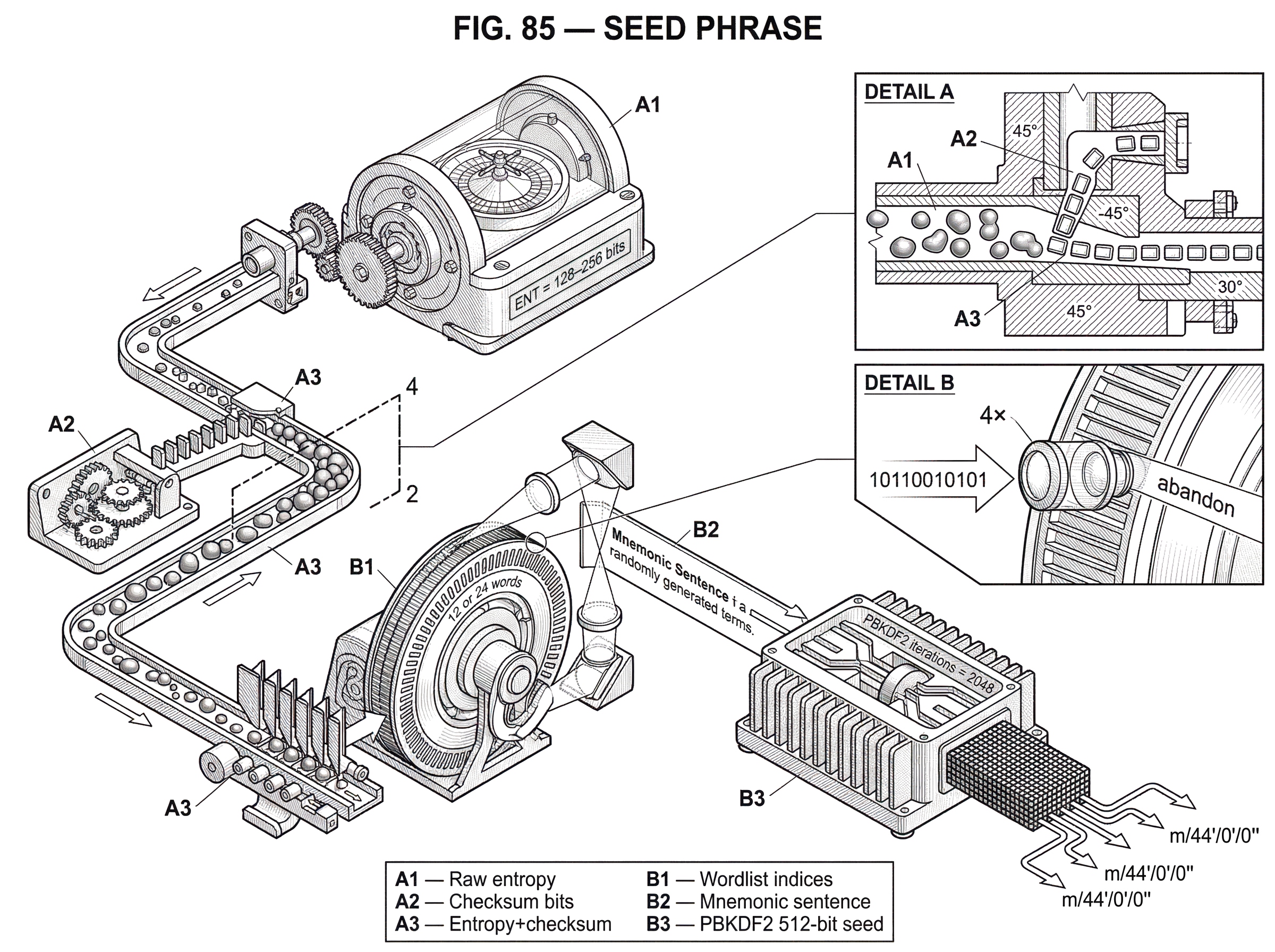
The core mechanism in BIP-39 is simple once you see the arithmetic. Start with ENT, the entropy length in bits. The standard allows ENT values from 128 to 256 bits, in multiples of 32. Then compute a checksum of length CS = ENT / 32 by taking the first ENT / 32 bits of the SHA-256 hash of that entropy. Append the checksum bits to the entropy bits. Finally, split the result into groups of 11 bits, and use each 11-bit value as an index into a fixed wordlist of 2048 words.
Why 11 bits? Because 2^11 = 2048. Each word stands for one number from 0 to 2047. The words are therefore just labels for bit patterns. The reason the phrase lengths come out to familiar sizes is the formula MS = (ENT + CS) / 11, where MS is the mnemonic sentence length in words. If ENT = 128, then CS = 4, so ENT + CS = 132, and 132 / 11 = 12 words. If ENT = 256, then CS = 8, so 264 / 11 = 24 words.
Here is the mechanism in concrete terms. Imagine a wallet generates 128 random bits. By themselves those bits are awkward for a human to handle. The wallet hashes them with SHA-256, takes the first 4 bits of that hash as a checksum, and appends those 4 bits to the original 128 bits, creating 132 bits total. It then cuts that 132-bit stream into 12 chunks of 11 bits each. Each chunk points to one word in the BIP-39 list. When you later type the 12 words back in, the wallet maps them back to 12 indices, reconstructs the 132-bit stream, separates the 128 entropy bits from the 4 checksum bits, and checks whether the checksum matches. That is why many wallets can detect a typo in the phrase even before deriving keys.
The checksum is useful, but it is easy to overestimate it. It is there mainly for error detection, not for security against attackers. A 12-word phrase has only 4 checksum bits, so it can catch many common mistakes, but not all possible corruptions. The security comes from the entropy, not from the checksum.
The wordlist design also carries a lot of hidden engineering. BIP-39 recommends wordlists where the first four letters uniquely identify each word, where easily confused pairs are avoided, and where the list is sorted for efficient lookup. It also strongly discourages non-English wordlists for generation because interoperability suffers when wallets do not agree on the same list or on text normalization details. That is not a statement that other languages are impossible; it is a statement about the cost of fragmentation in recovery workflows.
How are mnemonic words converted into the 512‑bit binary seed?
| Passphrase | PBKDF2 salt | Seed result | Recoverability | Best for |
|---|---|---|---|---|
| None | salt = "mnemonic" | 512‑bit seed (standard) | Mnemonic alone recovers | Simple portability |
| With passphrase | salt = "mnemonic"+passphrase | Different 512‑bit seed | Must provide same passphrase | Extra protection / deniability |
The mnemonic sentence is not yet the final secret used directly by most HD wallets. BIP-39 defines a second step that turns the words into a 512-bit binary seed. This conversion uses PBKDF2 with HMAC-SHA512. The mnemonic sentence, normalized as UTF-8 NFKD text, is used as the password. The salt is the string "mnemonic" concatenated with an optional passphrase, also normalized as UTF-8 NFKD. The iteration count is 2048, and the output length is 512 bits.
That detail matters because it separates phrase encoding from seed derivation. The words encode entropy plus checksum. PBKDF2 then deterministically stretches the mnemonic, with the optional passphrase folded in, into a fixed-length binary seed that downstream key-derivation systems can consume. So when people say “the seed phrase is the seed,” they are speaking loosely. Strictly, the phrase is converted into the binary seed.
The optional passphrase is where many wallets get a “25th word” reputation, though that nickname is imprecise. The passphrase is not an extra entry from the BIP-39 wordlist. It can be an arbitrary string. Mechanically, it changes the PBKDF2 salt, which means it produces an entirely different 512-bit seed from the same mnemonic words. BIP-39 notes an important consequence: every passphrase yields a valid seed. There is no built-in marker telling the wallet that the passphrase was “wrong”; a different passphrase simply opens a different deterministic wallet.
That property creates both a feature and a risk. The feature is plausible deniability: the same mnemonic can back multiple wallets depending on the passphrase supplied. The risk is recoverability. If you forget the passphrase, the mnemonic alone is not enough to restore the intended wallet. Nothing in the words themselves can help reconstruct it.
How can one seed phrase recreate many accounts and addresses?
| Path component | Level | Hardened? | Role | Why it matters |
|---|---|---|---|---|
| purpose' | level 1 | Yes | Spec indicator | Marks derivation standard |
| cointype' | level 2 | Yes | Chain separator | Keeps coins on different chains separate |
| account' | level 3 | Yes | User account | Partitions independent accounts |
| change | level 4 | No | Chain role | External vs internal addresses |
| addressindex | level 5 | No | Address counter | Enumerates addresses in chain |
The reason seed phrases became so important is not just that they are readable. It is that they pair naturally with hierarchical deterministic wallets. BIP-32 defines how a single seed can generate a tree of extended keys. At the root is a master secret and a master chain code. From there, child keys can be derived in a structured way, producing accounts, external receiving addresses, internal change addresses, and more; all deterministically.
BIP-32 generates master keys from a seed S by computing HMAC-SHA512 with key "Bitcoin seed" over S, then splitting the result into left and right halves. The left half becomes the master secret key material and the right half becomes the master chain code. That master pair is enough to derive an entire subtree of child keys. The chain code is what lets the wallet derive children in a way that is deterministic but not trivial reuse of the same secret.
This is the real compression point: the seed phrase does not back up individual addresses; it backs up the root from which address generation can be replayed. That is why the phrase can recover not just one account balance but a whole wallet history, provided the new wallet knows how to follow the same derivation rules.
A wallet still needs conventions about how to walk that key tree. BIP-44 provided a common layout: m / purpose' / coin_type' / account' / change / address_index. Here m is the master node, apostrophes indicate hardened derivation, coin_type' separates different cryptocurrencies, account' separates user accounts, change distinguishes externally visible receiving addresses from internal change addresses, and address_index counts addresses within a chain.
This is why the same seed phrase can, in principle, control multiple assets without reusing the same exact keys across them. In a BIP-44-style wallet, Bitcoin and Ether can live under different hardened coin_type' branches. SLIP-0044 maintains the registry of those coin type values. So a wallet can start from one mnemonic-derived seed and then derive, say, one subtree for Bitcoin and another for Ethereum, while keeping their address spaces separate.
How do I recover a wallet from a seed phrase (worked example)?
Suppose you set up a hardware wallet and it shows you 24 words. The device generated random entropy, encoded it as a BIP-39 mnemonic, and (whether or not you ever see the intermediate steps) converted that mnemonic into a 512-bit seed. From that seed it derived a master node and then a structured tree of account and address keys according to its supported derivation scheme.
Years later, the device fails. You buy a replacement from a different vendor and choose “recover wallet.” When you enter the 24 words, the new device maps the words back into indices, reconstructs the entropy-plus-checksum bitstream, validates the checksum, and runs the same PBKDF2 process to regenerate the 512-bit seed. If you had also used a BIP-39 passphrase, the new device must combine the same mnemonic with the same passphrase, or it will derive a different seed and show a different wallet.
From there the new device has enough information to regenerate the same root node and walk the same derivation paths. If both wallets agree on the relevant standards and conventions, they will rediscover the same accounts and addresses. The blockchain never stored your phrase. Recovery works because the derivation is deterministic: the same input secret produces the same key tree.
The phrase “if both wallets agree” hides an important caveat. A seed phrase is only part of wallet portability. The other part is the derivation scheme and path conventions used after seed creation. Two wallets may both accept BIP-39 words yet derive different keys if they use different curves, paths, or account conventions. So the phrase is necessary for recovery, but interoperability also depends on what comes next.
Why can one seed phrase be used across different blockchains?
People often associate seed phrases with Bitcoin because BIP-39 and BIP-32 emerged from the Bitcoin ecosystem. But the idea spread because the separation between mnemonic encoding and key derivation is flexible. The same BIP-39 mnemonic-to-seed step can feed different downstream derivation systems for different chains.
For secp256k1-based ecosystems, BIP-32-style derivation is the common pattern. For curves such as ed25519, many ecosystems rely on SLIP-0010 instead. SLIP-0010 generalizes hierarchical derivation across multiple curves, including secp256k1 and ed25519. It takes the binary seed (often explicitly expected to come from a BIP-39 mnemonic) and derives curve-specific master keys using HMAC-SHA512 with a curve-specific key string such as "Bitcoin seed" or "ed25519 seed".
This distinction matters because not all curves support the same derivation behaviors. In SLIP-0010, ed25519 and curve25519 support only hardened private-child derivation; public-child derivation is not defined for them. That changes wallet architecture. A chain built on ed25519 can still use seed phrases, but the shape of the derivation tree and the watch-only possibilities differ from a secp256k1 BIP-32 wallet.
You can see this in actual ecosystems. Solana wallets commonly use BIP-39-style mnemonics and derive under paths associated with Solana’s registered coin type, while operating in an ed25519 environment. Cardano also uses mnemonic-based recovery, but its wallet standard explicitly uses purpose 1852', coin type 1815', and a Cardano-specific BIP32-Ed25519 scheme rather than standard BIP-32. Polkadot documentation likewise treats a 12-word mnemonic as the recoverable secret behind an account, even though its broader key and address ecosystem is not just “Bitcoin standards transplanted unchanged.”
So the portable idea is not “all chains use the exact same wallet internals.” The portable idea is: a human can store one mnemonic that feeds the chain’s deterministic key system. The details after that point are chain- and wallet-specific.
What common mistakes do people make when using seed phrases?
The biggest mistake is treating a seed phrase like an ordinary login credential. A stolen password can often be changed. A stolen seed phrase usually means the attacker can recreate the wallet elsewhere, and the phrase itself cannot be revoked. If compromise is suspected, the remedy is typically to move assets to a new wallet created from a new seed on a clean device.
The second mistake is confusing seed phrases with brainwallets or memorable sayings. BIP-39 is explicit that mnemonics are for computer-generated entropy. User-created phrases feel safer because they feel memorable, but memorability is evidence of structure, and structure is what attackers exploit.
The third mistake is assuming that the words alone are always sufficient. Sometimes they are; sometimes they are not. If the wallet used a BIP-39 passphrase, that passphrase is required too. If the wallet used unusual derivation paths or a nonstandard wordlist, recovery into another wallet may fail or may appear to fail because the software is looking in the wrong branch of the key tree.
Another subtle failure mode comes from address discovery conventions. In BIP-44, wallets scan for used addresses and stop after a gap limit; commonly 20 consecutive unused external addresses. That works well enough for normal wallet behavior, but if a user generated addresses far beyond that gap in one wallet, another wallet restoring the same seed might not automatically discover them without a deeper scan. The seed is still correct; discovery assumptions are what break.
What is the seed phrase threat model and its main risks?
A seed phrase concentrates risk. That is its greatest usability win and its greatest security burden. Instead of many backups, you have one. Instead of many secrets, you have one root secret. The invariant is simple: whoever can reconstruct the seed can usually control everything derived from it.
That makes phishing and malware especially dangerous. Attackers do not need to break the underlying cryptography if they can convince a user to type the phrase into a fake recovery page or capture it from a compromised machine. Recent incident reporting around trojanized wallet software and fake wallet prompts follows exactly this pattern: counterfeit apps or altered wallet clients ask for or exfiltrate the recovery phrase because it is the shortest path to full compromise.
This also explains an important rule of thumb that legitimate wallet vendors keep repeating: they should never need your seed phrase in ordinary support interactions. Recovery phrases are for restoring a wallet into trusted software or hardware you control, not for proving ownership to a website, support agent, or pop-up warning.
How should I back up a seed phrase and what are the limits?
Because a seed phrase is a single root secret, backup strategy matters. Many users write the words down physically because the point of the mnemonic is to keep the recovery secret off fragile or compromise-prone digital systems. Product guidance from hardware-wallet vendors often emphasizes exact word order, offline storage, and protection from both theft and physical destruction.
At the same time, the plain BIP-39 model assumes a single secret that must be preserved intact. That is not the only possible recovery design. SLIP-0039, for example, applies Shamir secret sharing to create multiple mnemonic shares that can be combined according to a threshold policy. That changes the custody model from “protect one phrase perfectly” to “distribute trust across several shares.” It is not generally compatible with BIP-39, which is why migrating between the two is not straightforward.
This comparison is useful because it shows what is fundamental and what is conventional. The fundamental requirement is preserving sufficient secret material to reconstruct the wallet’s root seed. The convention is whether that secret material is represented as one BIP-39 mnemonic, several SLIP-0039 shares, or some other recovery system entirely.
Conclusion
A seed phrase is a human-friendly wrapper around cryptographic entropy. In the common BIP-39 model, random bits are encoded as words, those words deterministically produce a binary seed, and that seed becomes the root of a hierarchical key tree. That is why a short phrase can restore an entire wallet.
The idea is powerful because it reduces wallet recovery to preserving one secret well. It is dangerous for the same reason. If you remember one thing tomorrow, make it this: a seed phrase is not just a backup note; it is the recoverable form of the root secret that controls your wallet.
How do you secure your crypto setup before trading?
Secure your setup by treating the seed phrase as the single root secret and by verifying recovery before you trade. Cube uses non-custodial MPC custody, so you keep control of keys; but you must still create, record, and test your mnemonic and any passphrase before moving funds.
- Generate a new BIP-39 mnemonic on a trusted, offline device (prefer hardware). Write the full 12 or 24 words in exact order on physical media; do not save a screenshot or cloud copy.
- If you use an optional passphrase (the so‑called “25th word”), choose a strong phrase, record it separately from the words, and store the two backups in different secure locations.
- Test recovery on a clean device or a different wallet: restore the written words (and the passphrase if used), confirm the derived addresses or accounts match expected addresses, and never type the seed into a website or support chat.
- Fund your Cube account with a small test deposit and perform a small trade or withdrawal to confirm on‑chain addresses, fee estimates, and receipt flows before transferring larger balances.
Frequently Asked Questions
A stolen seed phrase generally cannot be "changed" or revoked; whoever obtains it can usually recreate the same wallet and control the derived keys, so the usual remedy is to move assets to a new wallet created from a new seed on a clean device.
The so-called "25th word" is a misnomer: it is an optional passphrase (an arbitrary string) concatenated onto the PBKDF2 salt during mnemonic→seed derivation, and it is not one of the BIP‑39 wordlist entries; using a different passphrase with the same words produces a completely different 512‑bit seed, and forgetting that passphrase means the original wallet cannot be recovered from the words alone.
BIP‑39 encodes entropy+checksum into words by appending CS = ENT/32 checksum bits to ENT bits of randomness, splitting the result into 11‑bit groups, and mapping each 11‑bit value into one of 2048 words (2^11 = 2048); the 11‑bit choice is just because the standard wordlist has 2048 entries.
Entering the correct words can still fail to show your funds if the restoring wallet uses different downstream conventions: different key‑derivation paths, a different curve or derivation algorithm (BIP‑32 vs SLIP‑0010/ed25519), a different wordlist/normalization, or if you used an optional passphrase - all of which cause the same mnemonic to produce different keys; address‑discovery rules (gap limits) can also hide used addresses even when the seed is correct.
No - BIP‑39 explicitly expects wallet software or hardware to generate the entropy; user‑created memorable phrases (brainwallets) are discouraged because human‑chosen phrases are structured and guessable, reducing security compared with machine‑generated randomness.
The checksum in a BIP‑39 mnemonic is for error detection, not for cryptographic strength: a 12‑word phrase includes only 4 checksum bits so it can catch many common input mistakes but cannot be relied on as the source of security - the security comes from the underlying entropy.
Yes - a single mnemonic can feed multiple blockchains because the BIP‑39 mnemonic→seed step is separate from the chain‑specific derivation step; different chains or wallets then apply their own derivation rules (BIP‑32/BIP‑44, SLIP‑0010, coin_type values from SLIP‑0044, or chain‑specific CIPs) to produce addresses for those ecosystems.
Common user mistakes include treating the phrase like a changeable password, writing it down out of order, storing digital copies (screenshots, cloud), using a passphrase and then forgetting it, and assuming automatic cross‑wallet compatibility; vendors therefore recommend offline, ordered physical backups and never sharing the phrase during support interactions.
Related reading