What Is Binance?
What is Binance? Learn how this centralized crypto exchange works, why traders use it, and the key trust, custody, and solvency trade-offs.
Introduction
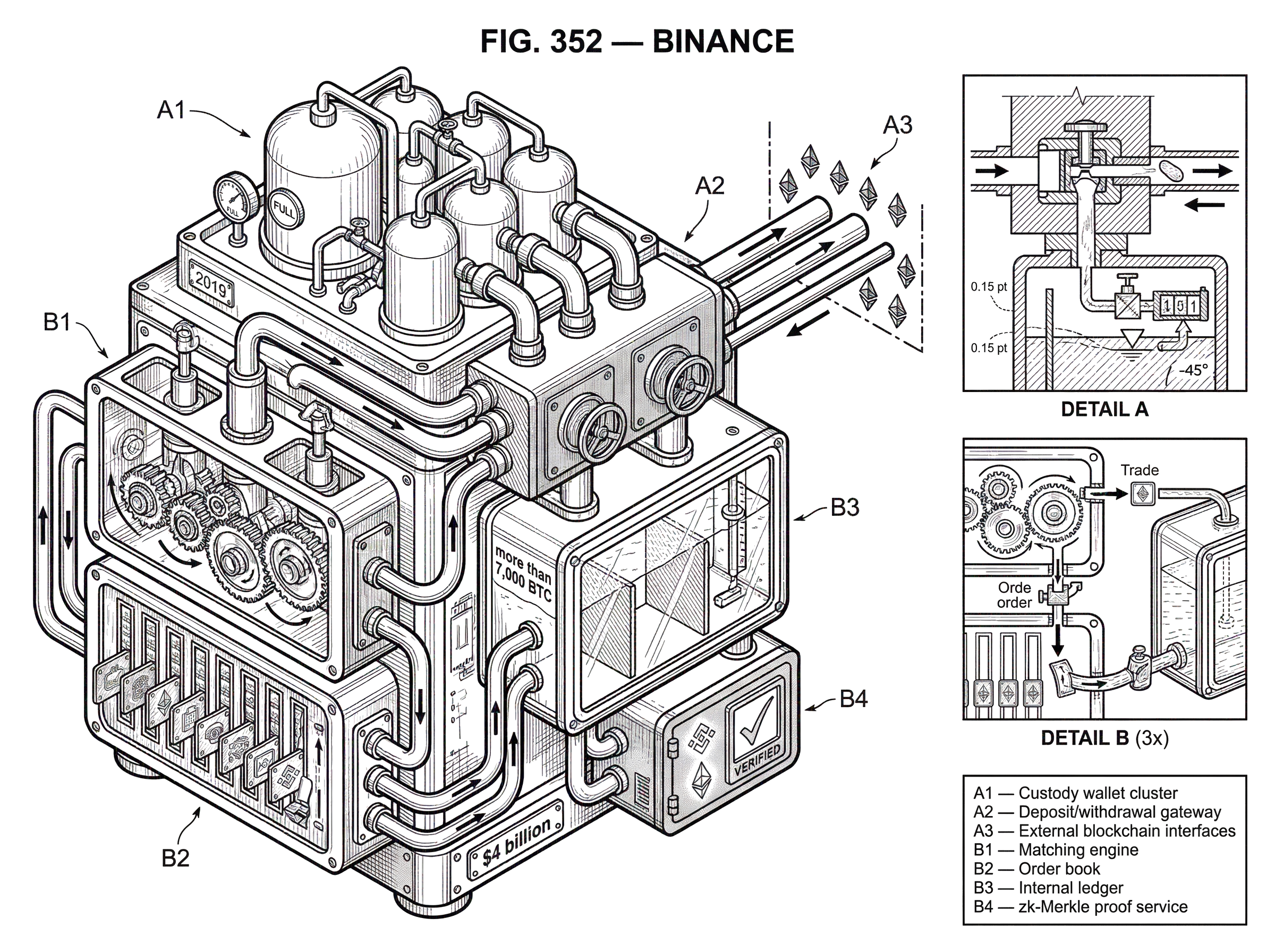
Binance is a centralized cryptocurrency exchange, and its importance comes from a simple trade: users hand operational control to a platform so they can get speed, liquidity, and a much easier market experience than using blockchains directly. That trade is the core of almost every major exchange, but Binance pushed it to a particularly large scale by trying to be more than a matching venue. For many users, it functions as a trading terminal, a custody layer, a payments rail, a yield interface, and a gateway between crypto ecosystems.
That can make Binance seem confusing. Is it just a place to buy and sell tokens? In one sense, yes. But that description misses the mechanism that makes it useful. Binance takes assets that natively live on many separate networks, records customer balances inside its own internal ledger, and then lets users trade those balances against one another much faster than those blockchains could settle every transaction on their own. Once you see that distinction (on-chain assets outside the exchange, off-chain balances inside it) most of the product starts to make sense.
Why use Binance instead of settling every trade on‑chain?
| Venue | Speed | Liquidity | Custody | Best for |
|---|---|---|---|---|
| Centralized exchange (Binance) | Instant internal matching | Deep order books | Exchange controls keys | Active traders, convenience |
| Decentralized exchange (DEX) | On-chain settlement latency | Typically thinner | Users retain keys | Trust-minimizing trades |
| On-chain direct trading | Slow chain confirmations | Fragmented liquidity | You control keys | Maximum self-custody |
Crypto markets are naturally fragmented. Bitcoin lives on one network, ether on another, stablecoins may exist on several, and many newer assets have their own chains or token standards. If every trade required direct on-chain settlement, trading would often be slower, more expensive, and harder to coordinate. Order books would be thinner, moving between assets would be awkward, and many users would spend more time managing wallets and transaction fees than actually expressing a market view.
Binance solves that by acting as a trusted intermediary. A user deposits assets into addresses controlled by the exchange. In return, Binance credits that user with balances in its internal system. From that point on, many actions that would be cumbersome on-chain become simple database updates combined with exchange risk controls. A market order can match instantly against another user’s order because Binance is updating internal balances, not waiting for a blockchain confirmation each time.
This is why centralized exchanges remain useful even in a world with decentralized finance. The main product is not just “access to crypto.” It is coordination: concentrated liquidity, fast execution, and a familiar account-based experience. That design especially suits active traders, market makers, and users who want broad asset access without juggling many wallets and protocols.
How does Binance handle deposits, internal ledgers, and trades?
| Stage | Who signs | Settlement ledger | Typical speed | When blockchain matters |
|---|---|---|---|---|
| Deposit | Exchange-controlled address | Credited on exchange ledger | Depends on chain confirmations | At deposit boundary |
| Trade | No on-chain signatures | Internal exchange ledger | Near-instant matching | Not during trades |
| Withdrawal | Exchange signs on-chain tx | Assets exit exchange wallets | Depends on blockchain | At withdrawal boundary |
From a user’s perspective, Binance begins with an account. The platform maintains identity, security settings, balances, and permissions around that account. Official developer documentation also shows Binance supporting OAuth 2.0 login flows for partner integrations, which is a clue that Binance is not only a consumer app but also part of a larger platform ecosystem. In other words, it has user accounts in the ordinary retail sense and account infrastructure that other applications can connect to in more controlled ways.
Once a user deposits crypto, the key shift happens: the exchange’s internal ledger becomes the practical source of truth for trading activity. If Alice deposits bitcoin and then sells it for USDT, that trade usually does not move coins on the Bitcoin blockchain and stablecoins on another chain at the moment of execution. Instead, Binance debits one balance and credits another within its own books. The blockchain matters at the boundary (when assets enter or leave the exchange) while the exchange ledger matters inside the venue.
This arrangement is why the experience feels fast. Matching engines can process orders much more quickly than public blockchains can finalize transactions. It also explains why Binance can offer many market types side by side. Spot trading is the simplest case: users exchange one asset balance for another. More advanced products, such as derivatives, build on the same centralized foundation but add margin logic, collateral requirements, liquidation rules, and other controls on top of the account system.
The practical result is that users come to Binance for different reasons, but those reasons are connected. A newcomer may use it because buying a major asset with a simple interface is easier than interacting directly with decentralized protocols. A high-frequency trader may care less about simplicity and more about deep liquidity and execution speed. An institution may care about custody workflows, subaccounts, APIs, and settlement operations. These are not separate products in spirit; they are different uses of the same centralized ledger and market infrastructure.
How can users verify an exchange’s solvency and what limits remain?
The central difficulty with any exchange is that users cannot directly observe its full balance sheet in real time. On-chain, a person can often inspect an address. Inside a centralized exchange, a person mostly sees an account statement and relies on the operator to be solvent, operationally competent, and willing to honor withdrawals. That is why proof, auditing, and custody practices matter so much.
One useful window into Binance’s approach is its open-source zk-Merkle proof-of-solvency tooling. Binance describes this repository as a proof-of-solvency tool for centralized exchanges. The basic idea is to let an exchange publish cryptographic evidence about customer liabilities and user inclusion without exposing every account publicly. The implementation uses several coordinated services: a witness generator prepares data, a prover creates zero-knowledge proofs, a user-proof service generates Merkle proofs for individual accounts, and a verifier checks both batch proofs and single-user proofs.
The intuition is straightforward. Imagine an exchange wants to show that your account is included in a larger liabilities snapshot. A Merkle proof gives you a path showing that your account balance contributes to a published root. Zero-knowledge machinery can then help prove statements about the full set of balances without revealing everything account by account. This improves privacy compared with dumping a raw liabilities table.
But here the trade-off becomes important. The verifier still depends on exchange-published inputs, including a liabilities summary and an account-tree root. That means the cryptography can help verify consistency relative to what the exchange published, but it does not magically remove all trust in the publisher. In plainer terms: proof systems can reduce some forms of opacity, but they do not eliminate the need to trust that the snapshot itself was honestly constructed and that assets are really there and accessible.
The tooling also reveals something practical about operating at exchange scale. The repository describes substantial infrastructure requirements: databases, Redis-compatible storage, and very large proving artifacts measured in multiple gigabytes. That is a reminder that “transparency” at large custodial platforms is not just a philosophical issue. It is also an engineering problem.
How does Binance act as market infrastructure for developers, institutions, and services?
A useful way to think about Binance is as a market operating system layered on top of many blockchains. The app is what users see, but underneath it is a set of systems for custody, matching, risk management, account permissions, identity checks, APIs, and asset routing. That is why large exchanges tend to expand outward. Once they already hold assets and maintain user balances, it is natural for them to add adjacent functions like lending, staking access, payments, institutional services, or developer integrations.
This is also where Binance becomes attractive to more than retail traders. Developers can integrate account-based access through Binance’s OAuth-based login flows, at least in the partner context described by its developer documentation. Institutions can care about custody structure and operational controls. Related custody documentation from Ceffu, formerly associated with Binance custody branding, describes models such as custodian-controlled wallets and co-sign arrangements, reflecting the broader demand for exchange-adjacent infrastructure rather than just consumer trading screens.
The pattern is consistent: users who value convenience, execution, and consolidated operations tend to prefer a platform like Binance. Users who value direct self-custody above all else may prefer on-chain alternatives, even if those are slower or more operationally demanding.
What are the main risks and trade‑offs of holding assets on Binance?
| Option | Convenience | Control | Main risk | Best for |
|---|---|---|---|---|
| Custodial exchange (Binance) | High | Low | Counterparty & legal risk | Traders, newcomers, institutions |
| Self-custody (wallets) | Low | Full private-key control | User error or lost keys | Privacy-focused users, sovereignty |
The most important constraint is not hidden fees or interface complexity. It is counterparty dependence. When assets are on Binance, the user is not personally signing every movement from a self-custodied wallet. The exchange controls the operational environment, enforces withdrawal policies, determines supported assets and networks, and can suspend or restrict activity.
Security history makes this trade-off concrete. In 2019, Binance reported a hot-wallet breach in which more than 7,000 BTC were stolen. Reporting at the time indicated the attackers accessed user API keys and two-factor authentication data, and Binance said it would cover the loss through its Secure Asset Fund for Users, or SAFU. The incident does not mean centralized exchanges are uniquely unsafe; self-custody has its own failure modes. But it does show the shape of exchange risk: users depend on the platform’s wallet architecture, internal controls, and incident response.
There is also organizational and legal risk. Major enforcement actions in the United States have alleged serious compliance failures, and the U.S. Department of Justice announced in 2023 that Binance and its CEO pleaded guilty to federal charges as part of a $4 billion resolution. Those developments matter not as background drama but because they affect the durability of the institution users rely on. A centralized exchange is not just software. It is a company with governance, jurisdictional exposure, banking relationships, compliance obligations, and operational points of failure.
Who benefits from using Binance and who should prefer self‑custody?
The shortest honest answer is that Binance is for people who want crypto markets to feel usable at scale. If you want broad asset access, quick execution, and many services tied to a single account, Binance is designed around that need. If you are a trader, that means deep order books and fast internal matching. If you are a more casual user, it means you can move from deposit to trade to withdrawal without understanding every chain underneath. If you are a business or integrator, it can mean account infrastructure and APIs that plug into a broader product.
The same design is less attractive if your first principle is minimizing trust in intermediaries. Binance can streamline crypto precisely because it centralizes decisions and operations that decentralized systems distribute outward to users and protocols. That is the benefit and the cost.
Conclusion
Binance is best understood not merely as a website for buying coins, but as a centralized market and custody system that turns many separate blockchains into one fast trading environment. Its usefulness comes from internalizing complexity: deposits and withdrawals touch public chains, while most trading happens on Binance’s own ledger. That makes crypto easier to use and markets easier to access; but only by asking users to trust the exchange’s custody, controls, and solvency. The trade is simple enough to remember: Binance offers convenience and liquidity in exchange for trust.
What should you look for before choosing a crypto exchange?
Before choosing an exchange, check custody model, liquidity, fees, supported networks, and APIs; then use the same tests on Cube to compare outcomes. On Cube you can run a small, end‑to‑end evaluation (deposit, trade, withdraw) and directly compare clearance times, spreads, and order types.
- Read the exchange’s custody documentation and confirm the custody model (custodial, third‑party custodian, or non‑custodial MPC). Then open Cube’s custody docs to verify its MPC/non‑custodial approach.
- Open the same market pair on both venues (for example BTC/USDC). Record best bid/ask, available depth at your typical trade size (e.g., 0.5–2 BTC), and estimate slippage for a market vs limit order.
- Compare fee schedules and withdrawal costs: note maker/taker fees, fee tiers, and on‑chain network withdrawal fees, then calculate total cost for a representative trade plus withdrawal on each platform.
- Run a small live test: fund a minimal deposit on the exchange and on Cube, execute the order type you use (limit or market), then withdraw to an external address to confirm supported networks, confirmation counts, and actual settlement time.
Frequently Asked Questions
Binance credits deposited assets to an internal account ledger and matches trades by updating those internal balances, so most trades do not create immediate on‑chain transactions; the blockchain is only used when assets enter or leave the exchange (deposits/withdrawals).
No - the zk‑Merkle tooling can cryptographically prove consistency between published liabilities and user inclusion, but it still depends on exchange‑published inputs (like the liabilities summary and account‑tree root) and therefore does not eliminate the need to trust that the snapshot was honestly constructed and that the underlying assets are accessible.
The repository and README show substantial operational demands: large proving artifacts and zk keys (multi‑GB examples), and services that assume dedicated MySQL and Redis/kvrocks storage plus high‑memory, multi‑core machines for proving and verification workloads.
Keeping assets on Binance creates counterparty dependence: the exchange controls withdrawals, supported assets and networks, and operational policies; the platform has experienced a 2019 hot‑wallet theft of over 7,000 BTC and has faced major U.S. enforcement actions (including a 2023 DOJ guilty plea and a reported $4 billion resolution), while self‑custody presents different but real failure modes.
As described in the project README, the verifier requires CEX‑published inputs (CexAssetsInfo and the account‑tree root) and the repository does not describe an on‑chain or external attestation mechanism tying those published inputs directly to an immutable source, so independent verification of origin is not provided there.
Binance suits users who want consolidated access, deep liquidity, fast execution, and platform services - for example active traders, market makers, institutions needing custody/APIs, and newcomers seeking a simpler UX - while users whose first priority is minimizing trust in intermediaries may prefer on‑chain self‑custody despite its added operational complexity.
Binance’s developer documentation shows support for OAuth 2.0 login flows and OAuth apps, but it states that Binance Login (OAuth2.0) is currently offered exclusively to close ecosystem partners and requires registering an entity account and creating an OAuth application to obtain client_id and client_secret.
Related reading