What is XRP Ledger?
Learn what the XRP Ledger is, how its validator and UNL-based consensus works, why it has a built-in DEX, and the tradeoffs behind XRPL.
Introduction
For the token explainer, see XRP.
XRP Ledger is a public blockchain designed to keep a shared financial state in sync quickly, cheaply, and with finality in a few seconds. That may sound like a familiar goal, but XRPL solves it in a noticeably different way from systems built around mining or generalized smart contracts. If you understand that difference, most of the ledger’s design starts to make sense: why it has no mining, why validators matter, why trust lists matter, and why features like issued assets and an on-ledger exchange are built into the protocol instead of layered on later.
The core problem is simple to state and hard to solve: if many independent servers are updating the same ledger, how do they all agree on which transactions happened, in what order, and what the balances are now? Bitcoin answers with proof of work and probabilistic settlement. Ethereum today answers with proof of stake and a broader programmable execution environment. XRPL takes a narrower path. It aims to be a shared ledger for payments and asset movement where the important property is fast agreement on state without mining.
That focus gives XRPL some real strengths. Transactions are designed to settle in seconds, fees are typically fractions of a penny, and the protocol includes features many chains leave to applications or smart contracts: issued tokens, escrow, payment paths, and a Decentralized Exchanges built directly into the ledger. But the same focus also creates its main conceptual wrinkle: XRPL consensus is not “trust no one” in the naive sense. It is a trust-shaped consensus system in which each server chooses which validators it relies on, and Safety depends on those trust choices overlapping enough across the network.
If you keep that picture in mind (a public ledger optimized for fast shared agreement on payments and assets) XRPL becomes much easier to reason about.
What state does the XRP Ledger maintain and why does it matter?
The thing a blockchain really maintains is not a list of blocks for its own sake. It maintains a state: who owns what, which ledger objects exist, which offers are open, which escrows are active, which trust relationships exist between accounts, and so on. XRPL makes that especially explicit.
The network processes transactions in sequential units called ledger versions, usually shortened to ledgers. Each ledger contains three kinds of information: the current state, the transactions applied to the previous ledger to produce that state, and metadata about the ledger version itself. That is an important design choice. In many systems, recovering the present requires replaying a long history. In XRPL, each validated ledger already contains the current state snapshot, so a server does not need the full transaction history just to know where things stand now.
That choice fits XRPL’s purpose. If the job is to keep a shared financial state synchronized, the present state is the critical object. History still matters for auditability and analysis, but operationally the network cares first about agreeing on the latest correct ledger. This also helps explain why the system can continue even though some very early ledger history was lost: because each ledger records full state, the chain of valid current states can remain usable without every earlier transaction being available.
A useful way to think about XRPL is as a distributed database with cryptographic verification and public consensus. That analogy explains why state synchronization is central and why transaction finality matters so much. It fails, however, if taken too far: unlike an ordinary database, there is no central administrator deciding the canonical order of writes. The hard part is precisely how independent servers converge on one authoritative next state.
How do transactions achieve finality on the XRP Ledger?
On XRPL, a transaction is the only way to cause changes in the ledger. A user signs a transaction, submits it, and the network attempts to apply it according to the protocol rules. The result is final only when the transaction is accepted into a validated ledger through consensus.
That last phrase matters. There is a difference between a transaction being seen by the network and a transaction becoming part of the agreed ledger state. XRPL is built to make that transition happen quickly (typically every three to five seconds according to the official overview) but it still depends on consensus. Until a ledger version is validated, the network is still in the process of deciding the next shared state.
There is another detail that often surprises newcomers: a transaction can fail and still appear in a validated ledger. Why? Because even a failed transaction changes one thing: the sender pays the transaction cost. That fee exists partly as anti-spam protection, so the ledger records the attempt and charges for the resources consumed. The practical consequence is that “included on-chain” does not automatically mean “the requested action succeeded.” To know what happened, you have to inspect the transaction metadata and result code.
XRPL also has pseudo-transactions, which are not signed and submitted by a client but are generated by ledger rules and still accepted through consensus. This is a reminder that the ledger’s state transitions are broader than just user-submitted messages. The consensus process is about agreeing on all state changes that the protocol recognizes, not only on retail-style payment instructions.
How does the XRP Ledger reach consensus without mining?
| Mechanism | Energy use | Fees | Trust model | Finality speed |
|---|---|---|---|---|
| Proof-of-Work | High energy | Often high | Economic-cost security | Minutes, probabilistic |
| Proof-of-Stake | Low–moderate energy | Lower than PoW | Stake-weighted security | Seconds–minutes |
| XRPL (RPCA) | Low energy | Fraction of a penny | UNL-based validator trust | Seconds finality |
Most people first meet blockchains through proof of work, where miners compete to append blocks by spending computational resources. XRPL was designed around a different question: can a public network agree on transaction order and ledger state without competitive resource expenditure?
Its answer is yes, but by changing the trust model.
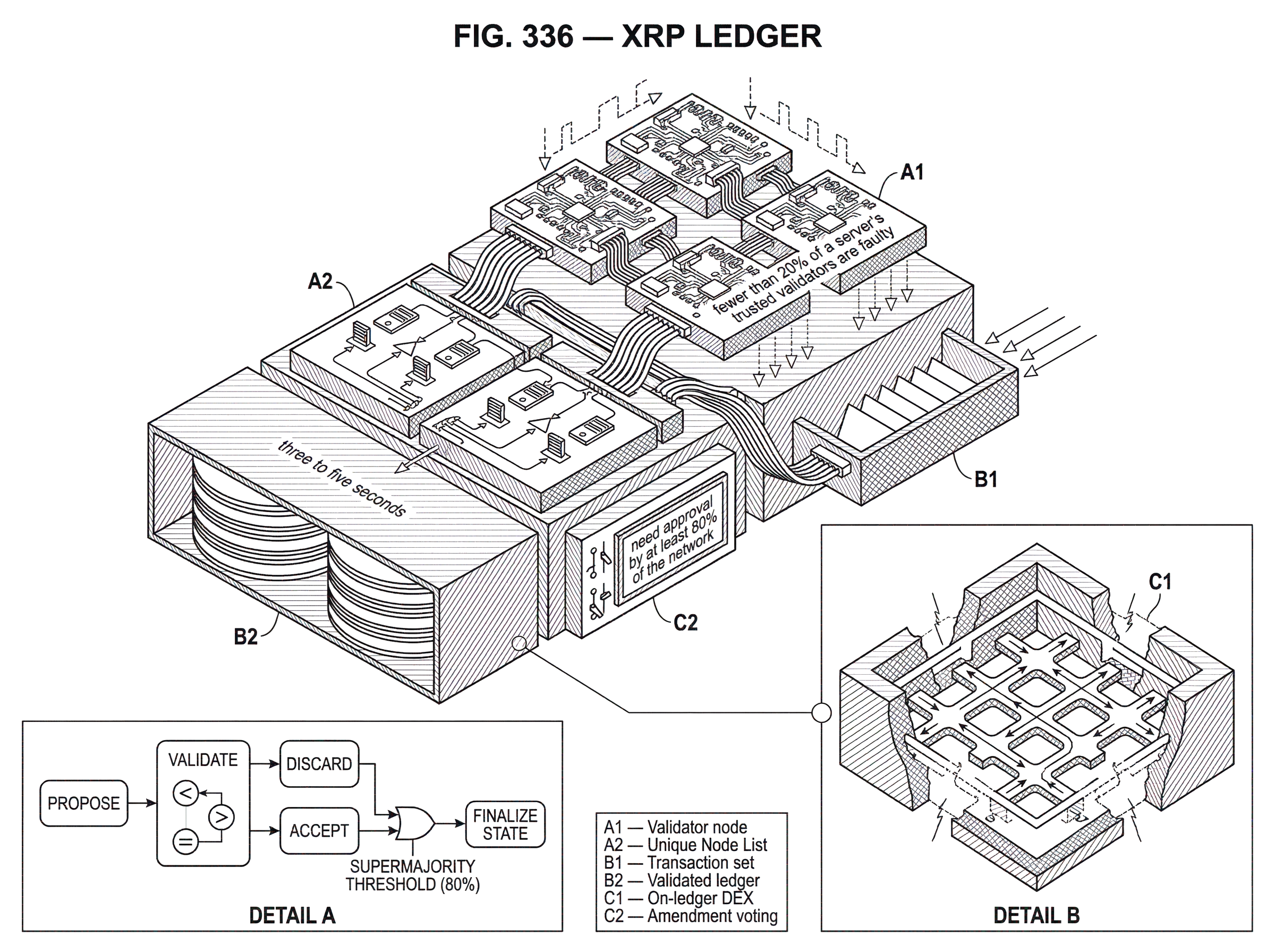
In XRPL, certain servers are configured as validators. A validator is just a rippled server that does everything a regular server does and also issues validation messages during consensus. Anyone can operate one. But simply running a validator does not automatically make it influential. Other servers only pay attention to a validator if they choose to trust it for consensus.
That choice is expressed through a Unique Node List, or UNL. Each server has a UNL: a list of validators it trusts not to collude and whose validation votes it will consider during consensus. The phrase “unique” can be misleading at first. It does not mean every server must have a radically different list. It means each server can, in principle, have its own trust set. In practice, those lists need substantial overlap.
Here is the mechanism in plain language. A server gathers proposed transactions for the next ledger, listens to messages from the validators on its UNL, and iteratively adjusts its proposal as the network converges. When enough trusted validators agree, the server considers a candidate ledger validated. The protocol is designed so that all honest servers with sufficiently overlapping trust assumptions converge on the same next ledger.
The crucial advantage of this design is obvious: no mining race, no block production auction, and no need to burn resources competitively to make progress. That is why XRPL can offer low fees and low energy use compared with proof-of-work systems. But the tradeoff is equally important: security now depends less on raw economic expenditure and more on how trust is distributed and coordinated across validator sets.
Why does XRPL use a Unique Node List (UNL) for consensus?
| UNL option | Overlap needed | Coordination | Centralization risk | Best use |
|---|---|---|---|---|
| Recommended lists | High overlap | High coordination | Publisher influence risk | Quick secure default |
| Custom UNL | Careful overlap | Low coordination | Risk of isolation | Private control or testing |
| Union / Hybrid | Built-in overlap | Medium coordination | Lower publisher dominance | Balance reliability and diversity |
If there is one idea that makes XRPL click, it is this: the network is not secured merely by having many validators; it is secured by enough overlap among the validators different servers trust.
That is a different mental model from “the longest chain wins” or “the stake-weighted chain wins.” On XRPL, each server asks a more local question: which validators do I rely on to tell me what the next correct ledger is? If different servers answer that question in incompatible ways, the network can stop agreeing.
The official docs are very direct about this. A UNL is a server’s list of validators it trusts not to collude, and that list determines which validation votes it listens to. The docs also emphasize that the chosen validators should be run by different parties and should not be likely to fail or collude in the same way. In other words, decentralization here is not just a count of nodes. It is the structure of trust relationships among them.
This is why recommended validator lists exist. A server can download signed recommended lists from publishers and use them as its UNL. The default server configuration uses lists published by the XRP Ledger Foundation and by Ripple. Anyone can publish a signed list in the correct format, but publishers matter because they influence which validators become widely trusted, and wide trust overlap is what keeps servers from drifting apart.
That creates both a solution and a tension. The solution is practical coordination: if many operators use overlapping recommended lists, the network is more likely to converge safely. The tension is governance: if too few publishers dominate those recommendations, trust can become socially centralized even if the protocol remains technically open.
XRPL’s own documentation does not hide this tradeoff. It notes that high UNL overlap is necessary to avoid forks, and that later research revised earlier assumptions upward; in the worst case, overlap may need to be as high as 90% between servers’ UNLs to prevent divergence. That is a very strong requirement. It means “everyone picks their own trust set” is true formally, but only within limits imposed by the need for shared safety.
What are XRPL’s safety and liveness guarantees, and what happens if they break?
| Fault share | Network effect | Safety risk | Operator action |
|---|---|---|---|
| <20% faulty | Consensus continues | Low safety risk | Normal operation |
| 20–80% faulty | Network halts progress | High operational pause | Investigate and restore validators |
| >80% faulty | Invalid transactions possible | High safety breach risk | Emergency recovery and governance |
Consensus systems are usually judged by two properties. Safety means honest participants do not finalize conflicting states. Liveness means the network keeps making progress. XRPL’s design makes a specific tradeoff between them.
According to the consensus documentation, as long as fewer than 20% of a server’s trusted validators are faulty, consensus can continue unimpeded. Confirming an invalid transaction would require more than 80% of trusted validators to collude. Between those regions lies the interesting failure mode: if more than about 20% but less than 80% of trusted validators are faulty, the system is expected to stop making progress rather than finalize conflicting invalid history.
That is an important design choice. When assumptions are stressed, XRPL prefers halting to silent divergence. For a financial ledger, that is often the safer failure mode. A pause is operationally painful, but two incompatible truths about balances are worse.
Still, this is not magic. Those guarantees are stated relative to each server’s trusted validator set. If operators choose poor UNLs, or if the overlap between UNLs becomes too weak, the guarantees weaken. The docs are careful here: the protocol is still evolving, and understanding of its limits and failure cases continues to develop. That is a healthy kind of caution. It means XRPL should not be described as having solved consensus once and for all; it has a working production design with explicit assumptions and ongoing analysis.
A smart reader might ask whether this makes XRPL “less decentralized” than other chains. The honest answer is that it depends what you mean by decentralization. If you mean open participation and absence of mining concentration, XRPL scores well in some ways: anyone can run a validator, and there is no proof-of-work cartel. If you mean that safety emerges with minimal coordination over trust assumptions, XRPL is more constrained. It depends on enough social and operational coordination around trusted validator sets.
How does a payment get validated on XRPL?; an example walkthrough
Imagine Alice wants to send a payment on XRPL, and the path from what she holds to what Bob wants may involve currency conversion through the on-ledger exchange. Alice signs the transaction and submits it to the network. Multiple servers receive it and consider it for the next open ledger.
Validators on each server’s UNL are also seeing incoming transactions and building candidate transaction sets. During the consensus round, they share proposals about which transactions belong in the next ledger. A server does not care equally about every validator on the internet; it mainly listens to the validators on its own UNL. As proposals circulate, servers compare what their trusted validators are endorsing and adjust toward the emerging supermajority view.
Suppose the payment is valid, the necessary offers exist, and enough trusted validators agree it should be applied. The transaction becomes part of the next validated ledger. At that moment, the state changes are no longer just tentative gossip. The balances update, offers may be consumed or remain partially open, and the result is part of the shared ledger everyone converges on.
If instead Alice’s transaction is malformed or violates some ledger rule, it can still end up recorded in a validated ledger as a failed transaction, with XRP consumed as the transaction cost. That detail reinforces the mechanism: consensus is deciding what happened, not only what succeeded. The ledger is an agreed record of state transitions and attempted transitions that matter to state.
Why does the XRP Ledger include a built‑in DEX and issued assets?
XRPL is easiest to understand if you stop treating it as “just a coin network.” The ledger was designed for payments across multiple assets, which is why it includes native support for issued tokens and a decentralized exchange directly on-chain.
The official overview describes the DEX as a high-performance, peer-to-peer, multi-currency exchange built directly into the blockchain. That is not an add-on application. It is part of the protocol’s financial plumbing. The reason is architectural: if the ledger’s job is to move value across currencies and issuers, then order books and pathfinding are part of settlement, not a separate product layer.
This design has consequences. It makes XRPL attractive for tokenization and cross-asset payment flows because an issuer can create assets on-ledger and users can trade or route payments through available liquidity. More recently, the protocol has also enabled Automated Market Makers, integrated with the existing DEX rather than replacing it. So XRPL now supports both order-book style liquidity and AMM-based liquidity within one ledger framework.
That combination is unusual. Many chains got exchanges by deploying smart contracts on top of a minimal base layer. XRPL instead started with exchange-like functionality near the protocol core and is only gradually extending programmability. That inversion explains both its efficiency in certain financial tasks and its narrower original design envelope.
What kinds of programmability does XRPL support (Hooks, AMMs, limitations)?
A common misunderstanding is that XRPL has no logic beyond payments. That is too simple. The ledger already supports a range of specialized transaction types and ledger objects; escrow, checks, issued assets, offers, account settings, and more. What it historically lacked was the kind of broad, arbitrary smart-contract environment associated with platforms like Ethereum.
That is starting to change, but carefully. XRPL.org describes Hooks as small WebAssembly modules designed specifically for XRPL and links them to a public testnet and amendment work. The important caveat is that Hooks are presented as in development, not as a blanket statement that fully general smart contracts are live on mainnet.
This matters because it shows the platform’s evolution without overstating it. XRPL’s original philosophy was to encode common financial actions directly into the ledger, which keeps execution narrower and easier to reason about. Adding programmable extensions can increase flexibility, but it also introduces the usual questions about determinism, safety, resource limits, and developer complexity. In other words, programmability is not a free upgrade; it changes the surface area of the protocol.
How are protocol changes proposed and adopted on the XRP Ledger?
XRPL is not static. Protocol changes are introduced through amendments, and the official docs say changes affecting transaction processing or consensus need approval by at least 80% of the network. The known amendments page adds an activation condition: amendments open for voting can become enabled on Mainnet if they hold a supermajority for at least two weeks.
Mechanically, this matters because XRPL’s rules are not whatever the latest software release happens to contain. A feature becomes part of the live protocol only when the network’s amendment process activates it. That helps separate code distribution from rule adoption.
Conceptually, amendments are where XRPL’s governance model becomes visible. There is open-source software, there are standards efforts such as XLS specifications, there are validator operators, there are recommended-list publishers, and there is the live network’s supermajority threshold for activation. None of those pieces alone defines governance. Governance is the interaction among them.
Some amendments add major capabilities. AMM is enabled. Clawback is enabled but disabled by default unless an issuer explicitly sets the relevant account flag. Hooks remain in development. This is worth stressing because XRPL is often discussed as if all announced features already exist in production. The amendment framework is the line between proposal and reality.
What is the XRP Ledger commonly used for today?
The protocol’s design naturally pulls it toward certain workloads. Low transaction costs, quick settlement, issued assets, and built-in exchange mechanics make XRPL a fit for payments, tokenized assets, treasury movement, stablecoin flows, and on-ledger trading. The overview also points to activity in tokenization, gaming, custody, NFTs, and DeFi.
Those uses are not arbitrary. They follow from the mechanism. If a ledger can cheaply update balances, maintain asset relationships, and settle multi-asset transfers in seconds, then applications that care about moving value efficiently will find it useful. That is also why XRPL is often compared with Stellar: both emphasize fast, low-cost payments, but they differ in consensus design and validator trust structure.
XRPL is less naturally suited to workloads that assume a fully general shared computer at layer 1. Developers can still build rich systems around it, and that may expand as programmability evolves, but the base layer was optimized for financial state transitions first.
What is the main tradeoff in XRPL’s design?
XRPL’s strongest idea is also its most important limitation: it replaces mining with a trust-coordinated validator model. That gives speed, low fees, and low energy use. It also means the network’s health depends on validator quality, publisher behavior, UNL overlap, and operator discipline.
The operational docs reflect this. Good validators are expected to have high uptime, agree with consensus, vote promptly, and identify themselves clearly. A validator should not be publicly exposed. Its keys should be generated and stored securely offline, and compromise requires immediate revocation. These are not incidental hygiene notes. In XRPL, operational trustworthiness is part of the consensus system itself.
This is why discussions of XRPL often become debates about whether trust lists are an acceptable engineering compromise or an undesirable centralization vector. The right answer is neither slogan. The protocol is decentralized in the sense that no single operator writes the ledger and anyone can run infrastructure. But it is also coordinated in a stronger sense than some other public chains because consensus depends on overlapping trusted validator sets and, in practice, on widely used recommended lists.
Conclusion
The XRP Ledger is best understood as a public blockchain built to keep a shared financial state synchronized with fast finality and very low transaction cost. Its built-in support for issued assets, path-based payments, and on-ledger exchange follows directly from that goal.
What makes XRPL distinctive is not just speed. It is the way speed is achieved: no mining, but a validator system organized around per-server trust lists with high overlap. That design is powerful when its trust assumptions hold, and that same design is where the protocol’s most important tradeoffs live. If you remember that, you understand both why XRPL exists and what must be true for it to work well.
How do you get exposure to XRP?
You can get exposure to the XRP Ledger by buying the XRP token on Cube Exchange and holding it in your account. Cube’s workflow keeps trading on-platform: fund your account, open the relevant XRP market, and place a spot order for the amount you want.
- Fund your Cube account with fiat via the on‑ramp or deposit a supported stablecoin (e.g., USDC).
- Open the XRP market that matches your funding (for example XRP/USD or XRP/USDC).
- Choose an order type: use a market order for immediate execution or a limit order to control entry price and reduce slippage.
- Enter the XRP amount or the fiat/stablecoin spend, review estimated fees and the expected fill, then submit the order.
Frequently Asked Questions
On XRPL, each validated ledger includes a full snapshot of the current state (balances, offers, ledger objects), so a server can know the present without replaying the entire transaction history. This is why the network can continue operating even if some early transaction history is missing.
Validators are regular rippled servers that issue validation messages, but they only influence a server’s view if that server lists them in its Unique Node List (UNL); anyone can run a validator, yet running one does not automatically make it trusted by the network.
Consensus on XRPL intentionally avoids mining by having servers trust validator votes from their UNLs to reach agreement quickly; this eliminates competitive resource expenditure (and its energy costs) but shifts security dependence onto how trust lists overlap and are managed.
A transaction is only final when it is included in a validated ledger after consensus (typically every three to five seconds), and failed transactions can still appear in a validated ledger because the sender still pays the transaction cost; you must inspect transaction metadata and result codes to see whether the requested action succeeded.
Each server chooses a UNL of validators it trusts, and safety depends on substantial overlap among servers’ UNLs; research and XRPL docs warn overlap requirements can be high (in the worst case cited as up to ~90%), so widely used recommended lists play a large role in practical coordination.
XRPL’s documented safety/liveness bounds say if fewer than ~20% of a server’s trusted validators are faulty the network can make progress, confirming invalid history would require more than ~80% of trusted validators to collude, and if faults fall between those regions the network is expected to halt rather than finalize conflicting histories.
Built‑in issued assets, order books, and pathfinding were included because XRPL was designed from the start to be a shared ledger for multi‑asset payments and exchange, so the DEX and on‑ledger tokenization are treated as protocol plumbing rather than add‑on applications; AMMs have also been enabled to complement the existing order‑book DEX.
Hooks are described as small WebAssembly modules under development and linked to a public testnet, not as broadly deployed, general‑purpose smart contracts on Mainnet; the docs caution that programmability is being introduced carefully and is still evolving.
Operator guidance in XRPL docs says validator keys should be generated and stored offline, validators should not be publicly exposed, and a compromised secret_key must be revoked immediately, but details like exact revocation timelines and UNL publisher vetting processes are noted as operational questions without fully prescriptive rules in the linked documentation.
Related reading