What is Trader Joe?
Learn what Trader Joe is, how its Liquidity Book AMM works, and why its discrete price-bin design matters for traders and LPs.
Introduction
Trader Joe is a decentralized exchange, now associated with the LFJ brand, that lets users trade tokens through smart contracts rather than a centralized intermediary. The useful question is not just whether it is a DEX, but what kind of DEX it is. Trader Joe’s identity is bound up with a particular market design called Liquidity Book, which changes how liquidity is arranged, how fees respond to volatility, and how liquidity providers choose where their capital sits.
That matters because decentralized exchanges all solve the same basic problem under pressure: they must let strangers trade on-chain, in real time, without a market maker manually quoting prices. The difference between one DEX and another is therefore mostly a difference in market structure. Trader Joe’s answer is to break the price range into discrete bins and let liquidity concentrate around the prices that matter most. If that clicks, the rest of the product makes sense.
Trader Joe also expanded beyond swapping. Its public code repositories include not only the core exchange and SDKs, but also a lending product called Banker Joe. Even so, the exchange mechanism is the center of gravity. It is the part that explains why a trader would route swaps there, why a liquidity provider would choose it over a simpler constant-product pool, and why the protocol’s trade-offs look the way they do.
Why Trader Joe organizes liquidity into discrete price bins (and what problem that solves)
| Model | Capital efficiency | Price movement | LP effort | Best for |
|---|---|---|---|---|
| Constant-product AMM | Low | Continuous slippage | Passive | Simple swaps |
| Uniswap v3 (concentrated) | High capital efficiency | Continuous within ranges | Requires active rebalancing | Experienced LPs |
| Liquidity Book (Trader Joe) | Comparable to v3 | Stepwise across bins | Targeted bin placement | Traders and active LPs |
An automated market maker has to do two things at once. It must quote a price for the next trade, and it must keep enough usable liquidity near the current market price that large trades do not move the price too far. Early AMMs solved this elegantly but inefficiently: they spread liquidity across the entire price curve, including prices the market may never visit. That made pools simple, but it also meant a lot of capital sat idle.
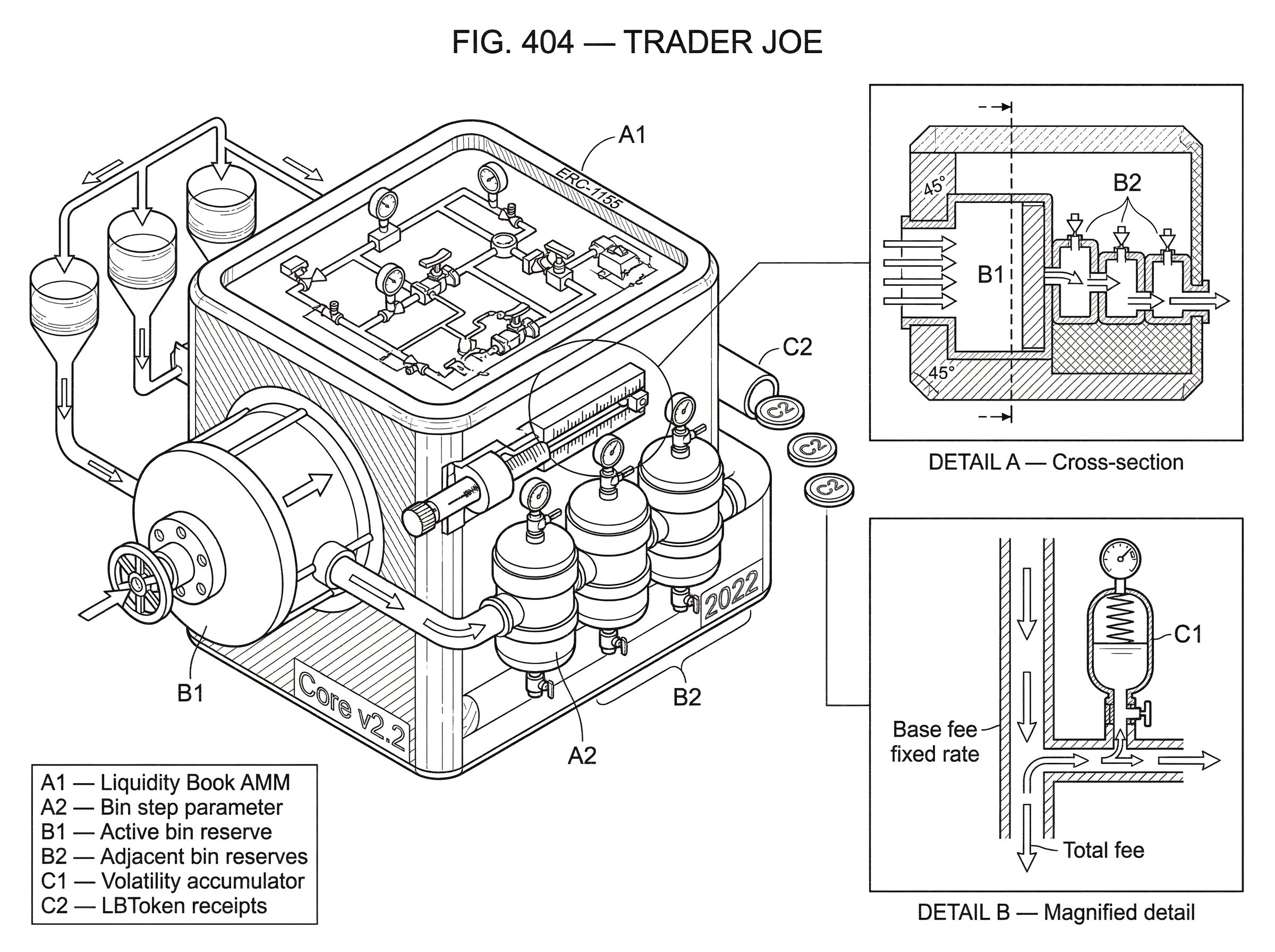
Trader Joe’s Liquidity Book starts from the observation that liquidity is most valuable near the prices where people are actually trading. Instead of treating the pool as one continuous curve, it divides prices into discrete bins. Each bin corresponds to a specific price. Liquidity providers can place funds into selected bins, which means they can concentrate capital where they expect trading to happen. The result is a market that aims for better capital efficiency without requiring a centralized market maker.
This is the main reason Trader Joe appeals to two different kinds of users. For traders, concentrated liquidity can mean deeper execution around the current price. For liquidity providers, it offers more control over where capital is deployed, which can improve fee generation if the chosen price region is active. But that extra control also means more responsibility: providing liquidity is less passive than in a pool that simply spreads funds everywhere.
How Liquidity Book executes trades across discrete bins
The core mechanism is simpler than it first sounds. A bin is a discrete price bucket. Liquidity in a bin sits at a fixed price, and the market as a whole is formed by aggregating many bins across a price range. The whitepaper describes each bin as a constant-sum market with its own fixed bin price and dynamic reserves. In practical terms, that means trading within a bin happens at that bin’s quoted price until the available reserves there are exhausted.
The market price is then determined by the active bin structure rather than by a single continuous formula over the whole pool. When a trade is small enough to fit inside the current active bin, it executes there. When the trade is larger, it consumes liquidity in that bin and then moves to the next adjacent bin with liquidity, and then the next if necessary. So a larger swap “walks” across bins. This is the mechanism behind both depth and slippage on Liquidity Book markets.
The spacing between bins is controlled by the bin step, which is the fixed percentage price difference between neighboring bins. A smaller bin step creates finer granularity, which can more closely track price movement but may require more bins to cover a range. A larger bin step makes the market coarser. This is not just a technical parameter. It shapes how precisely liquidity can be positioned, how many bins a trade may cross, and how a given market balances flexibility against operational simplicity.
A concrete example makes this easier to see. Imagine a token pair trading around a current market zone where several nearby bins contain liquidity. A small buyer arrives and wants only a modest amount. The swap uses the active bin and finishes there, so execution remains close to the displayed market price. Later, a larger buyer arrives. That second trade empties the active bin, then reaches into the next one, then perhaps a third. The buyer gets the full trade filled, but the average execution price worsens as more bins are crossed. Nothing mysterious happened: the protocol simply moved through the available inventory one price level at a time.
That design differs from the intuition many users bring from older AMMs. In a classic constant-product pool, the price slides continuously as reserves change. In Liquidity Book, price moves in steps across bins. The advantage is that liquidity can be packed where it matters. The limitation is that market quality depends strongly on how well liquidity is distributed across those bins.
How Trader Joe’s dynamic fee model adjusts during volatility
| Fee component | Trigger | Purpose | Effect on trader | Effect on LP |
|---|---|---|---|---|
| Base fee | Bin step | Cover baseline costs | Predictable cost | Stable fee income |
| Variable fee | Volatility accumulator | Compensate LP risk | Higher when volatile | Protects LPs |
| Protocol share | Per-market setting | Protocol revenue capture | Slightly higher net cost | Reduces LP split |
Liquidity Book does not only change where liquidity sits. It also changes how fees react to market conditions. According to the whitepaper, the total swap fee has two parts: a base fee tied to the bin step and a variable fee tied to a volatility accumulator. The practical idea is straightforward. If the market is moving rapidly and trades are crossing bins aggressively, liquidity providers face greater adverse-selection risk and potential impermanent loss. A higher fee in those moments is meant to compensate them.
This is one of Trader Joe’s more distinctive design choices. Many AMMs treat fees as mostly static, or at least externally chosen. Trader Joe instead tries to make the fee system partly endogenous to what the market is doing right now. If volatility rises, fees can rise. If trading is calmer, fees can remain lower. The intended consequence is a better balance between trader cost and LP protection.
That said, dynamic fees are only as good as the signal they respond to. The whitepaper notes that the volatility accumulator is based on bin crossovers, and under extremely volatile conditions it can have tracking error. So the model is useful, but not omniscient. It is an engineering approximation to market stress, not a perfect measurement of all trading risk.
How to provide liquidity on Liquidity Book: LBToken, bin placement, and fees
For liquidity providers, Trader Joe is not just a place to deposit two assets into a pool and forget about them. Because positions are tied to bins, liquidity has a location. The protocol represents these positions using LBToken, a liquidity receipt token standard built on ERC-1155. The important point is not the token standard by itself, but what it enables: liquidity can be represented across multiple price-located bins in a composable way.
This changes the LP experience. A provider can distribute liquidity evenly across a range, pack it tightly near the current price, or shape it according to a market view. If the provider places liquidity badly (for example, too far from active trading) capital may earn little because trades never reach those bins. If the provider places liquidity narrowly around the active price, capital can be more productive, but the position may need more active management as the market moves away.
There is another operational detail worth understanding. The whitepaper notes that adding liquidity to the active bin with the wrong asset composition can trigger an automatic swap and incur an active-bin composition fee, while inconsistent additions to inactive bins can revert. This is a good example of Trader Joe’s broader character: the protocol gives more precision, but precision creates more edge cases. Users who want that control may find it valuable; users who want maximum simplicity may prefer a blunter AMM design.
What Banker Joe lending adds to the Trader Joe platform
Trader Joe was not only a swap venue. Its public repositories include joe-lending, labeled Banker Joe protocol, showing that the project also built a lending and borrowing product. A Chainlink case study says Trader Joe integrated Chainlink Price Feeds into Banker Joe to supply market data for lending operations and describes Banker Joe as a lending platform on Avalanche. The reason this matters is architectural: once a DeFi platform moves into lending, reliable oracle inputs become essential because collateral values and liquidation logic depend on them.
This broader product surface makes Trader Joe more than a single-purpose exchange, but it also increases complexity. A DEX mainly has to manage trading logic and liquidity incentives. A lending protocol adds oracle dependencies, collateral policy, and liquidation risk. So while the Trader Joe name is often associated first with swapping, the surrounding platform has historically aimed to be a fuller DeFi venue.
What are the main security, governance, and oracle risks on Trader Joe
| Risk vector | Source | Impact | Mitigation | What users should check |
|---|---|---|---|---|
| Admin and governance | Privileged keys and roles | Parameter or fund control | Timelocks and multisig | Verify admin addresses and timelock |
| Smart‑contract bugs | Code vulnerabilities | Theft, DoS, incorrect state | Third‑party audits and bounties | Read recent audit reports |
| Oracles | Price feeds and TWAPs | Wrong pricing, liquidations | Decentralized feeds; TWAP limits | Check oracle sources and limits |
| Hooks and extensibility | Hook manager roles | Pair bricking or malicious logic | Role restrictions and review | Confirm hooks manager governance |
Because Trader Joe is a smart-contract system, the right question is not whether it is “safe” in a binary sense, but where the risks concentrate. Public audits from firms including Paladin and HashEx show substantial review coverage across multiple components. That is useful, but audits are snapshots, not guarantees. They reduce uncertainty; they do not remove it.
The most important risk themes in the supplied material are governance authority, extensibility, and oracle limitations. Paladin’s review of Core v2.2 highlights a hook system that can invoke external logic during pair interactions such as swaps, mints, burns, and flashloans. This makes the system more extensible, which is powerful for reward mechanisms and custom behavior. But it also expands the attack surface. In particular, the audit notes that control over LB_HOOKS_MANAGER_ROLE is a meaningful trust assumption because a malicious or compromised manager could add harmful hooks and effectively brick pairs.
There are also limits to oracle-based features. Paladin notes that the TWAP oracle can still be manipulated in certain timing scenarios, which means integrators should treat it as useful but not infallible. More broadly, DeFiSafety flags weak public documentation around admin controls and cites a 2022 exploit affecting xJOE holders, along with the absence of a public post-mortem. Even where code is open and heavily reviewed, operational transparency still matters.
For ordinary users, the practical consequence is simple. Trader Joe is most suitable for people who are comfortable evaluating smart-contract, governance, and market-structure risk rather than treating the platform like a custodial app. Traders benefit from execution and routing. LPs benefit from finer capital placement. But both groups are relying on contracts, parameter choices, and privileged roles that deserve scrutiny.
What changed after Trader Joe rebranded to LFJ and where to find the code
The project’s GitHub organization now presents the protocol under the LFJ identity, explicitly noting it is formerly Trader Joe XYZ and linking development to the lfj-gg organization. The repositories still make clear what the core product is: a decentralized exchange centered on the Liquidity Book AMM. That rebranding matters for finding the current codebase, but it does not change the underlying mechanism that made Trader Joe notable in the first place.
The memorable idea is this: Trader Joe organizes liquidity into discrete price bins so that capital can be concentrated where trading actually happens. Everything else follows from that. Traders get a market whose depth depends on how those bins are populated. Liquidity providers get more precision and potentially better capital efficiency, but at the cost of more active decisions. And the protocol as a whole becomes more expressive (and more complex) than a basic AMM.
Conclusion
Trader Joe is a decentralized exchange built around a bin-based AMM called Liquidity Book. Its core innovation is to replace a single continuous liquidity curve with discrete price bins, letting liquidity cluster near active trading prices and pairing that design with dynamic fees that react to volatility. If you remember one thing, remember this: Trader Joe is for users who want more control over on-chain market structure than a simple AMM can offer, and that extra control is both its advantage and its main trade-off.
How do you trade through a DEX or DeFi market more effectively?
Trade through a DEX or DeFi market more effectively by matching your execution method to on‑chain liquidity and order size. On Cube Exchange, fund your account, inspect pool or market depth for the target pair, and choose order options or split orders to limit slippage while keeping execution on‑chain.
- Fund your Cube account with fiat on‑ramp or deposit the crypto you plan to use on the same chain as the target market.
- Open the trading page for the pair on Cube and inspect pool/market details: check on‑chain reserves or displayed depth, recent trade sizes, and quoted price bands that indicate where liquidity is concentrated.
- Choose an order type and execution parameters: use a limit order for price control or a market order for immediate fill, and set a slippage tolerance appropriate to the pair’s depth (keep it tighter for thin or volatile tokens).
- For large trades, split the order into several smaller limit orders or stagger trades over time and monitor fills vs. remaining pool depth; adjust or cancel orders if the active liquidity band shifts.
Frequently Asked Questions
Liquidity Book replaces a single continuous liquidity curve with many discrete price "bins"; liquidity providers place funds into specific bins (fixed prices) so capital can be concentrated near active trading prices, whereas constant-product AMMs spread liquidity continuously across the entire price range. This gives higher capital efficiency near the market price but requires more active LP decisions.
A bin is a fixed-price bucket where liquidity sits at that bin’s quoted price; small trades execute inside the active bin, while larger trades consume one bin’s reserves and then "walk" into adjacent bins sequentially, producing stepwise price movement as more bins are crossed.
Swap fees have a base component tied to the bin step and a variable component driven by a volatility accumulator that increases fees when many bin crossovers occur; this aims to compensate LPs during rapid price movement but the accumulator can exhibit tracking error under extremely volatile events.
Liquidity positions are tokenized as LBToken receipts using the ERC‑1155 standard so price‑located liquidity can be encoded composably; this enables positions spanning multiple bins but also means LPs must manage where liquidity is placed or risk low fee generation if bins are inactive.
Adding liquidity to an active bin with the wrong asset composition triggers an automatic swap and an active‑bin composition fee, while attempts to add inconsistent liquidity to inactive bins will revert, so LPs must follow the protocol’s composition rules when depositing.
Audits note a significant trust/attack surface around the hooks system: the LB_HOOKS_MANAGER_ROLE can add hooks that alter pair behavior and, if misused, could brick pairs, and the on‑chain TWAP oracle can be manipulated in certain timing scenarios, so code reviews reduce but do not eliminate these risks.
Trader Joe (and its Banker Joe lending product) was historically deployed on Avalanche and auditors and project pages also list deployments on Arbitrum and BSC; Banker Joe integrated Chainlink Price Feeds for lending oracles per a Chainlink case study.
Bin step controls the percentage spacing between neighboring bins: a smaller bin step gives finer price granularity and tighter liquidity placement while larger steps make markets coarser; in practice many bins or many bin crossings can increase gas and latency, but precise on‑chain gas/latency costs for extreme bin counts are not specified in the whitepaper.
The protocol does not claim a definitive mitigation of MEV such as sandwiching for discrete bins, and the whitepaper/audit materials list MEV‑related risks (e.g., oracle/TWAP manipulation and unanswered questions about MEV specific to bin mechanics) as unresolved, so MEV remains an open operational risk.
Related reading