What is PancakeSwap?
Learn what PancakeSwap is, how its decentralized exchange works, why liquidity pools matter, and how users trade, stake, and earn with CAKE.
Introduction
PancakeSwap is a decentralized exchange, or DEX, built around the idea that you should be able to trade crypto directly from your own wallet instead of depositing funds with a company first. That sounds like a small interface change, but it shifts the whole structure of the market. On a centralized exchange, the platform keeps custody and updates balances in its own database. On PancakeSwap, the trade is carried out by smart contracts onchain, and you remain the holder of the assets until you authorize a transaction.
That design solves a specific problem. Many crypto users want access to open markets without account approval, centralized custody, or the operational bottlenecks of a traditional exchange. PancakeSwap became important because it paired that model with BNB Smart Chain, where transaction costs have generally been lower than on Ethereum according to PancakeSwap’s own overview. Lower fees make small trades, frequent portfolio changes, and yield strategies more practical, which is a large part of why the product found such a broad audience.
PancakeSwap’s official documentation describes it as a leading decentralized exchange on BNB Smart Chain and emphasizes three ideas repeatedly: trade from your wallet, keep control of your funds, and use the same liquidity infrastructure for earning opportunities as well as swapping. If you understand those three ideas, most of the platform’s products start to make sense.
How does PancakeSwap enable token trading without an order book?
| Custody | Liquidity source | Trade mechanism | Fees | Best for |
|---|---|---|---|---|
| Platform custody | Other traders' orders | Order‑book matching | Often higher | Large traders, fiat on‑ramps |
| User wallets | User‑supplied pools | AMM automated pools | Lower on BNB Smart Chain | Non‑custodial swaps, yield users |
At its core, PancakeSwap is market infrastructure. It gives buyers and sellers a way to exchange tokens, but not by matching them through a centralized order book in the way many traditional exchanges do. Instead, the exchange relies heavily on liquidity pools: pools of token pairs supplied by users. When someone swaps one token for another, the trade is routed against pooled liquidity held in smart contracts.
This is the key mental shift. On PancakeSwap, the market is not mainly “other traders posting quotes.” The market is “capital sitting in contracts, available for anyone to trade against.” That is why the same platform can serve two different kinds of users at once. A trader comes to convert one asset into another. A liquidity provider comes to deposit assets so the market can function, and earns fees in return. The trade side and the earning side are not separate businesses; they are two sides of the same mechanism.
PancakeSwap’s smart contract repository says its exchange protocol is based on Uniswap V2, combining core trading and liquidity logic and adding features such as zaps. That lineage matters because it tells you what problem the original design was trying to solve: make token trading work without centralized custody by replacing the order book with an automated pool-based system. PancakeSwap then built a broader consumer product on top of that base.
What does trading on PancakeSwap look like step‑by‑step?
From a user’s point of view, PancakeSwap begins with a wallet connection rather than an account signup. You connect a supported wallet, choose the tokens you want to swap, review the quoted outcome and fees, and then approve the transaction in your wallet. The protocol does not take custody in between. PancakeSwap’s docs are explicit here: unlike centralized exchanges, it does not hold your funds when you trade, and you retain ownership of your crypto.
A simple example makes this concrete. Imagine you hold Token A and want Token B. On a centralized exchange, you would typically deposit Token A, wait for the exchange to credit your balance, submit an order, and later withdraw Token B. On PancakeSwap, you instead authorize the smart contracts to use the amount needed for that trade. The swap executes onchain against available liquidity, and the resulting Token B ends up in your wallet. The mechanism is different, so the responsibilities are different too: you control the wallet, sign the transaction, and bear the consequences if you interact with the wrong token or unsafe third-party project.
That last point is not incidental. PancakeSwap can make trading open and non-custodial, but it cannot make every token listed in a decentralized market trustworthy. Open access is part of the product’s usefulness, and part of its risk.
Why provide liquidity on PancakeSwap? How LPs earn and what the trade‑offs are
| Action | Earning source | Typical return | Main risk | Best for |
|---|---|---|---|---|
| Quick swap | No earnings | N/A | Slippage, bad tokens | One‑off traders |
| Provide liquidity | Trading fees | Variable returns | Impermanent loss | Capital providers |
| Stake CAKE | CAKE rewards | Moderate returns | Token price risk | CAKE holders |
| Farm LP | CAKE + fees | Higher APR possible | Impermanent loss + volatility | Yield seekers |
A DEX only works if there is enough capital available for traders to use. PancakeSwap solves that by paying liquidity providers from trading activity and, in some products, from token incentives. If you deposit token pairs into a liquidity pool, your assets help absorb user trades, and you earn a share of trading fees. This is the most direct economic loop on the platform: traders need liquidity, and providers are paid for supplying it.
Once that is in place, PancakeSwap layers additional reward systems on top. The docs describe Yield Farms as places where users stake LP tokens to earn CAKE, PancakeSwap’s native token. The same docs describe Syrup Pools as a simpler staking flow where users stake CAKE to earn tokens, often with less market exposure than farming. The official overview is careful about the trade-off: farms can offer higher APR, but that comes with greater exposure to market fluctuations.
This is who PancakeSwap is especially for in practice. If you only want a quick wallet-to-wallet swap, the product can be just a DEX interface. But it is also designed for users who do not want their assets to sit idle. Someone with token pairs can provide liquidity and earn fees. Someone already holding CAKE can stake it. Someone willing to take more complexity can farm LP positions for additional rewards. The platform is built so the same user can move along that spectrum without leaving the ecosystem.
What is CAKE used for on PancakeSwap?
| Use | Mechanism | User benefit | Main trade‑off |
|---|---|---|---|
| Staking | Lock / stake CAKE | Earn rewards | Reduced liquidity while locked |
| Governance | Snapshot voting | On‑chain influence | Concentrated voting power |
| Incentives | Emissions to pools | Attracts liquidity | Inflationary pressure |
| Burns | Fee‑funded buybacks | Supply reduction | Depends on fee revenue |
CAKE is the token that ties much of PancakeSwap’s economic design together. It is used in staking products, reward distribution, and governance, and PancakeSwap’s tokenomics documentation shows that the team is trying to balance issuance with deflationary pressure from product fees.
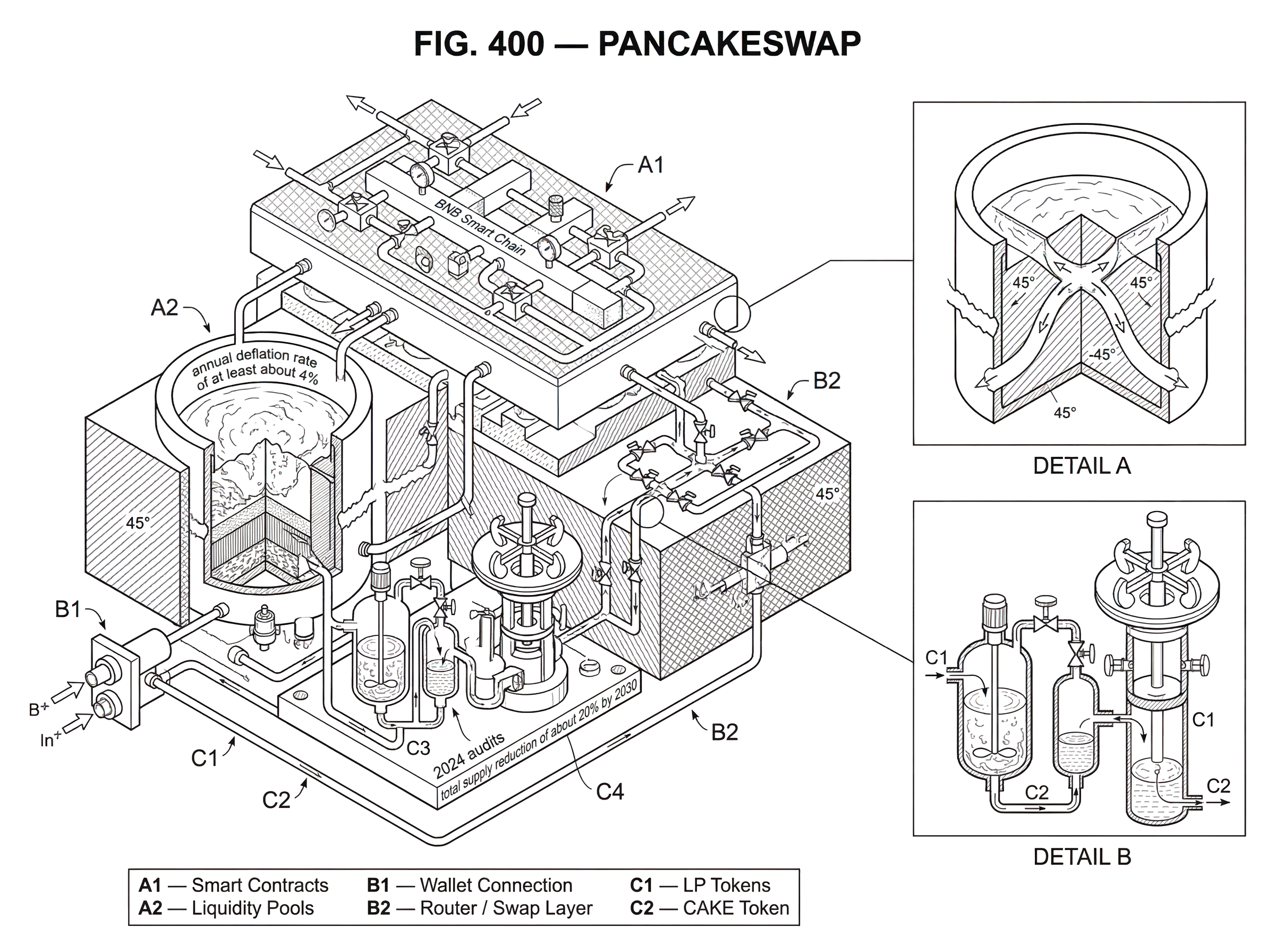
The mechanism is straightforward in principle even if the accounting is more involved in detail. Some PancakeSwap products emit CAKE as incentives to attract liquidity and participation. At the same time, PancakeSwap says burns are funded by fees across the product suite, including shares of spot trading fees and fees from products such as Prediction and Lottery. The protocol’s stated target is an annual deflation rate of at least about 4% and a total supply reduction of about 20% by 2030, though those are targets rather than guarantees.
What matters for a user is not just that CAKE exists, but why it exists. It is the tool PancakeSwap uses to direct behavior. If a pool needs liquidity, rewards can be pointed there. If the protocol wants to connect token value to ecosystem usage, fee-funded burns help do that. If holders should influence protocol decisions, the token becomes voting power.
How does PancakeSwap governance work (snapshots, voting, and gasless participation)?
PancakeSwap also uses CAKE in governance. Its voting guide says that participating in governance is free and does not require gas fees. Voting power is based on a snapshot block, meaning your voting weight is determined by your CAKE balance at a specific block height. Buying or depositing more after that snapshot does not increase your voting power for that proposal.
That design exists to preserve an important invariant: everyone voting on a proposal is measured against the same frozen ledger state. Without a snapshot, voting power could shift during the vote itself in ways that would be harder to reason about or easier to game. In practice, a user reviews a proposal in PancakeSwap’s voting portal, picks an option, and signs a wallet message to register the vote.
This tells you something broader about the product. PancakeSwap is not only an exchange interface; it is a protocol with parameters, incentives, and tokenomics that its community can influence. That matters more for recurring users, liquidity providers, and CAKE holders than for someone making a one-time swap, but it is part of the system’s structure.
Do audits and verified contracts make PancakeSwap safe?
PancakeSwap highlights several trust-reducing features in its docs: open-source software, verified contracts on BscScan, multisig use, time-locks, and published audit indexes. Its audit page lists reviews across major components, including recent 2024 audits for PancakeSwap Infinity core and periphery, along with audits for products such as Exchange V3, MasterChef V3, StableSwap, Lottery V2, and others. The developer docs also point to a bug bounty program.
These measures matter because smart-contract systems fail differently from centralized apps. If a server bug appears in a normal web company, the operator may be able to patch the backend quietly. If a smart contract has a flaw and users have entrusted funds to it, the damage can be immediate and onchain. Open source, contract verification, audits, multisig controls, and time-locks are all attempts to reduce that risk or make changes more visible.
But they are not guarantees. An audited protocol can still be exploited, and a safe core protocol does not protect users from every danger in the surrounding ecosystem. PancakeSwap’s openness means new or low-quality tokens can trade there. Secondary reporting around BNB Chain and PancakeSwap-linked markets also shows how token launches and liquidity setups can be manipulated when outside projects make weak assumptions. So the right conclusion is not “audited means safe.” It is “the protocol gives you more transparency than a black-box exchange, but you still need judgment.”
What advanced PancakeSwap features exist beyond simple token swaps?
PancakeSwap grew beyond a basic swap interface because once liquidity, routing, and token incentives exist, many adjacent products become possible. The docs reference features such as crosschain swap tools, limit and TWAP Order, perpetual trading, StableSwap, and gamified products like Lottery, Prediction, NFTs, and Pottery. The developer docs also show that PancakeSwap supports developer integrations across EVM resources, APIs such as a Subgraph, and even Aptos-specific contract documentation.
The newer PancakeSwap Infinity branding points to another important theme: improving gas efficiency and expanding functionality. Even without diving into implementation details, the message is clear. A DEX is not static infrastructure. Routing, contract design, and user workflows continue to evolve because costs, execution quality, and composability all matter in onchain trading.
For most users, though, the practical question stays simple: do you want a place to swap from your wallet, or do you want to participate in the market-making side too? PancakeSwap serves both, which is why it has remained more than just a token swap button.
Conclusion
PancakeSwap is best understood as a non-custodial marketplace built on shared liquidity. Traders use it to swap tokens without handing assets to an exchange. Liquidity providers and stakers use it to earn fees or rewards by supplying the capital that keeps those markets working.
Its appeal comes from that combination: wallet-based trading, relatively low-cost activity on BNB Smart Chain, and a broader ecosystem of staking, farming, governance, and related products built on the same foundation. If you remember one thing, remember this: PancakeSwap works by turning user-supplied liquidity into an open market, and everything else on the platform grows out of that design.
How do you trade through a DEX or DeFi market more effectively?
Trade through a DEX or DeFi market more effectively by prioritizing liquidity, execution type, and slippage before you submit a transaction. On Cube Exchange, fund your account, compare execution options, and then place orders with explicit slippage and split-order tactics to protect price outcomes while still executing onchain.
- Fund your Cube account with fiat or a supported crypto transfer.
- Verify the token contract address and check onchain pool depth or quoted available liquidity for the pair you plan to trade.
- Choose an execution type: use a limit order for strict price control or a market order for immediate fills; for AMM-style trades, set slippage tolerance (e.g., 0.5–1% for mid-cap pools, higher only if liquidity is thin).
- For large orders, split the trade into smaller chunks to reduce price impact, or stage multiple limit orders at different price points.
- Review fees, gas/network settings, and the destination address, then submit and monitor the onchain confirmation.
Frequently Asked Questions
Unlike a centralized exchange, PancakeSwap executes trades onchain via smart contracts and never custody your assets for you - you connect a wallet, sign transactions, and the swap happens against onchain liquidity without depositing funds to a third party.
PancakeSwap replaces an order book with liquidity pools: users deposit token pairs into smart-contract pools, traders swap against that pooled capital, and providers earn a share of trading fees and any token incentives for supplying liquidity.
Supplying liquidity can earn trading fees and CAKE incentives, but it exposes you to market-movement risk (the platform describes higher APRs for farms alongside greater exposure); if prices diverge between the two tokens you supplied, your position can underperform simply holding the tokens.
CAKE is used for staking rewards, liquidity incentives and governance voting; the protocol also funds periodic token burns from product fees and targets an annual deflation of around 4% and ~20% supply reduction by 2030, but those figures are stated targets, not guaranteed outcomes.
Governance voting uses a snapshot block to fix voting weight (your CAKE balance at that block determines power), voting is registered by signing through the wallet and does not require gas for participation, and buying or depositing CAKE after the snapshot does not increase voting power for that proposal.
PancakeSwap publishes audits, verified contracts, multisig control and timelocks and runs a bug bounty, which increase transparency and reduce risk exposure, but these measures do not eliminate the possibility of exploits or losses and do not make every token traded on the platform safe.
The exchange core is built on the Uniswap V2 automated market‑maker design (with PancakeSwap-specific additions such as zaps and other products), meaning it routes trades against liquidity pools rather than matching orders in an order book.
PancakeSwap Infinity is positioned to improve gas efficiency and expand functionality (routing and contract design are evolving to lower costs and add features), but the overview materials reference the goals without publishing measured gas‑savings or full implementation details publicly on the landing pages.
Related reading