What Is Phemex?
Learn what Phemex is, how its spot, futures, bots, lending, and proof-of-reserves tools work, and who this centralized crypto exchange is for.
Introduction
Phemex is a centralized cryptocurrency exchange, and the reason that matters is simple: in crypto, trading is easy to describe but hard to do well at scale. A useful exchange has to match buyers and sellers quickly, manage collateral for leveraged products, hold customer assets securely, and persuade users that those assets are actually there when needed. Phemex positions itself as a platform that does all of that in one place, combining trading, custody, and a set of adjacent products for users who want more than occasional spot purchases.
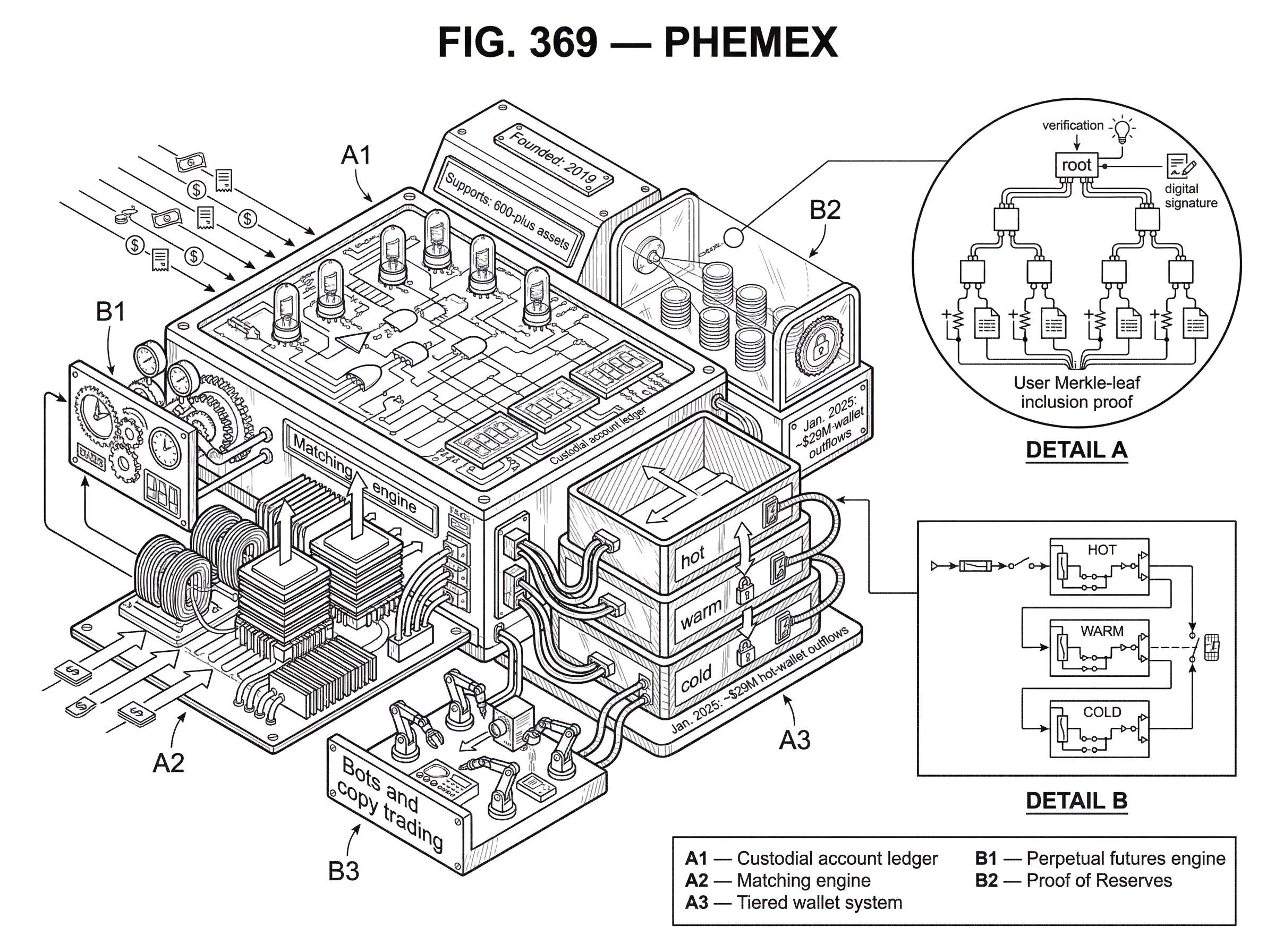
Founded in 2019, Phemex describes itself as a user-first exchange with more than 10 million users worldwide. Its core offering is familiar to anyone who has used a large crypto venue: you deposit assets into an account controlled by the platform, and from there you can trade spot markets, use perpetual futures, follow copy-trading strategies, run bots, or place funds into earning and lending products. That sounds like a bundle of features, but the more important point is the underlying design. Phemex is built for people who want speed, convenience, and a unified account, even if that means accepting the trade-off of a custodial platform.
What problems does Phemex solve for traders and account holders?
At first glance, an exchange seems to solve only one problem: finding someone on the other side of a trade. In practice, centralized exchanges solve a thicker problem. They aggregate liquidity, keep an internal ledger of user balances, net flows across many traders, and expose markets that would be cumbersome to recreate directly on-chain every time. That is why platforms like Phemex can offer not just spot trading, but also leveraged derivatives, algorithmic tools, and account-level services that depend on a common pool of collateral and a fast matching engine.
This is the key to understanding Phemex. It is not just a website for swapping tokens. It is a custodial trading system that turns deposited crypto into a flexible account balance you can deploy across several products. If you buy spot BTC, open a USDT-margined perpetual, copy another trader, and later move idle assets into an Earn product, you are not leaving one ecosystem for another. You are using different views on the same account infrastructure.
That design makes the platform useful for active traders. It also explains why Phemex puts so much emphasis on security architecture and proof of reserves. Once users give up direct control of their coins, the central question becomes trust: not whether the interface looks polished, but whether the exchange can remain solvent, process withdrawals, and manage risk under stress.
How does trading on Phemex work (spot, USDT‑M vs Coin‑M, and leverage)?
| Product | Collateral | P&L denomination | Typical leverage | Best for |
|---|---|---|---|---|
| Spot | Owned asset custody | Asset price exposure | No leverage | Buy-and-hold ownership |
| USDT‑M perpetual | Stablecoin (USDT/USDC) | USD‑denominated P&L | Up to 100x | Traders preferring USD accounting |
| Coin‑M perpetual | Underlying coin (BTC/ETH) | Asset‑denominated P&L | Up to 100x | Holders wanting asset exposure |
The user-facing flow starts with funding an account. Phemex says it supports spot trading across 600-plus assets, which is the straightforward side of the platform: you buy and sell cryptocurrencies for direct ownership inside your exchange account. “Direct ownership” here needs a small clarification. Economically, you are long the asset, and your account balance reflects that exposure. Operationally, however, the exchange still controls custody until you withdraw to your own wallet.
Where Phemex becomes more distinct is in derivatives. The platform offers perpetual futures in both USDT-M and Coin-M formats. The intuition is simple. A perpetual contract gives you price exposure without requiring spot ownership of the underlying asset. If the market moves in your favor, the contract gains value; if it moves against you, it loses value. The exchange continuously manages margin, collateral, and liquidation risk so the market can function even when users are trading with leverage.
The difference between those two contract types matters because the collateral changes how profit, loss, and account management feel in practice. In a USDT-M contract, margin is posted in a dollar-linked asset such as USDT or USDC, so traders often experience profit and loss in more stable accounting units. In a Coin-M contract, the collateral is the underlying coin itself, which means the collateral value can move with the market. That can be attractive for traders who already hold the asset and want to stay denominated in it, but it also makes risk less intuitive because both the position and the collateral can change together.
Phemex markets leverage up to 100x on futures. Mechanically, high leverage means a relatively small amount of collateral controls a much larger notional position. The attraction is obvious: small price moves can generate outsized returns. The danger is the mirror image: small adverse moves can wipe out margin and trigger liquidation. Phemex’s product design clearly aims at users who are comfortable with fast-moving markets and active risk management, not just long-term holders making occasional purchases.
A concrete example makes the account logic clearer. Imagine a trader deposits USDT, buys some spot ETH, and then opens a USDT-margined BTC perpetual because they expect a short-term move in bitcoin. They are now using the same centralized account in two different ways: one balance tracks owned ETH, while another position tracks synthetic BTC exposure through a contract. If they later decide they do not want to place every trade manually, they can route part of that account into a bot strategy or copy another trader’s positions. What makes this feel seamless is not that the products are identical, but that Phemex keeps them inside one custody and margin environment.
Why does Phemex offer bots, copy trading, Earn, and lending products?
These products are easiest to understand if you treat them as responses to a practical fact: many exchange users do not want a blank screen and total discretion. They want a platform that can turn market access into repeatable behavior. Phemex’s trading bots, including strategies such as grid and martingale, are meant to automate execution patterns that traders might otherwise run manually. Copy trading serves a similar need from another angle. Instead of encoding a strategy, the user follows another trader’s decisions.
That does not make either product inherently safer or smarter. It means Phemex is trying to reduce the friction between having an account and doing something with it. For newer or less time-intensive users, the hardest part of trading is often not order entry but decision-making. Automation and copying lower that barrier, though they also create a common misunderstanding: delegating trade selection does not remove market risk. It merely changes who or what is making the choices.
Earn and lending products extend the same logic beyond active trading. Phemex promotes wealth-management tools under Phemex Earn and a one-click lending product that lets users borrow against crypto collateral without selling it. The mechanism here is important. If a user wants liquidity but does not want to exit a crypto position, collateralized borrowing can unlock cash or stablecoins while preserving market exposure. That is useful in a custodial exchange setting because the platform already holds the assets and can manage collateral internally.
The benefit is convenience. The trade-off is again trust and counterparty dependence. The more services a user consumes inside a centralized venue, the more that venue becomes not just a matching engine but a balance-sheet intermediary.
How does Phemex’s Proof of Reserves (Merkle tree) attempt to prove custody and solvency?
| Transparency method | What it shows | User verification | Main limit | When useful |
|---|---|---|---|---|
| Merkle PoR | Hashed user liabilities + root | User can prove inclusion | May not show every internal wallet | Quick per-user inclusion check |
| Published wallets | On‑chain balances of listed addresses | Anyone can view on‑chain totals | Usually a portion of wallets shown | Reconcile liabilities to visible reserves |
| Third‑party audit | Auditor opinion on reserves | External report and attestations | Depends on scope and timing | Regulatory or legal reassurance |
Every centralized exchange eventually faces the same skepticism: if users cannot see the full internal ledger, how can they know the platform is solvent? Phemex’s answer is a Proof of Reserves system built around a Merkle tree. The idea is elegant even if the details matter a great deal.
A Merkle tree is a way of combining many pieces of data into a single top-level fingerprint, called a root hash. On Phemex, the relevant data are user liabilities; in plain language, what the platform owes users. Each user can verify that their own hashed balance entry is included in the tree without seeing everyone else’s balances. If your entry is included, and the aggregate liabilities are published, then the next question is whether the exchange controls enough assets to cover those liabilities.
Phemex says its PoR tool lets users pick a proof date, inspect their balance inclusion in the Merkle tree, and compare liabilities with reserve assets shown on the platform’s published wallets. The platform also says the top root hash can be interpreted as total liabilities for an asset, and that liabilities should be equal to or lower than the reserve assets shown. This is the core solvency claim.
The useful intuition is that PoR tries to prove two things at once: first, that your balance is counted in what the platform says it owes; second, that the platform shows enough assets to cover what it owes in aggregate. That is better than asking users to trust a generic statement. But it is not the same thing as perfect transparency. Phemex’s own materials indicate the reserve display covers a portion of published wallets, and the available documentation does not provide full third-party attestation details in the sources here. So PoR is best understood as a meaningful transparency tool, not as a reason to stop asking questions.
What is Phemex’s security architecture and what did the January 2025 hot‑wallet incident reveal?
| Wallet tier | Purpose | Exposure level | Typical share of assets | Operational speed |
|---|---|---|---|---|
| Hot wallet | Process live withdrawals | High exposure | <10% | Fast |
| Warm wallet | Operational liquidity and batching | Medium exposure | 20% | Moderate |
| Cold wallet | Long‑term offline storage | Low exposure | 70%+ | Slow |
Phemex says it uses a tiered wallet system, keeping the majority of assets in cold and warm wallets and a smaller share in hot wallets for day-to-day operations. It also describes multi-signature approval, Shamir Secret Sharing, and AWS Nitro Enclaves as part of its private-key protection model, alongside partnerships with providers such as Fireblocks. The underlying principle is standard for custodial exchanges: keep most value away from internet-facing systems, and make movement from deep storage require multiple controls.
That architecture matters because not all wallets serve the same role. A hot wallet exists to process live withdrawals and operational flows, so it must remain more exposed. A cold wallet exists to reduce exactly that exposure, at the cost of speed and convenience. The user usually notices this distinction only when something goes wrong.
In January 2025, Phemex reported unusual activity in its hot wallet and temporarily suspended deposits and withdrawals while it investigated and restored services in stages. The exchange said user funds were safe, that it had sufficient reserves, and that it released a proof of reserves for transparency. A reputable secondary report described roughly $29 million in outflows from hot wallets that were swapped into ETH, based on third-party security-firm tracing. The larger lesson is not just that incidents happen. It is that the promises made by a custodial exchange are tested precisely when the hot-wallet layer fails and the rest of the system has to contain the damage.
That episode clarifies who Phemex is for. It is for users who value centralized execution, deep product integration, and exchange-managed convenience enough to accept that operational resilience and custody quality are part of the product itself. On a venue like this, security is not a background feature. It is part of the mechanism that makes trading possible at all.
Where does Phemex fit among centralized exchanges and multi‑product venues?
Phemex sits in the part of the market occupied by multi-product centralized exchanges: platforms that want to be a trader’s main operating environment rather than a single-purpose broker. Its spot and perpetual offerings aim at active crypto users. Its bots and copy trading are there for users who want structure or delegation. Its Earn and lending products are there for users who want idle balances and collateral to stay productive inside the same account.
That integrated model is attractive because it compresses many financial actions into one interface. It is also why regulation and market-access questions matter around the edges. The platform requires identity verification to unlock higher limits and features, and public regulatory actions in some jurisdictions have challenged aspects of its market access and authorization. Those issues do not change what Phemex is mechanically, but they do remind users that a centralized exchange is always both a product and an operating entity, and those cannot be separated cleanly.
Conclusion
Phemex is best understood as a custodial crypto trading platform built around a unified account. Its usefulness comes from bringing spot trading, perpetual futures, automation, copy trading, lending, and earning tools into one fast-moving system. The convenience is real, but so is the central trade-off: when an exchange does more for you, you must trust more of your assets, execution, and risk management to the exchange itself.
What should you look for before choosing a crypto exchange?
Compare custody, execution, fees, and product fit before you pick an exchange. Use a short checklist to compare the venue against Cube Exchange’s workflow: Cube offers MPC-based non-custodial accounts, low-latency markets, and transparent fee tiers you can evaluate side‑by‑side.
- Check the custody model: confirm whether the venue is custodial or non‑custodial and whether Cube’s MPC non‑custodial model and withdrawal controls meet your needs.
- Compare derivatives and order types: open the exchange’s perpetuals page and note collateral formats (USDT‑M vs Coin‑M), max leverage (e.g., 100x on some venues), and supported order types (limit, market, stop‑loss). Replicate the same check on Cube.
- Calculate execution and cost for a sample trade: use each exchange’s fee schedule to compute maker/taker fees, funding rates for perpetuals, and withdrawal fees for the asset and chain you plan to use.
- Verify security and transparency: review proof‑of‑reserves details, published wallet addresses or attestations, recent incident reports, and named custody partners; confirm Cube’s published custody model and any audit links.
Frequently Asked Questions
Phemex’s Proof of Reserves (PoR) uses a Merkle‑tree: each user can verify their hashed balance is included in the aggregate liabilities, and the platform publishes reserve wallet balances so users can compare total liabilities to claimed reserves. This proves your balance is counted and that the platform shows some assets to cover liabilities, but it is not identical to full transparency because the published reserves cover only a portion of wallets and the materials don’t show exhaustive, independently attested snapshots.
The sources reviewed do not show a named, regularly published third‑party attestation or auditor for PoR snapshots; Phemex describes the system as a “self‑proving” Merkle‑tree tool but the documentation and PoR pages in the snapshot don’t include auditor names, signed roots, or a public attestation schedule. That means external audit/attestation status is unresolved in the available materials.
Phemex reported in January 2025 that unusual hot‑wallet activity prompted temporary suspension of deposits and withdrawals and it published a PoR for transparency; independent reporting traced roughly $29 million of outflows from hot wallets swapped into ETH, while Phemex publicly said cold wallets and user funds were safe. The public materials do not, however, publish a definitive forensic conclusion or a confirmed total of any losses, so the extent and attribution remain partially unresolved.
Offering up to 100x leverage amplifies both gains and losses: a small favorable move can produce large returns, while a small adverse move can wipe margin and trigger liquidation. Phemex’s product materials state the platform provides up to 100x and emphasize active risk management, but the reviewed materials do not publish full, granular margin and liquidation mechanics in the snapshot.
Yes - Earn and one‑click lending are custodial products that keep assets inside your Phemex account and rely on the platform to manage collateral and counterparties. The article and help pages stress the convenience of keeping assets productive on a custodial venue but also note the counterparty and balance‑sheet dependence that creates additional trust requirements.
The PoR interface and help pages indicate Phemex publishes balances for a portion of its wallets, but they do not list a complete, clearly scoped set of internal wallet addresses or publish machine‑verifiable historical Merkle roots in the captured documents. That means you can verify inclusion for your account in the Merkle tree as presented, but you cannot verify from the provided pages that every internal wallet or every asset is covered without additional disclosure.
Phemex describes a tiered security architecture: the company says most assets are held in cold and warm storage, a smaller amount in hot wallets, and that controls include multi‑signature schemes, Shamir Secret Sharing, AWS Nitro Enclaves and partnerships with custody vendors such as Fireblocks. These are standard custodial controls in the materials, but the documents are company descriptions and do not replace independent penetration testing or forensic proof of resilience.
Phemex has faced regulatory scrutiny and enforcement‑related filings in multiple jurisdictions: for example, an Ontario Tribunal found statutory breaches (with remedies to be decided), Phemex entities have entered liquidation or dissolution in some corporate filings, and the UK FCA issued a consumer warning. These documents show active regulatory concerns and unresolved remediation or sanction outcomes in the public record.
Trading bots and copy‑trading lower the friction of executing strategies but do not eliminate market risk; they simply change who or what makes trading decisions. The article explicitly cautions that automation and copying can reduce the effort of decision‑making while leaving users exposed to the same price and liquidation risks as manual traders.
Related reading