What is Bribes (DeFi)?
Learn what DeFi bribes are, how gauge-vote markets work, why they emerged in veTokenomics, and what risks they create for protocol governance.
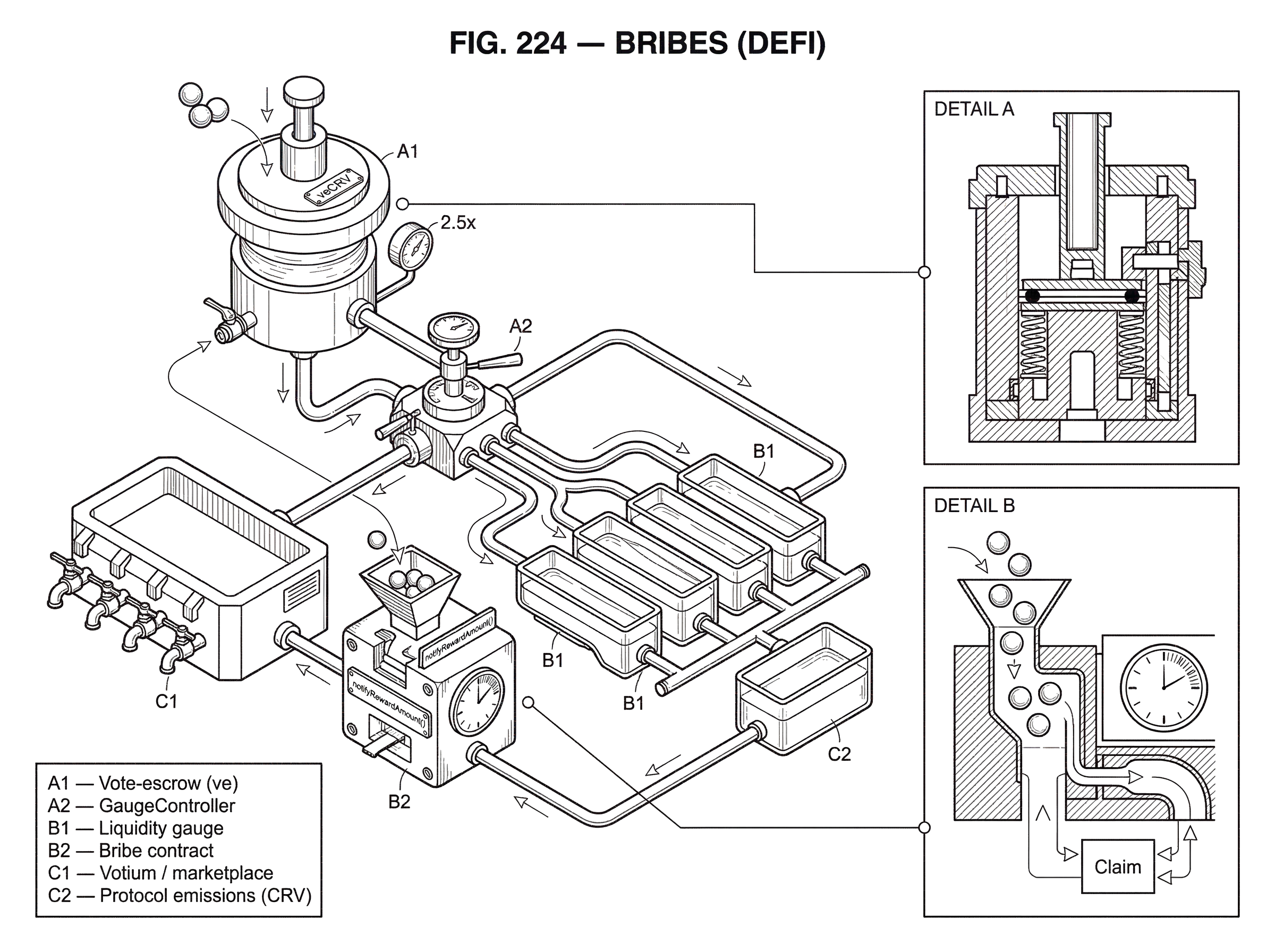
Introduction
Bribes in DeFi are payments offered to token holders or vote holders in exchange for using their governance power in a particular way. The idea sounds like a moral judgment, but mechanically it is simpler than that: if a vote controls something valuable, that vote itself becomes valuable, and markets will usually form around it.
That is the core puzzle. Many DeFi systems were designed so governance tokens would align long-term users with the protocol. Yet the moment a vote decides where token emissions go, which pool receives incentives, or whether a proposal passes, the vote stops being just a governance right. It becomes a cash-flow right. A protocol, trader, or outside project can then ask a straightforward question: is it cheaper to buy the outcome by paying voters than to earn the outcome directly?
This is why bribes became especially important in vote-escrow and gauge-based systems such as Curve and later designs inspired by it. Curve’s documentation describes the key ingredients directly: users lock CRV into veCRV, use that voting power to allocate weight across liquidity gauges, and gauges then receive a fraction of newly minted CRV proportional to the vote they receive. Once that mechanism exists, a pool that benefits from more emissions has a reason to pay voters to direct emissions toward it.
So the best way to understand DeFi bribes is not as an isolated trick, but as a consequence of protocol design. If governance controls an economic faucet, bribes are the market that forms around access to that faucet.
Why do bribes form in DeFi governance systems?
A governance vote matters only if it changes something scarce. In many DeFi systems, the scarce thing is not the vote itself but what the vote controls: token emissions, liquidity incentives, protocol fees, treasury allocations, or parameter changes that alter profitability. The vote is valuable because it redirects future cash flows.
This becomes very concrete in gauge systems. Curve’s liquidity gauge design measures liquidity provided to a pool and distributes CRV and other rewards to liquidity providers. But not every pool gets the same share. Curve’s GaugeController lets veCRV holders allocate voting power to gauges, and each gauge receives a share of newly minted CRV proportional to the voting weight assigned to it. So a protocol with a pool on Curve is not just hoping users will show up. It can try to increase its pool’s emissions by persuading or paying voters.
At that point, the economic comparison is simple. Suppose a protocol wants more liquidity in its pool because deeper liquidity improves trading, peg stability, borrowing conditions, or the attractiveness of its token. It could try to attract liquidity by handing rewards directly to liquidity providers. Or it could pay the people who control gauge votes, so the protocol itself receives more native emissions from the host platform. If paying voters costs less than buying the same liquidity in some other way, bribing is rational.
That is why bribes are best thought of as price discovery for governance influence. They reveal that a vote was never merely expressive. It was an asset controlling a stream of benefits.
How do bribe systems mechanically operate in ve/gauge setups?
| Part | Role | On‑chain example | Main risk |
|---|---|---|---|
| Vote‑bearing power | Creates scarce voting rights | veCRV / veNFT locks | Concentration of power |
| Distribution | Maps votes to rewards | Gauges / GaugeController | Allocation manipulability |
| Reward offering | How bribes are posted | Bribe contracts / Votium | Late or permissioned deposits |
| Reward claiming | Payout tied to participation | VotingReward / claim functions | Accounting complexity |
The mechanism usually has four moving parts, and what unifies them is that each part turns political influence into something economically tradable.
First, a protocol creates vote-bearing power. In Curve this is veCRV, obtained by locking CRV. In Velodrome, the repository describes VotingEscrow.sol as a ve-style NFT representing locked voting power. In Solidly-style systems, locks are often represented as veNFTs rather than balances tied to an address. The exact representation differs, but the function is the same: someone holds a scarce right to influence allocation.
Second, votes control distribution, not just abstract policy. Curve’s docs are explicit that users allocate veCRV toward gauges and gauges receive a corresponding fraction of newly minted CRV. Velodrome’s contracts describe a Voter.sol that handles votes, creates voting rewards, and distributes emissions to gauge contracts. Solidly’s README similarly says gauges distribute token rewards to LPs based on voting weights defined by ve voters. This step is crucial. If votes did not control something with monetary value, bribing them would be far less attractive.
Third, a system or side market creates a way to offer rewards to voters. Sometimes this is native to the protocol. Solidly states that gauge bribes are natively supported, that bribes inherit from gauges, and that users who voted can claim rewards. In other cases, this is provided by an external marketplace. Votium’s official docs show separate manuals for voters and buyers, which already tells you that the system is built around matching two sides: those selling voting influence and those buying it.
Fourth, rewards are distributed according to actual vote participation. Velodrome’s repository describes VotingReward contracts that distribute rewards for a voting epoch proportionally based on user checkpoints, and IncentiveVotingReward.sol stores externally provided rewards for the current epoch. A ChainSecurity audit of Velodrome’s superchain contracts defines BribeVotingReward as the contract storing bribes for a specific gauge, where anyone can deposit whitelisted tokens and users who voted for that gauge can claim rewards. So the payment is not vague or off-chain. It is attached to a measurable on-chain action: having voted in favor of a target.
Once those four pieces exist, bribes stop being a social oddity and become infrastructure.
Why would a protocol pay voters to influence gauge weight?
| Option | Mechanism | Typical cost profile | Best when |
|---|---|---|---|
| Pay LPs directly | Directly fund LP rewards | Higher direct subsidy cost | Building long‑term liquidity |
| Pay voters (bribe) | Deposit incentives to voters | Potentially lower if efficient | Reallocate emissions quickly |
| Do nothing | Rely on organic yields | Lowest immediate expense | Strong product‑market fit |
Imagine a stablecoin project has a liquidity pool on a DEX that uses gauge voting. The project cares about that pool because deeper liquidity helps users trade with lower slippage and can make the stablecoin appear more credible. But liquidity providers do not show up just because the project wants them to. They show up where returns are attractive.
Now suppose gauge votes determine how much of the DEX’s native token emissions this pool receives next week. If the stablecoin pool gets more gauge weight, LPs in that pool earn more rewards, which makes the pool more attractive, which can deepen liquidity. The stablecoin project could pay LPs directly. But another route is to deposit incentives into a Bribe contract or bribe marketplace: “if you vote for our pool this epoch, you can later claim our token, stablecoins, or some other reward.”
A voter then compares options. Voting for Pool A might earn little. Voting for the stablecoin pool might earn a larger side payment. If enough voters switch, the stablecoin pool gets more gauge weight. Then the host protocol’s emissions flow toward that pool, LP returns rise, and more capital may enter.
The important point is that the bribe buyer is not usually paying for the vote as an end in itself. They are paying for the downstream effect of the vote: more emissions, more liquidity, deeper markets, better peg conditions, or a stronger competitive position.
That is also why the word “bribe” can be a little misleading. In ordinary language it suggests a hidden or illicit payment. In DeFi, these payments are often public, programmatic, and expected. The controversial part is usually not whether the payment exists, but whether turning governance into an explicit marketplace improves or corrupts the protocol.
Why do veTokenomics and gauge-based systems attract bribes?
Bribe markets did not appear everywhere at once. They became especially important where governance power was both concentrated and persistent.
Vote-escrow systems do this intentionally. Locking tokens for longer usually gives more voting power, which is meant to align long-term holders with the protocol. Curve’s design makes locked CRV useful in two linked ways. It gives governance influence over gauges, and it also affects reward boosting. Curve’s gauge docs show a boosting formula in which a user’s effective balance can be increased based on their voting-escrow position, allowing up to a 2.5x reward boost for sufficiently staked users. That means locked voting power is not just symbolic. It affects who earns more and where emissions flow.
This creates a strong incentive to aggregate voting power. If one entity can gather a large share of locked governance rights, it can sell influence more efficiently than many small holders acting separately. That is a big reason the Curve ecosystem evolved into what people called the Curve Wars. Secondary research and market reporting describe how Convex accumulated substantial control over Curve-related vote power, and Votium emerged as a marketplace through which protocols could pay for that influence. The governance right became separable from the long-term ideology of governance. It could be monetized.
This concentration is not an accident in the narrow sense. It follows from economies of scale. If managing locks, votes, claims, and optimization is operationally annoying, users often delegate to an aggregator. The aggregator becomes the practical owner of governance leverage. Then bribe markets become easier, because buyers prefer dealing with a large block of influence rather than thousands of small wallets.
So veTokenomics does two things at once. It tries to create long-term alignment by imposing a cost to exit. But it also creates a durable pool of vote power that can be rented.
What do protocols and voters gain from bribe markets?
Protocols buy bribes because the expected benefit can exceed the cost. The benefit may be deeper liquidity, more trading activity, better borrowing conditions, stronger peg defense, or simply competitive survival in an environment where rival protocols are also paying for emissions. Some research on Convex summarizes the logic plainly: bribers are betting that the cost of the bribe is less than the value gained from more liquidity and additional rewards.
Voters accept bribes because they own an income-producing right. If the protocol lets them decide where emissions go, then refusing compensation can look irrational. A voter can reason: “my vote is going to be cast anyway; I might as well direct it where the reward is highest.” This is especially true when voters are not emotionally attached to the long-term health of every protocol competing for their support.
Marketplaces emerge because they reduce friction on both sides. A buyer wants a standard way to deposit incentives, specify a target, and reach the relevant voting bloc. A voter wants to see available incentives, vote once, and claim rewards without monitoring bespoke deals. Votium’s docs, with separate buyer and voter manuals, reflect exactly this coordination role.
From that perspective, bribe markets are not weird edge cases. They are exchanges matching demand for influence with supply of influence.
How do timing and epoch rules shape the effectiveness and fairness of bribes?
A common mistake is to think a bribe market is just a static payment board. In reality, it is shaped heavily by timing constraints in the underlying governance system.
Curve’s gauge voting is not continuous in the naive sense. Its docs explain that GaugeController records vote points and scheduled changes by week, and new changes apply at the start of the next epoch week. A single gauge vote also cannot be changed more often than once every 10 days. These rules matter because they make influence chunky. You are not buying a constant stream of real-time control. You are buying the ability to affect the next scheduled allocation window.
That chunking changes strategy. Buyers often care about the next epoch, not some indefinite future. Voters compare rewards over a bounded window. Marketplaces can package incentives around those windows. And because reaction time is limited, late information can create unfairness or at least asymmetry.
The ChainSecurity audit of Velodrome highlights this clearly. It notes that bribes can be added at any time to a BribeVotingReward contract using notifyRewardAmount(), even after voting is over, meaning users cannot react to those late bribes once the voting window has closed. That is a very specific mechanical issue, but it illustrates a broader point: the fairness of a bribe market depends not just on who can pay, but on when information becomes actionable.
Which protocols and governance models allow bribes beyond Curve?
Although the popular origin story centers on Curve, the mechanism is broader than one protocol or one chain.
Solidly embedded bribes directly into protocol design. Its README says gauge bribes are natively supported, bribes inherit from gauges, and arbitrary rewards can be added permissionlessly via notifyRewardAmount(address token, uint amount). That means the protocol itself recognizes external incentives as part of the expected operating environment rather than treating them as an awkward side effect.
Velodrome, built in the Solidly tradition, uses separate reward contracts for voting incentives. The repository describes IncentiveVotingReward for externally provided rewards and FeesVotingReward for fee-based rewards. This distinction is important. Not every payment to voters is an outsider trying to distort governance. Sometimes the protocol routes fees generated by a pool back to those who voted for it. Mechanically, though, both systems reinforce the same lesson: voting rights can be paired with economic claims.
Balancer also adopted a ve-style governance structure with veBAL, though the evidence provided here is only from top-level docs and not enough to make strong technical claims about its bribe implementation. Still, its inclusion matters because it shows the pattern is architectural. Once a protocol uses lock-based voting to direct emissions or incentives, the conditions for bribe markets tend to reappear.
So “bribes in DeFi” really means a family of market structures that arise whenever governance influence can redirect money.
What are the main arguments in favor of bribe markets?
The strongest defense of bribes is not that they are noble. It is that they are honest.
Token governance is already weighted by capital. A wallet with more governance tokens has more influence. In that setting, supporters argue, pretending votes are purely civic is sentimental. If votes are economically weighted and economically consequential, then a market price for votes simply makes that reality visible. A buyer who values an outcome highly can pay for it. A voter can choose the highest-value use of their influence. The market clears.
Under this view, bribes improve allocative efficiency. Instead of a protocol blindly spraying incentives at liquidity providers, it buys governance influence where it is cheapest. Instead of governance rights sitting idle, token holders monetize them. Journalistic coverage of projects like Bribe framed this as Voter Extractable Value: an attempt to route value to governance token holders by enabling payments in exchange for specified voting behavior.
There is a real insight here. Bribe markets reveal hidden subsidies that would otherwise exist in a less legible form. If a protocol’s growth depends on winning governance allocation, the cost of that influence will show up somewhere. A transparent bribe market may make that cost easier to observe.
What are the main criticisms of bribe markets?
The strongest criticism is also mechanical, not merely moral: bribes can break the alignment that the original governance design was supposed to create.
Vote-escrow systems try to reward participants who are committed for the long term. But if those participants can sell each voting decision to the highest bidder, then the protocol no longer gets long-term judgment. It gets a sequence of local auctions. The voter’s objective becomes maximizing personal reward per epoch, not maximizing protocol health over years.
This creates a principal-agent problem. The protocol wants emissions to go where they create durable value. The voter may prefer whichever destination pays the largest side incentive today. A bribe can therefore redirect inflation toward pools that are strategically aggressive or temporarily profitable for their sponsors rather than socially valuable for the host protocol.
The result can be expensive liquidity that does not last. Critics of gauge wars argue that protocols end up spending heavily to win emissions and attract TVL, only to watch that liquidity rotate away when incentives move elsewhere. Even if that critique is sometimes overstated, the mechanism is plausible: if capital arrives because a reward stack is temporarily high, it may leave when the stack falls.
There is also a concentration problem. If aggregators accumulate a large share of voting power, bribe markets can become markets for buying the decisions of a few intermediaries rather than many users. That may increase efficiency, but it weakens the decentralization story.
What technical failures and attack surfaces do bribe systems introduce?
| Risk | How it occurs | Practical impact | Mitigation (brief) |
|---|---|---|---|
| Late deposits | Bribes added after voting | Voters cannot react | Enforce deposit cutoffs |
| Cross‑chain ordering | Delayed bridge messages | Temporary inconsistent state | Bounded windows and delays |
| Inaccurate accounting | Complex vote/claim logic | Wrong reward splits | Clear on‑chain bookkeeping |
| Missing audits / ops | Unreviewed marketplace code | Exploit or admin risk | Third‑party audits and bounties |
Bribes are not only an economic design issue. They also create concrete implementation risks.
Reward contracts have to track who voted, for what, in which epoch, and how much reward each voter earned. That accounting becomes more complex when votes can change, when incentives can be deposited at varying times, or when the system spans multiple chains. The Velodrome audit shows how quickly complexity compounds in cross-chain settings: message ordering between root and leaf chains can temporarily create inconsistent state, and claims for incentives follow a specific cross-chain path before tokens reach the recipient.
That matters because a bribe market is only as trustworthy as its accounting. If deposits can be made after the actionable voting window, some users gain information advantages. If state can be temporarily inconsistent across chains, claims can become unfair or manipulable. If whitelists, fee logic, or delegation systems are badly designed, the marketplace around governance can inherit new attack surfaces.
Operational risk matters too. A DeFiSafety review of Votium reported missing audits and limited documentation at the time of that assessment. Whether or not one agrees with every part of that review, the broader lesson is sound: marketplaces that monetize governance become systemically important, so their own contract quality and admin controls matter.
Can bribes occur outside gauge voting, and how do they work?
Most discussion of DeFi bribes focuses on gauge voting because the mechanism is vivid and the rewards are recurring. But the same logic can apply to broader governance proposals.
If a proposal changes treasury spending, whitelists an asset, adjusts collateral rules, approves an integration, or changes protocol fees, then someone may benefit enough to pay token holders to vote a certain way. Secondary reporting on the startup Bribe described exactly this wider ambition: building marketplaces for vote buying in protocols such as Aave and Tokemak, not just Curve-style gauge systems.
The mechanism is identical in first principles. A proposal changes expected cash flows. A voter controls part of that change. Therefore a third party may pay for the vote.
The difference is that gauge bribes often feel more normalized because they recur in regular epochs and attach to emissions allocation, while proposal bribes can feel more politically charged because they target explicit governance decisions. But economically, both are markets for influence.
How do custody and delegation practices affect bribe markets and vote coordination?
Bribe markets often rely on delegation, aggregation, or automated claiming, which means users do not always exercise governance manually from a single wallet. In broader DeFi infrastructure, this is one place where cryptographic coordination matters. For example, in threshold-signing systems used for decentralized settlement, no single actor needs to control a full private key. **Cube Exchange uses a 2-of-3 threshold signature scheme for decentralized settlement: the user, Cube Exchange, and an independent Guardian Network each hold one key share, no full private key is ever assembled in one place, and any two shares are required to authorize a settlement. ** That is not a bribe mechanism, but it is a useful real-world example of how governance, delegation, and settlement rights can be structured so economically valuable actions do not depend on one custodian or signer.
The analogy helps explain one thing and fails at another. It helps because both settings are about distributing control over valuable rights. It fails because threshold signing is mainly a custody and authorization design, while bribe markets are mainly about incentive design. Still, the comparison is useful: once a right is valuable, the structure of who can exercise it and how they coordinate becomes part of the economics.
What is fundamental, and what is just convention
The fundamental part is simple: bribes emerge when votes control value. That is the invariant across Curve, Votium, Solidly, Velodrome, and governance markets beyond gauges.
What is conventional is the packaging. A bribe can be native or external. It can be distributed by a dedicated reward contract, a marketplace, a Merkle claim system, or protocol-integrated reward storage. Voting power can be an address balance, a locked token, or an NFT. Epochs can be weekly or follow some other cadence. Tokens deposited as incentives can be permissionless or whitelisted. These are implementation choices.
If you remember only one thing, remember this: DeFi bribes are not an accidental cultural quirk. They are the predictable market outcome of giving token holders control over a valuable allocation decision. When governance steers money, votes become rentable assets; and bribe markets are the machinery that prices that rent.
How do you trade through a DEX or DeFi market more effectively?
Trade through a DEX or DeFi market more effectively by checking pool depth, choosing an execution method that matches your tolerance for price movement, and using Cube Exchange to fund and submit the trade. On Cube, you fund your account and then execute swaps or open the relevant market access flow while monitoring quoted liquidity, slippage, and fees.
- Fund your Cube account with fiat or a supported crypto transfer and confirm the deposit cleared on-chain.
- Inspect the target pool’s on-chain liquidity: check reserves, 24‑hour volume, and the estimated price impact for your intended trade size.
- Choose an execution type: use a limit order for price control or a market swap for immediacy. For large orders, split the trade into smaller chunks to reduce slippage.
- Set a slippage tolerance and expiry/deadline, review estimated fees and gas, then submit the order and confirm the on‑chain receipt after settlement.
Frequently Asked Questions
Bribes are usually implemented as on‑chain reward contracts or marketplace deposits that earmark tokens for voters who supported a specific gauge or proposal; users who voted for the target can later claim those deposited rewards (examples include Solidly's notifyRewardAmount hook, Velodrome's IncentiveVotingReward/BribeVotingReward contracts, and Votium's buyer/voter workflows).
ve-style tokenomics make bribes more likely because locking creates durable, tradable voting power (e.g., Curve's veCRV and boosting logic can raise effective rewards up to 2.5x), and that durable block of influence can be aggregated and rented by third parties.
Timing rules matter because many gauge systems batch weight changes into weekly epochs and limit how often a vote can change (Curve docs note weekly scheduling and a ~10‑day minimum between changes), and audits of Velodrome show bribes can be deposited after voting closes, meaning late deposits can be non‑actionable and create informational unfairness.
Bribes can be provided either natively by a protocol (Solidly explicitly supports gauge bribes via native reward hooks) or via external marketplaces and aggregators (Votium and projects like Bribe built marketplaces to match buyers and voters), so both models exist in practice.
The main technical risks are complex and error‑prone accounting (tracking who voted, when, and for which epoch), cross‑chain ordering and message delays that can make claims inconsistent, late or off‑window deposits that advantage some actors, and the added attack surface of under‑audited bribe marketplaces (Votium's PQR flagged missing audits and limited documentation).
A core objection is that bribes convert long‑term governance alignment into short‑term auctions: voters often rationally choose the highest ephemeral payment per epoch, which can redirect emissions toward temporarily profitable or strategic pools rather than outcomes that maximize the host protocol's long‑term health.
Bribes are not confined to gauge voting; the same logic applies whenever governance decisions change cash flows, so third parties may pay token holders to vote on treasury spending, asset whitelists, parameter changes, or other proposals (and startups have explicitly targeted non‑gauge protocols like Aave and Tokemak).
Aggregators like Convex concentrate locked vote power and operationally simplify claiming and vote management, which makes buying influence cheaper and more scalable for bribe buyers, but that concentration also increases the risk that a few intermediaries effectively sell large blocks of governance decisions.
Related reading