What Is Mark Price?
Learn what mark price is in derivatives trading, how exchanges calculate it, and why it matters for margin, unrealized P&L, and liquidation.
Introduction
Mark price is the price a derivatives venue uses when it needs a fair estimate of what a contract is worth right now, especially for risk management. That sounds simple, but it solves a specific and important problem: the most visible market price (the last traded price) is often the worst possible number to use when deciding whether to liquidate someone.
A single trade can print far above or below the broader market for reasons that have little to do with the asset’s true value. In a thin book, one aggressive order can move the last price sharply. In a stressed market, a brief wick can appear and disappear in seconds. If an exchange used that raw last trade to decide margin calls and liquidations, traders could be forced out by noise, by temporary illiquidity, or in the worst case by manipulation. Mark price exists to answer a narrower question than “what just traded?” It asks: **what is the best estimate of fair contract value for purposes of margining and liquidation? **
That is why mark price sits at the center of derivatives risk engines. Official venue rules make this explicit. Binance RCH defines mark price as a price determined from several factors including the derivative’s last price, the first bid and first ask in the global orderbook, the funding rate, and a price index, with the exact method varying by contract. Its procedures go further: mark price is an estimate of contract value used to calculate margin requirements, and liquidation occurs when mark price reaches or crosses the liquidation price. Bybit says the same thing more directly in product rules: liquidation is triggered by mark price, not simply by the last traded price.
The core idea is easy to miss because the term sounds like accounting jargon. But mechanically, mark price is a defense against a mismatch between price discovery and risk control. Price discovery can tolerate noisy prints; risk control usually cannot. Once that distinction clicks, most of the design choices around mark price start to make sense.
Why can't exchanges use the last traded price for margin and liquidation?
| Price type | Purpose | Susceptible to | Used for |
|---|---|---|---|
| Last traded price | Record of most recent trade | Single-trade noise and manipulation | Trade execution reference |
| Mark price | Estimate of fair value | Smoothed inputs limit manipulation | Margining and liquidation |
The last traded price answers a factual question: what was the price of the most recent match? That is useful, but it is not automatically a good estimate of fair value. If a market is deep, active, and well arbitraged, the gap may be small. But derivatives venues cannot assume those conditions all the time, because the cost of being wrong is asymmetrical. A bad chart candle is annoying; a bad liquidation is permanent.
Here is the mechanism. A leveraged position survives only while the trader’s margin balance stays above a required threshold. If the venue checks that threshold against a noisy number, then noise becomes economically real. A single off-market trade can erase margin on paper long enough to trigger liquidation, even if the broader market never moved that far. That is why venues separate the number used for execution from the number used for risk.
This is not unique to crypto derivatives. Traditional futures markets also need a fair valuation number distinct from any one trade. CME’s daily settlement prices serve that role at end of day: they reflect fair market value during the settlement window and are used to mark positions to market and determine profit and loss. Crypto venues had to solve the same problem intraday and continuously, because perpetuals trade around the clock and liquidations happen in real time.
So the market ends up with two different prices serving two different functions. The last price is about the most recent transaction. The mark price is about the venue’s best estimate of fair value for margining. That separation is fundamental, not cosmetic.
How is a mark price constructed from indexes, basis, and smoothing?
Across venues, mark price systems differ in detail, but the architecture is surprisingly consistent. They usually combine an external anchor with one or more local adjustment terms and then apply some form of smoothing or robustness rule.
The external anchor is typically an index price: a price derived from spot markets across multiple exchanges or liquidity sources. Binance RCH defines its price index as a volume-weighted average spot price across approved constituent exchanges and liquidity sources for the underlying asset. Bybit similarly describes index price as a weighted average of multiple spot exchange quotes, adjusted for data usability and weighting factors. The purpose is straightforward: if one venue’s own derivatives book becomes temporarily distorted, the exchange still has an outside reference linked to the broader market.
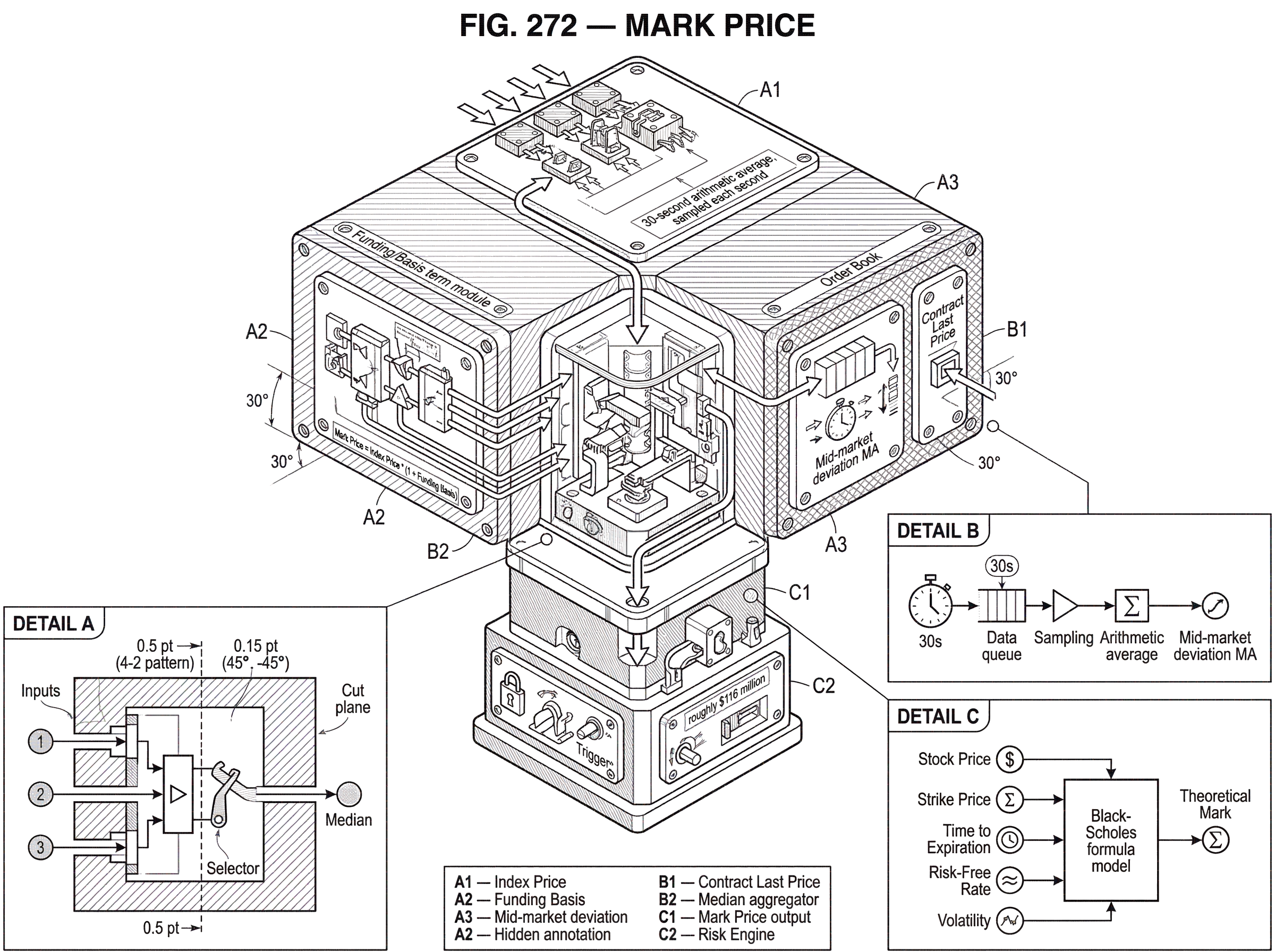
But an index alone is not enough. A perpetual futures contract is not always equal to spot at every moment. Funding, expected carry, and order-book conditions can create a basis; a gap between the contract and the underlying index. So many venues adjust the index with a basis term. Bybit expresses this very cleanly: Mark Price = Index Price * (1 + Funding Basis), where funding basis depends on the funding rate and the time remaining until the next funding event. Binance RCH’s procedures use a more layered design for perpetuals, but the same logic is visible: one component incorporates index price and funding, another incorporates recent order-book deviation from index, and a third uses the contract’s own last traded price.
Then comes the robustness rule. Instead of trusting any one input, the venue often combines several candidate prices and chooses a statistic that is hard to manipulate. Binance RCH says that for perpetual futures in normal sessions, mark price is the median of three values: a funding-adjusted index term, an index-plus-moving-average term, and the contract price. HTX uses a similar median-of-three structure for USDT-margined contracts. The median matters because it ignores any one extreme input. If one component is temporarily wrong, but the other two are reasonable, the mark price stays reasonable.
That is the key design pattern: anchor to the broader market, allow for contract-specific basis, and resist outliers.
How does mark price prevent wrongful liquidations? (worked example)
Imagine a trader is long a perpetual futures contract with high leverage. The contract’s last traded price is 100. The broader spot market across several major venues is also around 100, so the index price is 100 as well. The trader’s position is close to its maintenance margin threshold, but not yet in liquidation.
Now suppose someone hits a thin order book and a small trade prints at 96. If liquidation were based on last trade alone, the system would suddenly treat the contract as if the market had genuinely moved 4% lower. For a highly leveraged trader, that could be enough to cross the liquidation threshold instantly.
But the exchange asks a different question. It looks at the index, which is still near 100. It looks at the best bid and ask, which may imply a mid-market closer to 99.7 than 96. It may look at a short moving average of the book’s deviation from the index, which smooths away a one-second spike. It may also incorporate funding basis if the contract is expected to trade slightly rich or cheap to spot. After combining those inputs, the mark price might come out at 99.5.
Nothing magical happened. The venue did not deny that a trade printed at 96. It simply refused to treat that one print as fair value for risk management. The trader is not liquidated because the market, in any broader sense, has not actually moved enough.
Now reverse the case. Suppose the broader market really does fall and the index drops persistently from 100 to 95, while order-book quotes and recent contract trading follow it lower. Then the mark price falls too, and liquidation does occur if the trader’s margin is insufficient. The system still responds to real market movement. What it tries not to do is confuse a transient print with a real repricing.
This is the entire point of mark price in one example: it filters market information before turning that information into forced risk actions.
How are mark prices calculated for perpetual futures and how does funding matter?
| Component | Source | Purpose | Typical timescale |
|---|---|---|---|
| Funding-adjusted index | Spot index + funding | Reflects funding basis | Seconds to hours |
| Index + moving average | Spot index + short EMA | Smooth local book deviation | 30-second average |
| Contract price | Exchange trade feed | Reflects recent executions | Instant |
Perpetual futures are where mark price matters most, because they do not expire and therefore need a continuous fair-value mechanism. The deepest connection here is with funding.
A perpetual contract has no settlement date pulling it back to spot. Instead, exchanges use funding payments between longs and shorts to keep the contract near the underlying market. If the perpetual trades rich to spot, funding tends to become positive so longs pay shorts; if it trades cheap, funding tends to become negative so shorts pay longs. That creates incentives for traders to push the contract back toward the underlying price.
Because funding is part of how perpetuals stay aligned with spot, it often appears directly in mark price formulas. Bybit makes this explicit with its funding basis term. Binance RCH’s perpetual formula includes Price1, a funding-adjusted price derived from the index price, last funding rate, and time until next funding, and Price2, an index price plus a moving-average deviation term. In other words, mark price is not just “spot copied into derivatives.” It is an estimate of fair perpetual value, which is spot plus or minus a basis shaped partly by funding.
The moving-average term deserves attention. Binance RCH defines its moving average as the 30-second arithmetic average, sampled each second, of the mid-market deviation of the venue’s best bid and ask from the price index. This tells you something important about what the venue is trying to measure. It does not want the entire local order book; it wants a short memory of how the contract’s quoted market has been sitting relative to the broader index. If the contract has been consistently quoted above the index for 30 seconds, that is more informative than a single trade. If the deviation disappears immediately, the average barely moves.
This is a good example of a general principle: mark price is not trying to predict the future; it is trying to estimate fair present value while discounting microstructure noise.
Some venues add further protections in stressed or low-liquidity conditions. Binance RCH’s procedures describe different price-index modes for certain traditional-finance perpetuals, including exponentially weighted moving average modes and even fixed modes during weekends or holidays. HTX adds clamping rules that limit how far mark price can deviate from last price. These choices reflect the same engineering problem under different market conditions: when input data are sparse or unstable, the venue may deliberately favor continuity over raw responsiveness.
Why are options' mark prices model‑based instead of taken from trades?
For options, the idea is the same but the mechanism changes. An option’s fair value cannot usually be read directly from spot or from a simple basis-adjusted index. It depends on strike, time to expiry, underlying price, interest assumptions, and above all implied volatility.
That is why Binance RCH’s procedures say options mark price is calculated in real time using the Black–Scholes model, with implied volatility determined from the option’s best bid and ask, inputs from specialized liquidation market makers, and venue-defined volatility caps and floors. This is not merely a smoothed market price. It is a theoretical price produced from a pricing model using market-derived inputs.
The reason is practical. Many options trade infrequently. If the exchange used last traded price alone, a stale print from minutes or hours ago could drive margin calculations long after the market had moved. A theoretical mark lets the venue infer fair value continuously from the current underlying and current volatility information, even when the option itself is not actively trading.
The analogy here is useful but limited. You can think of options mark price as similar to an appraised house value when there are few recent sales: the estimate uses observable market inputs and a model rather than one transaction. The analogy explains why a model is needed. It fails because an option’s value is much more mechanically model-driven than a house appraisal, and small changes in volatility assumptions can move the output materially.
So for options, the main source of disagreement is not usually one bad last trade. It is the modeling choice: how implied volatility is inferred, capped, or smoothed. That means option mark prices are unavoidably more dependent on venue methodology than simple perpetual marks.
How does mark price determine margin requirements and trigger liquidation?
The most important consequence of mark price is that it governs when positions become dangerous in the eyes of the venue. Binance RCH defines liquidation price as the mark price at which a participant’s margin balance falls below the margin requirement. Its procedures state that liquidation occurs when mark price reaches or crosses that level. Bybit likewise says liquidation is triggered by mark price.
This means mark price is not just a display metric. It is part of the control loop that moves markets from normal trading into forced deleveraging. Unrealized profit and loss, margin balance, maintenance threshold, liquidation trigger; all of these can depend on the mark rather than on the last execution.
That design has a practical consequence traders often misunderstand. A trader may see the last traded price move sharply and assume liquidation is imminent, but if mark price remains relatively stable, liquidation may not happen. The reverse can also be true: if the broader market genuinely weakens and the mark falls even while the venue’s own last price looks temporarily better, the trader can still be at risk. What matters is not which number feels more favorable in the moment. What matters is which number the risk engine trusts.
Some venues go even further in protecting against accidental triggers. HTX says liquidation requires both last-price and mark-price margin ratios to be non-positive, using mark price as an extra reference to reduce unnecessary liquidations. That is one particular policy choice, not a universal rule. The fundamental point is broader: liquidation logic is downstream of the mark-price methodology.
Why does index construction affect mark price integrity and manipulability?
| Index type | Sources | Manipulation resistance | Best for |
|---|---|---|---|
| Multi-source VWAP | Multiple spot venues | High resistance | Liquid markets |
| Single-source feed | One exchange or AMM | Low resistance | Narrow or illiquid assets |
| Pegged or fallback | Redemption/oracle peg | Very high resistance | Stablecoins or emergencies |
If mark price depends on an index, then the integrity of the mark depends heavily on the integrity of that index. This is where the design becomes less about formulas and more about source quality.
A robust index usually aggregates multiple venues, weights them sensibly, and has rules for stale data, bad prints, and venue outages. Binance RCH’s price index uses approved constituent exchanges and liquidity sources. Bybit says its index price is a weighted average of spot quotes subject to usability tests and weight adjustments. The goal is to make it costly for any single venue anomaly to distort the benchmark.
The danger of getting this wrong is not theoretical. The Mango Markets case showed how a derivatives platform that relied on oracle prices from a small number of external venues could be manipulated through those source markets. According to the SEC complaint, the oracle looked at exchange rates on three outside platforms, and those oracle prices were automatically fed into Mango’s perpetual futures pricing. By aggressively buying on the oracle source venues, the attacker pushed the relevant token’s spot and perpetual prices sharply higher, inflated the marked value of his position, and then borrowed roughly $116 million against that inflated collateral before prices collapsed.
The exact implementation details differ between a centralized exchange mark price and an on-chain oracle, but the lesson is the same: a fair-value system is only as hard to manipulate as its inputs. Multi-source construction, volume weighting, outlier handling, and governance over constituent changes are not side details. They are the security model.
That is also why venue discretion matters. Binance RCH’s procedures note that it may amend price-index constituents, mark-price inputs, caps, and parameters, and may treat components differently during outages or maintenance. This flexibility can be useful in emergencies, but it also means the method is partly operational and governed, not purely mechanical. Traders should understand both sides of that tradeoff. Flexibility can stabilize markets; it can also make the precise mark harder to predict from first principles alone.
What is mark price used for, and what guarantees does it not provide?
Mark price exists to support margining, unrealized P&L, and liquidation logic. It is a risk-management price. It is not necessarily the price at which you can enter or exit a position immediately.
This distinction matters because traders often read mark price as if it were an executable market quote. Usually it is not. Your order fills against the order book, not against the mark. If the book is thin or volatile, your realized exit can still be much worse than the mark. Conversely, the mark can move against you even if the last few prints look favorable, because the mark is following the broader fair-value estimate rather than the most recent trade.
So mark price solves one problem while leaving another intact. It reduces wrongful or noisy liquidations. It does not eliminate slippage, market impact, or all manipulation risk. If the index itself is compromised, or if the venue’s fair-value model is poorly designed, mark price can still fail; just in a more sophisticated way.
When can mark price fail, and which policy choices change its behavior?
The strongest assumption behind mark price is that the venue can estimate fair value better than any single trade can. Often that is true. But the exact estimate depends on choices that are not dictated by nature.
How many exchanges should feed the index? How should weights be assigned? What counts as stale or unusable data? Should the mark use a median of candidate prices, a weighted average, an exponential smoother, a clamp, or a theoretical model? How quickly should it adapt during stress? These are engineering and governance choices. Different venues answer them differently because they are balancing competing goods: responsiveness, robustness, predictability, and resistance to gaming.
There is also a deeper tension. The more closely a mark tracks the live market, the more quickly it reflects genuine stress; but also the more exposed it is to transient dislocations. The more heavily it is smoothed or bounded, the more stable it becomes; but the greater the risk that it lags true conditions. There is no universal setting that eliminates this tradeoff.
That tension becomes especially visible in unusual assets or stressed environments. Research and case studies around oracle and collateral pricing show that venue-specific or self-referential price sources can create feedback loops. If liquidations push down a local market, and that local market feeds the mark or collateral value, the system can amplify its own distress. Some postmortem work on exchange and protocol incidents has argued for adding redemption values, proof-of-reserves checks, or fallback modes for certain pegged assets. Whether those approaches are appropriate depends on the product. The general lesson is narrower and more durable: mark price is a risk-control model, and like any model, its failures tend to appear at the edges.
Conclusion
Mark price is the exchange’s estimate of fair contract value for risk management, not just the latest traded price on screen. It exists because liquidation and margin systems need a number that is harder to distort, less noisy than last trade, and better anchored to the broader market.
In practice, that usually means combining an external index with contract-specific basis adjustments, smoothing short-term deviations, and using robust aggregation rules such as a median. For perpetuals, funding is part of the story; for options, theoretical pricing models often are. And because liquidation thresholds are tied to mark price on major venues, understanding mark price is really understanding how the exchange decides when your position is safe, stressed, or gone.
If you remember one thing tomorrow, remember this: the last price tells you what just happened; the mark price tells the risk engine what counts.
How do I start trading crypto derivatives more carefully?
Start by sizing and setting margin mode before you trade. Use Cube Exchange to fund your account, pick the right margin mode, and place controlled orders that limit liquidation risk. These steps focus on practical controls: position size, leverage, order type, and monitoring mark‑price exposure.
- Deposit funds to your Cube account via the fiat on‑ramp or a supported crypto transfer, and enable the margin mode you prefer (isolated for per‑position limits or cross for shared collateral).
- Choose the derivative market and place a limit or post‑only order to enter. Use reduce‑only or limit orders to avoid accidental larger fills and prefer limits when liquidity is thin.
- Size the position by notional value and set maximum leverage explicitly (for example, 5x instead of 25x). Calculate a maintenance‑margin buffer so your liquidation price stays well clear of short‑term wicks.
- Set stop‑loss and take‑profit orders and enable mark‑price alerts. Watch mark price as the trigger for margin checks, and reduce leverage or add collateral if the mark moves toward your liquidation level.
Frequently Asked Questions
Because a single off-market trade or a tiny wick can temporarily move the last traded price far from the broader market, and using that noisy number for margin or liquidation would allow transient prints or manipulative trades to trigger permanent forced closings; mark price is a smoothed, anchored estimate used to avoid those false liquidations.
A typical mark price combines an external index (a volume‑weighted or multi‑exchange spot reference), contract‑specific adjustments such as a funding basis, and a robustness/smoothing rule (e.g., a moving average or taking the median of candidate prices) so it is anchored to the broader market but resists outliers.
Perpetual mark prices commonly include a funding‑adjusted index term (to reflect expected carry), plus short‑memory averages of how the contract’s quoted mid deviates from the index; exchanges often blend those components (for example, a median of funding‑adjusted index, index‑plus‑moving‑average, and contract price) to keep the fair value responsive yet robust.
For options the mark is often a theoretical price computed from an option model (e.g., Black–Scholes) using the current underlying, inferred implied volatility from bids/asks or market makers, and venue caps/floors - because many options trade infrequently, a model gives a continuous fair‑value reference.
Yes - a mark price can be manipulated if its inputs are weak; the Mango Markets incident shows how an oracle built from only a few sources can be gamed, so exchanges mitigate this risk by aggregating many venues, applying volume weights, outlier rejection, and governance over index constituents.
During outages or maintenance venues may intentionally change mark‑price behavior (for example setting moving‑average components to zero, switching smoothing modes, or applying fixed modes), so mark values can deliberately deviate from normal operation to preserve continuity or safety.
No - mark price is a risk‑management reference used for margin, unrealized P&L, and liquidations, not an executable quote; your actual fills come from the live order book and can suffer slippage or impact even when the mark looks favorable.
Different venues balance responsiveness, robustness, and anti‑gaming differently (choices about index constituents, weights, smoothing windows, medians vs. averages, clamping), so mark formulas and therefore liquidation triggers vary by platform and even by contract; exact per‑contract algorithms and parameters are typically specified in each venue’s contract specifications or procedures.
Related reading