What is Isolated Margin?
Learn what isolated margin is, how it works in leveraged trading, how liquidation behaves, and why traders use it to limit losses to one position.
Introduction
Isolated margin is a way of using leverage that confines the collateral supporting a trade to that trade itself, instead of letting losses spill into the rest of your account. That sounds like a small settings change, but it solves a very specific problem: in leveraged trading, the most dangerous losses are often not the first losses, but the ones that keep pulling in more collateral after the trade has already gone wrong.
If you have only ever traded spot, the need for this can feel odd. You buy an asset, it goes down, and you still own it. Margin trading and derivatives are different because your position is supported by a margin balance that can be adjusted, borrowed against, and liquidated. The central design choice is therefore not just what market are you trading, but which funds are allowed to defend the trade when price moves against you.
That is the real point of isolated margin. It creates a boundary around a position. Inside that boundary sit the funds assigned to keep that position alive. Outside it sits the rest of your account, which the system will not automatically drain to rescue that particular trade. Exchanges often contrast this with cross margin, where collateral is shared more broadly across positions or across all positions of the relevant asset type.
The key idea is easy to remember: isolated margin localizes failure. A losing isolated position can still be liquidated, and you can still lose all the margin assigned to it. But the loss is meant to stop there, rather than becoming a claim on the rest of your available collateral.
Why use isolated margin to prevent one trade from draining your account?
Leverage amplifies both returns and fragility. When you open a leveraged position, you are controlling more exposure than the cash you posted. That means there is a threshold below which your collateral is no longer sufficient to support the position. If the market moves far enough against you, the platform closes the position through liquidation.
Without isolation, there is a natural tendency for the system to treat your account as one collateral pool. That can be useful when positions are meant to support each other. A profitable or conservatively margined position can help absorb temporary losses elsewhere. But this same flexibility is what makes cross-style collateral dangerous: a single bad trade can begin consuming funds that were not mentally or strategically allocated to it.
Imagine a trader with several positions. Perhaps one is a high-conviction hedge, another is a lower-risk basis trade, and a third is a speculative punt on short-term volatility. If all available collateral is shared, the speculative trade is not truly self-contained. Once it starts losing, the platform may keep drawing on the common pool to delay liquidation. That can turn a mistake in one market into stress across the entire portfolio.
Isolated margin was designed to stop that chain reaction. Instead of saying, “Use whatever funds are available to support this trade,” it says, “This position gets this much collateral, no more unless I explicitly add more.” That changes the geometry of risk. It does not make the position safer in the sense of guaranteed profitability. It makes the scope of damage more predictable.
How does isolated margin ring-fence collateral for a position?
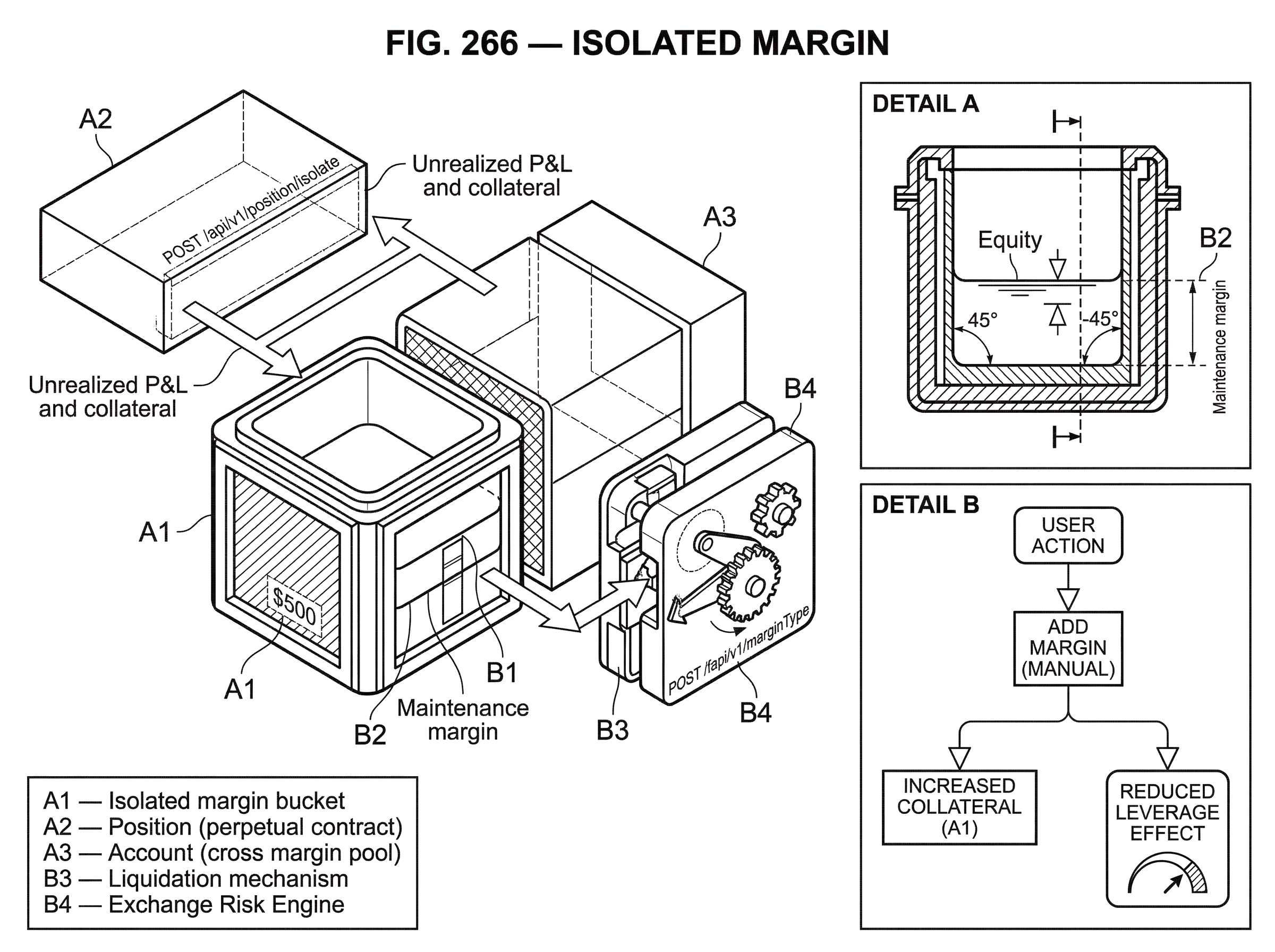
The simplest way to think about isolated margin is as a dedicated collateral bucket attached to a specific position, contract, or symbol. The exact unit depends on the platform. Some venues describe the setting as per position. BitMEX’s API, for example, exposes a POST /api/v1/position/isolate endpoint and says users can switch isolated margin “per-position,” explicitly calling it “fixed margin.” Other exchanges expose it at the symbol level. Binance’s USDⓈ-M futures API offers POST /fapi/v1/marginType with marginType set to ISOLATED or CROSSED, while Bybit’s V5 API exposes a per-symbol switch where tradeMode is 0 for cross and 1 for isolated.
That implementation detail matters less than the invariant they share: the platform tracks margin separately for the isolated trade instead of treating it as freely shared account equity. CoinMarketCap’s glossary captures the user-facing consequence cleanly: isolated margin lets traders isolate the margin a position uses so they can limit potential liability to the initial margin allocated to that position.
Once you see that, the rest follows mechanically. The platform marks the position to market as price changes. Losses reduce the equity inside that isolated bucket. If equity falls toward the maintenance requirement, liquidation risk rises. If the position is liquidated, the system closes it using the collateral in that bucket. Under isolated margin, the platform is generally not supposed to keep drawing from unrelated balances to save that trade.
Bybit’s contract rules make this explicit in user-facing terms: the maximum loss for a position under isolated margin is limited to the initial margin and any manually posted extra margin, and if the position is liquidated, no extra margin will be drawn to the position. That statement captures both the benefit and the limit. The benefit is bounded liability at the position level. The limit is that bounded liability can still be fully lost.
What are initial and maintenance margin, and why can isolated positions still be liquidated?
A common misunderstanding is to treat isolated margin as a kind of liquidation shield. It is not. It changes where losses can come from, not whether large adverse moves can force the position closed.
To open a leveraged trade, you post initial margin. This is the amount needed to establish the position, and it depends mainly on position size and leverage. If you choose higher leverage, the required initial margin is lower, because you are posting less collateral per unit of exposure. But that also means you have less room for error.
To keep the position open, you must remain above maintenance margin, the minimum collateral level required to support it. Bybit describes maintenance margin as the minimum needed to hold a leveraged position and notes that the calculation includes the maintenance margin rate applied to contract value and the taker fee needed to close the position. The precise formula varies by venue and product, but the principle is universal: there is some lower bound below which the system will not continue carrying the trade.
Here is the mechanism in plain language. Suppose you open a leveraged ETH perpetual and allocate a fixed amount of isolated margin to it. If ETH moves against you, the unrealized loss comes out of the equity tied to that position. As the remaining equity shrinks, the gap between your position and the liquidation threshold shrinks too. If the market keeps moving the wrong way and your isolated equity falls to the maintenance requirement, the exchange liquidates. The fact that the rest of your account still has funds does not automatically save the trade, because those funds are outside the isolated bucket.
This is why isolated margin is best understood as damage containment, not risk removal. You are deciding in advance how much collateral a trade is allowed to burn through before it dies.
Example: How isolated margin limits loss on a leveraged ETH trade
Consider a trader who wants to take a speculative short-term position in ETH but does not want that idea to endanger the rest of the account. They open a perpetual contract and assign $500 of isolated margin to the position. The contract gives them more market exposure than $500 because leverage is involved, but the collateral defending the trade is still only that assigned amount.
Now imagine the market moves sharply against them. Their position accumulates losses. Because the trade is isolated, those losses reduce the equity assigned to this ETH position alone. If price keeps moving the wrong way and liquidation is triggered, the trade is closed and the trader loses the isolated margin attached to it. CoinMarketCap gives essentially this example: if a trader assigns $500 of isolated margin and is liquidated, the maximum loss for that position is that $500 amount.
What did isolated margin accomplish here? Not a better entry. Not a better forecast. Not immunity from liquidation. What it accomplished was separation. The losing ETH trade did not automatically reach into other funds that might have been intended for another contract, another coin, or simply left unused as reserve.
That separation is especially valuable when a portfolio contains positions with very different purposes. A trader may want one volatile directional bet to be tightly capped while allowing another more strategic position to use broader collateral support. Isolated margin allows that distinction to exist operationally rather than only as an intention in the trader’s head.
When and why do traders choose isolated margin?
People usually choose isolated margin for one of two underlying reasons, and both come from the same principle of control.
The first reason is position-level risk budgeting. A trader may decide in advance that a particular trade deserves only a fixed loss budget. Isolated margin makes that budget enforceable by the venue’s liquidation system. This is useful for speculative setups, event trades, or markets where the trader expects elevated volatility and does not want the position to “borrow credibility” from the rest of the portfolio.
The second reason is portfolio compartmentalization. If several positions coexist, especially with different risk profiles, isolation prevents one liquidation from becoming a portfolio-wide event. CoinMarketCap notes that isolated margin is particularly useful for speculative traders and for users holding diverse portfolios with positions carrying different levels of risk. That is not because isolated margin is universally better, but because it matches a portfolio where not all trades should have access to all collateral.
There is also a psychological benefit, though it should not be overstated. Traders often believe they are risking a certain amount on a trade, but under cross margin the system may behave differently from that intuition by using shared collateral to keep the position alive longer. Isolated margin narrows the gap between the trader’s intended risk cap and the platform’s margin behavior.
Isolated margin vs cross margin: trade-offs in safety and capital efficiency
| Mode | Contagion | Capital efficiency | Liquidation timing | Best for |
|---|---|---|---|---|
| Isolated | No spillover to account | Lower (per-position buckets) | Earlier liquidation risk | Speculative capped-loss trades |
| Cross | Can draw on account funds | Higher (shared collateral) | Can delay liquidation | Hedged books and market makers |
If isolated margin were strictly better, cross margin would not exist. The reason both modes persist is that they optimize for different things.
Isolated margin optimizes for containment. Cross margin optimizes for flexibility. When collateral is shared, spare equity from elsewhere in the account can absorb temporary losses and reduce the chance that a position is liquidated by a short-lived move. This can be valuable for hedged books, market makers, or traders who deliberately manage portfolio risk at the account level rather than the trade level.
The cost of isolated margin is therefore mostly a cost in capital efficiency. If each position must defend itself with its own collateral, then idle margin in one place cannot automatically protect a stressed position elsewhere. CoinMarketCap puts this in simpler retail terms by saying exposure is limited to one position in a particular market. That is the visible symptom of a deeper fact: ring-fencing collateral makes each trade less able to benefit from unused strength elsewhere.
Bybit’s description of cross margin shows the opposite design choice. In cross margin, all available margin of the relevant asset type can be drawn to prevent liquidation. That can keep a fundamentally sound but temporarily stressed position alive. But it also means a trader has granted the system permission to spend more of the account defending that position.
So the choice is not “safe” versus “unsafe.” It is where do you want flexibility to live? If you want flexibility at the portfolio level, cross margin is often more suitable. If you want hard boundaries around individual trades, isolated margin is often the better fit.
Can you add margin to an isolated position and how does it affect liquidation?
| Action | Collateral change | Leverage effect | Liquidation effect | Control required |
|---|---|---|---|---|
| Leave as-is | No change | Leverage unchanged | Higher liquidation probability | No action |
| Add extra margin | Increase isolated collateral | Lower effective leverage | Reduces liquidation risk | Manual decision |
| Switch to cross | Expose account funds | Effective leverage may change | May prevent liquidation | Opt-in system change |
Isolation does not always mean rigidity. Many platforms allow a trader to add more margin to an isolated position after it is opened. This is an important nuance because it shows that isolated margin is not merely an on-off switch; it is a boundary with a gate that the trader can choose to open manually.
Bybit states that traders may manually append extra margin to an isolated position, which reduces effective leverage and improves the liquidation price. Mechanically, this makes sense. The position size stays the same, but the collateral defending it increases. More collateral means more adverse price movement can be absorbed before the equity falls to maintenance margin.
That manual addition is a good illustration of why isolated margin is about control rather than austerity. You are not forbidding a position from receiving more support. You are requiring an explicit decision before that happens. The platform will not automatically transfer unrelated funds into the trade, but you can choose to do so.
There are, however, operational details that vary by venue. Bybit notes a notable caveat: if position leverage is adjusted, extra margin previously posted is reset to zero. That kind of platform-specific rule matters in practice because it affects how traders manage positions dynamically. The general concept remains stable across venues, but the exact user experience does not.
How do exchanges expose isolated margin in their APIs and UIs?
Although isolated margin is conceptually simple, its implementation reveals something important: venues treat margin mode as a configurable risk engine setting, not just a label in the user interface.
On BitMEX, isolated margin appears in the API as a per-position toggle through POST /api/v1/position/isolate, with the documentation explicitly saying it switches margin isolation (also called fixed margin) on and off. On Binance futures, changing margin mode is done with POST /fapi/v1/marginType, where the caller provides a symbol, a marginType, and a timestamp; the allowed values are ISOLATED and CROSSED. Bybit similarly provides a per-symbol endpoint that requires a product category, a symbol, and a tradeMode integer indicating cross or isolated, with optional leverage fields.
These API surfaces show that isolated margin is not an obscure edge case. It is a core piece of derivatives infrastructure that must be configurable in automated systems as well as in exchange apps. They also show that the concept is not tied to a single exchange architecture. Some systems scope it per position, some per symbol, and some pair it tightly with leverage selection and risk limits.
Even in spot-margin style systems, exchanges expose isolated-margin markets separately. Binance’s margin API includes GET /sapi/v1/margin/isolated/allPairs, which returns the list of isolated-margin trading pairs and flags such as whether buying, selling, and margin trading are allowed for each symbol. That is the operational footprint of isolation: the exchange has to know not only that isolated margin exists, but exactly where it is offered and how to track those isolated books.
How do different liquidation mechanisms affect outcomes for isolated positions?
| Design | Who benefits | Trader outcome | When used |
|---|---|---|---|
| Partial liquidation | Exchange / risk engine | Reduces position size, limits loss | Routine during stressed positions |
| Insurance fund | Deficits covered collectively | Buffers trader losses | When liquidations exceed collateral |
| Auto-deleveraging (ADL) | Opposite counterparties | Counterparty positions reduced | When insurance fund insufficient |
| Discounted collateral sale | Liquidators | Borrower suffers steep loss | Common in DeFi lending liquidations |
Isolated margin limits the spread of losses across your account, but what happens inside the isolated bucket still depends on the venue’s liquidation design. This is where many simplified explanations stop too early.
Liquidation is not just a threshold event; it is a process. In DeFi research on major Ethereum lending protocols, liquidation is described as selling debt collateral at a discount to liquidators. The study finds that liquidation systems can strongly incentivize liquidators while still producing excessive discounted selling at the borrower’s expense. That research is about lending protocols rather than exchange margin mode menus, so the mapping is not one-to-one. But it highlights a broader point: even if the amount at risk is isolated, the realized outcome depends on how the platform unwinds distressed positions.
In centralized derivatives venues, liquidation may involve partial liquidation, fees, insurance funds, and in extreme cases auto-deleveraging. Bybit’s rules discuss the insurance fund and ADL as downstream mechanisms when liquidations close above or below bankruptcy price. Those details matter because they remind us that isolation draws the boundary of who pays, but the venue’s risk engine still determines how the closing process happens and what secondary mechanisms are triggered.
So when evaluating isolated margin, there are really two questions. The first is: how much collateral can this position consume? Isolation answers that. The second is: how does the venue close the position once that collateral is no longer enough? That answer depends on the platform’s liquidation machinery.
Common misconceptions about isolated margin
The most common misunderstanding is believing isolated margin means “I can only lose my initial margin, full stop.” That is sometimes close enough for intuition, but it can be incomplete. If the platform lets you add extra isolated margin, then the actual at-risk amount becomes the initial margin plus any extra margin you manually attach. Bybit states this explicitly.
A second misunderstanding is assuming isolated margin is always the conservative choice. It is conservative with respect to contagion across your own account. It is not automatically conservative with respect to probability of liquidation. Because isolated positions cannot automatically draw on unused collateral elsewhere, they may be liquidated sooner than an equivalent position under cross margin during a temporary adverse move.
A third misunderstanding is thinking this is purely a retail convenience feature. The existence of direct exchange APIs for switching margin mode shows otherwise. Programmatic traders, strategies, and risk systems need explicit control over whether a position is ring-fenced or collateral-sharing. Isolation is part of the market’s mechanical configuration, not just a simplified user setting.
Which isolated margin behaviors vary by exchange and what should you check?
The broad idea of isolated margin is stable, but important details are not universal. Some venues describe the scope as per position, others per symbol. Some allow margin to be added or removed while a position is open. Some combine the switch with leverage changes. Some make cross margin the default and require the user to opt into isolated mode, as Bybit does.
The exact liquidation threshold, maintenance margin schedule, fee treatment, and restrictions on switching modes are also venue-specific. The Binance, Bybit, and BitMEX API pages are useful because they prove the control surfaces exist, but they do not fully describe every behavioral side effect. For example, the endpoint references do not always spell out what happens if you try to switch modes with active orders or how collateral moves under every edge case. That is an implementation detail traders and developers must verify in the product rules and live behavior of the specific venue they use.
This is not a flaw in the concept. It is simply a reminder that isolated margin is a design pattern implemented by specific risk engines, not a single protocol law with identical behavior everywhere.
Conclusion
Isolated margin is best understood as a way to put a hard boundary around a leveraged trade. The position gets its own collateral allocation, losses consume that allocation, and liquidation ends the position without automatically recruiting the rest of your account to defend it.
That is why isolated margin exists. It turns leverage from an account-wide promise into a position-level budget. The price of that protection is lower capital efficiency and less automatic support from spare collateral elsewhere. If you remember one thing, remember this: isolated margin does not make a bad trade safe; it makes the damage from that trade easier to contain.
How do you start trading crypto derivatives more carefully?
Trade derivatives more cautiously by sizing each position, choosing isolated margin when you want a hard per-trade loss cap, and using order controls to limit execution risk. On Cube Exchange you can fund your account, pick the derivatives market, set margin mode and per-position collateral, and then place orders with explicit risk controls.
- Fund your Cube account with fiat or a supported crypto deposit.
- Open the derivative market (symbol) you plan to trade and switch the margin mode to Isolated or set an isolated margin amount for that position.
- Set leverage and choose an order type: use a limit order for price control or a market order for immediate execution; add a stop-loss order to cap downside.
- Review the position’s liquidation price and, if needed, manually add extra isolated margin or lower leverage to move the liquidation threshold away from spot price.
Frequently Asked Questions
Isolated margin confines the collateral for a trade to a dedicated bucket attached to that position (or symbol), while cross margin treats available funds as a shared pool that can defend multiple positions; isolated localizes losses, cross offers portfolio-level flexibility to absorb temporary losses.
No - isolated margin does not prevent liquidation; it only limits which funds the exchange will use to defend the trade, so a large adverse move can still drive the position to its maintenance threshold and trigger liquidation.
Often yes: many venues let you manually add extra margin to an isolated position to lower effective leverage and move the liquidation price, but rules vary and some platforms reset added margin when you change leverage, so the ability and permanence of additions depend on the exchange.
Not necessarily; while isolated margin generally limits a position’s maximum loss to the initial margin plus any extra margin you explicitly post, that statement omits platform-specific rules (e.g., manual additions or interactions with bankruptcy handling), so the at‑risk amount can be more than the initial margin in practice.
Isolated margin reduces capital efficiency because each trade must carry its own collateral buffer, whereas cross margin lets idle equity elsewhere protect a stressed position; choose isolated for hard per‑trade loss budgets and cross for portfolio‑level flexibility.
It depends by platform: some systems expose isolation per position (e.g., BitMEX’s per-position isolate endpoint), others expose it per symbol (Binance and Bybit examples), so whether isolation is per-position or per-symbol is an implementation detail you must check for the exchange you use.
Isolation answers who pays, not how the position is closed - liquidation outcomes still depend on the exchange’s rules (partial liquidation, insurance funds, auto‑deleveraging, fees) and, in DeFi analogues, on liquidator behavior and discounts, so identical isolated losses can realize differently across venues.
You cannot assume seamless mode switches; the article and API references note implementation differences and incomplete documentation for edge cases, so whether you may switch margin modes with open positions or what immediate effects occur is platform‑specific and must be verified in the exchange’s rules or API docs.
Related reading