What is Deribit?
Learn what Deribit is, how its crypto options and futures exchange works, and why traders use it for derivatives, margin efficiency, and API access.
Introduction
Deribit is a centralized crypto exchange focused on derivatives trading, especially options, futures, and perpetuals. That matters because derivatives are where many professional traders actually express views, hedge risk, and manage capital efficiently; they are not simply a more aggressive version of spot trading. A platform built for derivatives has to solve a different problem from a general-purpose exchange: it needs deep order books, precise risk management, fast execution, and a margin system that can handle portfolios rather than just single positions.
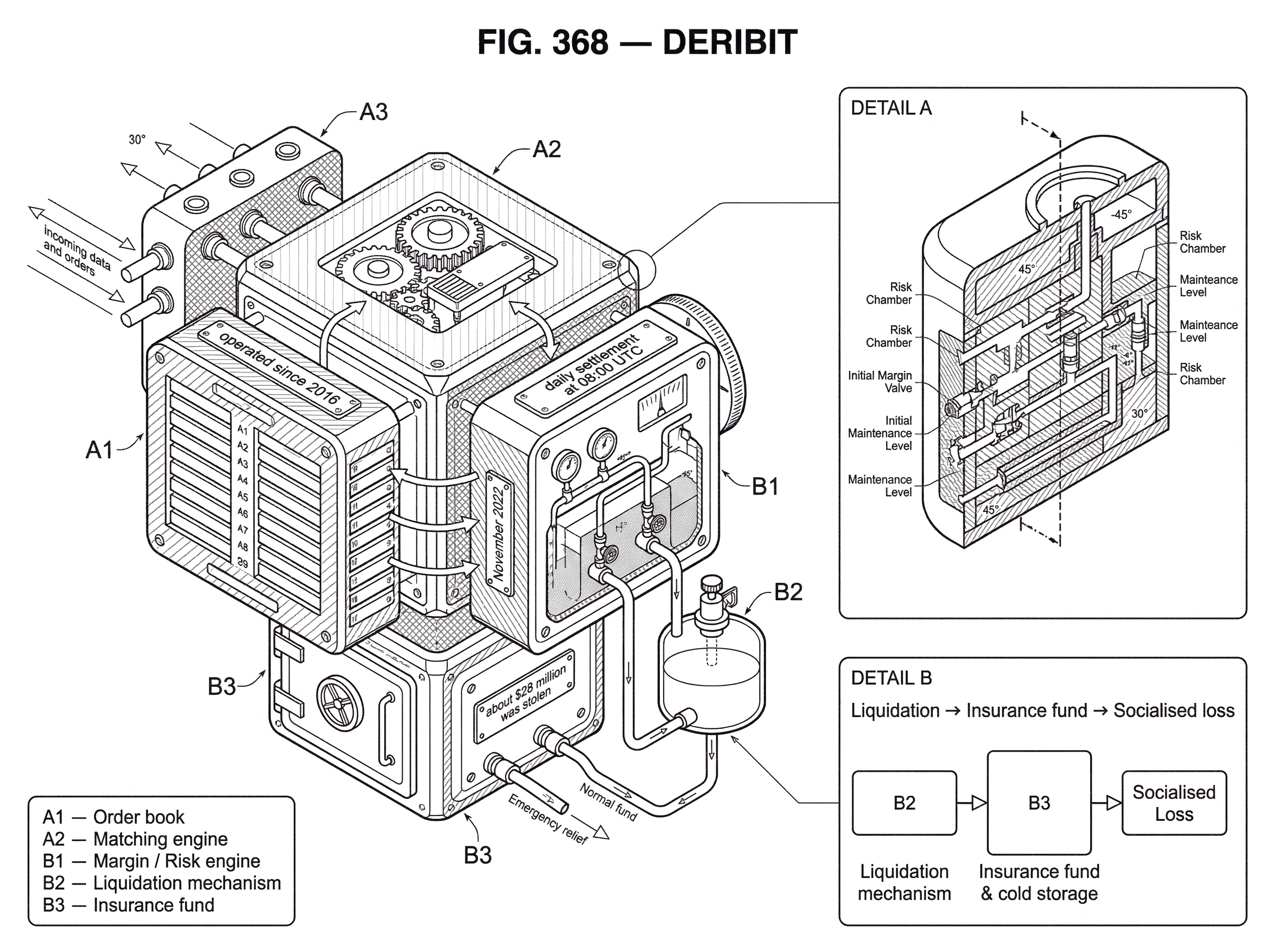
Deribit has built its identity around that problem. The platform offers crypto options, perpetuals, futures, and spot trading, but its center of gravity is clearly derivatives. By its own description, it has operated since 2016 and is widely used by market makers, hedge funds, investment firms, and quantitative traders. That positioning tells you what kind of exchange it is trying to be: not the easiest place to buy your first bit of crypto, but a specialized venue for traders who care about execution quality, hedging tools, and capital efficiency.
Why do derivatives exchanges like Deribit operate differently from spot exchanges?
The simplest way to understand Deribit is to start with the gap between spot trading and derivatives trading. In spot, you are mostly exchanging one asset for another: buy BTC, sell ETH, hold USDC. The main questions are price, custody, and settlement. In derivatives, the product is a contract whose value depends on the price of something else. That adds a new layer: the exchange must continuously manage the risk that traders cannot meet their obligations as prices move.
That is why Deribit’s useful features are tightly connected to risk machinery. If you trade an option or a Perpetual contract, the exchange cannot just wait until the end and hope all parties can settle. It needs margin rules, liquidation logic, mark prices, and a loss-absorption system for accounts that go bankrupt. These are not side details. They are the mechanism that makes the market tradable at all.
This also explains who finds Deribit attractive. Options traders need liquid strikes and expiries. Market makers need an API and reliable matching. Hedged traders need a margin model that recognizes offsetting positions instead of charging full margin on each leg separately. If the exchange does those things well, it becomes valuable even to users who could trade the same underlying assets elsewhere.
What products (options, futures, perpetuals, spot) can you trade on Deribit?
Deribit offers four product types: options, perpetuals, futures, and spot. The important distinction is not just the menu, but how these products relate to different trading goals.
Options are the clearest sign of Deribit’s niche. An option gives the holder the right, but not the obligation, to buy or sell an asset under defined terms. Traders use options when they care not only about direction, but also about volatility, downside protection, or structured payoff shapes. That makes options markets much more demanding than simple buy-sell markets, because users need many strikes, expiries, and enough liquidity across them to enter and exit positions without excessive slippage. Deribit’s claim to being the largest crypto options and futures exchange, with a dominant share in BTC and ETH options, matters mainly because liquidity tends to reinforce itself in options markets.
Perpetuals and futures serve a more direct role. They let traders take leveraged long or short exposure without holding the asset in spot form. A perpetual has no fixed expiry, while a futures contract does. For many users, these are the main directional trading instruments. Spot exists on Deribit too, but mainly as part of the broader trading environment rather than as the platform’s defining purpose.
How does Deribit’s margin system work and why does it matter for traders?
| Model | Assessment | Capital efficiency | Best for | Liquidation risk |
|---|---|---|---|---|
| Standard | Per-position calculations | Lower efficiency | Single-leg bets | Higher for offset books |
| Portfolio | Portfolio-level assessment | Higher efficiency | Multi-leg hedged books | Lower via netting |
The most important user-facing mechanism on Deribit is its margin system. Margin is the collateral that stands behind your positions. Without it, derivatives trading would collapse into unsecured promises.
Deribit defines initial margin as the minimum margin needed to open a position. If your account exceeds its initial margin usage, you cannot add more risk, and non-risk-reducing open orders can be canceled. It defines maintenance margin as the minimum required to keep positions open. If your account breaches maintenance requirements, positions can be liquidated until the requirement is back under control or the position is fully closed.
The deeper idea is that margin is not only about leverage. It is about protecting the market from contagion when prices move sharply. Suppose a trader uses collateral to sell options and the market moves against them. The exchange cannot allow losses to keep growing unchecked, because those losses would eventually become someone else’s problem. Maintenance margin and liquidation are the circuit breakers that try to stop an account from going deeply negative.
Deribit supports both Standard margin and Portfolio margin, and this difference is central to how sophisticated traders use the platform. Under Standard margin, each position is assessed separately and the requirements are added together. That is simple, but it can overstate risk when positions offset each other. Under Portfolio margin, the system looks at the risk of the portfolio as a whole. A trader who is long one option and short another related option may be taking much less net risk than the two positions suggest individually, so portfolio-based assessment can be much more capital efficient.
The same logic extends further in the exchange rulebook, which describes multiple margin mechanisms, including segregated and cross-collateral variants. The practical point is straightforward: Deribit is designed for traders whose positions interact. If you only ever place a single outright bet, a simple per-position margin model may be fine. If you run spreads, hedges, or multi-leg options books, recognizing portfolio effects is a major advantage.
A concrete example makes this clearer. Imagine a trader who buys one BTC option and sells another option at a different strike as part of a spread. Economically, that trader has capped both upside and downside relative to a naked short option. A simple position-by-position system may still charge substantial margin on the short leg as if it stood mostly alone. A portfolio-aware system instead asks the more relevant question: what is the worst plausible loss of the package? That is the question professional derivatives traders actually care about, and it is why portfolio margin can make the platform meaningfully more usable for them.
Are Deribit’s APIs and execution features suitable for market‑making and low‑latency trading?
| Interface | Latency | Directionality | Best use | Notes |
|---|---|---|---|---|
| WebSocket JSON-RPC | Lowest latency | Bidirectional stream | Real-time market making | Recommended for live trading |
| HTTP JSON-RPC | Higher latency | Request-response | Ad hoc scripts and queries | Easy to use |
| FIX API | Low latency | Session oriented | Institutional order flow | Standard in finance |
Deribit is also built for users who do not trade only through a webpage. Its API documentation offers three access methods: JSON-RPC over WebSocket, JSON-RPC over HTTP, and FIX API. The recommended interface for most real-time use cases is WebSocket, because derivatives trading often depends on constant updates to prices, positions, and risk state.
That technical design reveals something important about the platform. In a derivatives venue, especially one used by market makers and quantitative firms, the API is not a convenience layer on top of the exchange. It is part of the exchange itself. Traders may stream market data, recalculate fair values, quote options, hedge deltas, and modify orders continuously. Latency, rate limits, authentication scopes, and environment separation between test and production all matter because many users are running systems rather than manually clicking trades.
Deribit explicitly separates test and production environments and requires separate accounts and API keys for each. That may sound inconvenient, but it reflects a sensible boundary: experimentation should not accidentally become live trading. For institutions and algorithmic traders, this separation is part of operational discipline.
What are Deribit’s liquidation, insurance fund, and socialised loss procedures?
| Stage | Trigger | User impact | Timing |
|---|---|---|---|
| Liquidation | Breach maintenance margin | Positions forcibly closed | Immediate |
| Insurance Fund | Negative balance after liquidation | Covers bankrupt shortfall | Immediate to short term |
| Socialised Loss | Insurance fund depleted | Profitable traders taxed pro rata | Applied after settlement |
| Withdrawal hold | Current‑session profits unsettled | Withdrawals delayed | Daily settlement 08:00 UTC |
Deribit’s design becomes most visible under stress. If an account falls below maintenance margin, the platform may liquidate positions. If liquidation still leaves a negative balance, losses move into a second layer: the Insurance Fund, which exists to cover bankruptcies. If that fund is insufficient, Deribit’s rules describe a Socialised Loss Mechanism under which traders with positive intraday profits can have a pro-rata amount deducted.
This is one of the platform’s most important trade-offs, and it should be understood plainly. On Deribit, your risk is not only the market risk of your own positions. In extreme conditions, there is also platform-level counterparty structure: liquidation, insurance, and then potentially socialized loss. That does not mean the system is unusual for derivatives markets in principle; it means the exchange must define a loss waterfall so contracts remain enforceable even during disorderly markets.
A small but practical consequence appears in withdrawals. Deribit states that current-session profits can only be withdrawn after daily settlement at 08:00 UTC, specifically because of how its socialized loss system operates. So if you make money during a session, that profit is not always immediately portable. For active traders managing liquidity across venues, that timing matters.
There are also governance and operational constraints. Personal verification, or KYC, is required before users can deposit, withdraw, or trade. Access is restricted for certain jurisdictions, including the United States. Deribit also states that it does not guarantee uninterrupted platform availability and reserves the right to reverse or adjust trades it regards as abnormal. These are not marketing details, but part of the actual contract between trader and venue.
How did Deribit handle custody and transparency after the 2022 hot‑wallet hack?
Because Deribit is a centralized exchange, users also take custody and operational risk. The exchange rulebook states that Deribit either holds users’ virtual assets directly or controls them through third-party custodians. A public incident in November 2022 made that risk concrete: Deribit reported that its hot wallet was compromised and about $28 million was stolen, while stating that client assets, trading, cold storage, and the insurance fund were unaffected and that the loss was covered by company reserves.
What matters here is not only the incident itself, but what it shows about the platform’s operating model. Deribit said it keeps the large majority of user funds in cold storage and later migrated hot-wallet operations to Fireblocks, with manual confirmation for withdrawals. That improves security but creates a trade-off: more human control generally means less immediacy. Deribit said withdrawals would no longer be instant and aimed to process most within 60 minutes.
On transparency, Deribit has also published a Proof-of-reserves explainer describing a daily snapshot system for customer liabilities and on-chain assets, using a modified Merkle-tree approach intended to let users verify inclusion without exposing other users’ balances. The caveat is that assets held by third-party custodians are excluded from the public asset file because they are not in Deribit’s direct control. So the proof gives useful visibility, but not a perfect picture of every custody arrangement.
Why do professional traders use Deribit for crypto derivatives?
Put together, Deribit is best understood as infrastructure for serious crypto derivatives trading. Traders choose it when they need liquid options markets, portfolio-aware margining, and programmatic access that fits market-making or quantitative workflows. The platform’s features make the most sense for people managing risk across positions rather than making isolated spot trades.
That specialization is also why Deribit can feel less beginner-friendly than a retail-first exchange. KYC is mandatory before trading begins. The products themselves are leveraged and structurally riskier than spot. And the exchange’s risk controls, liquidation logic, and loss waterfall are things users need to understand before they matter, not after.
Conclusion
Deribit is a crypto derivatives exchange built around a simple but demanding idea: if traders want options, futures, and perpetuals to be genuinely useful, the exchange must manage risk as carefully as it matches orders. Its value comes from deep derivatives liquidity, margin systems that understand portfolios, and technical access suited to professional trading. The trade-off is that using Deribit means accepting the discipline, constraints, and counterparty structure that make those markets possible in the first place.
What should you look for before choosing a crypto exchange?
Before choosing a crypto exchange, check custody model, execution quality, fees, and product support and then run the same tests on Cube Exchange to compare real behavior. Fund a small amount on Cube, open the same derivative or spot market, and use Cube’s interface or API to replicate your checks so you can compare custody, latency, margin rules, and withdrawal behavior side‑by‑side.
- Read the exchange’s custody and security pages and note whether funds are held custodially, split hot/cold, or run through third‑party custodians; then open Cube’s security docs to compare custody model and proof‑of‑reserves scope.
- Compare margin and risk rules: verify if the venue supports portfolio margin, inspect liquidation mechanics (insurance fund and any socialised loss rules), and review the options/futures fee schedule; flag any session withdrawal limits (for example, Deribit holds current‑session profits until 08:00 UTC).
- Test execution and APIs: create sandbox or test API keys, stream WebSocket or FIX market data, place and cancel small limit orders, and measure latency and fills; repeat the same API checks on Cube to compare throughput and order behavior.
- Run a live micro test: deposit a small amount to each platform, execute a small trade in the product you need, then request a withdrawal to observe actual processing time, verification requirements, and any settlement gating.
Frequently Asked Questions
Portfolio margin assesses the risk of your entire portfolio (recognizing offsets between related positions) and is therefore more capital efficient for multi‑leg books; Standard margin treats positions separately and simply adds their requirements, which can overstate risk for hedged trades.
If an account falls below maintenance margin Deribit can liquidate positions until the account meets margin requirements or is closed; if liquidation leaves a negative balance losses are first absorbed by the Insurance Fund and, if that is depleted, a Socialised Loss Mechanism may pro‑rata deduct profits from other members.
No - Deribit restricts withdrawal of current‑session profits until daily settlement at 08:00 UTC, a limitation tied to how its insurance fund and socialised loss system operate.
Deribit publishes Proof‑of‑Reserves snapshots but explicitly excludes assets held with third‑party custodians from the public asset file, and the firm states snapshots are taken daily; however, some support pages were not retrievable so full methodological details and third‑party attestations are not fully documented in the available sources.
Deribit reported a November 2022 hot‑wallet compromise in which about $28 million was stolen, stated client funds, cold storage and the insurance fund were unaffected, said the loss was covered by company reserves, and moved hot‑wallet operations to Fireblocks while adding manual withdrawal confirmations.
The Rulebook allows Deribit to trigger a Socialised Loss Mechanism that pro‑rata deducts profits from Members when the Insurance Fund is exhausted, but the exact numeric thresholds, Insurance Fund size, and precise allocation formulas are not specified in the public materials.
Yes - Deribit supports JSON‑RPC over WebSocket and HTTP and a FIX API, recommends WebSocket for real‑time use cases, and enforces separate test and production environments that require separate accounts and API keys.
No - KYC/personal verification is mandatory before deposits, withdrawals or trading, and Deribit’s Rulebook lists a comprehensive set of restricted jurisdictions that explicitly includes the United States.
Related reading