What is Bybit?
Learn what Bybit is, how its crypto exchange works, and why its unified account, derivatives markets, fees, and API matter to active traders.
Introduction
Bybit is a centralized cryptocurrency exchange: a platform where users can buy and sell assets such as Bitcoin and Ether, place orders in spot and derivatives markets, and manage those positions through a single account system. That sounds straightforward, but the interesting part is why an exchange like Bybit exists in this form. Crypto markets run continuously, prices move across many instruments at once, and active traders often do not want separate piles of capital trapped in separate products. Bybit’s design is aimed at solving that coordination problem.
At the surface level, Bybit is the website and trading platform at bybit.com, with market access, account management, documentation, help-center materials, and official announcements. But at a user level, the platform is better understood as a venue for matching buyers and sellers across different kinds of crypto exposure. Someone might want to buy Bitcoin outright on spot. Someone else might want a perpetual contract that tracks Bitcoin’s price with leverage. Another user may want to hedge an options position with futures. Bybit tries to make those activities live inside one exchange rather than across disconnected systems.
That choice tells you who the platform is really built for. A beginner can arrive because the homepage presents the simple promise of buying and selling Bitcoin and Ether. But much of the product architecture points toward more active users: traders who care about order types, margin efficiency, funding costs, liquidation behavior, and API access. The platform is useful precisely because it reduces the friction between those needs.
What core market functions does Bybit perform as a centralized exchange?
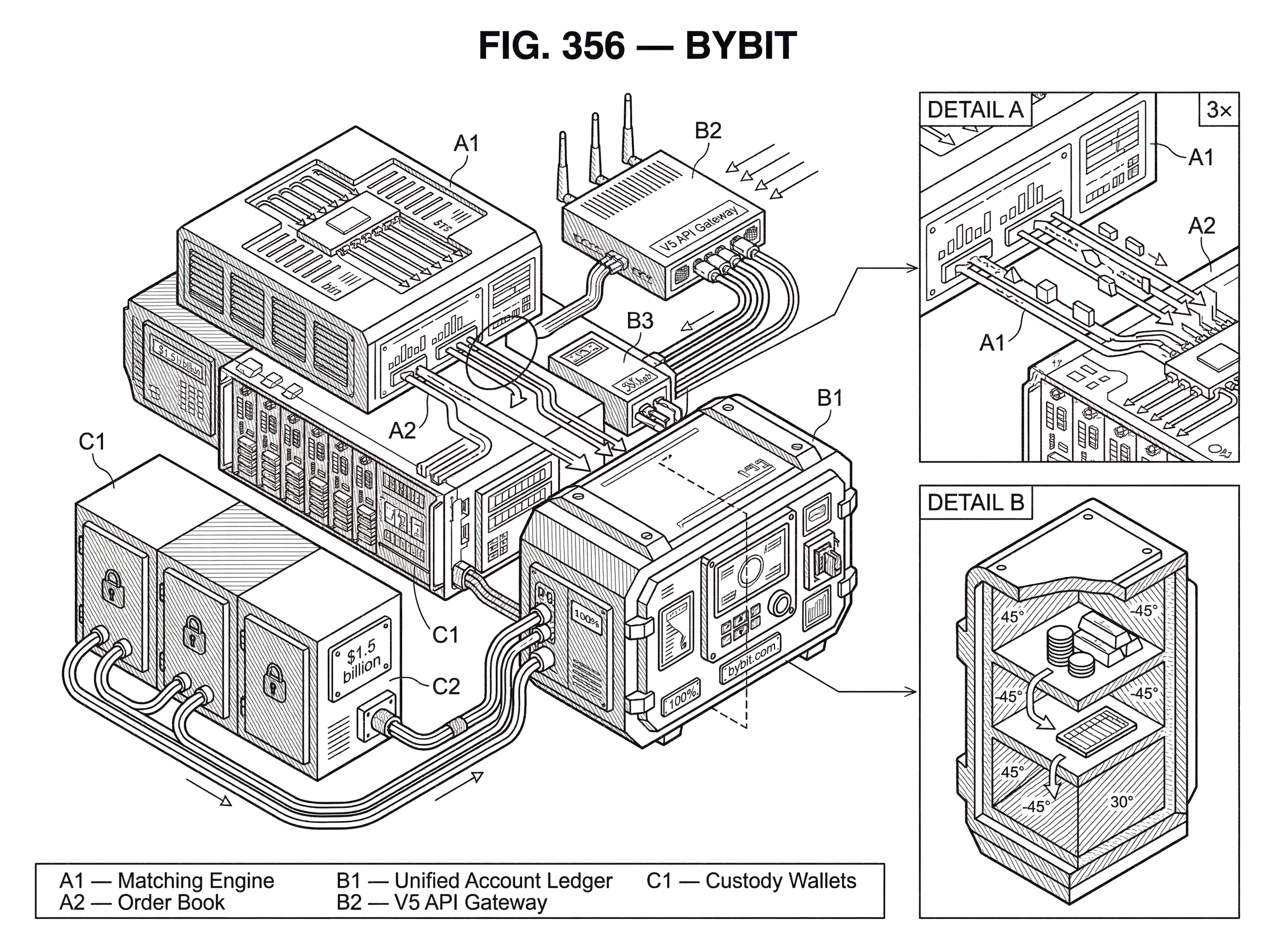
An exchange solves a basic market problem: two people may want opposite trades, but they need a place to discover price, post liquidity, and settle the result. Bybit does that in the familiar centralized-exchange way. Users deposit assets or otherwise fund an account, submit orders, and the platform’s matching engine pairs those orders when price and quantity align. If you place a marketable order, you take liquidity that already exists. If you place a resting order that waits in the book, you provide liquidity for someone else to trade against later.
That distinction matters because Bybit uses a maker-taker fee model. For non-VIP users, the published baseline fees are 0.1% maker and 0.1% taker on spot, 0.01% maker and 0.06% taker on perpetual and futures markets, and 0.03% maker and 0.03% taker on options. Those numbers are not just pricing details; they shape the behavior the platform is encouraging. Lower maker fees on derivatives reward users who post liquidity and help deepen the book, while higher taker fees reflect the value of immediate execution.
The practical consequence is that Bybit is not only a place to hold crypto. It is a place to interact with market structure. Traders who care about spread, depth, execution speed, and fee drag will experience the platform differently from users who simply want occasional spot purchases. That is why the exchange combines beginner-facing entry points with infrastructure for much more demanding workflows.
Why do traders use derivatives, perpetuals, or leverage instead of only spot on Bybit?
| Product | Ownership | Leverage | Expiry | Typical use |
|---|---|---|---|---|
| Spot | Owns the asset | No leverage | Immediate settlement | Simple buy-and-hold |
| Perpetual | No asset ownership | Leverage available | No expiry | Capital-efficient directional bets |
| Options | No ownership until exercised | Leverage via premium | Has expiry | Asymmetric payoff and hedging |
If all users wanted was direct ownership of crypto, a spot exchange would be sufficient. But crypto traders often want exposure without buying the asset outright, or they want leverage, hedging, or income strategies. That is where Bybit’s broader product set matters. Official documentation and third-party market profiles describe support for spot, derivatives, and options, alongside related products such as leveraged trading features and earn-style offerings.
The important idea is that these products are not separate because of branding; they are separate because they express different economic relationships to the same underlying asset. A spot purchase means you own the asset balance itself on the exchange. A perpetual contract gives you directional price exposure without an expiry date, but it introduces margin and funding mechanics. An option gives you a more asymmetric payoff structure, but also more complexity in pricing and risk. Bybit’s usefulness comes from letting users choose the exposure that fits their objective rather than forcing every trade into simple buy-and-hold.
A concrete example makes this easier to see. Imagine a trader who believes Bitcoin will rise over the next week, but does not want to tie up the full amount of cash required to buy the position on spot. On Bybit, that trader may choose a perpetual contract instead. The exchange lets the trader post margin and control a larger notional position than the cash posted. That is the appeal. But the mechanism changes the risks: if the market moves against the position, margin falls, liquidation becomes possible, and periodic funding payments may add cost depending on market conditions. The product is more capital-efficient, but only because the exchange is now managing leveraged exposure rather than simple ownership.
How does Bybit’s unified account affect margin, collateral use, and capital efficiency?
| Feature | Unified account | Separate accounts | Practical impact |
|---|---|---|---|
| Capital portability | Shared across products | Isolated per product | Less idle capital |
| Margining | Portfolio-level margining | Per-product margining | Lower required collateral |
| Transfers | No manual transfers | Manual transfers required | Faster trade setup |
| Risk propagation | Losses affect whole account | Losses confined to product | Requires total-account risk view |
The clearest expression of Bybit’s design philosophy appears in its unified account system. In the V5 API documentation, Bybit describes unified accounts as allowing the sharing and cross-utilization of funds across spot, perpetuals, and options, with profit and loss offset across positions. This is the compression point for understanding the platform: Bybit is trying to make capital portable across products.
Why does that matter? In a fragmented exchange, you might need one balance for spot, another for futures, another for options, and manual transfers between them. That creates operational drag and can leave capital idle. A unified account changes the mechanism. Instead of treating each product silo as a sealed box, the platform lets collateral support multiple positions at once. If one position is profitable and another is temporarily losing, those exposures can be considered together rather than in isolation.
For active traders, this is a major improvement in capital efficiency. Bybit also documents support for borrowing and portfolio-margin behavior within unified-account mode. Borrowing means users can pledge multiple assets as collateral to obtain margin across products. Portfolio margin means risk is assessed at the portfolio level across supported contract types, rather than as a series of unrelated positions. The benefit is obvious: less trapped capital, more flexible hedging, and a more realistic view of risk when positions offset each other.
The trade-off is just as important. Once funds and risk are unified, mistakes propagate more easily too. A floating loss in one area can create debt that accrues hourly interest. Cross-product collateral means a user must think in terms of total account risk, not just the isolated trade on screen. The system is more efficient, but it also demands a more disciplined user.
What ongoing costs should I expect when trading leveraged products on Bybit?
| Cost type | Applies to | Frequency | Who pays | Effect |
|---|---|---|---|---|
| Funding fee | Perpetual contracts | Periodic (hours) | Longs or shorts depending | Can erode carry |
| Borrowing interest | Margin and loans | Hourly accrual | Borrower | Ongoing interest cost |
| Trading fees | All markets | Per trade | Trader | Execution cost and fee drag |
| Liquidation fees | Spot margin, loans, options | On liquidation event | Liquidated trader | Extra loss at liquidation |
A common misunderstanding is to think of exchange fees as only the trading commission. On Bybit, as on other derivatives venues, the deeper costs come from the mechanism of the product itself. The clearest example is the funding fee on perpetual contracts.
A perpetual contract has no expiry, so the exchange needs another way to keep its price anchored to the spot market. Bybit explains this through periodic payments between long and short position holders. When the perpetual price trades above spot and the funding rate is positive, longs pay shorts. When the relationship flips, shorts pay longs. This is not a fee paid to Bybit in the ordinary sense; it is a transfer between market participants that nudges the perpetual price back toward spot.
That mechanism has real consequences. A trader can be correct about direction and still suffer from poor carry if funding remains expensive. Likewise, borrowed funds in margin products can incur hourly interest, and some product categories carry liquidation fees. Bybit states that it does not charge liquidation fees for perpetual and futures trading, but it does for spot margin, crypto loans, and options. So the true user experience depends on which market you are in, not simply that you are “trading on Bybit.”
How do developers and professional traders integrate strategies with Bybit’s API and platform?
Bybit is also built to be operated programmatically. Its V5 API unifies spot, derivatives, and options under a single specification, with a standardized endpoint structure such as v5/market, v5/order, v5/position, v5/account, and v5/asset. That detail matters because it shows the platform is not only a website for clicking buttons. It is infrastructure for bots, execution systems, portfolio tools, and professional trading workflows.
The reason unified APIs matter is the same reason unified accounts matter: they reduce friction between related tasks. A developer building a strategy does not want one integration for spot data, another for futures orders, and a third for account balances if the exchange can present them coherently. Bybit’s API design suggests it wants traders and firms to treat the venue as a programmable trading environment, not merely a retail front end.
This again clarifies who benefits most. Casual users may never notice the API at all. But market makers, quantitative traders, arbitrage desks, and active discretionary traders often care as much about operational consistency as about listed assets. A clean API surface, bulk order management features, and unified account logic make the platform more usable for that class of participant.
What custody, audit, and security limits should users know about Bybit?
Because Bybit is a centralized exchange, users are trusting the platform with custody and settlement. That creates a question decentralized protocols do not eliminate but frame differently: how do users judge whether the venue is solvent and operationally reliable?
Bybit has published proof-of-reserves materials, and independent Hacken audits in 2025 reported that in-scope reserves exceeded user liabilities for audited assets, with reserve ratios above 100%. The audit methodology included proof of liabilities, proof of wallet ownership, and Merkle-tree validation. This is useful because it gives users a way to verify that certain on-chain assets appear to back customer balances at a point in time.
But it is important not to overread what such audits mean. The reports explicitly note that a proof-of-reserves attestation is not a full financial audit of all assets, liabilities, or overall organizational condition. Solvency transparency is helpful; it is not the same thing as saying every operational risk has been removed.
That distinction became very concrete in 2025, when Bybit disclosed a major security incident affecting an Ethereum cold wallet and associated public reporting described losses of roughly $1.5 billion. The broader lesson is not merely that an incident happened. It is that custody soundness and security soundness are related but different questions. A platform can publish reserve attestations and still face serious operational security risks. Users evaluating Bybit should understand both sides of that equation.
Who should use Bybit and when is the platform the right choice?
Bybit makes the most sense for users who want more than a basic brokerage-style crypto purchase flow. Its structure is especially useful for people moving between spot and derivatives, managing collateral actively, or integrating trading systems through APIs. The platform’s account model, fee structure, and product range all point in that direction.
That does not mean it is only for professionals. A newer user can still use Bybit in the simple way the homepage suggests: fund an account and buy or sell major crypto assets. But the exchange’s real character shows up when a user starts asking more demanding questions: Can I hedge this spot position with a perpetual? Can I use one collateral pool across multiple markets? Can I automate order entry and risk monitoring? Bybit is built to answer yes to those questions.
The cost of that flexibility is complexity. Funding rates, borrowing interest, liquidation behavior, and cross-margin interactions are not incidental details. They are the mechanism of the platform. Anyone using Bybit beyond simple spot trading is really using a leveraged, multi-product market system, and should think about it that way.
Conclusion
Bybit is best understood not just as a place to buy crypto, but as a multi-market trading platform designed to make capital, execution, and risk management work across spot, derivatives, and options in one environment. Its unified account system is the key idea: it turns separate trading products into parts of a shared balance and margin framework.
That makes Bybit especially useful for active traders and developers, while also making it more complex than a simple buy-and-hold app. If you remember one thing, remember this: Bybit’s main value is not only access to crypto markets, but the ability to move between different forms of exposure without leaving the same exchange system.
What should you look for before choosing a crypto exchange?
Compare custody, execution, fees, and supported workflows before you pick an exchange. Cube Exchange can serve as a practical comparison anchor because it uses a non-custodial MPC model and exposes common order types and APIs you can test directly. Use the steps below to turn venue research into a short, actionable evaluation.
- Open each platform’s Security or Terms page and record the custody model (custodial hot/cold wallets vs. MPC/non‑custodial), any proof‑of‑reserves links, and recent audit dates.
- On Bybit and Cube, find a liquid BTC or ETH market page and list supported order types (limit, market, stop‑limit, IOC/FOK) and available APIs or testnets for programmatic execution.
- Compare published fees: note maker/taker rates, the perpetual funding-rate history for the asset, withdrawal fees by coin/chain, and any listed liquidation or borrowing charges.
- Fund a small amount or use the testnet on Cube. Place one limit order and one market order (or use the API). Record fill quality, displayed fees, and time‑to‑fill to compare real execution against Bybit.
Frequently Asked Questions
Bybit’s unified account lets spot, perpetuals, and options share collateral and offset profit and loss at the account level, enabling portfolio-margin behavior and cross-product borrowing so collateral can support multiple positions simultaneously. The platform notes that borrowing creates recorded debt and interest is charged hourly, and the trade‑off is that losses in one product can more easily affect the whole account.
Perpetual contracts impose periodic funding-rate transfers between longs and shorts to keep the perpetual price near spot (funding is paid to other traders, not Bybit), and traders also face borrowing interest on margin and potential liquidation-related costs depending on product. Bybit states it does not charge liquidation fees for perpetuals and futures but does apply liquidation fees for spot margin, crypto loans, and options.
Bybit has published Hacken proof‑of‑reserves reports (2025) showing in‑scope on‑chain reserves exceeded audited user liabilities and reported reserve ratios above 100%, but the audits are point‑in‑time solvency attestations and explicitly are not comprehensive financial audits of all assets, liabilities, or the organization’s overall position.
In 2025 Bybit disclosed a major security incident affecting an Ethereum cold wallet with public reporting of roughly $1.5 billion in losses and subsequent forensic reporting linking the operation to the Lazarus Group; independent investigators noted likely modification of an S3 bucket in the attack chain. Those events illustrate that a proof‑of‑reserves attestation does not eliminate custody or operational security risks.
Bybit is built both for casual buyers (simple spot purchases) and for active traders and developers; its account model, fee structure, derivatives and options listings, unified APIs, and tooling particularly benefit market makers, arbitragists, quant desks and users who need cross‑product hedging or programmatic execution.
Baseline non‑VIP trading fees published in the article are 0.1% maker/0.1% taker for spot, 0.01% maker/0.06% taker for perpetuals and futures, and 0.03% maker/0.03% taker for options; VIP tiers can reduce fees and withdrawal fees are fixed per coin/chain while fiat deposit/withdrawal charges vary by currency, method and region.
Bybit’s V5 API unifies spot, derivatives and options under common endpoints (examples include v5/market, v5/order, v5/position, v5/account, v5/asset) and the project provides official SDKs, a Postman collection and community SDKs, which reduce integration work for strategies that span multiple products.
The public Terms landing page links to the canonical Terms of Service but does not itself identify which legal entity is the contracting party or fully disclose governing‑law details; users should consult the linked, up‑to‑date Terms of Service for the definitive legal and jurisdictional information.
Related reading