What is dogwifhat
Learn what dogwifhat (WIF) is, how its fixed-supply Solana memecoin works, what drives demand, and what risks holders actually own.
Introduction
dogwifhat, or WIF, is a meme token on Solana, and the most important thing to understand is that buying it is mainly buying exposure to a social asset, not to a cash-flowing protocol or a token that is required to use a product. The project’s own framing is unusually direct: it is “literally just a dog wif a hat.” That sounds flippant, but it is clarifying. Many tokens are difficult to evaluate because the branding suggests utility while the economics depend mostly on speculation anyway; WIF is closer to honest about what it is.
That does not make it trivial. A token with no defined utility can still become liquid, widely listed, culturally important, and heavily traded. In that case, demand comes from attention, community coordination, exchange distribution, and the market’s habit of treating a meme as a tradable brand. WIF has reached that stage. It has broad visibility, a large holder base by memecoin standards, and access through both Solana decentralized trading venues and centralized exchanges.
So the right question is not whether WIF powers an application. It does not, in the ordinary sense. The right question is what you are actually getting exposure to when you hold it, what limits supply, what keeps the market liquid enough, and what could break the token’s role.
What is dogwifhat (WIF) on Solana?
WIF is an SPL token on Solana. The on-chain token address published by the project and referenced by market infrastructure is EKpQGSJtjMFqKZ9KQanSqYXRcF8fBopzLHYxdM65zcjm. An SPL token is the Solana equivalent of a standard fungible token: it is a token issued under Solana’s token program rather than a custom application with its own separate chain.
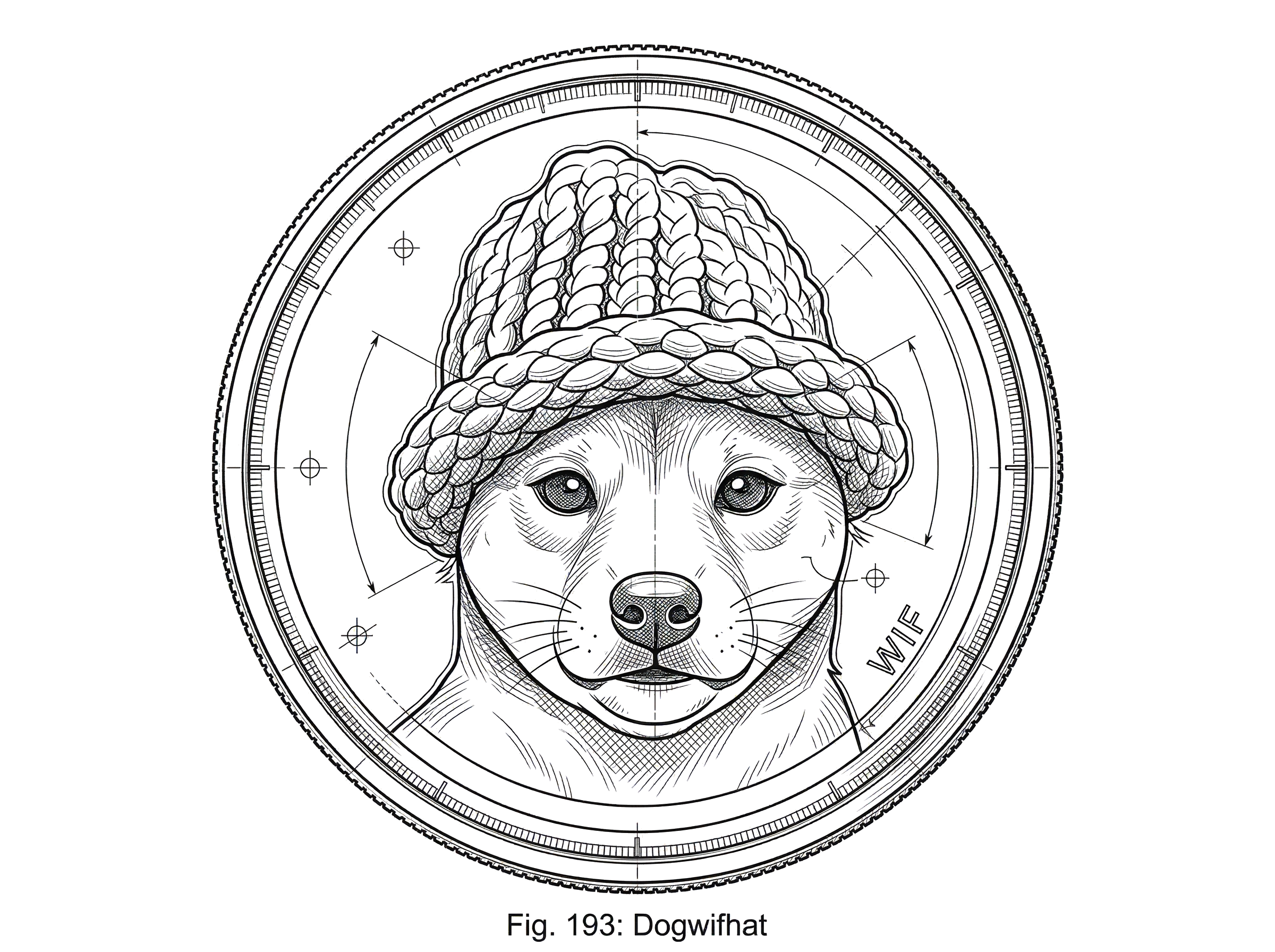
The token launched in November 2023 and became known through a simple image and identity: a Shiba Inu wearing a pink knitted hat. That simplicity helps explain the market structure. WIF is not trying to convert holders into users of a lending market, a governance system, or a fee-sharing product. Its main function is to serve as the object of speculation, community identity, and meme transmission itself.
This is where many readers overcomplicate memecoins. With WIF, the token is the product. There is no deeper business model that turns activity somewhere else into a claim on revenue here. If people want exposure to the meme, they buy the token. If exchanges want to list a highly demanded meme asset, they add markets for the token. If traders want a liquid vehicle for Solana memecoin speculation, they trade the token. The token does not sit underneath the story; it is the thing being traded because of the story.
How many WIF tokens exist and can the team mint more?
For a token like WIF, supply mechanics deserve close attention because there is no yield, fee stream, or formal utility to offset dilution risk. The cleaner the supply, the easier it is to understand what holders own.
Third-party audit material describes WIF as having a fixed supply of 998,906,272.68 tokens, with mint authority disabled. The same report says both mint and freeze authorities have been revoked. In plain English, no one can create more WIF from the official mint, and no central operator can freeze token accounts using those authorities. That removes two common risks in low-quality tokens: surprise inflation and issuer control over transfers.
Supply figures shown by the project site and market data pages are broadly consistent with that picture, putting total and circulating supply at about 998.84 million to 998.91 million WIF. The exact displayed number can vary slightly by source because of rounding, but the key point is stable: essentially the full supply is already out, and there is no meaningful future unlock schedule implied by the published supply data.
That changes the nature of the bet. With many newer tokens, holders must worry about venture allocations, treasury unlocks, emissions, or staking rewards increasing float over time. WIF appears much simpler. The main supply questions are not about future issuance. They are about who already holds the tokens, how concentrated those holdings are, and how much supply is actually available for trading at a given moment.
Why does dogwifhat (WIF) have market value without protocol utility?
WIF demand comes from market behavior rather than protocol necessity. No one needs WIF to pay gas on Solana, secure a validator set, redeem an underlying asset, or access a required application function. Demand instead arises when traders, communities, and platforms decide that WIF is worth listing, quoting, holding, and talking about.
There are a few reinforcing loops behind that demand. The first is attention. Meme tokens rise when they become legible symbols that many market participants recognize instantly. WIF’s branding is simple enough to spread across trading screens, social posts, profile pictures, merch, and exchange listings without needing explanation.
The second is liquidity. A meme token becomes more useful to speculators when they believe they can enter and exit quickly. Evidence from exchange announcements and Solana trading interfaces shows WIF has been supported on venues including Jupiter and major centralized exchanges. Easy access turns curiosity into actual order flow. A trader is much more likely to buy a meme asset if it is already integrated into the places they use.
The third is social proof. Listings by established exchanges do not create intrinsic value, but they do widen the potential buyer base and make custody easier for users who do not want to interact directly with Solana wallets and decentralized exchanges. Gemini announced custody and trading support for WIF. Binance. US listed WIF on a WIF/USDT market and specified Solana for deposits and withdrawals. Those decisions lower operational friction and can extend the token’s life as a tradable market object.
The fourth is reflexivity. When a memecoin becomes a known ticker, price moves themselves attract more attention. That is especially true on Solana, where low fees and fast settlement make repeated trading, swapping, and meme rotation easier. Usage does not create demand for WIF; tradability does.
How does Solana’s design affect WIF trading, liquidity, and risk?
It would be easy to say “WIF is on Solana” and leave it there, but the chain changes the cost and speed of speculation. Solana’s low transaction costs and fast execution make it well suited for high-frequency retail activity, rapid order routing, and decentralized exchange trading in smaller size. That environment has been fertile for memecoins.
For WIF, being an SPL token means it plugs into the Solana trading stack. Wallet support, routing through aggregators, and liquidity on Solana-native venues all help turn the token from a static meme into something that can sustain real turnover. A memecoin on a slower or more expensive chain may still rally, but the friction of buying and selling is higher. On Solana, that friction is lower, which helps speculative demand express itself faster.
The same feature cuts both ways. Lower friction also means faster exits, quicker rotation into the next theme, and more room for automated trading strategies to exploit inefficient order flow. WIF is not defended by sticky utility. If sentiment weakens, the same trading rails that helped it grow can accelerate the decline.
If I hold WIF, what exposure and custody differences should I expect?
Some tokens change character depending on how you hold them. Staking can convert a plain token into a yield-bearing position. Wrappers can transform direct ownership into a custodial or bridged claim. Fund structures can introduce tracking error, fees, or redemption rules. WIF is much simpler.
If you hold native WIF on Solana, you are holding the token directly. There is no core staking mechanism that pays you for locking it, and there is no protocol-native yield stream that changes the economics of idle ownership. Spot WIF is close to pure price exposure.
If you hold WIF on a centralized exchange, the economic exposure is still broadly the same, but the operational exposure changes. You gain convenience, fiat or stablecoin funding rails, and easier order entry, but you rely on the exchange for custody, withdrawals, and venue-specific access. That is useful for many traders, especially with a memecoin where execution convenience can outweigh on-chain participation.
For readers asking how to buy dogwifhat, market access is part of the story because access itself supports demand. Readers can buy or trade WIF on Cube Exchange, moving from a bank-funded USDC balance or an external crypto deposit into trading from one account, using either a simple convert flow for first buys or spot market and limit orders for more active entries. That does not change what WIF is, but it does change how easily a new buyer can become part of the market.
There are references in secondary sources to bridged or cross-network availability, but the core economic unit remains the Solana token. When dealing with any wrapped or bridged version of WIF, the exposure gains an extra dependency: you are no longer only exposed to WIF’s price, but also to the bridge or issuer maintaining the mapping correctly.
What risks remain for WIF despite a fixed supply and revoked authorities?
A fixed supply and revoked authorities are positive structural traits, but they do not make WIF safe in the broader sense. The main risks are market-structure risks.
The most obvious is that WIF has no defined utility. Gemini’s listing announcement states that directly: its value may derive only from the continued willingness of market participants to demand and trade the token. That is not a legal disclaimer you should ignore; it is the core economic fact. If attention fades and the market moves on, there is no embedded protocol use that must keep buying pressure alive.
Another risk is concentration. Secondary market sources have flagged the possibility of large bundled holdings and meaningful supply concentration in a small number of wallets. Even if exact percentages should be treated carefully, the general issue is credible and important. In a token with fixed supply and no cash-flow anchor, large holders can shape float, sentiment, and price impact.
Execution risk also deserves more attention than newcomers expect. A reported Solana incident involving a very large WIF trade in a low-liquidity pool showed how badly order execution can go wrong when size meets shallow liquidity. The trade created an opportunity for an MEV bot to backrun the transaction and extract a large profit. The lesson is broader than that single episode: in memecoins, the headline market cap can look large while the actual tradable depth at a given price is much thinner than buyers assume.
There are really two prices for WIF. There is the displayed market price on screens, and there is the executable price for the size and venue you personally use. Those can diverge sharply during volatility, especially on decentralized venues or in fragmented liquidity.
How does community support influence WIF’s market value versus fundamentals?
WIF’s market role depends heavily on community energy. The token has built an identity strong enough to support merchandise, user-generated imagery, profile-picture tools, and organized promotional campaigns. A highly visible example was the community crowdfunding effort that raised roughly $700,000 in an attempt to place the mascot on the Las Vegas Sphere.
That kind of behavior shows the meme can coordinate capital and attention beyond ordinary trading. For a memecoin, that is a form of strength. Community effort can keep a token culturally alive long after its first speculative wave.
But community strength should not be confused with durable economic rights. A successful meme campaign can increase awareness and liquidity, yet it does not give holders a claim on revenue, governance control over a productive system, or legal rights to a treasury. It is best understood as support for attention, not as a substitute for underlying cash flows.
The distinction is clearest when markets cool. In a bull phase, community visibility can look like a moat. In a quiet market, it can turn out to be mostly a marketing surface. WIF’s future therefore depends less on product adoption than on whether the meme remains one of the few that traders still care enough to price.
What factors could cause WIF’s market relevance or price to decline?
WIF does not need a product failure to weaken. It mainly needs the market to stop caring.
That can happen through several channels. Attention can migrate to newer memecoins. Liquidity can fragment across venues or chains. Large holders can sell into thinner order books. Exchanges can reduce support or traders can rotate away from Solana meme risk as a category. None of these require a bug in the token contract.
There is also a subtler risk: the better WIF is understood, the less room there is for people to imagine hidden utility. In some tokens, greater understanding improves the thesis. With WIF, understanding clarifies that the thesis is cultural liquidity. If that culture remains strong, the token can hold relevance. If it weakens, there is not much beneath it to catch the fall.
At the same time, the qualities that have helped WIF endure are also clear. The supply appears fixed, the contract-level control levers are limited, the branding is unusually memorable, and market access is broad enough that the token remains easy to trade. For a memecoin, those are meaningful advantages.
Conclusion
WIF is a fixed-supply Solana memecoin whose value comes mainly from attention, liquidity, and exchange access rather than utility or cash flows. Holding it is mostly a direct bet that the dog-with-a-hat meme stays liquid and desirable long enough for the market to keep pricing it. Its contract design is relatively simple and clean; its risk is that the entire thesis is social.
How do you buy dogwifhat?
dogwifhat can be bought on Cube through the same direct spot workflow used for other crypto assets. Fund the account, choose the market or conversion flow, and use the order type that fits the trade you actually want to make.
Cube lets readers move from a bank-funded USDC balance or an external crypto deposit into trading from one account. Cube supports both a simple convert flow for first buys and spot markets with market and limit orders for more active entries.
- Fund your Cube account with fiat or a supported crypto transfer.
- Open the relevant market or conversion flow for dogwifhat and check the current price before you place the order.
- Use a market order for immediacy or a limit order if you want tighter price control on the entry.
- Review the estimated fill and fees, submit the order, and confirm the dogwifhat position after execution.
Frequently Asked Questions
Related reading