What is Filecoin?
Learn what Filecoin is, how its storage proofs and markets work, why storage providers earn FIL, and where the protocol’s design depends on key assumptions.
Introduction
For the token explainer, see FIL.
Filecoin is a decentralized storage network that tries to answer a specific question: how do you pay strangers on the internet to keep your data, and then verify they actually kept it? Ordinary cloud storage solves this with contracts, reputation, and a company in the middle. A peer-to-peer network cannot rely on any of those in the same way. It needs a mechanism that turns storage from a promise into something the network can check.
That requirement explains almost everything about Filecoin’s design. It is not just “blockchain storage” in the vague sense of putting files somewhere decentralized. It is a network where clients pay for storage and retrieval, storage providers earn the native token FIL, and the chain uses cryptographic proofs to audit whether promised storage is really being provided. In Filecoin, storage is not merely an application running on top of the chain; proven storage is part of what gives participants power in the chain itself.
This makes Filecoin different from both conventional cloud storage and from blockchains whose consensus is secured by computation or by staked capital alone. Filecoin’s core bet is that useful infrastructure work (keeping data available over time) can be measured well enough to anchor a crypto-economic system. If that works, you get more than a ledger: you get a market for long-term data storage with public verification built in.
How does Filecoin solve the long‑term decentralized storage problem?
The hard part of decentralized storage is not moving bytes around. Peer-to-peer systems have done that for a long time. The hard part is creating a reliable long-term guarantee. If someone says, “I will store this 32 GiB of data for the next year,” the client needs more than a handshake. The network also needs more than self-reporting, because a provider could claim to be storing data while silently deleting it to save disk space.
This is where systems like IPFS help and where they stop. IPFS uses content addressing: a file is identified by what it is, not by which server currently holds it. If you know a file’s CID, any node that has a copy can serve it. That is powerful because the reference to the data stays stable even if the hosting location changes. But content addressing alone does not force anyone to keep a copy for months or years. Historically, many nodes pinned content voluntarily or through service arrangements, but the protocol itself did not create a strong built-in incentive for long-term retention.
Filecoin adds that missing incentive layer. It keeps the useful property of content-addressed data and combines it with a market in which clients pay providers to store data for an agreed period. The key difference is that payment is tied to ongoing cryptographic evidence. A provider does not simply say “trust me”; it must repeatedly prove to the network that it sealed and continues to store the data it committed to keep.
The broad purpose, then, is simple to state: turn durable storage into something that can be bought, sold, and publicly audited in a decentralized network. But making that true requires both market design and proof design.
How does Filecoin combine an open storage market with on‑chain enforcement?
| Market | Service | Pricing | Settlement | Proofs required | Best for |
|---|---|---|---|---|---|
| Storage Market | Long term capacity | Market driven | On-chain deals | PoRep and PoSt | Archival durability |
| Retrieval Market | Serve bytes quickly | Per transfer payments | Off-chain channels | No ongoing PoSt | Low latency delivery |
At a high level, Filecoin has two intertwined layers.
The first is an economic layer. Clients want storage or retrieval. Providers offer disk capacity and bandwidth. Prices are not centrally set; they emerge from open markets. The whitepaper describes two verifiable markets: a Storage Market and a Retrieval Market. In the storage market, clients and storage providers make deals for keeping data over time. In the retrieval market, clients pay to fetch data back, typically with low-latency payment mechanisms rather than waiting for every small transfer to settle directly on-chain.
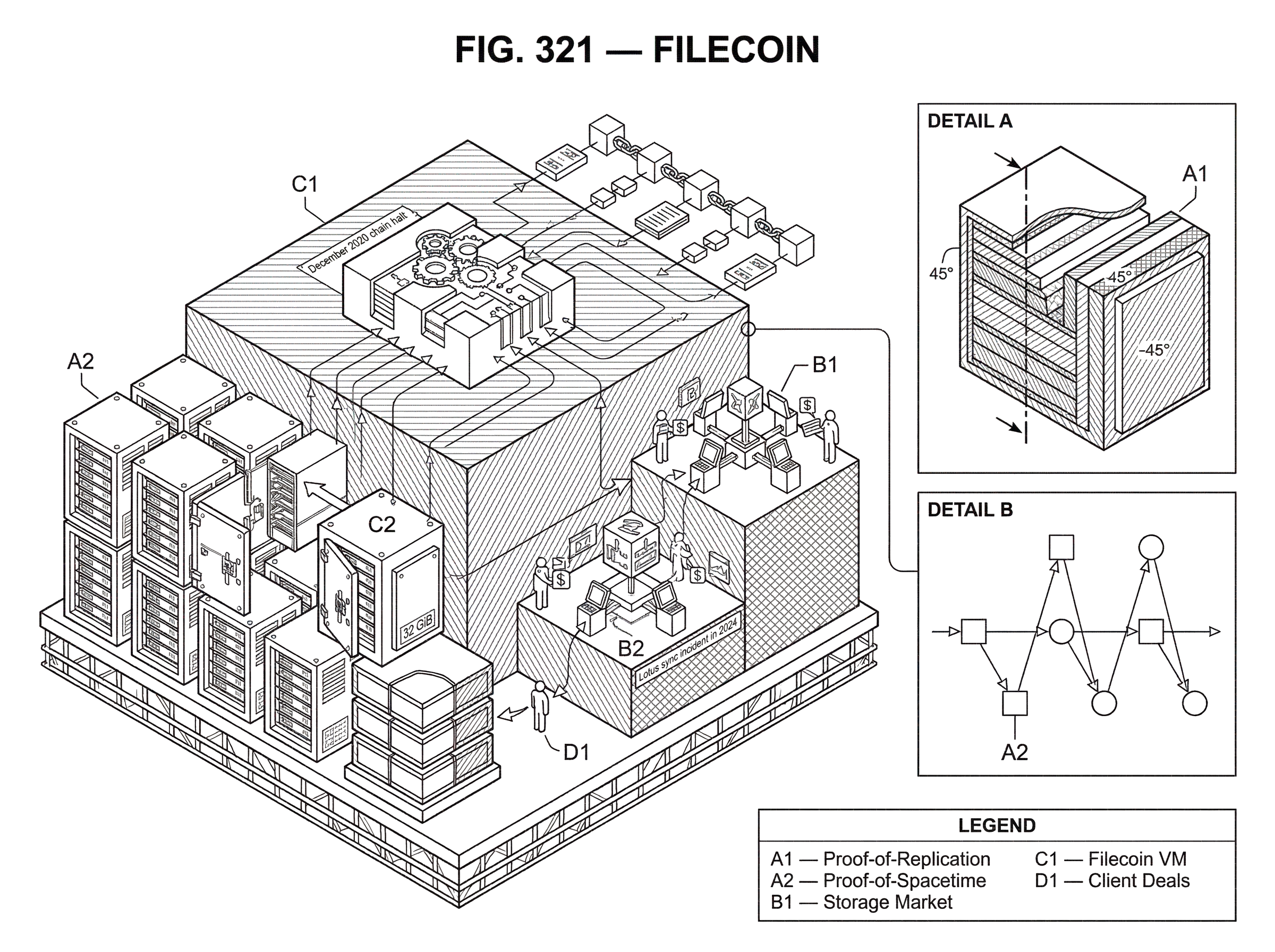
The second is an enforcement layer. Storage deals are only meaningful if the network can tell whether providers are honoring them. Filecoin’s answer is a pair of proofs: Proof-of-Replication and Proof-of-Spacetime. The first establishes that a provider created a distinct stored replica of the client’s data. The second establishes that the provider continues storing that data over time. Together they convert “I have your file” from an unverifiable claim into a claim with a checkable cryptographic witness.
This combination is the central idea. The market creates demand and prices. The proofs create accountability. Without the market, there is no reason to volunteer long-term storage. Without the proofs, there is no reliable way to enforce storage promises among strangers.
How does Filecoin cryptographically prove providers actually store data?
| Proof | Primary purpose | What it proves | When performed | Economic effect |
|---|---|---|---|---|
| PoRep | Create unique replica | Provider-specific replica | At sealing time | Makes allocation costly |
| PoSt | Ongoing storage audit | Data retained over time | Periodic chain challenges | Enables penalties for faults |
To see why Filecoin needs two different proofs, start with the failure mode it is trying to avoid. Suppose a provider accepts payment from many clients for the “same” storage, but only keeps one copy, or keeps no copy and hopes never to be checked. Or suppose it stores the data for a week, collects payment, and later deletes it while still claiming compliance. A single static proof would not be enough, because the network needs both a proof that storage was committed in the right way and a proof that it persisted through time.
Proof-of-Replication, or PoRep, addresses the first problem. In Filecoin’s formal definition, PoRep lets a prover convince a verifier that it stores a replica R that is a physically independent copy of data D, unique to that prover. The intuitive point is that the provider should not be able to pretend that one generic copy satisfies many separate obligations. The protocol requires a sealing process that transforms the stored data into a provider-specific replica. That sealing work is intentionally meaningful and, in the practical designs described in the whitepaper, slow and sequential.
Why does that matter? Because if replicas are provider-specific, then claiming storage implies actually allocating storage resources. A miner cannot cheaply reuse a single undifferentiated copy to inflate its power or its payments. The network is trying to measure committed storage, not just possession of a popular file.
Proof-of-Spacetime, or PoSt, addresses the second problem. PoRep shows that the provider committed a proper replica. PoSt shows that the provider is still storing the data for a duration t. In ordinary language, PoSt is the network’s repeated audit. The chain challenges providers at intervals, and they must respond with proofs that are publicly verifiable. If they fail to do so, their claim on storage capacity weakens and they can be penalized.
There is an important subtlety here. Filecoin is not trying to prove that data is instantly retrievable at every moment by every client under all network conditions. What it proves directly is narrower and more mechanical: that a provider has committed storage in the required way and continues to maintain it across time according to the protocol’s audit schedule. Retrieval is related, but it is not identical to the storage proof itself.
What happens step‑by‑step when you store a file on Filecoin?
Imagine a research lab wants to archive a large dataset for several years. The lab does not want to rely on a single cloud vendor, and it wants a verifiable record that its data remains stored. On Filecoin, the lab acts as a client and looks for storage providers willing to take the deal.
A provider offers terms: price, duration, and available capacity. If the client accepts, the provider does not merely copy the file into a normal folder and call it done. It performs the sealing process that creates a unique replica tied to its own storage commitment. This is where PoRep enters. The work is computationally and operationally significant because the protocol wants the commitment to be costly to fake.
Once that sealed sector is committed, the provider can begin earning for the storage service; but only if it keeps proving continued storage. Over time, the chain requires repeated proofs that the sector remains stored. Those are PoSt-style checks. If the provider’s machine goes offline, loses the data, or cannot produce valid proofs, the failure is not invisible. It becomes economically visible through penalties and loss of standing in the protocol.
Later, when the lab wants the data back, retrieval is a separate flow. The client can retrieve from a provider that has a copy and is able to serve it. Filecoin’s whitepaper describes the retrieval market as using an off-chain orderbook and micropayment channels. That design aims to make repeated small payments practical for transferring data, because paying for every chunk with a normal on-chain transaction would be too slow and expensive.
This example shows the full mechanism. The storage promise becomes credible because sealing creates a real storage commitment, periodic proofs keep the promise auditable, and payment is attached to that auditable commitment rather than to trust alone.
How does proven storage determine mining power on Filecoin?
| Consensus | Scarce resource | Selection basis | Useful work? | Main trade-off |
|---|---|---|---|---|
| Proof-of-Work | Electricity | Hashrate | No | High energy cost |
| Proof-of-Stake | Staked capital | Stake weight | No | Wealth centralization |
| Filecoin useful-work | Proven storage | Storage power share | Yes | Proof and market complexity |
Filecoin’s most unusual design choice is that proven storage is not only a service sold in a market. It also determines mining power. In the whitepaper and the specification, a storage miner’s power is proportional to the amount of storage it has committed and can prove. The protocol uses a useful-work consensus in which election probability for block production scales with that storage power.
The motivation is straightforward. In proof-of-work systems, miners burn energy to earn the right to propose blocks. In proof-of-stake systems, validators lock capital. Filecoin asks whether the scarce resource securing the chain can instead be storage capacity that is actually doing something useful for users. If so, consensus work and application work are aligned rather than separated.
That alignment is elegant, but it comes with assumptions. The network must be able to measure storage commitments well enough that consensus weight reflects real provided capacity. That is why PoRep and PoSt are so central. If the proofs were weak, miners could fake storage, gain disproportionate consensus power, and undermine both the market and the chain.
The consensus design described in the whitepaper includes an Expected Consensus approach, where the probability that a miner is elected to create a block is proportional to its share of total power. In effect, a miner with more proven storage gets more chances to participate in consensus. This is the mechanism by which Filecoin ties chain security to the storage resource it cares about.
What is fundamental here is the principle that consensus weight tracks proven useful capacity. The exact election mechanism, randomness beacon details, and implementation specifics can evolve, but that principle is the center of the protocol.
Why does Filecoin require collateral and how does slashing work?
Proofs alone are not enough. They show whether a provider is meeting commitments, but the protocol also needs a reason for providers to care about failure. Filecoin therefore requires storage providers to lock collateral and subjects them to penalties when they miss proofs, allow sectors to go offline, terminate commitments improperly, or commit consensus faults.
This is easier to understand if you think in terms of incentives rather than punishment. A storage deal spans time. During that time, a provider may be tempted to repurpose the disk, cut operational corners, or run with inadequate redundancy. By requiring collateral up front, the network gives the provider something to lose if it underperforms. The future penalty turns today’s promise into a financial obligation.
The official slashing guidance makes this concrete. Fault fees accrue when a sector is offline and fails to submit the required Proofs-of-Spacetime. There are also sector penalties, termination fees, and separate consensus-fault slashing for malicious consensus behavior. Not every failure is treated as equally malicious: the documentation notes built-in exceptions for providers with a history of honest behavior, including cases where a missed WindowPoSt in the current proving period may avoid immediate penalty if the sector is later recovered. That detail matters because a network meant to support real operators must distinguish between transient operational faults and outright cheating.
So the mechanism is not “perfect storage or instant punishment.” It is more nuanced. Filecoin uses proofs to observe reliability and collateral to make unreliability costly enough that, on average, rational providers prefer to stay compliant.
Why are Filecoin’s storage and retrieval markets separate?
A common misunderstanding is to assume that if data is stored, retrieval is automatically solved in the same way. Filecoin separates these because the two services have different economics.
Long-term storage is about committing disk space over months or years. Retrieval is about serving bytes quickly when someone asks. The first rewards capacity reservation and durability. The second rewards bandwidth, network proximity, caching, and responsiveness. A provider well suited for cheap archival storage may not be the best low-latency retrieval node.
That is why Filecoin models them separately. The whitepaper describes a storage market with verifiable storage commitments and a retrieval market using off-chain order matching and micropayment channels. This separation is not cosmetic. It reflects the fact that “keeping data” and “serving data quickly” are different jobs with different cost structures.
It also explains why Filecoin is often discussed alongside IPFS rather than as a replacement for it. IPFS provides content addressing and peer-to-peer distribution semantics; Filecoin adds an incentive system for retention and retrieval. The two fit together because a CID tells you what data you want, while Filecoin provides a market-based reason for someone to keep and serve it.
What role does the Filecoin VM (FVM) play in storage deals and on‑chain state?
Filecoin is not only a storage marketplace with a token. The specification describes a Filecoin Virtual Machine, or FVM, which acts as the chain’s replicated state machine. This is where on-chain actors, balances, market logic, and contract execution live.
That matters because long-running storage relationships need on-chain state. Deals have terms, collateral must be tracked, power must be accounted for, penalties must be applied, and system actors must update network-wide state as proofs are submitted and sectors change status. The VM is the mechanism that keeps all of these transitions consistent across nodes.
In Filecoin terminology, an actor is roughly analogous to a smart contract object with code, state, a balance, and methods. Built-in actors handle core protocol roles. The newer FVM tooling also broadens programmability, including EVM-runtime support and programmatic storage interfaces in the official docs. That makes Filecoin more than a fixed-purpose storage chain: developers can build applications that interact directly with storage-related state and payment flows.
Still, the fundamental point is not “Filecoin has smart contracts too.” It is that storage commitments require stateful protocol machinery, and the VM is where that machinery executes.
What real use cases and workloads is Filecoin best suited for?
The clearest use cases follow directly from the mechanism. Filecoin is most natural where data is large, durability matters, and public verifiability or multi-provider storage is valuable. The official docs point to examples such as NFT content storage, archival datasets, backups, and media or web3 application backends.
This pattern makes sense. If your main concern is ultra-fast random reads from a single region with strict centralized service-level guarantees, conventional cloud infrastructure may still fit better. Filecoin becomes more attractive when you care about open markets, content-addressed data, resilience across providers, and cryptoeconomic incentives for long-term retention.
That is also why it compares differently to the idea of data availability in rollup systems. Data availability is usually about ensuring transaction data is accessible long enough for verification and dispute processes; a shorter-horizon guarantee with different trust and performance assumptions. Filecoin is aimed at longer-lived storage commitments. The two ideas both concern “is the data there?”, but they solve different time-scale problems.
What assumptions and dependencies underlie Filecoin’s design and risk model?
Filecoin is ambitious, and some of its hardest parts are exactly where the assumptions matter most.
The first dependency is on the practicality of the proofs. The whitepaper is explicit that the practical PoRep and PoSt constructions rely on succinct proof systems such as zk-SNARKs, and it notes the trusted setup concern common to many SNARK systems. It also points out that sealing is slow and sequential. These are not cosmetic engineering details. They shape hardware requirements, operational complexity, and the trust model around proof generation and verification.
The second dependency is on implementation determinism. Because Filecoin is a blockchain with a VM, all nodes must compute the same state transitions from the same blocks. The December 2020 chain halt showed what happens when that assumption breaks. The reported cause was latent non-determinism in a storage miner actor code path: different nodes iterated data in different orders, producing divergent outcomes. No data was lost, and retrieval remained possible, but the incident is a useful reminder that a storage blockchain inherits the ordinary risks of replicated state machines in addition to the special risks of proof systems and market design.
A more recent Lotus sync incident in 2024, affecting some nodes with a “failed to verify beacon” error, points in the same direction from another angle: the protocol is not just a set of ideas but a living software stack. Running a decentralized storage network means depending on implementations, releases, monitoring, backports, and operator coordination.
The third dependency is on market behavior. Open pricing is a feature, but it does not guarantee ideal outcomes by itself. Storage and retrieval quality depend on provider incentives, collateral costs, client deal selection, and off-chain operational competence. A protocol can make dishonesty expensive without making every honest provider equally competent.
How do implementations and governance shape Filecoin in practice?
A network like Filecoin only works if many independent parties can implement and operate it. The canonical protocol specification defines the architecture and rules, but production use depends heavily on software clients. Lotus is the reference implementation in Go and remains the main operational entry point for many node operators and storage providers. Its tooling separates roles into components such as the node daemon, miner daemon, and worker processes, reflecting the real operational complexity of sealing, proving, and chain participation.
At the same time, Filecoin is not frozen. The governance repository defines Filecoin Improvement Proposals, or FIPs, as the main way to propose and ratify changes. That matters because many of Filecoin’s important behaviors (proof parameters, penalty rules, protocol upgrades, standards, and recovery procedures) are not one-time design decisions. They evolve with the network.
This is worth stating plainly: Filecoin is not just a whitepaper idea about decentralized storage. It is a governed protocol with a VM, markets, multiple implementations, and upgrade processes. Understanding Filecoin means understanding all four together, because each corrects for limitations in the others. The proofs keep the market honest. The market makes the storage economically meaningful. The VM tracks the obligations. Governance updates the rules when reality exposes weaknesses.
Conclusion
Filecoin is best understood as a blockchain that tries to make storage a verifiable, tradable, and consensus-relevant resource. Clients pay for storage and retrieval. Providers earn FIL by sealing data, proving they still hold it, and serving it back. The chain turns those promises into enforceable commitments through Proof-of-Replication, Proof-of-Spacetime, collateral, and penalties.
The memorable idea is simple: Filecoin treats storage not as an unverifiable service promise, but as something a decentralized network can audit over time. Everything else (the markets, the miner power model, the VM, and the operational complexity) follows from that one design choice.
How do you buy Filecoin?
Buy FIL on Cube Exchange by funding your account and placing a spot trade on a FIL fiat or stablecoin pair. The workflow below walks through funding, opening the FIL market (e.g., FIL/USDC or FIL/USD), choosing an order type, and submitting your trade on Cube Exchange.
Frequently Asked Questions
Proof-of-Replication (PoRep) proves a provider created a provider‑specific sealed replica of the client’s data so the replica cannot be cheaply reused, while Proof‑of‑Spacetime (PoSt) is the repeated audit that proves the provider continues to store that sealed replica over time; both are required because one proves uniqueness of commitment and the other proves persistence across the deal period.
Filecoin’s proofs prove that a provider committed and continues to hold a sealed replica according to the protocol’s audit schedule, not that the data is instantly retrievable to every client at every moment; retrieval is a related but separate concern handled by the retrieval market and provider serving capability.
Filecoin ties consensus weight to proven storage power so a miner’s probability to produce blocks scales with its share of committed, provable storage; this design assumes the network can measure storage commitments reliably, which is why PoRep/PoSt quality is critical to security.
Providers must lock collateral and face penalties - fault fees, sector penalties, and termination fees - when they miss proofs or otherwise fail commitments, but the protocol includes exceptions and distinctions between transient operational faults and malicious behavior rather than treating every missed WindowPoSt as identical.
Filecoin separates long‑term storage and retrieval because they have different cost structures: storage rewards capacity reservation and durability, while retrieval rewards bandwidth and responsiveness; the retrieval market is designed to use an off‑chain orderbook and micropayment channels for low‑latency payments.
The protocol and its security depend on practical choices in the proof systems: the whitepaper and docs note reliance on succinct proof systems (e.g., zk‑SNARKs/SCIP) and warn of trusted‑setup concerns, and they also note sealing is slow and sequential - these are explicit trust and performance assumptions.
Implementation and operational risks include non‑deterministic behavior across nodes and software bugs - illustrated by a December 2020 chain halt caused by latent non‑determinism in actor code and a 2024 Lotus sync incident - so running the network depends on careful, deterministic implementations, testing, and coordination.
The Filecoin Virtual Machine (FVM) is the chain’s replicated state machine where actors (on‑chain objects with code, state, and balances) execute market logic, track deals, collateral, proofs, and penalties - this stateful machinery is necessary because storage commitments span time and must be consistently tracked across nodes.
Filecoin is designed to complement IPFS: IPFS provides content addressing and distribution semantics (CIDs), while Filecoin adds an economic layer that pays providers to retain and optionally serve content over time, making long‑term retention verifiable and marketable.
Related reading