What is Ondo?
Learn what Ondo is, how its tokenized Treasury products like OUSG work, and why users choose yield-bearing onchain dollar exposure.
Introduction
Ondo is a platform for bringing yield-bearing traditional financial assets onchain, especially short-term US Treasury exposure packaged into tokenized products that can move through crypto wallets and blockchain applications. That matters because most dollar tokens in crypto are designed to stay at 1 USD and be easy to transfer, but they usually do not pass through the underlying yield available in traditional cash markets. Ondo’s basic idea is to close that gap: let users hold blockchain-native tokens while still accessing returns from instruments like short-duration treasuries.
The useful way to think about Ondo is not as “just another stablecoin issuer.” It sits in the space between a money-market product and an onchain token. The product has to do two jobs at once. It has to represent ownership or exposure to offchain assets that exist in the traditional financial system, and it has to behave in a predictable way onchain so wallets, exchanges, and protocols can use it.
That dual requirement explains much of how Ondo is designed. Its documentation emphasizes both blockchain infrastructure and traditional finance controls: onboarding, eligibility rules for some products, published reports, fund administration, audits, and smart-contract documentation. In other words, the onchain token is only the visible layer; underneath it is an operational system that has to keep token balances tied to real-world assets and cash flows.
What problem does Ondo solve for onchain cash management?
| Option | Yield | Onchain usability | Liquidity | Best for |
|---|---|---|---|---|
| Ordinary stablecoin | No Treasury yield | Native wallet transfers | High, 24/7 | Fast payments and swaps |
| Traditional brokerage | Treasury yield | Offchain only | Market-hours settlement | Regulated custody, yield |
| Ondo (OUSG) | Passes Treasury yield | Wallet-native tokens | Instant mint/redeem (limits) | Onchain cash management |
The central problem is simple: blockchains are good at transfer and programmability, but the most conservative yield-bearing assets still mostly live offchain. If a user holds ordinary stablecoins, they usually get liquidity and settlement speed but no direct Treasury yield. If they buy traditional fixed-income products through a broker, they may get the yield, but they lose the always-on, wallet-native usability that makes onchain assets attractive.
Ondo’s answer is to package those offchain assets into tokens that can be issued, held, transferred, and in some cases redeemed through blockchain rails. That makes the asset easier to use in a global, internet-native setting. A [treasury team, DAO, fund, or individual who already operates onchain can keep capital in a form that fits crypto workflows without giving up exposure to short-term government-backed instruments.
This is why Ondo has both an asset-management side and a technology side. The asset-management side creates and manages the tokenized financial products. The technology side builds the protocol and contract infrastructure that lets those products exist and interact onchain. If you removed either half, the system would fail. Without the offchain asset management, the token would not be meaningfully backed. Without the onchain infrastructure, it would just be a conventional fund with a website.
How does Ondo convert offchain Treasury exposure into onchain tokens?
At the user-facing level, Ondo’s flow is straightforward. A user reviews a product, completes onboarding if required, connects a wallet, and subscribes using stablecoins or in some cases a USD wire. In return, the user receives tokens representing the product exposure. When the user wants to exit, they request redemption, and the timing depends on the specific product.
What makes this more than a simple deposit-and-withdrawal interface is the mechanism in the middle. The token is not supposed to be valuable because traders agree it is valuable; it is supposed to derive value from underlying assets and the legal-operational structure around them. Ondo’s documentation repeatedly points users to the underlying assets, expected yield, risk, eligibility, smart-contract addresses, audits, and trust resources because those are the pieces that anchor the token to something real.
That also explains why Ondo’s products are not all equally open. Some are general-access, while others are limited to users eligible for what Ondo calls its Qualified Access Funds. This is not just a marketing segmentation choice. It follows from the kind of underlying product being offered and the legal wrapper needed to hold and distribute that exposure.
What is OUSG and how does it represent short-term Treasury exposure?
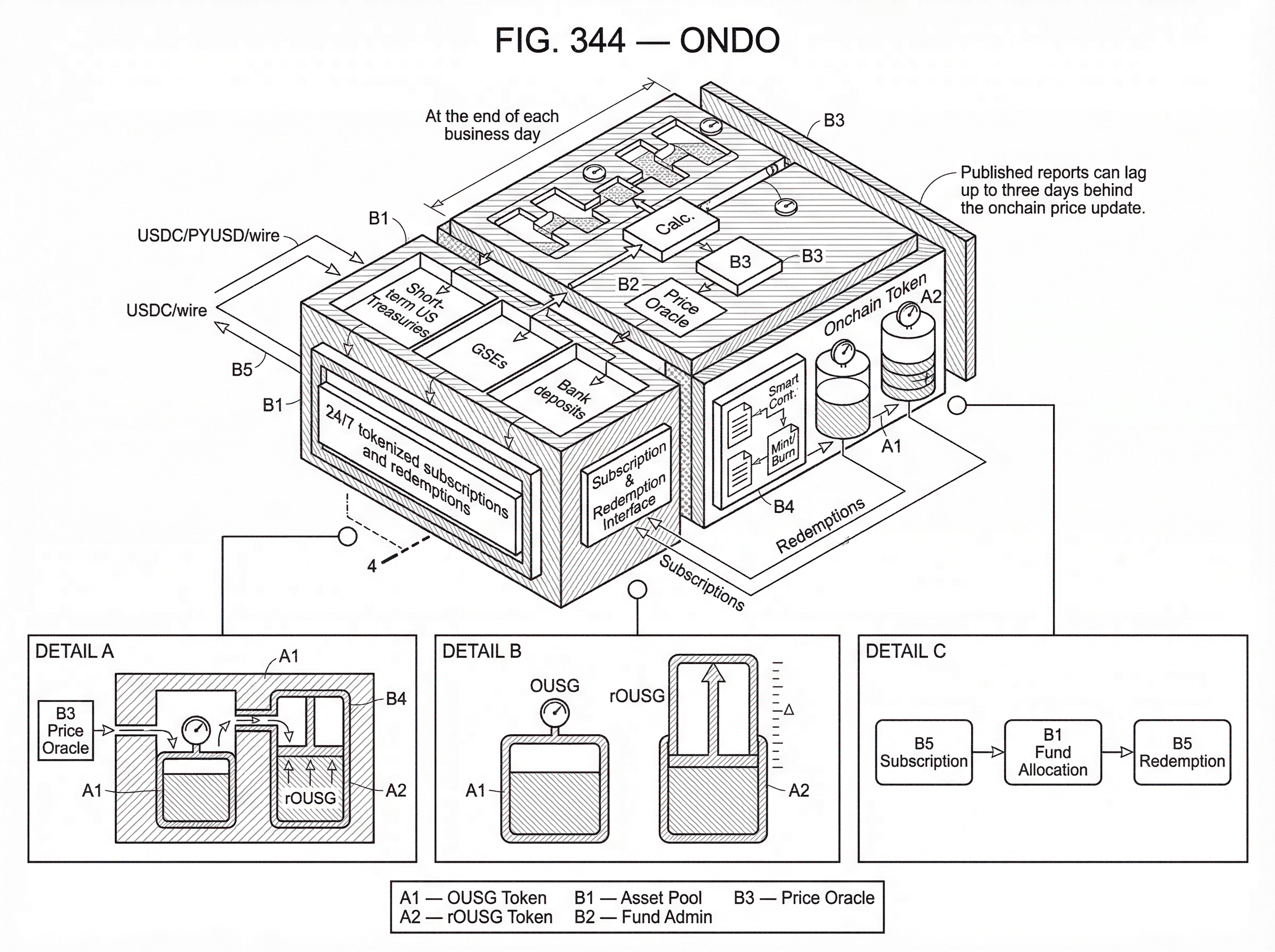
The clearest example of Ondo’s model is OUSG, short for Ondo Short-Term US Government Treasuries. OUSG is designed to give holders liquid exposure primarily to short-term US Treasuries and government-sponsored enterprise securities. According to Ondo’s documentation, the portfolio is invested through funds issued by major asset managers, with some liquidity held in bank deposits and](https://scribe-topic-id.invalid/foundations.defi.treasury_management) USDC.
The important point is that OUSG is trying to represent a very familiar traditional finance position in an onchain form: a conservative, short-duration dollar asset held for cash management. That makes it attractive to users who care less about speculative upside and more about preserving principal while earning a market-based return on idle dollars.
Imagine a DAO treasury that has raised funds in stablecoins and does not need all of that capital immediately. Leaving the funds in a non-yielding stablecoin is operationally simple but economically costly when Treasury yields are positive. Moving into a traditional brokerage account might improve yield but makes the funds less composable with onchain operations. OUSG exists for this middle ground. The treasury can subscribe through Ondo’s process, receive onchain tokens, and continue to think in wallet balances while the underlying portfolio is tied to short-term government instruments.
Ondo says OUSG supports 24/7 tokenized subscriptions and redemptions, including instant minting and redemption in USDC or PYUSD through its website, subject to minimums and service limits. That convenience is a large part of the product’s appeal. But it is worth seeing the trade-off clearly: “24/7” at the token interface does not mean the underlying traditional markets themselves are natively 24/7. The experience depends on Ondo’s operational design, liquidity buffers, counterparties, and limits.
OUSG vs rOUSG; how do accumulating and rebasing tokens differ?
| Token | Price behavior | Yield delivery | Wallet impact | Best for |
|---|---|---|---|---|
| OUSG (accumulating) | NAV rises over time | Price appreciation | Token count unchanged | Integrations tolerating price changes |
| rOUSG (rebasing) | Price stays at 1 USD | Balance increases via rebase | Token count increases | Systems requiring $1 unit price |
A detail that often confuses first-time readers is that Ondo offers both OUSG and rOUSG. These are two ways of expressing the same underlying economic exposure.
The ordinary OUSG token is an accumulating token. As the underlying assets earn yield, the token’s net asset value rises over time. In plain language, you still own the same number of tokens, but each token becomes worth more.
The rOUSG version is a rebasing token. Its target is to remain at 1 USD per token, and instead of the token price drifting upward, the holder receives more tokens as yield accrues. So the gain appears in wallet balance rather than token price.
This distinction matters because different parts of crypto infrastructure handle value changes differently. Some systems are comfortable with an asset whose price changes over time. Others work better with a token that tries to keep a stable unit price while adjusting balances. Ondo’s design is essentially offering two accounting formats for the same underlying return stream.
The mechanism is operationally specific. At the end of each business day, Ondo updates the fund’s net asset value based on underlying performance and fees, updates an onchain OUSG price oracle, and that update then triggers the rebase logic for rOUSG. So the token behavior onchain is downstream of offchain asset performance plus a pricing-and-oracle process. This is a useful example of how tokenized real-world assets work in general: the chain does not observe Treasury coupons directly; it relies on a controlled reporting bridge from the offchain asset world into onchain state.
Where do the risks lie in Ondo’s tokenized Treasury products?
| Risk domain | Who controls | Primary risk | What to verify |
|---|---|---|---|
| Asset custody & valuation | Fund manager and custodian | Misstated NAV or custody loss | NAV reports, audits, attestations |
| Onchain contracts & oracles | Protocol maintainers and oracle setters | Price-feed errors or contract bugs | Smart-contract audits, oracle checks |
With a product like Ondo, the key question is not only “what does the token do?” but also “what must be true offchain for the token to deserve trust?” The answer includes fund administration, valuation, reporting, custody, and smart-contract security.
For OUSG, Ondo states that NAV Consulting, the fund administrator, has direct read-only access to the fund’s accounts daily. Ondo says it independently calculates the fund’s net asset value each day, reconciles with the administrator, and then publishes daily financials. It also notes that published reports can lag up to three days behind the onchain price update. That lag is not necessarily alarming, but it is exactly the sort of operational detail a serious user should understand. The token may update onchain before the full reporting package appears publicly.
Ondo also publishes smart-contract addresses, audits, and developer guides. A Nethermind audit of Ondo oracle-related contracts identified issues across several severity levels, with a mix of fixes and acknowledged findings. The larger lesson is not that audits eliminate risk; they do not. The lesson is that a tokenized Treasury product carries two kinds of technical dependency at once: the underlying assets must be correctly held and valued, and the onchain contracts and oracles must correctly reflect that reality.
This is where tokenized finance differs from purely crypto-native collateral. The hard part is not just preventing a key compromise or a contract bug. It is maintaining a credible mapping between a blockchain token and an offchain balance sheet. In some settlement systems, key management itself is decentralized through threshold signing. For example, Cube Exchange uses a 2-of-3 Threshold Signature Scheme for decentralized settlement, where the user, Cube Exchange, and an independent Guardian Network each hold one key share, no full private key is ever assembled in one place, and any two shares are required to authorize settlement. That example is not Ondo’s custody model, but it helps clarify the design space: modern financial infrastructure increasingly tries to reduce single points of failure at the signing layer, while products like Ondo also need institutional controls at the asset and reporting layers.
Who should use Ondo’s Treasury tokens and in which treasury workflows?
Ondo is best understood as infrastructure for people and institutions that already think in dollars but want those dollars to be onchain and productive. That includes crypto-native treasuries, funds, exchanges, and users who keep significant idle stablecoin balances and would prefer Treasury-linked yield over zero-yield cash equivalents.
At the same time, Ondo is not trying to mimic the frictionless openness of a purely permissionless stablecoin in every case. OUSG is a qualified-access product, and transfers are restricted to onboarded eligible investors. That constraint is not incidental; it shapes where the token fits. A fully permissionless DeFi primitive can spread everywhere quickly because anyone can hold it. A tokenized fund share may be more constrained, but in exchange it can offer a cleaner connection to regulated offchain assets.
This is why comparing Ondo directly to ordinary stablecoins can be misleading. A conventional dollar stablecoin is mainly optimized for par stability and transfer utility. Ondo’s products are optimized for yield-bearing exposure with onchain usability. Those are related goals, but not the same one.
Conclusion
Ondo is a system for turning short-term traditional financial assets, especially Treasury-linked exposure, into blockchain-native tokens that can be held and moved onchain. Its core idea is simple: keep the usability of crypto wallets and token rails, but attach them to assets that earn real-world yield.
The main thing to remember is this: **Ondo is useful when you want dollars onchain to behave less like inert cash and more like a yield-bearing asset.
** Everything else exists to make that promise believable.
- onboarding
- fund structure
- NAV updates
- rebasing
- reporting
- audits
How do you trade Ondo-related assets?
You can trade Ondo-related assets (for example OUSG or rOUSG) by funding a Cube Exchange account and executing spot trades or transfers for the tokenized funds. On Cube, start by depositing a supported stablecoin (such as USDC), then open the market for the Ondo token you want and place the order using the execution type that matches your tolerance for price movement.
- Deposit USDC (or another supported stablecoin) into your Cube account via bank transfer or on-chain transfer.
- Search for the Ondo token ticker (OUSG or rOUSG) and open the corresponding market; verify the token contract and network before trading.
- Choose an order type: use a limit order to control price and slippage or a market order for immediate execution.
- Enter the quantity, review estimated fees and any minimum order size shown, then confirm and submit the trade.
Frequently Asked Questions
Related reading