What is Zaif?
Learn what Zaif is, how this Japan-registered centralized crypto exchange works, what services it offers, and the key custody trade-offs for users.
Introduction
Zaif is a Japan-registered centralized crypto-asset exchange that lets users buy, sell, hold, and use crypto through a custodial platform. That sounds straightforward, but the interesting part is why a service like Zaif exists at all. Crypto was originally framed as a system where people hold assets themselves, yet many users still choose exchanges because exchanges remove much of the operational burden: they handle order matching, custody, app access, fiat on-ramps, and product features that are hard to recreate on your own. Zaif sits squarely in that space.
If you want the shortest useful description, Zaif is a platform for people who want crypto access in a form that feels closer to an online financial service than to running blockchain software. It offers simple buying and selling, order book trading, recurring accumulation, staking, margin-related products, automated trading tools, payment-related services, and an OTC-style desk for larger trades. At the same time, because it is custodial, the central question is never just what can you trade? It is also who holds the assets, under what terms, and what risks follow from that choice?
How does Zaif simplify crypto access for retail users?
The problem Zaif solves is not the existence of crypto itself. Blockchains already exist. The problem is that direct participation is often inconvenient for ordinary users. Buying crypto through self-custody typically means managing wallets, safeguarding keys, handling addresses carefully, funding accounts through separate channels, and navigating market mechanics that are easy to misunderstand. A centralized exchange compresses all of that into a single account.
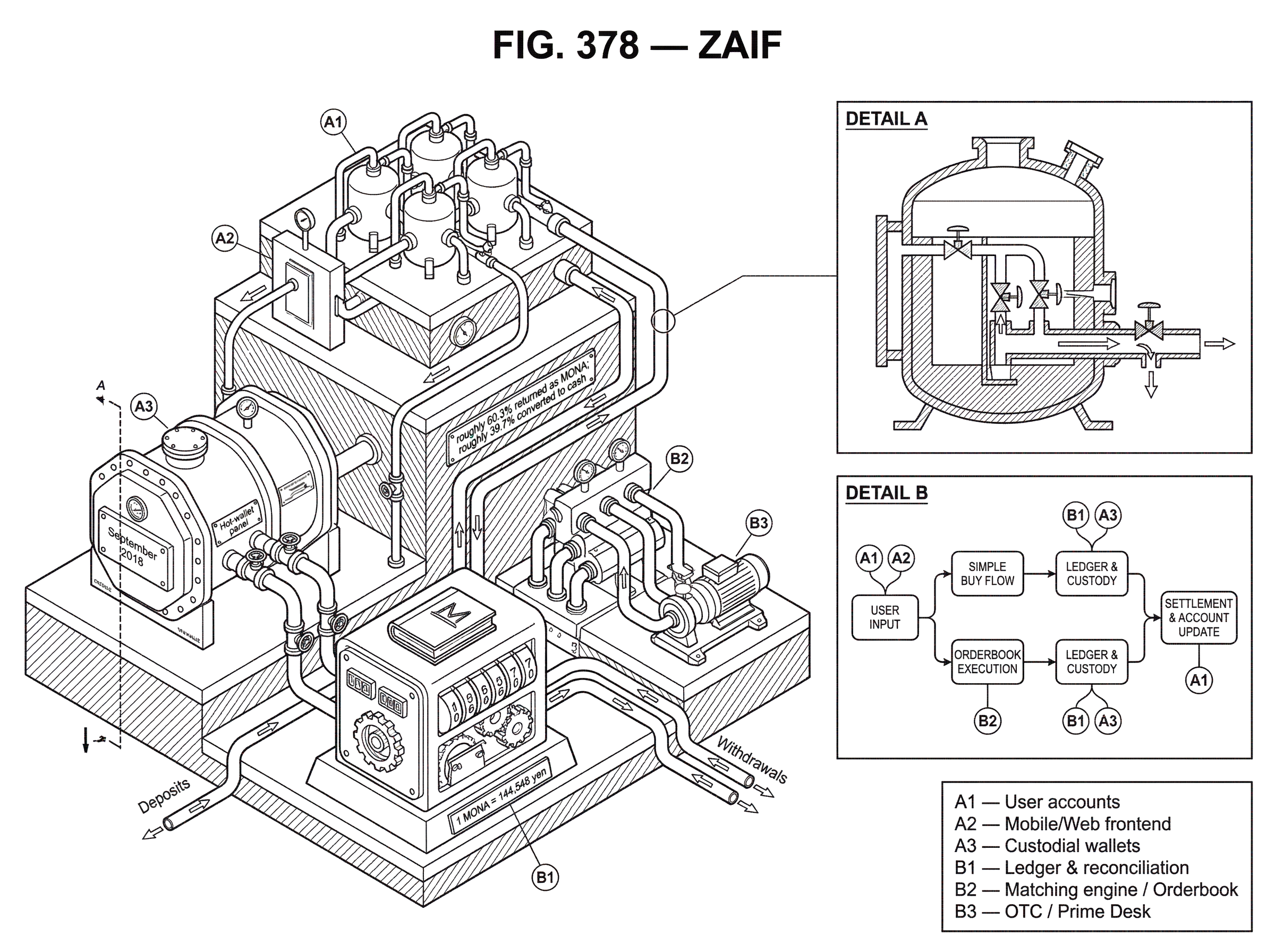
That is Zaif’s user-facing mechanism. You open an account with the platform, deposit funds or otherwise fund your activity, and then interact with crypto balances through Zaif’s interface rather than directly through raw blockchain tooling. The exchange becomes the coordinating layer between the user and the underlying assets. It provides prices, custody, interfaces, and execution venue. In return, the user accepts that the exchange is an intermediary with operational and financial importance.
This is why Zaif offers both a simple purchase flow and a more traditional orderbook environment. These are not just two decorative product categories. They solve two different user problems. The simple buy/sell service exists for users who care most about ease: Zaif says this service has no sales commission and allows transactions from a few hundred yen, which lowers the threshold for someone trying crypto for the first time. The orderbook exists for users who want more direct participation in market pricing rather than accepting a simplified dealer-style flow.
That distinction matters because many newcomers misunderstand exchange pricing. “No commission” does not mean “no trading cost.” Zaif explicitly notes that in its simple buy/sell service there is a difference between purchase and sale prices. In plain language, the convenience product may embed cost in the spread between the buy and sell quote. The exchange is making trading easier by abstracting away market structure, and that abstraction has a price.
How does Zaif handle buying, trading, and custody in everyday use?
| User case | Zaif feature | Primary benefit | Main trade-off |
|---|---|---|---|
| Small‑budget buyer | Simple buy/sell | Low minimum, easy start | Wider spread, less price control |
| Price‑control trader | Orderbook trading | Tighter pricing control | Requires order knowledge |
| Routine saver | Coin accumulation | Automatic dollar‑cost averaging | Less timing flexibility |
| Yield participant | Staking via platform | Earn rewards without validators | Custody risk, potential lockups |
| Large trader | Prime Desk (OTC) | Managed execution, lower impact | Higher counterparty dependence |
At a high level, Zaif works like other custodial exchanges: it maintains user accounts, records balances, provides trading interfaces, and handles asset transfers into and out of its own controlled systems. What the user sees is an app or web interface. What the platform is doing behind the scenes is maintaining ledgers, managing custody, and connecting user actions to market venues and wallet operations.
A simple example makes this concrete. Suppose a new user wants to buy a small amount of bitcoin with only a modest budget. On Zaif, that user can use the simple buy/sell flow and purchase from a few hundred yen upward. The important thing is not just that the amount is small; it is that the interface is designed so the user does not need to think first about limit orders, liquidity depth, or matching engines. Zaif is packaging crypto access as a retail-friendly transaction. That is useful for experimentation, small recurring exposure, or onboarding someone who would otherwise never touch an exchange screen full of bids and asks.
Now imagine a different user who cares about price control. That person is more likely to use orderbook trading, where the key mechanism is matching buyers and sellers at quoted prices. Here, Zaif is less of a direct seller and more of a venue operator. The platform’s usefulness comes from concentrating liquidity and presenting market structure in an accessible way. The trade-off is complexity: the user gets more control, but must understand how orders behave.
Zaif extends this same logic into adjacent services. Coin accumulation products exist for users who want a savings-like rhythm rather than a discretionary trading workflow. Automated trading tools are for users who want execution rules or ranking-based strategy assistance rather than constant manual input. Staking is for users who want yield-like participation through the platform instead of managing validator or wallet-level details themselves. Prime Desk serves the opposite end of the spectrum: larger trades often need a more managed execution process because pushing size through a public orderbook can move the market.
So the product set looks broad, but the underlying idea is consistent. Zaif is taking activities that are native to crypto markets and reformatting them into managed services for different kinds of users.
Why is Zaif built for mobile retail users and multiple product types?
| Design axis | Retail‑focused | Pro‑focused |
|---|---|---|
| Interface | Mobile‑first, one‑hand UI | Desktop, orderbook‑centric UI |
| Minimum trade size | Few‑hundred‑yen purchases allowed | Larger sizes, smaller spreads |
| Product mix | Payments, card, accumulation | Advanced trading, margin, APIs |
| Mobile emphasis | High (apps emphasized) | Lower (desktop tools favored) |
| Best user | Casual retail investors | Active traders, institutions |
Zaif’s feature mix suggests a platform aimed first at Japanese retail users who want convenience, small starting sizes, and mobile access, while still leaving room for more active traders and larger clients. Its iOS and Android apps, and its emphasis on one-handed smartphone operation, fit that pattern. The product is trying to reduce friction not only in trading but in ongoing account use.
This is also why the service includes things that go beyond pure speculation. Payment-related services, a card product, social tipping, and recurring accumulation all point toward a broader view of crypto as something users might hold, spend, transfer, or integrate into everyday digital finance. Whether any individual user needs that full set is secondary. What matters is that Zaif is not only an exchange screen; it is a platform trying to turn crypto into an account-based experience.
There is a useful way to think about this design. Self-custody gives the user maximum direct control but demands skill and care. A service like Zaif gives the user a managed interface to crypto. That managed interface is what makes small-entry investing, mobile-first trading, and multi-product participation practical for many people.
The analogy is that Zaif is less like downloading open-source infrastructure and more like using an online brokerage or payments app. That analogy helps explain why the service is easier to use and why it can bundle many financial functions. But the analogy fails in an important place: crypto-assets are not the same as cash deposits, and the risks of custody, protocol failure, and transfer mistakes remain materially different.
What are the custody and counterparty risks of using Zaif versus the convenience it provides?
| Feature | Zaif (custodial) | Self-custody |
|---|---|---|
| Ease of use | High (managed interface) | Low (manual wallet ops) |
| Counterparty risk | Material (solvency, hacks) | Low (no intermediary) |
| Control of keys | Platform holds keys | User holds keys |
| Recovery options | Exchange may compensate | No third‑party compensation |
| Best for | Beginners, mobile users | Long‑term holders, privacy‑focused |
This is the part of Zaif that matters most to understand. Zaif itself states that crypto assets are not fiat currency, that their value is not guaranteed by a state, and that prices can fall sharply or even become worthless. It also warns that failures in transfer records or related systems can destroy value, that losing necessary keys or passwords can prevent asset use, and that if the company becomes insolvent, deposited cash and crypto may not be returnable.
Those warnings are not boilerplate decoration. They describe the actual structure of the service. When you use a centralized exchange, you are not only taking market risk on the asset. You are taking counterparty and custody risk on the platform. The exchange is the party operating the wallet systems, maintaining the ledgers, and standing between you and direct control of the asset. That is what makes the service convenient, and that is also what creates a new point of failure.
Zaif’s own history makes this concrete. In September 2018, its hot-wallet infrastructure suffered unauthorized external access, leading to the loss of bitcoin, bitcoin cash, and MonaCoin. Public notices and related transfer documents show how serious the consequences were: service interruptions, compensation arrangements, business transfer mechanics, and a change in operating control tied to financial support and remediation. Some assets were restored in kind, while MONA involved a mixed treatment in which roughly 60.3% was returned as MONA and roughly 39.7% was converted into cash at a fixed rate of 1 MONA = 144.548 yen for the affected compensation framework.
The deeper lesson is not merely that Zaif had an incident. It is that centralized exchanges concentrate operational risk. A user choosing convenience is also choosing dependence on the exchange’s security, solvency, and recovery process. Zaif’s published notices after the incident, including customer-consent mechanics for business transfer and compensation, are a reminder that the legal and operational wrapper around custody becomes crucial precisely when something goes wrong.
Who should use Zaif and when should you choose self‑custody instead?
In practical terms, Zaif is for users who want crypto exposure without building their own full stack of wallets, trading tools, and payment rails. A first-time buyer can use the simple purchase flow and start with small amounts. A more engaged trader can use the orderbook. A user who prefers routine over timing decisions can use accumulation features. Someone seeking platform-level convenience may care about the mobile app, staking access, or card and payment integrations. A larger participant may care more about Prime Desk.
That does not mean it is ideal for everyone. Users who want maximum control over keys, minimal platform dependence, or the strongest possible separation from exchange insolvency risk will naturally prefer self-custody for long-term holdings. But that is exactly why exchanges like Zaif continue to exist: many users value operational simplicity more than absolute control, at least for part of their activity.
Conclusion
Zaif is best understood as a custodial crypto platform that makes digital-asset access easier by turning difficult market and wallet operations into account-based services. Its simple buy/sell flow, orderbook trading, accumulation tools, and broader platform features are all versions of the same idea: reduce user friction and let the exchange do the heavy lifting.
The memorable point is this: Zaif’s usefulness comes from convenience, and its main risk comes from the exact same source. The platform is for people who want crypto in a managed form; and understanding that trade-off is the key to understanding what Zaif really is.
What should you look for before choosing a crypto exchange?
Compare custody, fees, and execution before you pick an exchange; those four dimensions determine real user experience. Use Cube Exchange as a practical comparison anchor: Cube is non-custodial (MPC/threshold signing) and exposes orderbook and simple-buy workflows with transparent fee schedules so you can directly compare against Zaif's custodial flows.
- Verify the custody model on each provider’s policy page; note whether the platform is custodial (Zaif) or non‑custodial/MPC (Cube) and record who holds signing keys.
- Open the BTC market on each platform and compare available order types (limit, market, stop‑loss) and the posted maker/taker fees; for simple buy flows, measure the buy–sell spread on a small test amount.
- Check withdrawal rules and limits: perform the KYC steps, view on‑chain withdrawal fees and daily limits, and confirm estimated on‑chain settlement times for your destination address.
- Compare supported workflows you need (recurring buys, staking, OTC desk) and review historical security notices or incident disclosures to assess operational track record.
Frequently Asked Questions
Zaif is aimed at retail users who want easy, mobile-first crypto access without running their own wallets - first-time buyers can start with small amounts via the simple buy/sell flow - while still supporting more active traders (orderbook trading), routine investors (coin accumulation), staking users, and larger clients (Prime Desk). Users who prioritize maximum control over keys and minimal counterparty risk are better served by self-custody.
Zaif’s simple buy/sell flow is designed for ease and small minimums (it markets no sales commission but embeds trading cost in the buy–sell price spread), whereas orderbook trading gives users direct price control by matching buyers and sellers on a venue but requires understanding orders and liquidity. The two flows trade simplicity for implicit cost (simple flow) versus complexity for tighter price control (orderbook).
Zaif and its notices explicitly warn that crypto assets are not fiat, their value is not guaranteed, and deposited cash and crypto may not be returnable if the company becomes insolvent; the homepage does not disclose third‑party insurance or full guarantees, so assets should not be treated as guaranteed deposits.
In September 2018 Zaif reported unauthorized external access to hot wallets and losses of bitcoin, bitcoin cash, and MonaCoin; a rescue/recapitalization and business-transfer process involving Fisco followed, and compensation treated MONA partly in‑kind (about 60.3%) and partly as cash (about 39.7%) using a fixed rate of 1 MONA = 144.548 yen, though technical attack details and some loss accounting remained under investigation.
Zaif’s public notices state that customers who did not consent to the business transfer could be unable to log in or have claims that the transferee cannot handle; the detailed procedures and timelines for returning assets to non‑consenting customers were not fully specified in the notices.
Zaif links to information‑security and risk‑management pages, but it does not publish specific custody metrics such as cold‑wallet ratios or third‑party insurance coverage on its homepage, and it explicitly withheld technical details of the 2018 intrusion while investigations were ongoing.
While Zaif’s simple‑buy messaging emphasizes “no sales commission,” the article and site explain that convenience products may embed costs in the buy/sell spread; additionally, the homepage references a fee page but does not present full numerical fee schedules and spread tables for every service or pair, limiting immediate fee comparability.
Zaif is a Japan‑registered crypto‑asset exchange (registration number cited) and lists affiliations with the Financial Services Agency and Japanese industry associations such as the Japan Virtual and Crypto assets Exchange Association, indicating it operates within Japan’s regulatory framework.
Related reading